Modular Programming Features and Why They Matter

Why Understanding Modular Programming Features Gives You a Real Edge
What are the features of modular programming is one of those questions that sounds academic but has real, practical consequences for anyone building software at scale.
Here is a quick answer:
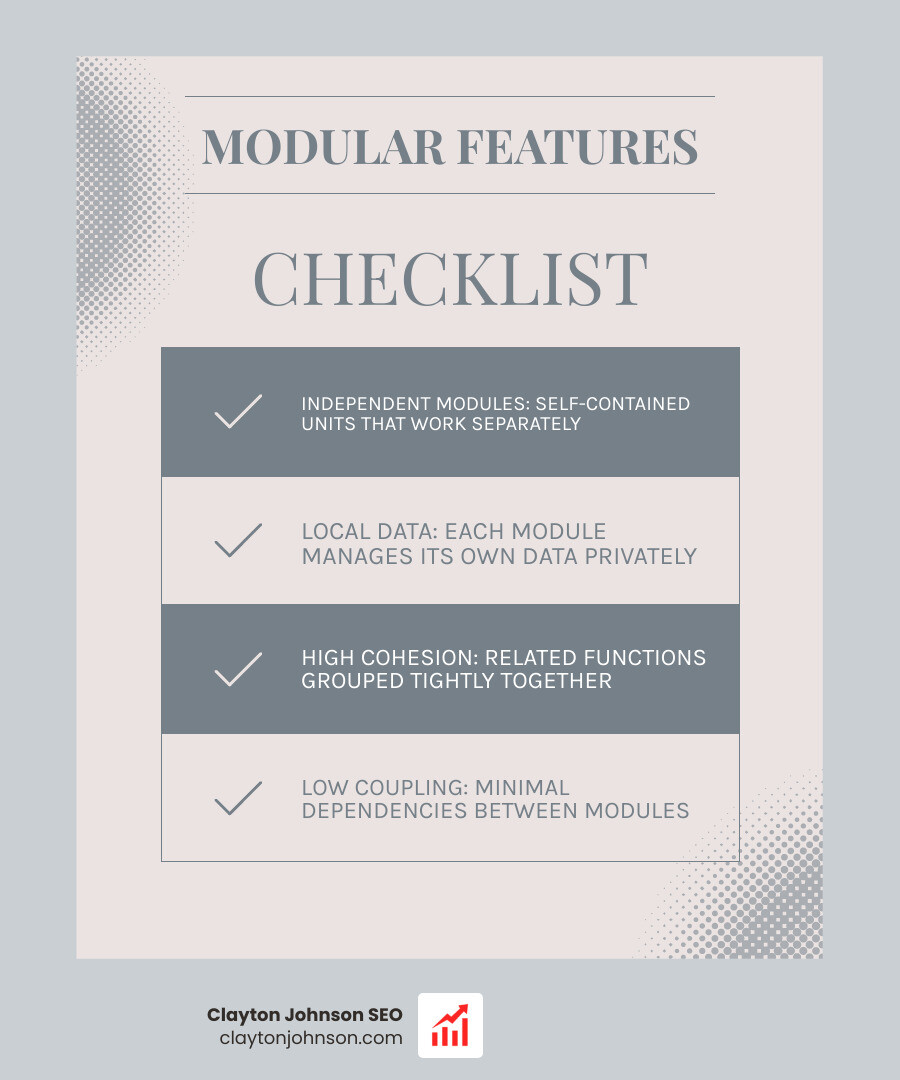
The core features of modular programming are:
- Independent modules – programs are divided into separate, self-contained units
- Local data – each module manages its own data
- Algorithm emphasis – focus is on what the code does, not how data is structured globally
- High cohesion – everything inside a module is closely related
- Low coupling – modules depend on each other as little as possible
- Information hiding – internal workings are hidden behind a clean interface
- Reusability – modules can be used across multiple projects
- Clear interfaces – modules interact through well-defined contracts
Most software starts simple. Then it grows. And without a clear structure, it turns into what developers call spaghetti code – thousands of tangled lines where nobody is sure what is broken or why.
Modular programming solves that. It has been a core software design approach for a long time, and it remains just as relevant today.
The idea is straightforward: break your program into smaller, independent pieces. Each piece does one job well. Each piece can be built, tested, and updated without touching the rest.
One real-world example makes this concrete. A company reduced deployment time to AWS from nearly a full day down to just one hour – simply by breaking apart a monolithic system into modules.
That is the power of getting this right.
What are the Features of Modular Programming?
When we talk about what are the features of modular programming, we are really talking about a philosophy of “divide and conquer.” Instead of writing one giant, continuous script, we build a system of interlocking blocks.
This approach relies on functional partitioning. We take a complex problem and slice it into logically discrete functions. Each slice becomes a module. For example, in an e-commerce app, you might have one module for the “Shopping Cart,” another for “Payment Processing,” and a third for “User Authentication.”

Separation of Concerns (SoC)
A major feature here is the Separation of Concerns. This is the idea that each module should address a specific “concern” or piece of functionality. By keeping these concerns separate, we make the code much easier to read and navigate. If there is a bug in the payment logic, we know exactly which folder and file to open. We don’t have to hunt through a 5,000-line file of unrelated code.
Comparing Programming Paradigms
To truly understand what are the features of modular programming, it helps to see how it stacks up against other styles.
| Feature | Modular Programming | Structured Programming | Object-Oriented Programming (OOP) |
|---|---|---|---|
| Primary Unit | Module | Function / Procedure | Object / Class |
| Data Handling | Local to module | Global or passed | Encapsulated in objects |
| Reusability | High (module level) | Moderate (function level) | High (class/inheritance) |
| Focus | Algorithm & Decomposition | Logical flow & Control | Data & Behavior together |
| Key Principle | Information Hiding | Top-down design | Inheritance & Polymorphism |
While modular programming is often compared to Modular programming in its purest sense, modern development often blends these. For instance, you can use modular principles within an OOP language like Java or a functional language like Haskell.
Core Characteristics and What are the Features of Modular Programming in Practice
In practice, modularity isn’t just about having multiple files. It’s about how those files behave. If you have ten files but changing one line in File A breaks File B, C, and D, you don’t actually have a modular system—you have a distributed monolith.
Independent Modules
The most defining characteristic is independence. A module should be a “mini-program” in its own right. It should contain everything it needs to execute its specific task. This independence is what allows for “local reasoning.” As a developer, we can look at a single module and understand exactly what it does without needing to hold the entire architecture of the million-line application in our head at once.
Local Data and Algorithm Emphasis
Unlike some older styles of programming where data was often global (accessible by anything), modular programming emphasizes local data. Each module has its own variables and state that are not accessible to the outside world.
Furthermore, there is a distinct emphasis on the algorithm. We focus on the process: “How do we calculate the tax?” or “How do we sort this list?” The module is the container for that specific logic.
When we are working on Claude code modularization tips for cleaner projects, we often find that keeping modules small—typically under a couple of hundred lines—is the “sweet spot” for maintainability.
JavaScript and Modern Modularity
In the modern web, we see these features daily. For example, JavaScript Modules allow us to export specific functions or constants from one file and import them into another. This keeps the global namespace clean and prevents different parts of the app from “stepping on each other’s toes.”
Interface vs. Implementation and Information Hiding
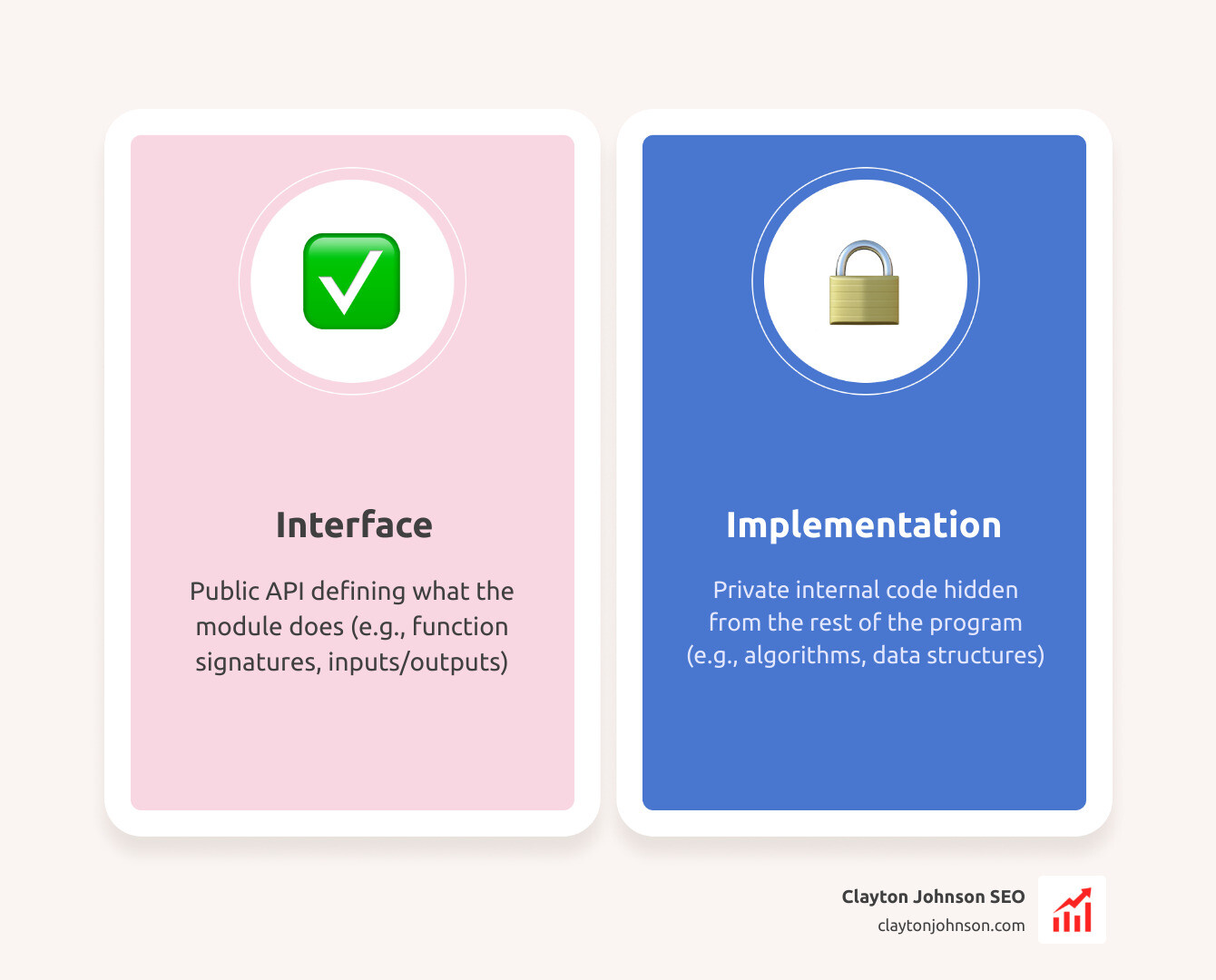
This is where the magic happens. Every module has two sides: the Interface and the Implementation.
- The Interface (The “What”): This is the public face of the module. It tells the rest of the program, “Here is what I can do for you.” Think of it like a menu in a restaurant. It lists the dishes you can order but doesn’t tell you how the chef cooks them.
- The Implementation (The “How”): This is the actual code inside the module. It’s the “secret sauce.” The rest of the program doesn’t see this, and more importantly, it doesn’t need to see it.
The Power of Information Hiding
Information hiding is a cornerstone of what are the features of modular programming. By hiding the internal logic, we create a “contract” between the module and the user (the client).
If we decide to change the internal algorithm—perhaps to make it faster or more secure—we can do so without breaking the rest of the app, as long as the interface (the menu) stays the same. This isolation is vital for long-term project health. It’s a key part of the Single Responsibility Principle, which dictates that a module should have one, and only one, reason to change.
High Cohesion and Low Coupling Principles
If you want to build a truly modular system, you have to master two concepts: Cohesion and Coupling. We like to think of these as the “Golden Rules” of software architecture.
High Cohesion: Stay Focused
Cohesion refers to how closely related the things inside a module are.
- High Cohesion: Every function inside the module supports the same goal (e.g., all functions in a “Math” module are about mathematical calculations).
- Low Cohesion: The module is a “junk drawer” of unrelated functions (e.g., a module that handles database connections, formats dates, and sends emails).
We always strive for high cohesion. It makes the module predictable and easier to test.
Low Coupling: Stay Independent
Coupling refers to how much modules depend on each other.
- Low Coupling: Modules interact through simple, well-defined interfaces. They don’t care about each other’s internals.
- High Coupling: Modules are deeply intertwined. Changing a variable in one module requires changing code in three others.
Low coupling is the goal. It allows us to swap out modules like Lego blocks. If you find your code is getting “tangled,” it might be time for some code refactoring with Claude AI for the lazy but brilliant. AI can be a fantastic tool for identifying areas where your modules have become too “chatty” or dependent on one another.
Benefits and Implementation of Modular Architecture
Why do we go through all this effort? Because the benefits are massive, especially as a project scales.
- Code Reusability: Once you build a solid “User Auth” module, you can use it in your next ten projects. You aren’t reinventing the wheel; you are building a library of assets.
- Easier Testing: It is much easier to test a 100-line module that does one thing than a 10,000-line monolith that does everything. You can run unit tests on each piece in isolation.
- Faster Debugging: When something breaks, modularity helps you isolate the problem. If the PDF isn’t generating, you check the PDF module. You don’t have to worry that the database logic is somehow interfering.
- Scalability: Modular systems are easier to grow. You can add new features by adding new modules rather than trying to wedge more code into an already bloated system.
When we are mastering AI coding workflows on GitHub, we use modularity to allow different AI agents or human developers to work on different parts of the codebase simultaneously without merge conflicts.
Real-World Examples and What are the Features of Modular Programming in Modern Languages
Modular programming isn’t tied to one specific language; it’s a paradigm that appears in almost every modern environment.
C and Header Files
In C, we use .h files (headers) to define the interface and .c files to provide the implementation. We use keywords like static to hide functions from the rest of the program, effectively implementing information hiding in a language that has been a staple of the industry for a long time.
Java and Interfaces
Java takes this further with the interface keyword. An interface defines a set of methods that a class must implement, but it doesn’t provide the code itself. This allows for “Pluggable” architectures where you can swap one implementation for another at runtime.
Python Packages
Python uses modules (single .py files) and packages (folders containing multiple modules). By using import statements, we can bring in only the specific tools we need, keeping our memory footprint low and our code clean.
The TinyMCE Example
A great example of modularity in action is the TinyMCE GitHub repository. They don’t just have one giant “editor” file. Instead, they break the editor down into over 30 specific modules.
- For example, their Katamari module is dedicated solely to data structures.
- Another module might handle only HTML DOM manipulation.
This level of granularity is exactly what are the features of modular programming looks like in a professional, industrial-strength application.
Advantages for Team Collaboration and Scalability
One of the most overlooked features of modular programming is how it helps people work together.
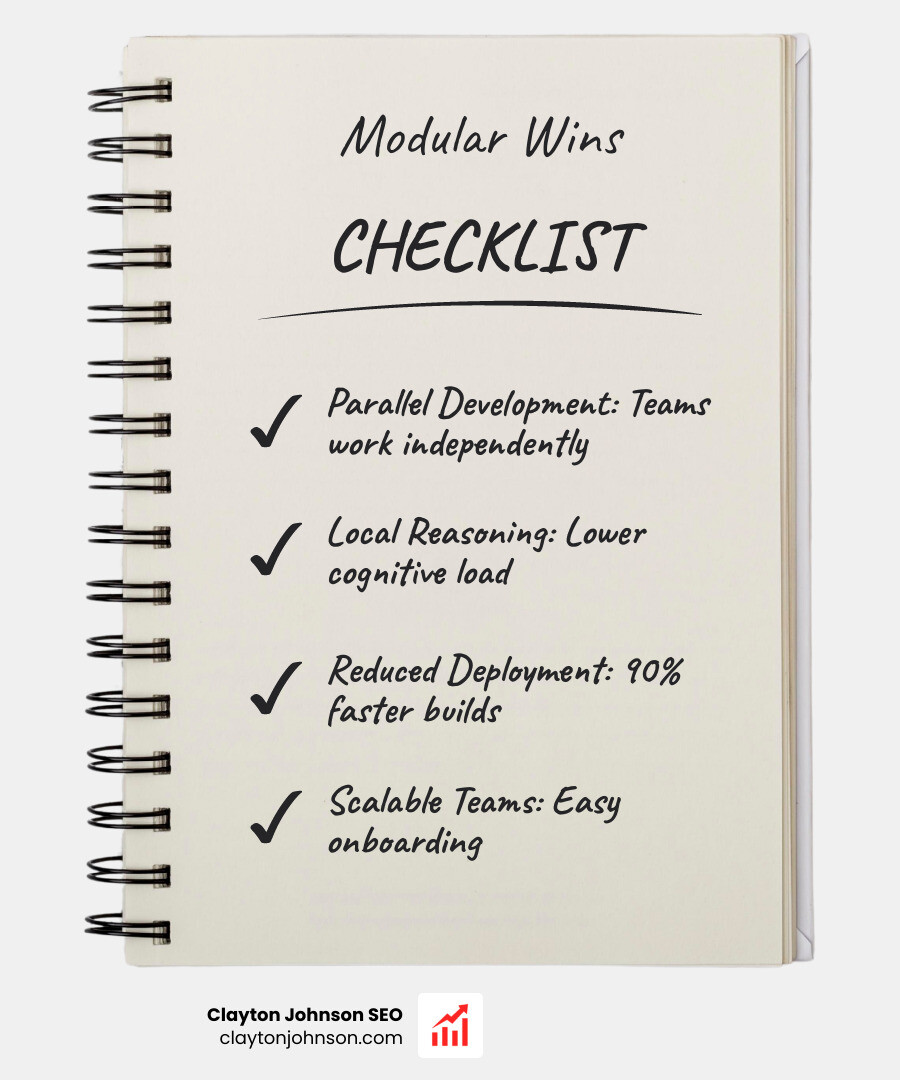
Parallel Development
In a monolithic system, only one or two people can safely touch the code at a time without breaking things. In a modular system, Team A can work on the “UI” module while Team B works on the “API” module. As long as they agree on the interface (the contract) beforehand, they can work in parallel.
Local Reasoning
We’ve mentioned this before, but it bears repeating. “Local reasoning” means a developer only needs to understand the module they are currently working on. They don’t need to be a “Grand Architect” who knows every line of the entire system. This lowers the barrier to entry for new team members and reduces the cognitive load on everyone.
Reduced Deployment Time
Remember the statistic from the intro? Modularizing a system can cut deployment times from a full day to an hour. This happens because you only need to redeploy the modules that changed, rather than rebuilding and re-testing the entire “giant ball of mud.”
If you want to move faster, you need to stop writing monoliths and start chaining your AI prompts or your code. Small, discrete units of work always move through the pipeline faster than large, bulky ones.
Best Practices for Designing Modular Systems
Building a modular system takes discipline. It is very easy to let “architectural drift” set in, where modules slowly become more coupled over time. Here is how we prevent that:
- Strict Naming Conventions: Use clear, consistent names for your modules and functions. If a module is named
PaymentProcessor, it shouldn’t contain code for formatting usernames. - Use Dependency Injection: Instead of a module “reaching out” to grab what it needs, “inject” the dependencies into it. This makes the module much easier to test and swap.
- Keep Modules Small: If a module starts approaching 500 lines of code, ask yourself if it should be split into two smaller modules.
- Document the “Why,” Not Just the “How”: Your interface documentation should explain what the module does and why someone would use it. The code itself should explain how it works.
- Automate Your Testing: Use CI/CD pipelines to ensure that every module passes its unit tests before it is merged.
At Clayton Johnson SEO, we apply these same “system-level” thinking principles to marketing. Whether we are building scalable coding frameworks or search engine strategies, we believe in clarity, structure, and leverage.
If your software (or your SEO strategy) feels like a tangled mess, we can help you untangle it. Feel free to reach out and contact us to discuss how structured systems can drive compounding growth for your business.
Conclusion
Understanding what are the features of modular programming is about more than just organizing files. It is about building a system that is resilient to change, easy to understand, and ready to scale.
By focusing on independent modules, high cohesion, and low coupling, you create a codebase that serves you rather than one you have to fight against. Whether you are a solo founder or leading a large engineering team, modularity is the key to moving fast without breaking things.
Start small. Find one piece of “spaghetti” in your current project and wrap it in a clean interface. Once you feel the relief of being able to update that code without fear, you’ll never want to go back to the monolith.