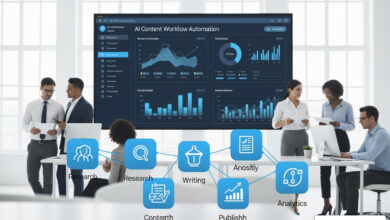
Operational Systems & Marketing Mix Terms Demystified

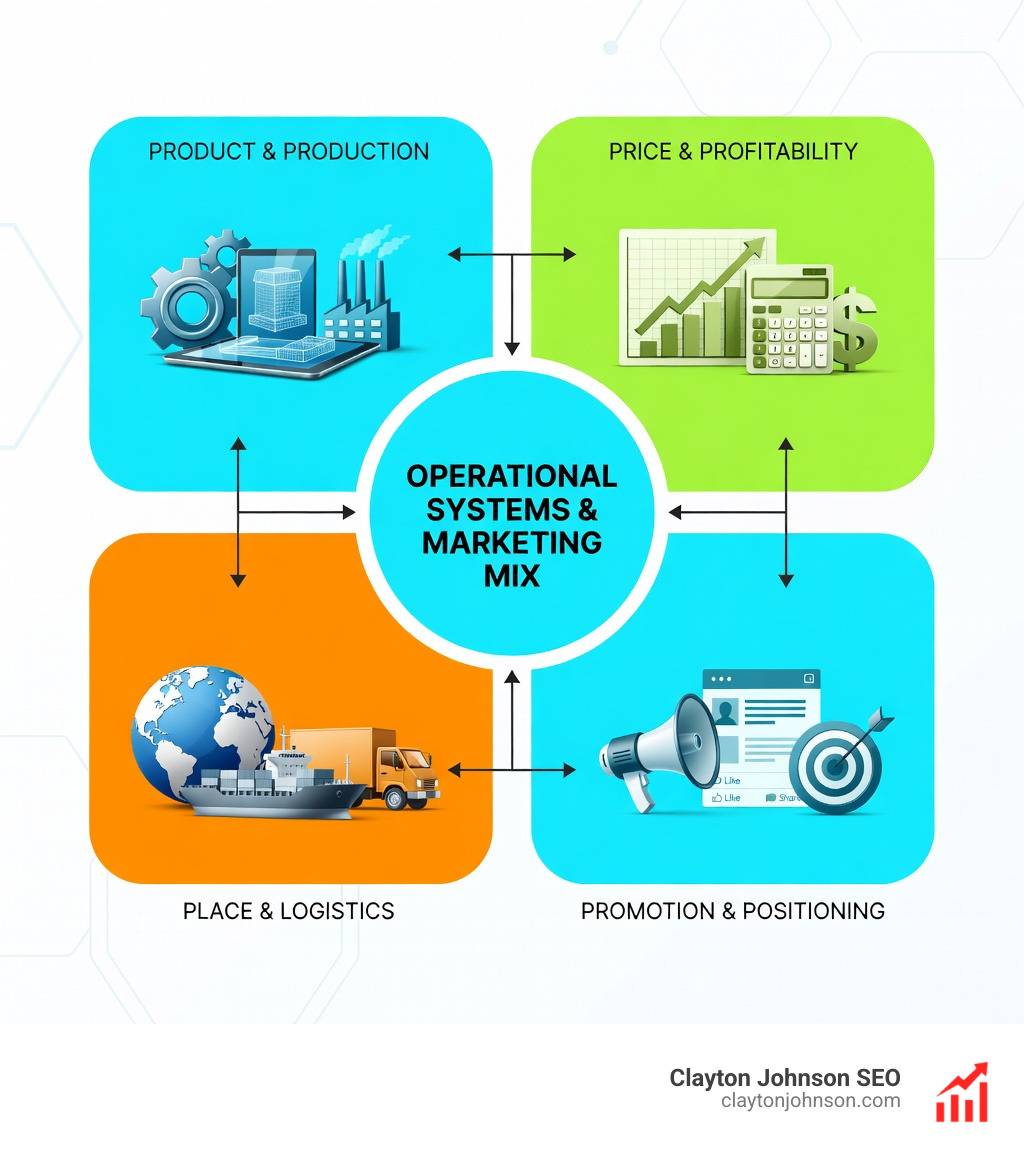
Why Operational Systems & Marketing Mix Matter More Than Ever
Operational Systems & Marketing Mix define how marketing strategy becomes reality. Most marketing plans fail not because the strategy is wrong, but because execution breaks down. Here’s what you need to know:
What They Are:
- Operational Systems: The processes, tools, and workflows that turn marketing plans into daily actions
- Marketing Mix: The tactical elements (4 Ps or 7 Ps) that deliver your value proposition to customers
Why They Matter:
- Bridge the gap between strategic vision and tactical execution
- Prevent “random acts of marketing” that waste budget
- Align resources, timelines, and team accountability
- Enable agile response to market changes
Key Integration Points:
- Product decisions need operational capacity to deliver
- Pricing strategy requires finance and operations alignment
- Distribution channels depend on supply chain capabilities
- Promotion timing must sync with production schedules
The research is clear: companies like Coca-Cola, Nike, and Starbucks succeed not just through brilliant strategy, but through operational excellence that executes the marketing mix flawlessly. When operations can’t deliver what marketing promises, customers experience friction—and revenue suffers.
As Clayton Johnson, I’ve spent years helping companies build scalable systems that connect strategic positioning with operational execution, diagnosing where the strategy-execution gap emerges and implementing frameworks that turn marketing plans into measurable growth. This guide will show you how to integrate Operational Systems & Marketing Mix into a cohesive engine for sustainable competitive advantage.
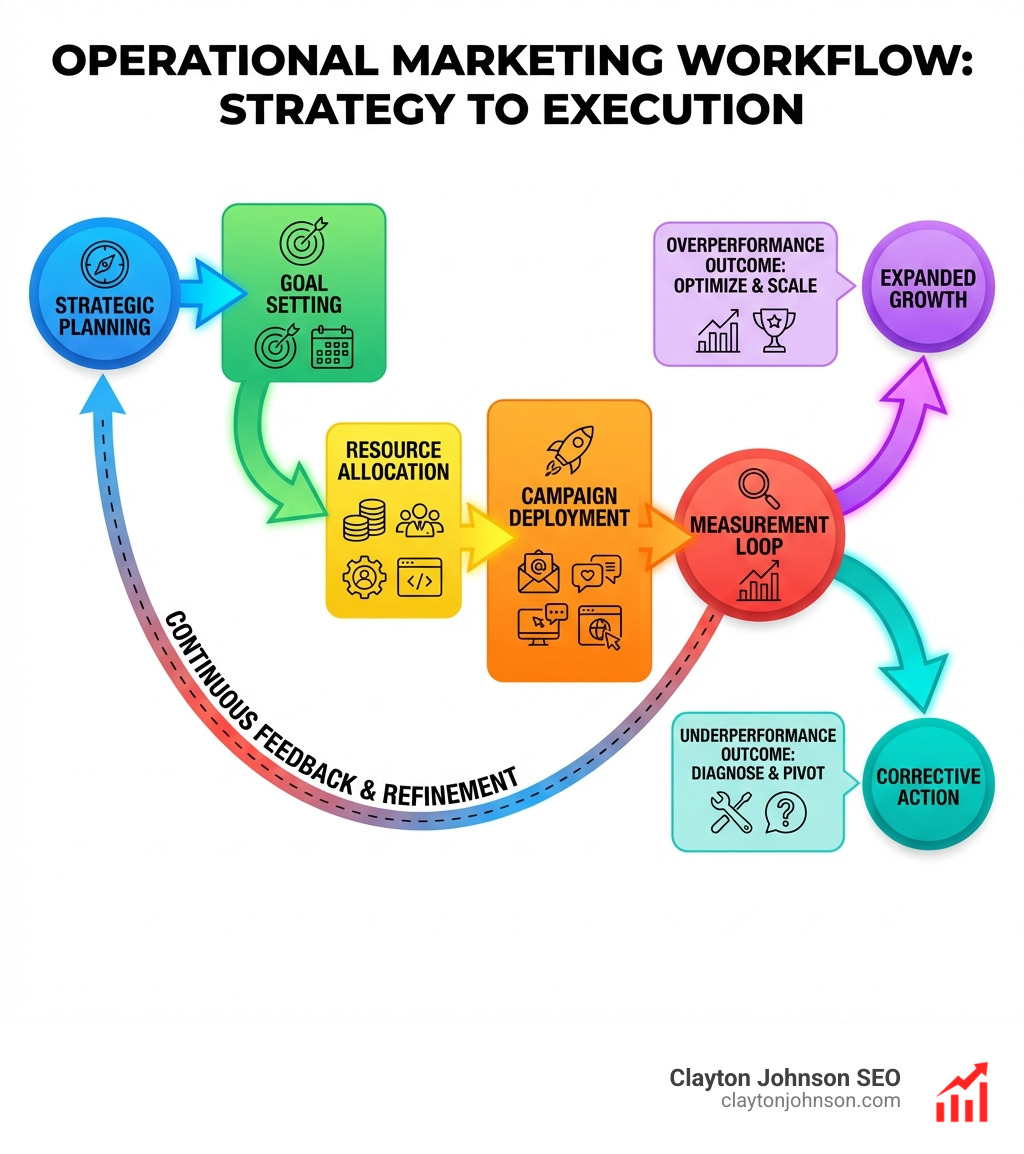
Defining the Operational Marketing Plan and Its Strategic Role
An operational marketing plan is the tactical blueprint that bridges the gap between a high-level strategic vision and the day-to-day grind. While a strategic plan looks at where we want to be in three to five years, the operational plan focuses on the “how” of the next 6 to 12 months. It’s the difference between saying “we want to be the market leader in Minneapolis” and “we are launching three targeted SEO content marketing campaigns this quarter with a budget of $50,000.”
We often call this the “Plan for the Plan.” It involves setting short-term tactics and medium-term goals that are grounded in reality. Without this operational layer, marketing departments often find themselves making “educated guesses” on spend and headcount. A solid operational plan ensures that resource allocation—whether it’s manpower, software, or ad spend—is aligned with the company’s actual capacity.
As highlighted in A Review of Marketing-Operations Interface Models, the success of a firm depends on how well marketing (the demand side) coordinates with operations (the supply side). If marketing promises a 24-hour turnaround but the operational system is built for a five-day cycle, the marketing mix fails regardless of how good the “Promotion” looks.
Bridging the Strategy-Execution Gap with Operational Systems & Marketing Mix
The “death spiral” in marketing occurs when there is a massive chasm between strategy and execution. When teams don’t have clear operational systems, they default to “random acts of marketing”—posting on social media because “we haven’t posted in a while” or launching a discount because sales are slow. These acts might feel productive, but they rarely move the needle on long-term goals.
To prevent this, we need operational alignment. This means creating visibility across the team so everyone knows the “why” behind the “what.” When every team member has access to the roadmap, buy-in increases. They aren’t just executing tasks; they are fueling a system. Operational systems provide the guardrails that keep the Operational Systems & Marketing Mix from veering off-track when a shiny new trend appears.
Core Components of a Successful Operational Plan
What does a successful plan actually look like? It isn’t a 50-page document that gathers dust in a Google Drive folder. It is a living framework consisting of:
- SMART Goals: Specific, Measurable, Achievable, Relevant, and Time-bound.
- Budgeting: Planning at least six months in advance to influence finance rather than just receiving a “hand-me-down” number.
- Headcount & Responsibilities: Knowing exactly who is responsible for which lever of the marketing mix.
- Timelines: Detailed execution schedules that account for operational bottlenecks.
- Performance Measurement: A feedback loop that looks at ROI and Customer Acquisition Cost (CAC) in real-time.
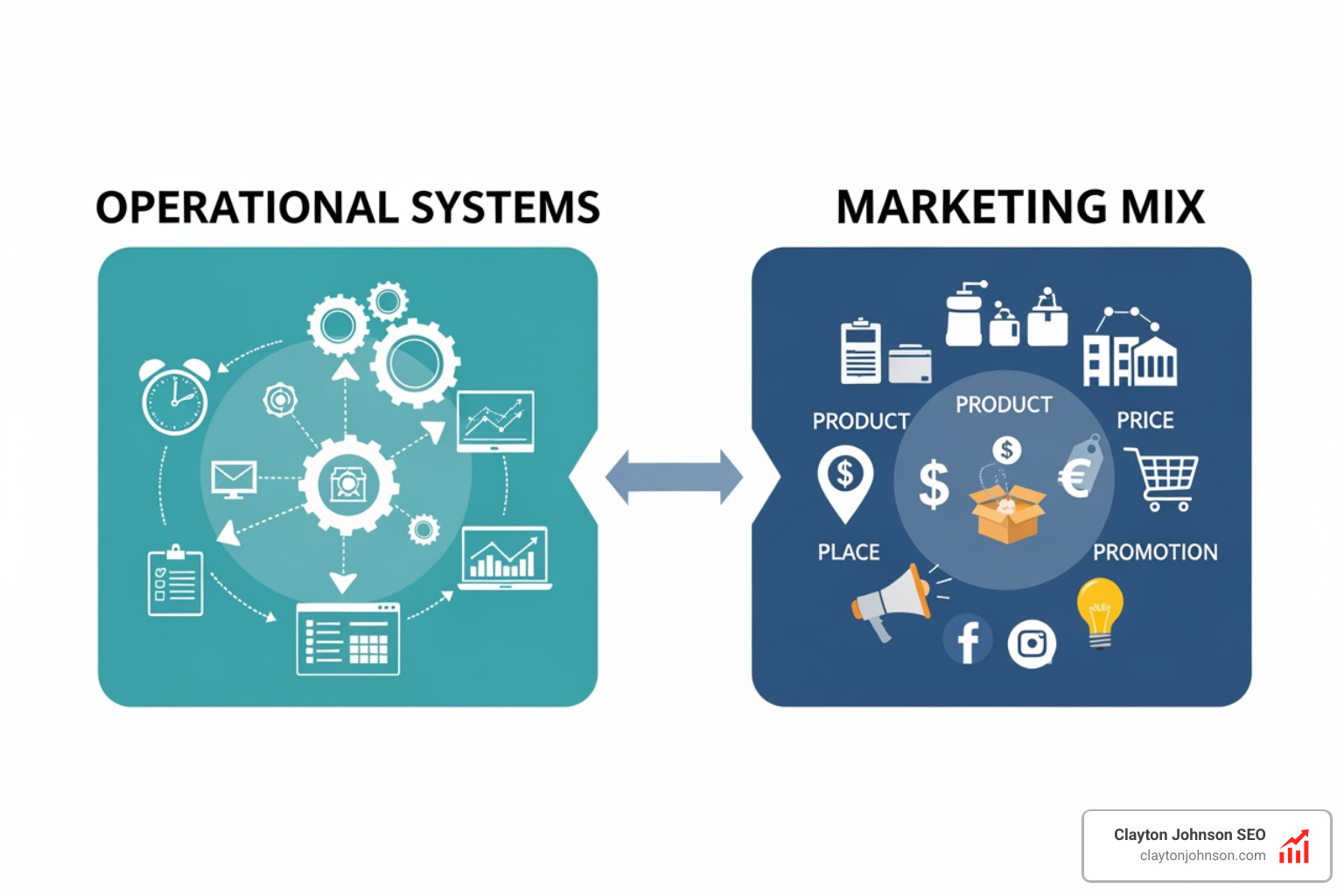
Integrating the 4 Ps and 7 Ps into Operational Execution
The Operational Systems & Marketing Mix framework relies heavily on the classic 4 Ps: Product, Price, Place, and Promotion. However, these aren’t just concepts; they are operational challenges.
- Product: Involves lifecycle management and innovation. For example, Apple’s ability to sell $201.1 billion worth of iPhones in FY 2024 isn’t just about design; it’s about an operational system that can manufacture and ship millions of units without a hitch.
- Price: This isn’t just a number. It requires alignment with finance to ensure premium pricing or discount strategies don’t erode margins.
- Place: Choosing distribution channels—whether it’s a brick-and-mortar store in Minneapolis or a global e-commerce platform.
- Promotion: The communication strategy. Think of Absolut Vodka, which grew from 10,000 cases in 1980 to 4.5 million by 2000 through a consistent, operationally disciplined promotion campaign.
For many modern businesses, especially in the service sector, we expand this to the 7 Ps.
Service-Based Excellence: People, Process, and Physical Evidence
In a service-based business, the “Process” is the product. If we are providing paid advertising services, our operational system is the value.
- People: The staff who provide expert advice. In a service model, your people are your strongest promotional tool.
- Process: The logistics of how a service is delivered. Is it fast? Is it efficient? Does it provide a seamless customer experience?
- Physical Evidence: Since services are intangible, customers look for “evidence” of quality. This could be a professional website, clean packaging, or even the case studies we publish.
To adopt a more customer-centric approach, we also look at the 4 C’s of Marketing: Consumer, Cost, Convenience, and Communication. This shifts the focus from what we want to sell to what the customer actually needs.
| Model | Focus Area | Elements |
|---|---|---|
| 4 Ps | Product-Centric | Product, Price, Place, Promotion |
| 7 Ps | Service-Centric | 4 Ps + People, Process, Physical Evidence |
| 4 Cs | Customer-Centric | Consumer, Cost, Convenience, Communication |
Real-World Success: From Coca-Cola to Nike
We can see the power of Operational Systems & Marketing Mix in action through iconic campaigns:
- Coca-Cola’s “Share a Coke”: This wasn’t just a creative idea; it was an operational feat. They had to change their manufacturing process to print individual names on millions of bottles. The result? A 2% increase in U.S. sales and a massive boost in engagement.
- Nike’s Digital Transformation: By focusing on their digital operational systems, Nike saw an 83% growth in digital sales in a single quarter. They integrated their “Place” (app/website) with their “Product” (inventory systems) perfectly.
- Starbucks Loyalty: Their operational focus on the “People” and “Process” through their loyalty program led to a 15% increase in membership and higher spending per customer.
Aligning Operational Systems & Marketing Mix for Scalable Growth
One of the biggest hurdles in growth is the “demand-supply conflict.” Marketing is great at generating demand, but if operations can’t keep up, you end up with unhappy customers and wasted ad spend. We solve this by creating execution roadmaps that align marketing goals with operational capabilities.
This requires deep collaboration between marketing, operations, and finance. Finance needs to understand the financial requirements of the resources operations will manage. Marketing needs to understand the constraints of those resources so they don’t make promises the company can’t keep.
Agility and Scenario Planning in Operational Systems & Marketing Mix
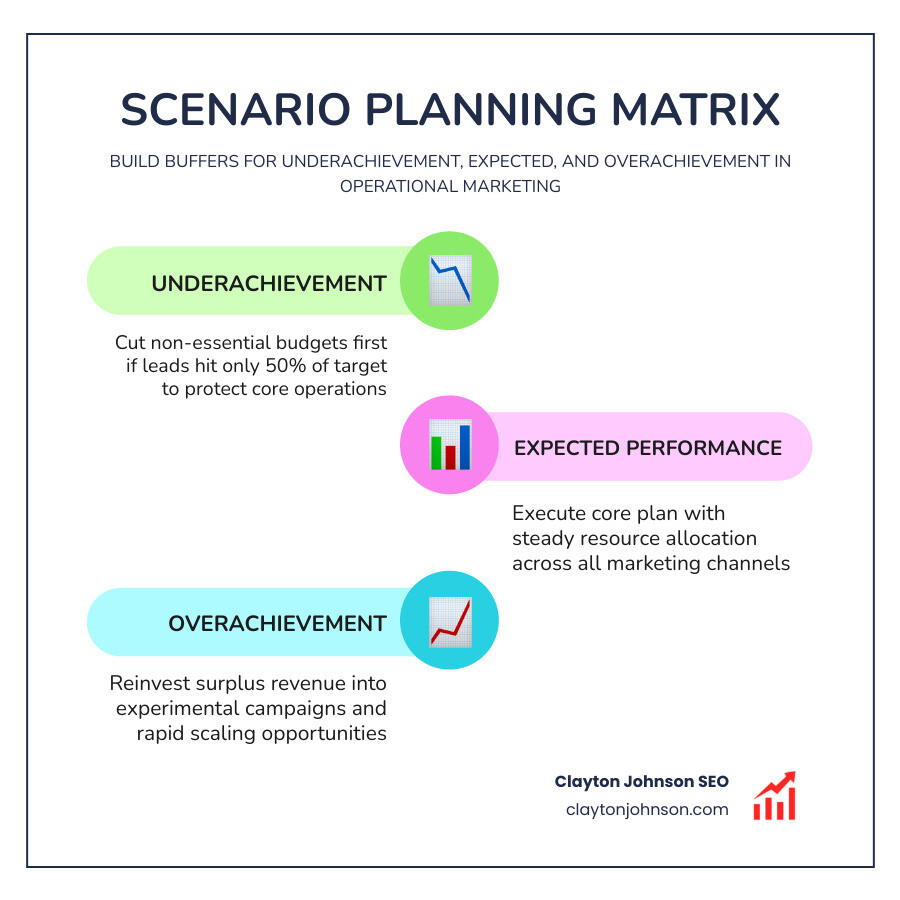
If the last few years have taught us anything, it’s that “hope is not a strategy.” An agile operational plan includes scenario planning. We recommend building “buffers” for different outcomes:
- Underachievement Scenarios: What happens if we hit only 50% of our lead goal? Which budgets do we cut first?
- Overachievement Scenarios: If we blow past our revenue targets, how do we reinvest that “found money” into experimental marketing or social media marketing?
- Opportunistic Marketing: Leaving room in the plan to pivot when a sudden market opportunity arises (like a competitor going out of business or a viral trend).
Measuring Success: KPIs and Tools for Operational Marketing
You cannot manage what you do not measure. In Operational Systems & Marketing Mix, we move beyond “vanity metrics” like clicks and impressions. We talk to the CFO in “dollars and cents.”
Key metrics include:
- ROI (Return on Investment): The ultimate measure of whether the system is working.
- CAC (Customer Acquisition Cost): How much it costs to bring in a new customer via specific channels.
- LTV (Lifetime Value): Ensuring the customers we acquire are worth the operational effort to keep them.
- Channel-Level Performance: Measuring which specific “Place” is delivering the best results.
Tools like CRM systems (Salesforce, HubSpot) and marketing performance platforms (like Planful) are essential. They provide a “single source of truth” where goals, budgets, and results live together, ensuring that the paid advertising team isn’t working in a silo away from the content team.
Future Trends in Operational Marketing Systems
The future of Operational Systems & Marketing Mix is increasingly digital and automated. We are moving away from rule-based systems toward “signal recognition.”
- Hyper-Personalization: Using AI to treat customers based on their specific context in real-time.
- Sustainability: Marketing “Purpose” as a core part of the “Product” and “Process.”
- Data Privacy: Building operational systems that respect ethical marketing boundaries while still delivering results.
- AI-Assisted Workflows: Using tools to handle the repetitive “running the business” tasks so humans can focus on “planning the business.”
The Role of AI and Automation in Operational Systems & Marketing Mix
Generative AI is changing how we handle marketing operations. It allows us to unlock efficiency by automating content creation, data analysis, and even multivariant AB testing at scale. This isn’t just about saving time; it’s about increasing velocity.
By using AI-assisted workflows, a small team can act like a much larger one, essentially finding “extra FTEs” (Full-Time Equivalents) within their existing headcount. This extra time can then be redirected toward high-value work—like improving the customer experience or launching that “big initiative” that’s been sitting on the back burner.
Frequently Asked Questions about Operational Marketing
What is the difference between a strategic and an operational marketing plan?
A strategic plan is your “North Star”—it defines the long-term direction, target markets, and brand positioning. An operational marketing plan is the “Engine”—it details the specific tactics, budgets, timelines, and responsibilities needed to reach those strategic goals over the next year. Strategy is about what we want to achieve; operations is about how we execute it daily.
Why do marketing plans commonly break down during execution?
Plans usually fail due to a lack of visibility, poor communication, or insufficient detail. If the plan is “stored in a Google Drive and never looked at again,” the team defaults to “random acts of marketing.” Without clear operational systems to track progress and adjust to market changes, the strategy-execution gap becomes too wide to bridge.
How does digital transformation impact marketing operations?
Digital transformation replaces manual, siloed tasks with integrated systems. It allows for real-time data flow between marketing, sales, and finance. This makes the Operational Systems & Marketing Mix more agile, data-driven, and capable of hyper-personalization, turning marketing from a “cost center” into a “growth engine.”
Conclusion
Mastering the Operational Systems & Marketing Mix is the secret to turning a great idea into a profitable reality. It requires more than just creative flair; it demands disciplined processes, integrated tools, and a commitment to aligning your marketing “demand” with your operational “supply.”
At Clayton Johnson SEO, we specialize in helping businesses in Minneapolis and beyond build these very systems. Whether you need to refine your SEO content marketing or build a more robust email marketing workflow, we provide the actionable frameworks and interactive tools to help you diagnose growth problems and execute with measurable results. Don’t let your brilliant strategy die in the execution phase—build the operational engine it deserves.