Predicting the Future with Interactive SEO ROI Simulators


Why Every Growth Decision Needs Financial Clarity
An Interactive SEO ROI simulator helps you estimate the financial returns from organic search investments by modeling traffic growth, conversion rates, and revenue over time—before you commit budget.
Quick Answer: What an Interactive SEO ROI Simulator Does
| Component | What It Calculates | Why It Matters |
|---|---|---|
| Traffic Projection | Monthly organic sessions based on keyword volume and CTR | Shows visibility potential |
| Revenue Forecast | Conversions × AOV or LTV | Translates traffic into dollars |
| Break-Even Timeline | When revenue exceeds total SEO cost | Justifies budget allocation |
| Scenario Testing | Conservative vs. aggressive growth paths | De-risks planning |
Most marketing leaders know SEO should work. But they can’t quantify how much or how fast.
That gap kills budget approval. It creates execution chaos. And it makes SEO feel like a bet instead of a system.
The problem isn’t effort—it’s measurement architecture. Traditional SEO dashboards track rankings and sessions. But executives care about pipeline, profit, and payback period.
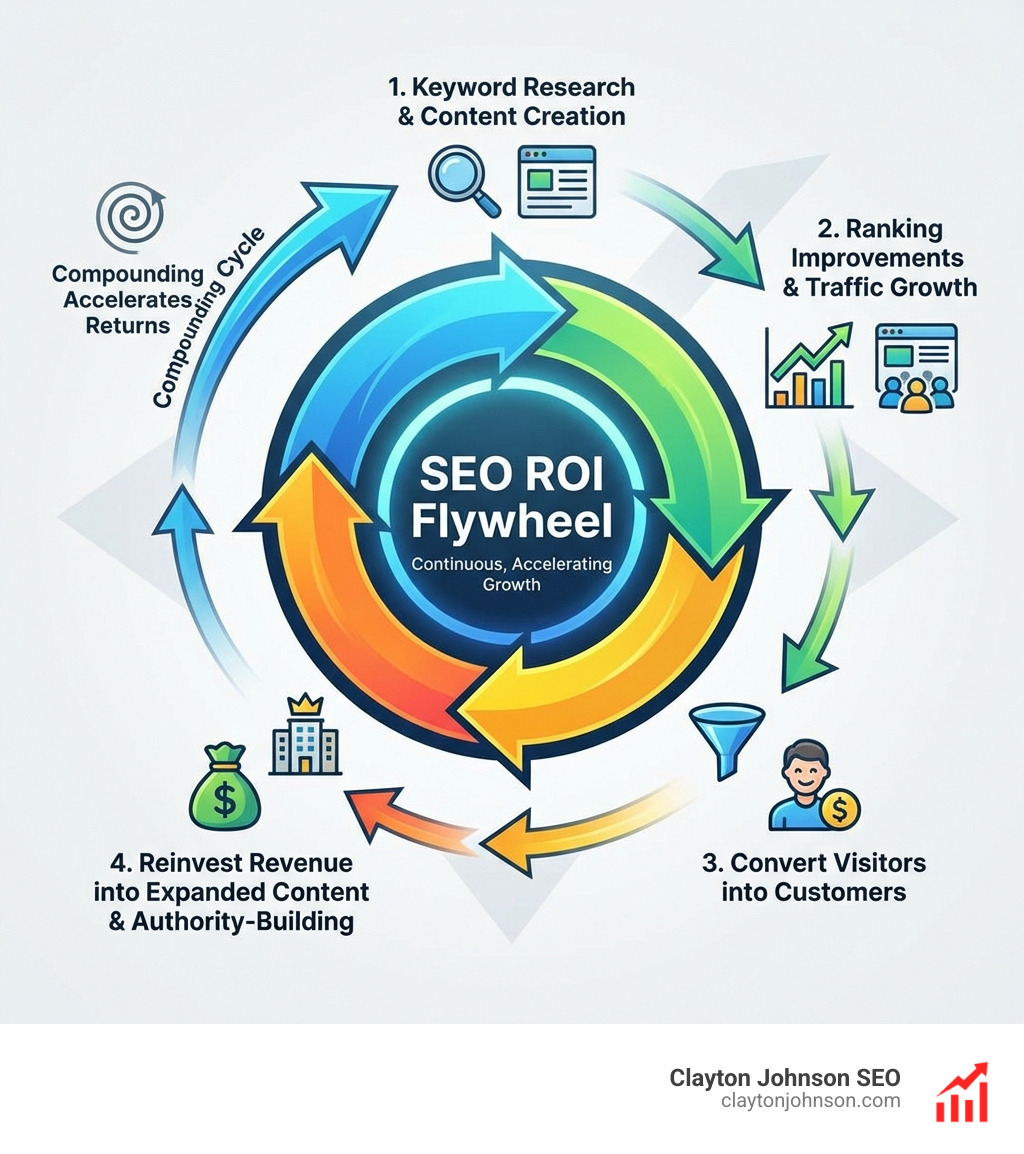
An interactive simulator bridges that gap. It models revenue outcomes across different business models: e-commerce average order value, SaaS lifetime value, enterprise lead-to-close funnels. It factors in ramp-up time, conversion rates, and competitive intensity.
Instead of pitching “more traffic,” you present “12-month ROI at conservative, realistic, and optimistic growth rates.”
That’s the difference between getting budget and getting ignored.
The challenge is knowing which inputs matter, how to model churn and attribution correctly, and what pitfalls distort forecasts. Most calculators oversimplify. They ignore SaaS-specific dynamics like expansion MRR. They miss multi-touch attribution. They assume linear growth when SEO compounds.
This guide walks through how to use an Interactive SEO ROI simulator strategically—not just plug in numbers, but test scenarios, optimize resource allocation, and forecast long-term growth even as markets shift.
I’m Clayton Johnson, and I’ve spent years building structured SEO forecasting systems that align organic strategy with revenue outcomes. In this guide, I’ll show you how to leverage an Interactive SEO ROI simulator to turn fragmented SEO efforts into predictable growth architecture.
Interactive SEO ROI simulator terms simplified:
- Competitive SEO analysis tool
- SEO
- Startup SEO case studies
What is an Interactive SEO ROI Simulator and Why Does It Matter?
At its core, an Interactive SEO ROI simulator is a financial modeling tool designed to translate technical SEO metrics into the language of the C-suite: dollars and cents. Unlike a static spreadsheet, these simulators allow you to toggle variables like conversion rates, ranking improvements, and investment levels to see how they impact your bottom line in real-time.
For SaaS businesses and high-growth startups, this isn’t just a “nice-to-have” tool; it is a fundamental component of structured growth architecture. In the Minneapolis market and beyond, competition for organic visibility is fierce. You cannot afford to guess where to allocate your resources.

Why does it matter so much?
- Decision-Making: It helps you decide whether to double down on existing content or launch a new topic cluster based on projected revenue, not just search volume.
- Budget Allocation: It provides the data needed to justify a $5,000 monthly spend versus a $10,000 spend by showing the difference in the “break-even” month.
- Stakeholder Alignment: It moves the conversation away from “we are ranking for this keyword” to “this keyword strategy is projected to add $50k to our MRR by Q4.”
The Shift from Traffic Metrics to Revenue Outcomes
For too long, SEO success was measured by “vanity metrics”—organic sessions, impressions, and keyword rankings. While these are important leading indicators, they don’t pay the bills. An Interactive SEO ROI simulator forces a shift toward revenue outcomes.
By integrating conversion value and financial accountability into the SEO workflow, we stop treating organic search as a siloed experiment. Instead, it becomes a predictable revenue driver. When you can show that a 1% increase in conversion rate on your high-intent pages is worth more than 10,000 new blog visitors, you change the entire strategy of the marketing department.
Key Data Inputs for Accurate SEO Forecasting
To get an accurate result from an Interactive SEO ROI simulator, you need to feed it high-quality data. Garbage in, garbage out. If your inputs are based on guesses, your forecast will be a fantasy.
Here are the essential metrics we track for a robust model:
- Starting Monthly Organic Traffic: Your current baseline from Google Search Console or GA4.
- Target Search Volume: The total monthly searches for the keyword clusters you are targeting.
- Click-Through Rate (CTR) Benchmarks: Industry-standard data for different ranking positions.
- Website Conversion Rate: The percentage of organic visitors who become leads or customers.
- Customer Lifetime Value (LTV) or Average Order Value (AOV): The total revenue generated by a single customer.
- Monthly SEO Investment: The total cost of agency fees, content creation, tools, and internal resources.
Calculating Returns for Different Business Models
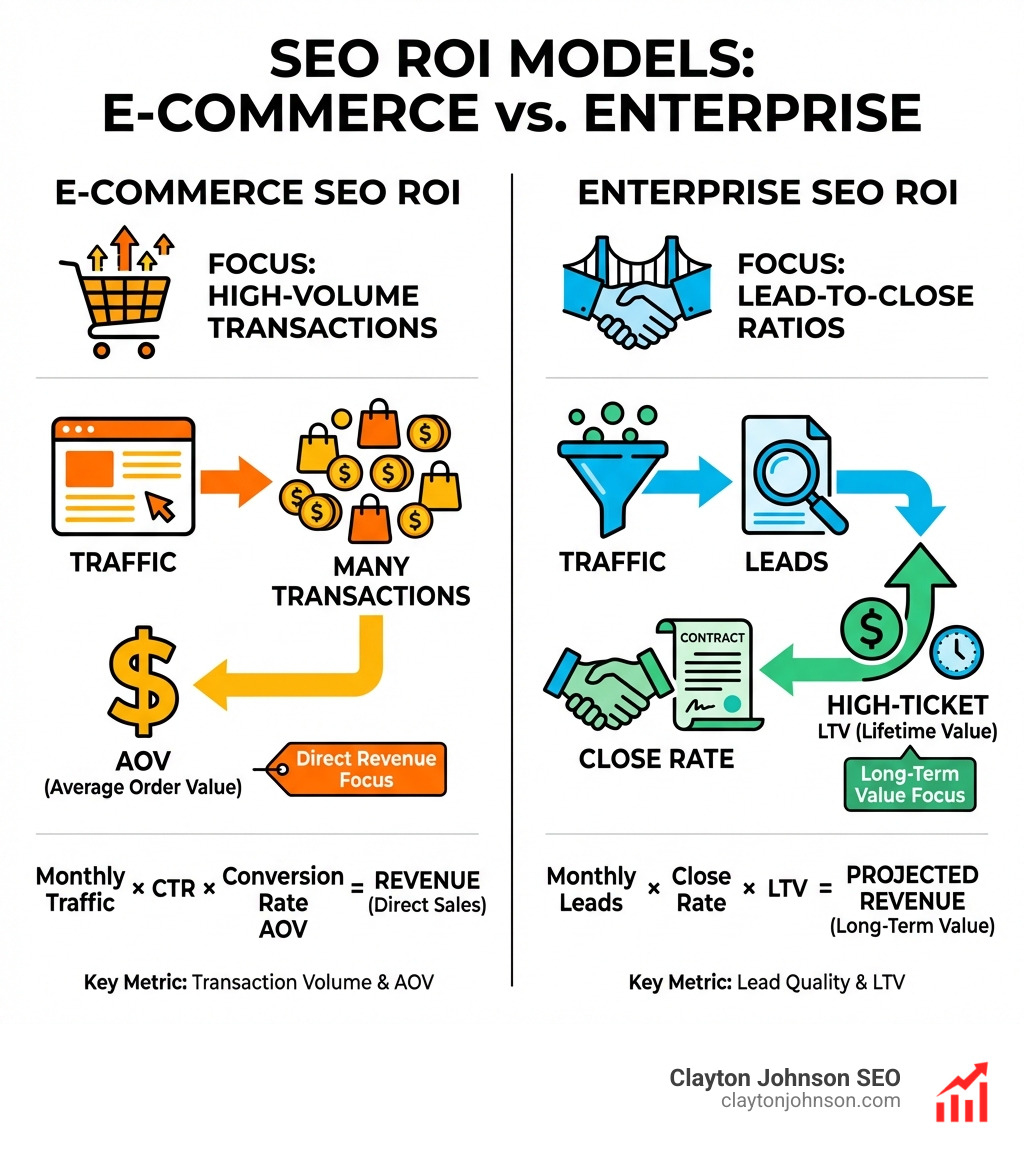
Not all SEO is created equal. The way we calculate ROI for a local Minneapolis e-commerce shop is vastly different from an enterprise SaaS platform.
E-commerce ROI Modeling
In e-commerce, the math is relatively direct:
Monthly Traffic × CTR × Conversion Rate × Average Order Value = Revenue
Because e-commerce often has lower margins but higher volume, the simulator needs to account for the cost of goods sold (COGS) to find the true ROI.
SaaS and Enterprise ROI Modeling
For SaaS, we look at SaaS-specific ROI modeling. Here, we prioritize Lifetime Value (LTV) over a single transaction. Since SaaS relies on subscriptions, the ROI compounds as customers stay on the platform.
Monthly Leads × Close Rate × LTV = Projected Revenue
Using industry conversion rate benchmarks is crucial for setting realistic expectations during the initial setup.
How to Use an Interactive SEO ROI Simulator to Optimize Strategy
Once your data is in, the real magic happens. You can use the Interactive SEO ROI simulator to run “What If” scenarios. This is where you move from being a technician to a strategist.
Testing Scenarios with an Interactive SEO ROI Simulator
What happens if a major Google algorithm update drops your rankings by 20%? Or, conversely, what happens if your new content cluster hits the #1 spot faster than expected?
We use scenario testing to create a “safety cushion” for our clients. By running a Sensitivity Analysis, you can model three paths:
- Conservative: 5% monthly growth with a 15% “reality check” reduction on traffic.
- Realistic: 8% growth based on historical performance and current content velocity.
- Aggressive: 12% growth assuming high-authority backlink acquisition and rapid technical fixes.
| Growth Scenario | Projected Traffic (Year 1) | Break-Even Month | Estimated ROI |
|---|---|---|---|
| Conservative | 15,000 | Month 9 | 150% |
| Realistic | 25,000 | Month 6 | 320% |
| Aggressive | 45,000 | Month 4 | 750% |
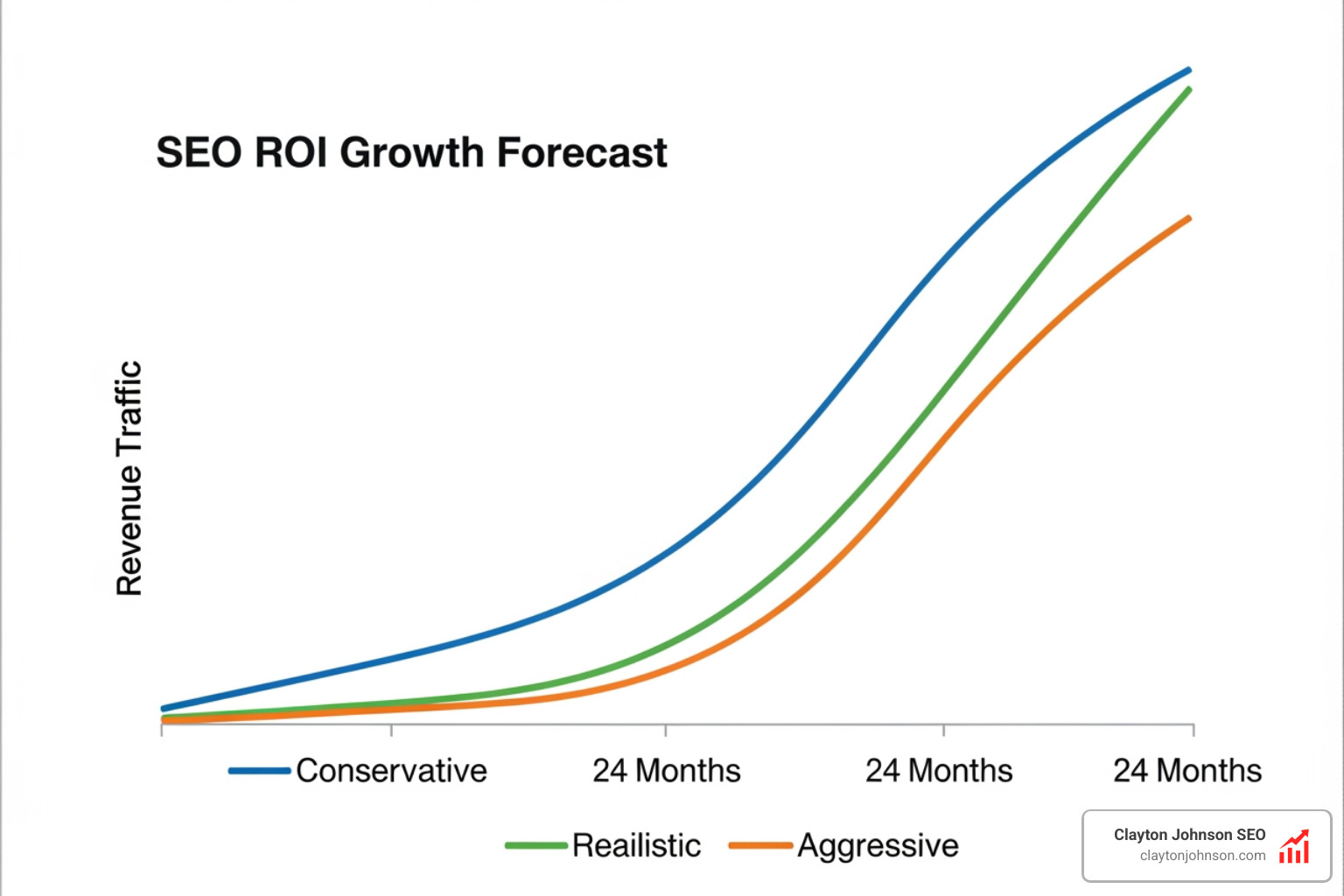
This level of long-term forecasting allows you to navigate market fluctuations without panicking. If you know that even in a conservative scenario, you break even by month 9, you have the confidence to stay the course when rankings fluctuate in month 3.
Avoiding Common Pitfalls in SEO ROI Modeling
Even with a great Interactive SEO ROI simulator, there are traps that can lead to misleading conclusions.
1. Ignoring the Ramp-Up Period
SEO is a marathon. Research shows it typically takes 6-12 months to see significant results. A common mistake is expecting a positive ROI in month 2. A realistic simulator should model $0 or very low revenue in the first few months of a new campaign to account for this “ramp-up” phase.
2. The Attribution Trap
Last-click attribution is the enemy of SEO ROI. A user might find your blog post via Google, leave, see a retargeting ad on LinkedIn, and then convert via a direct search. If you only credit the last click, SEO looks like it failed. We advocate for multi-touch attribution models to capture the true “assist” value of organic content.
If you want a neutral, non-vendor overview of attribution concepts to align stakeholders on definitions, start with marketing attribution on Wikipedia).
3. Forgetting Churn in SaaS
If you are using a SaaS SEO ROI simulator, you must factor in churn. If you acquire 100 customers but lose 10% of them every month, your LTV calculation needs to reflect that reality.
The Role of AI in Enhancing Simulator Accuracy
Advanced technologies like AI are fundamentally changing how we forecast. AI Agents can now evaluate 10x more data points than a human with a spreadsheet. In e-commerce, AI-driven inventory optimization can improve turns by 20-30%, which directly impacts the “profit” side of your ROI equation.
In the context of an Interactive SEO ROI simulator, AI helps by:
- Predictive Modeling: Analyzing historical algorithm patterns to predict ranking volatility.
- Data Validation: Automatically scrubbing “outlier” data from your analytics to ensure the baseline is clean.
- Automated Insights: Identifying which specific content clusters are underperforming relative to their projected ROI, allowing for real-time strategy pivots.
At Demandflow, we integrate AI-augmented marketing workflows to ensure that the data driving your decisions is as accurate as possible. It’s not about replacing human judgment; it’s about giving humans better data to judge.
Frequently Asked Questions about SEO ROI
What is a good ROI for an SEO campaign?
A strong SEO ROI typically ranges from 300% to 500% annually. However, this varies by industry. High-ticket enterprise SaaS might see much higher returns over a 3-year period due to compounding LTV, while high-competition e-commerce might hover around 200-300%.
How long does it take to see a positive return from SEO?
Most businesses notice initial improvements within 3-4 months, but the “break-even” point—where total profit exceeds total investment—usually occurs between months 6 and 12. This is why we recommend a minimum 12-month commitment to any SEO strategy.
Can I use an ROI simulator for local SEO?
Absolutely. For local businesses in Minneapolis, the simulator focuses on “Lead Value” and “Close Rate.” You can model the value of a phone call or a contact form submission to see if local ranking efforts are paying off compared to PPC costs.
Conclusion
The era of “guessing” in SEO is over. By using an Interactive SEO ROI simulator, you move from tactical guesswork to structured growth architecture.
Whether you are a founder looking for clarity or a marketing leader needing to justify a budget increase, financial modeling is your most powerful tool. It allows you to see the future of your organic growth and make the necessary adjustments today to ensure that future is profitable.
At Clayton Johnson SEO and Demandflow, we don’t just “do SEO.” We build the infrastructure for compounding growth. We help you find the leverage points in your business where search-intent content can drive the highest measurable return.
Ready to stop guessing and start growing? Let’s build your growth architecture together.