Stop Shouting and Start Building Authority with These Content Systems


Why Most Content Strategies Fail to Build Real Authority
Authority building content systems are structured frameworks that combine topical content clusters, strategic internal linking, expert-led insights, and continuous optimization to establish your brand as the go-to source in your niche—for both search engines and AI answer engines.
Quick Framework Overview:
- Define your topical authority map – Identify core topics where you can demonstrate genuine expertise
- Build pillar-cluster architecture – Create comprehensive pillar pages supported by in-depth cluster content
- Implement strategic internal linking – Connect related content to signal topical depth to search engines
- Showcase expertise signals – Add author credentials, original research, and proof of experience
- Optimize for AI visibility – Structure content for reusability in AI Overviews, ChatGPT, and other answer engines
- Measure and iterate – Track branded searches, referring domains, and topical coverage expansion
Most companies treat content like a megaphone. They publish more. They shout louder. They chase keywords. And they wonder why traffic doesn’t convert.
The truth? Authority isn’t built through volume—it’s built through systems.
Google’s algorithm has fundamentally shifted. Since the Helpful Content System launched, search engines reward comprehensive expertise over generic coverage. The data backs this up: 48% of companies awarded business to organizations after engaging with their thought leadership content, while another 54% made a purchase for a new product or service after that engagement.
But here’s what changed everything: AI search.
AI Overviews, ChatGPT, and other answer engines don’t just rank pages—they select passages from brands they trust. Your content either gets cited as an authority, or it disappears entirely. There’s no middle ground.
The problem most brands face:
- Content exists in silos with no topical depth
- No strategic internal linking to signal expertise
- Generic information anyone could write
- Zero visibility in AI-generated answers
- Traffic that bounces instead of converts
The solution isn’t more content. It’s structured content architecture designed to build authority systematically.
I’m Clayton Johnson, and I’ve spent years engineering authority building content systems that transform fragmented marketing into cohesive growth engines through strategic frameworks, topical modeling, and AI-augmented workflows. These systems don’t just improve rankings—they position brands as the definitive source in their category.
The Strategic Blueprint for Authority Building Content Systems
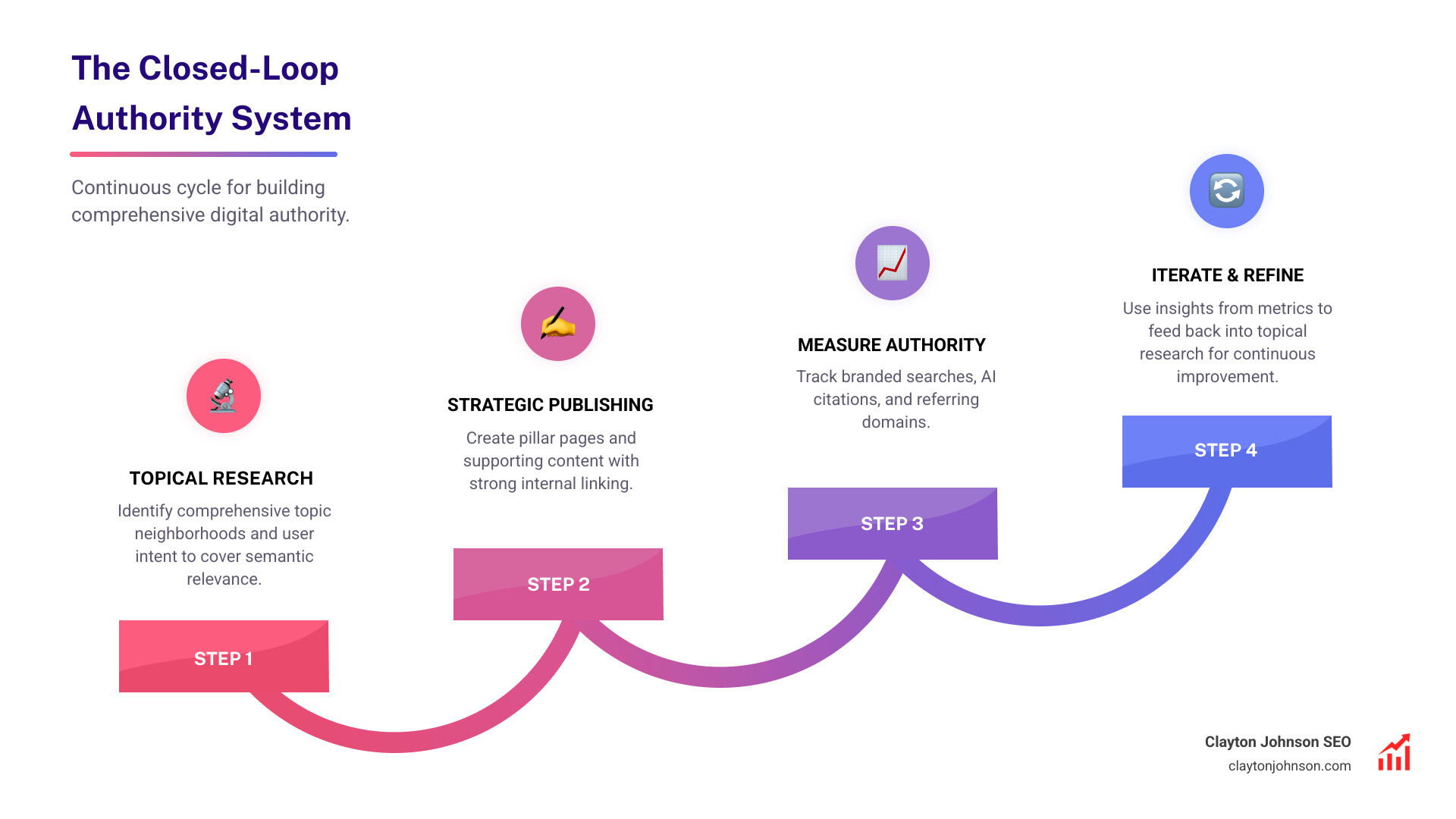
Building authority is often confused with being “famous.” In reality, digital authority is about legibility. It is the degree to which search engines and users can verify that you know what you’re talking about. We don’t just “do SEO”; we build authority building content systems that act as a closed-loop growth engine.
A closed-loop system means your strategy and execution live in one connected cycle. Most teams plan in a spreadsheet, write in a doc, and report in a third tool. This fragmentation causes “authority leakage.” In our system, every piece of content published becomes an input for the next cycle of planning. We focus on semantic relevance—ensuring your content doesn’t just mention keywords, but covers the entire “neighborhood” of a topic.
This alignment is critical for modern search. Google’s E-E-A-T guidelines (Experience, Expertise, Authoritativeness, and Trustworthiness) aren’t just suggestions; they are the scorecard. Furthermore, the Helpful Content System explicitly rewards sites that demonstrate depth. If you’re just scratching the surface of a topic to chase a high-volume keyword, you’re building on sand. You need a structured SEO content marketing strategy that treats every page as a brick in a larger fortress of expertise.
Designing Authority Building Content Systems for AI Search
We are living in the era of “Answer Engines.” When a user asks ChatGPT a question or looks at an AI Overview on Google, the AI isn’t just looking for a link; it’s looking for a source.
To earn these citations, your content must be modular and reusable. AI systems select passages that are clear, factual, and backed by a strong source reputation. If your brand is consistently cited across a range of related prompts, your “AI Authority” grows. This requires a shift in how we write. We move away from long, fluff-filled introductions and get straight to the “outcome” or the answer. This makes your content easy for an AI to parse and credit.
Our research on AI prompts shows that the brands winning in AI search are those that provide first-principles thinking—explaining why something works, not just what it is.
Implementing Topic Clusters and Pillar Pages
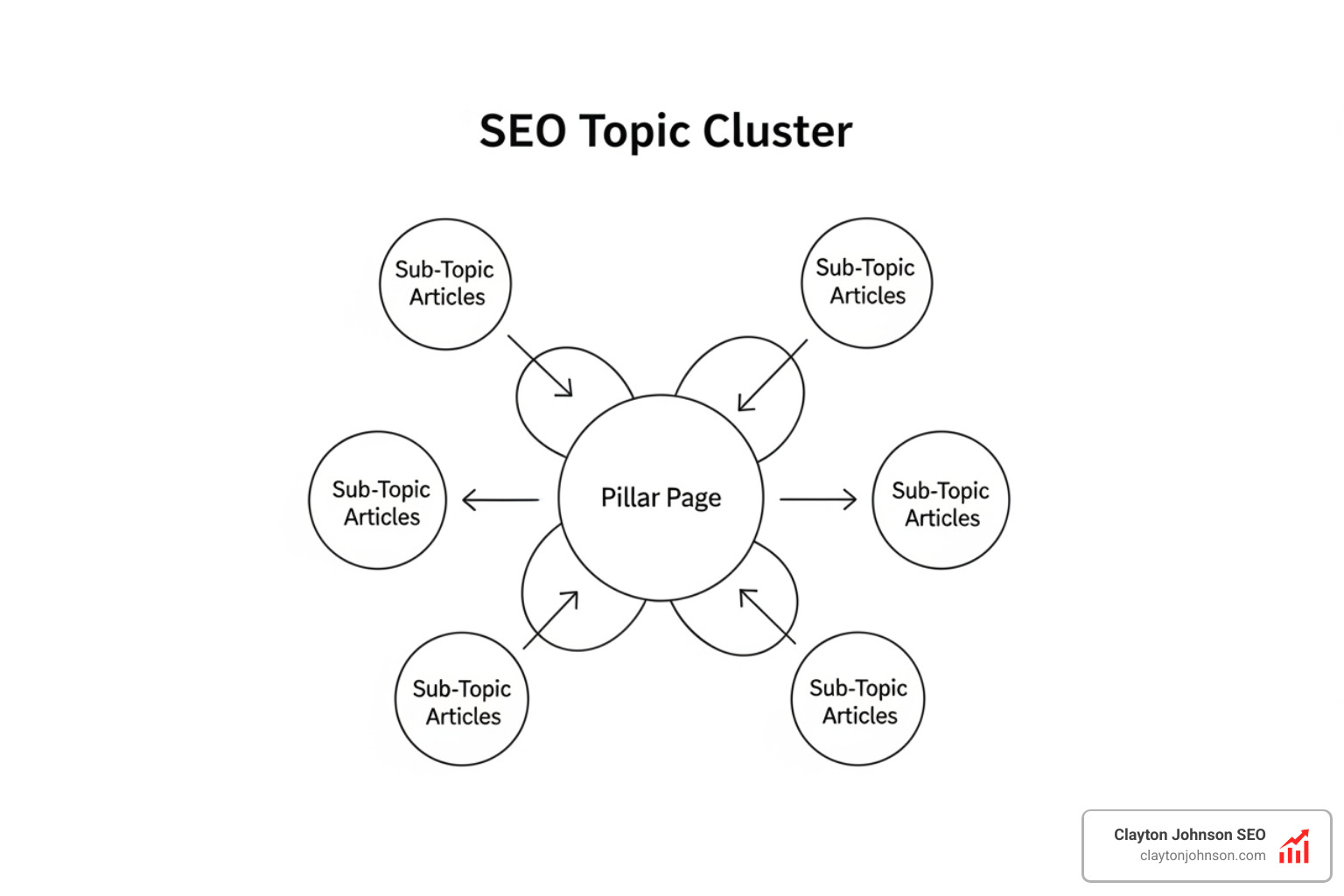
The “Topic Cluster” is the physical architecture of authority. It consists of:
- A Pillar Page: A comprehensive resource (often 2,500+ words) that covers a broad topic in depth.
- Cluster Content: Specific articles that dive deep into sub-topics mentioned on the pillar page.
- Internal Linking: The “glue” that connects them, signaling to Google that these pages are part of a single topical authority system.
By mapping keywords to specific roles within a cluster, we avoid “topical cannibalization”—where two of your own pages fight for the same spot in search results. Instead, each page reinforces the other. If you need help architecting this, our SEO consultancy focuses on building these maps before a single word is ever written.
Core Pillars of Topical Expertise and Credibility
How do you distinguish yourself from a “content mill”? You provide what AI cannot: original data and first-hand experience.
| Feature | Thin Content | Authoritative Content |
|---|---|---|
| Source | Rehashed secondary research | Original research & data journalism |
| Depth | Surface-level summaries | In-depth case studies & whitepapers |
| Proof | Generic claims | Statistics, proof, & corroboration |
| Goal | Keyword coverage | User satisfaction & problem solving |
Original research is a powerhouse for authority. Statistics show that 56% of marketers who use original research find that it meets or exceeds their expectations. When you produce a report that uncovers new insights, you become the primary source. Journalists and other bloggers will link to you as the authority, which builds your backlink profile naturally. Check out our original research statistics to see how this impacts rankings.
Showcasing Proof and Corroboration
Authority isn’t just what you say; it’s what others say about you. User-generated content (UGC), such as reviews and testimonials, provides essential third-party validation. In fact, 72% of consumers consider reviews from fellow customers more credible than brand statements.
We integrate this social proof directly into the content system. By showcasing case studies and customer success stories, we move the user from “I’m interested” to “I trust them.” This is a key part of conversion optimization. If you’re looking to turn traffic into revenue, you need to learn more about our conversion optimization approach.
Leveraging Expert-Led Content
Google wants to see a “face” behind the information. Anonymous content is a red flag. We use Subject Matter Experts (SMEs) to lead the content creation process. This doesn’t mean the expert has to write every word, but their insights must be the “soul” of the piece.
We reinforce this through:
- Detailed Author Bios: Explaining the writer’s credentials and experience.
- Person Schema: Technical code that tells search engines exactly who the author is and why they are reputable.
- Source Reputation: Building a footprint where your experts are quoted on other authoritative sites (using platforms like HARO).
These expertise signals tell search engines that the content is backed by a real human with real knowledge, which is a significant factor in source reputation.
Scaling Operations and Humanizing the Brand
One of the biggest hurdles to building authority building content systems is consistency. You can’t be an authority if you only publish once every three months. To scale, many businesses look toward offshore talent.
Regions like the Philippines offer a massive pool of skilled, English-speaking writers who can produce high-quality content at a fraction of the cost of a domestic in-house team. This isn’t about “cheap content”; it’s about cost-effective scalability. By outsourcing the heavy lifting of drafting and formatting, your internal experts can focus on strategy and high-level editorial governance.

Scaling Authority Building Content Systems with Offshore Talent
When scaling with offshore teams, the “system” part of authority building content systems becomes even more important. You need:
- Editorial Governance: Clear style guides and brand voice documents.
- Workflow Automation: Tools that move a piece from brief to draft to review seamlessly.
- Quality Control: A dual-track review process where both an editor and an SME check every piece for factual accuracy.
We provide a content distribution checklist to ensure that once this content is produced, it reaches the right eyes through every possible channel.
Humanizing Authority Through Personal Branding
In an AI-heavy world, humans crave connection. “Building in public”—sharing your wins, losses, and processes transparently—builds a level of trust that corporate logos cannot. We encourage founders and leaders to put a face to the brand.
Whether it’s through hyper-personalization in email marketing or engaging directly with the audience on social media, humanizing the brand creates a “mere exposure effect.” The more people see and interact with the humans behind the company, the more they trust the company’s authority. Explore our email marketing services to see how we build these personal connections at scale.
Measuring Growth and the 90-Day Authority Sprint
You cannot manage what you do not measure. But we don’t just look at “vanity metrics” like total traffic. We look at Authority Metrics:
- Branded Searches: Are more people searching for your company name?
- Referring Domains: Are high-quality sites linking to your topic clusters?
- Topical Coverage: How much of your “topical map” have you successfully claimed?
- Impressions: Using Google Search Console to see if you are appearing for the right “head keywords.”

The 90-Day Authority Implementation Plan
Building authority doesn’t happen overnight, but you can see significant movement in 90 days if you follow a structured sprint:
- Month 1: Foundations. Define your brand identity, audit existing assets, and build your initial topical map. Fix your author bios and social proof.
- Month 2: The Cluster Build. Produce one “pillar” resource and 4-6 supporting cluster articles. Implement rigorous internal linking.
- Month 3: Distribution & Recognition. Pitch your original research to the media. Share insights on social. Track branded search growth and AI citations.
By the end of 90 days, you aren’t just “doing content”; you have a repeatable habit and a growing body of work that search engines recognize as authoritative.
Real-World Authority Success Stories
We’ve seen these systems work across various industries. For example, a B2B company used influencer storytelling to see an 800% increase in page views. Another client in a highly competitive medical-adjacent niche (Kineon) achieved over 1,000 monthly clicks and significant revenue from a single content cluster in less than six months.
These aren’t accidents. They are the result of moving away from “shouting” and moving toward a structured growth architecture.
Frequently Asked Questions about Content Authority
What is the difference between topical authority and domain authority?
Topical authority is about proving expertise in a specific subject. It’s what Google uses to decide if you are a “go-to” source for a topic. Domain Authority (DA) is a third-party metric that predicts how well a whole website will rank based on its link profile. While they are related, you can have high topical authority for a niche even if your overall domain authority is still growing.
How long does it take to build brand authority from scratch?
While you can see initial “authority signals” (like increased impressions) within 90 days, true brand authority usually takes 6 to 12 months of consistent effort. It is an investment that compounds over time. Each piece of authoritative content makes the next one easier to rank.
Can small businesses compete with large brands for authority?
Absolutely. In fact, small businesses have an advantage: they can go deep where big brands go wide. By owning a very narrow niche (e.g., “SEO for Minneapolis law firms” instead of just “SEO”), a small business can demonstrate a level of specific expertise that a giant corporation can’t match.
Conclusion
The digital landscape is too crowded for “more content” to be the answer. To win today, you need to stop shouting and start building.
At Clayton Johnson SEO, we don’t believe in random acts of marketing. We believe in structured growth architecture. Through Demandflow.ai, we provide the frameworks, taxonomy-driven SEO systems, and AI-augmented workflows necessary to build a compounding growth engine.
Authority isn’t a badge you wear; it’s a system you build. If you’re ready to stop chasing the algorithm and start leading your industry, it’s time to implement a system that works for you.
Work with Clayton Johnson today to build your authority ecosystem.