Why Use AI in Business? From Efficiency to Innovation

Why How AI Impacts Business Is the Most Important Question in Strategy Right Now
How AI impacts business is no longer a theoretical debate — it is happening across every function, every industry, and every company size right now.
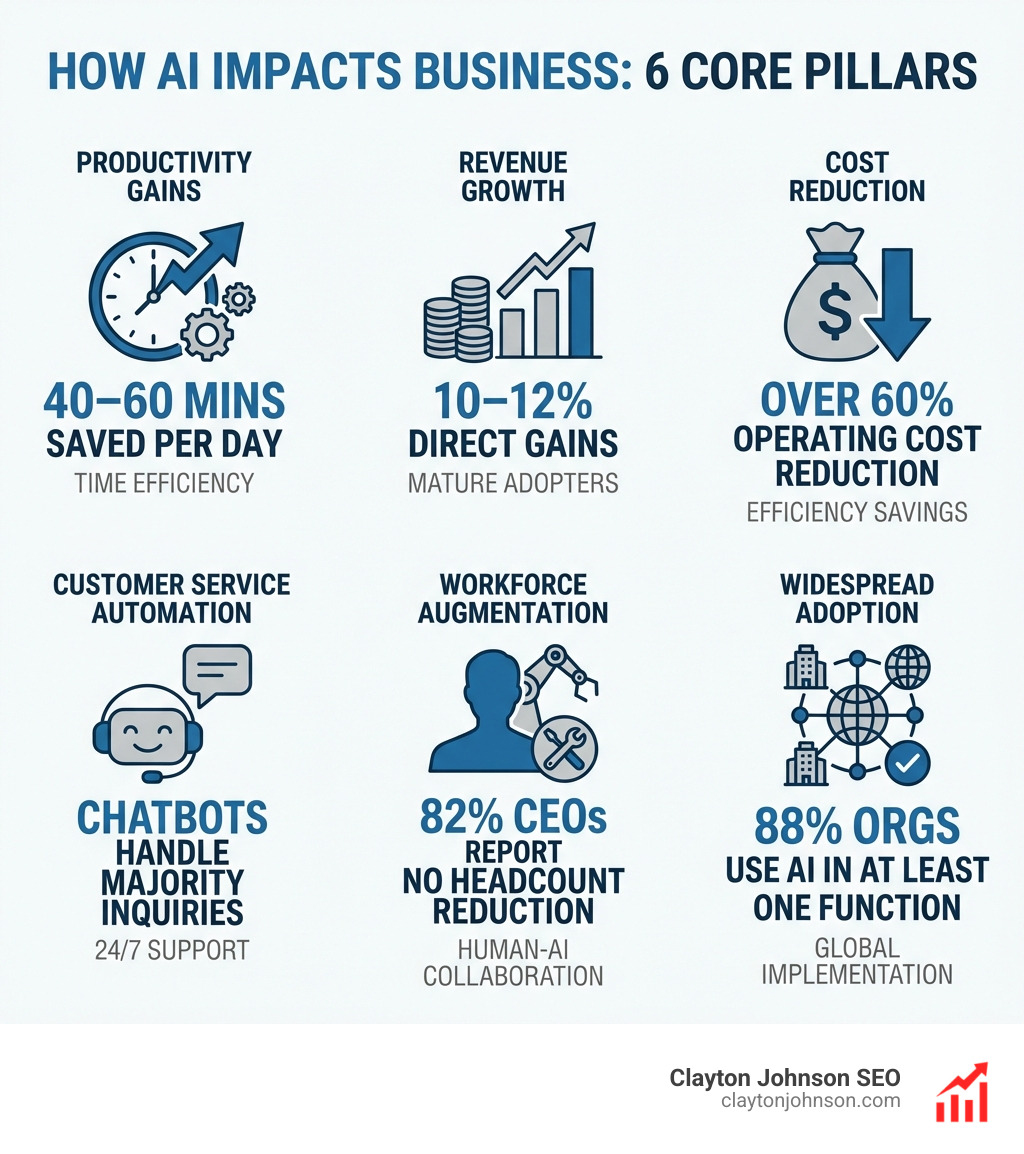
Here is a quick summary of the core impacts:
| Area | Impact |
|---|---|
| Productivity | Workers report saving 40–60 minutes per day |
| Revenue | Mature AI adopters see 10–12% direct revenue gains |
| Cost reduction | AI can reduce operating costs by over 60% |
| Customer service | Chatbots now handle the majority of inquiries in many industries |
| Workforce | 82% of CEOs report AI has not reduced headcount |
| Adoption rate | 88% of organizations use AI in at least one business function |
The business case is clear. But knowing that AI matters is not the same as knowing how to make it work for your specific situation.
Most companies are experimenting. Very few are scaling. And the gap between those two groups is growing fast.
Companies that have moved beyond pilots are seeing measurably better financial outcomes — higher margins, faster cycle times, and stronger competitive positioning. Those still treating AI as a side project are falling behind.
This guide breaks down exactly where AI creates the most value, which business functions benefit most, what the real risks look like, and how to build a strategy that compounds over time rather than stalls in the pilot phase.
I am Clayton Johnson, an SEO strategist and growth operator who works at the intersection of AI-assisted workflows, structured content systems, and scalable marketing architecture — including hands-on experience applying AI to diagnose and solve the exact growth problems this guide addresses around how AI impacts business. The frameworks and insights here are built from real strategic work, not theory.
Defining Artificial Intelligence in a Modern Business Context

In a business context, artificial intelligence (AI) isn’t about sentient robots; it’s about software that can simulate human cognitive functions like learning, problem-solving, and pattern recognition. When we talk about how AI impacts business, we are referring to the transition from static software to “intelligent” systems that can adapt and provide insights at a scale no human team could match.
According to Grand View Research, the global AI market is projected to grow at a staggering compound annual growth rate (CAGR) of 38.1%. This growth is driven by the integration of several core technologies:
- Machine Learning (ML): Algorithms that improve automatically through experience. In business, this powers everything from credit scoring to inventory management.
- Predictive Analytics: Using historical data to forecast future outcomes, such as customer churn or equipment failure.
- Generative AI (GenAI): Models capable of creating new content—text, images, or code—based on the data they were trained on.
- Natural Language Processing (NLP): Technology that allows machines to understand and respond to human language, forming the backbone of modern customer service.
Types of AI Used in Business
To understand the landscape, we categorize AI into three distinct “flavors” currently found in the enterprise:
- Weak (Narrow) AI: This is what most businesses use today. It is AI designed to perform a specific task, like a chatbot answering a billing question or an algorithm suggesting a product.
- Strong (General) AI: This remains a theoretical concept where a machine possesses the ability to understand or learn any intellectual task that a human being can.
- Agentic AI: A rising trend where AI “agents” can perform multi-step workflows autonomously, making decisions to reach a goal rather than just providing a single output.
- Foundation Models: Large-scale models (like those powering ChatGPT) that serve as a base for many different applications, from coding to creative writing.
Evolution of AI Adoption
The barrier to entry has collapsed. Previously, AI was the playground of tech giants with massive R&D budgets. Today, we see a massive democratization through SME accessibility. Small businesses can now access enterprise-grade intelligence through simple API connections and cloud-native platforms. While large firms are focused on enterprise scaling—integrating AI into every department—smaller founders are using these tools to punch way above their weight class.
How AI Impacts Business Productivity and Revenue

The numbers behind how AI impacts business are hard to ignore. We aren’t just talking about marginal gains; we are seeing fundamental shifts in the P&L statement. Research shows that AI can deliver potential margin increases of 10-20% while reducing operational costs by over 60%.
One of the most compelling findings from a significant majority of CEOs is that 70% expect GenAI to transform how their company creates value. Furthermore, sectors that are “AI-ready” are experiencing 4.8 times more productivity growth than those lagging behind.
Measuring how AI impacts business through ROI and KPIs
When we implement AI systems for our clients, we don’t just look at “cool factor”—we look at measurable leverage. Key metrics include:
- Revenue Boost: Organizations in the optimizing phase of AI report 10-12% revenue gains, according to another recent IBV study.
- Cycle Time: AI-first organizations report 74% greater cycle time reductions, meaning they get products to market faster.
- Labor Productivity: AI could increase labor productivity growth by 1.5 percentage points over the next decade.
High Performers vs. Laggards
There is a widening gap between companies that “get it” and those that don’t. High performers treat AI as a core strategic pillar, not a shiny new toy.
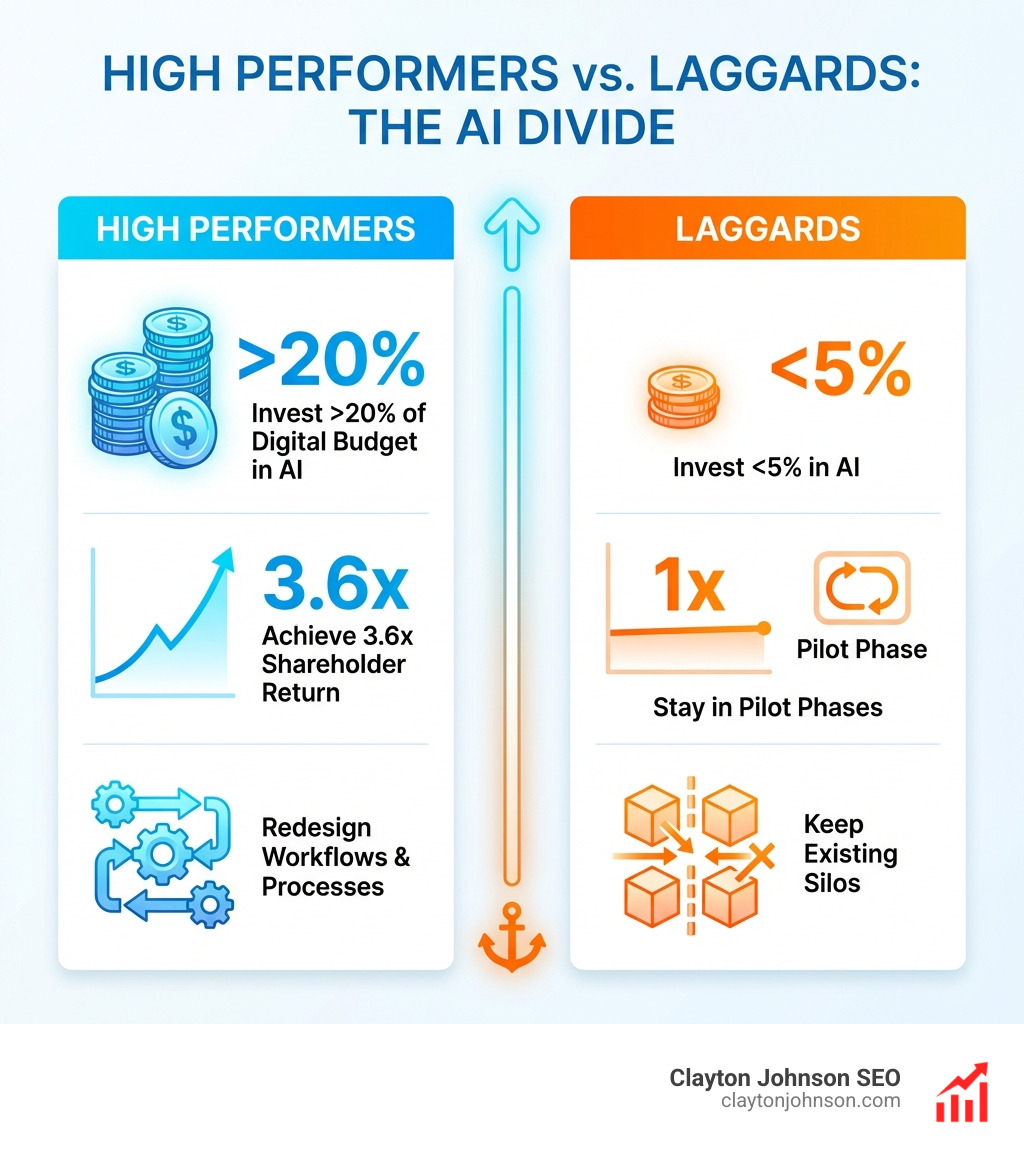
The differentiator is often workflow redesign. High performers don’t just sprinkle AI on top of old processes; they rebuild the process around what the technology can now do.
Core Applications Across Key Business Functions

AI is moving out of the IT department and into every corner of the office. If you’re looking for More info about artificial intelligence services, you’ll find that the most successful implementations happen where data is plentiful and tasks are repetitive.
- Operations & Logistics: AI is used for predictive maintenance—predicting when a machine will break before it does—and optimizing supply chains. In mining, for instance, AI has made data processes 18 times faster.
- Cybersecurity: 51% of businesses now use AI for threat detection, using it to spot patterns that indicate a breach in real-time.
- Demand Forecasting: Retailers use AI to adjust prices dynamically based on inventory levels and weather patterns.
Marketing and Customer Service
This is where how AI impacts business is most visible to the public.
- Hyper-personalization: AI analyzes customer behavior to serve the right offer at the exact right moment.
- Virtual Agents: In banking, more than 60% of inquiries are now handled by chatbots. These aren’t the frustrating bots of old; modern virtual agents can resolve complex issues end-to-end, saving millions in support costs.
- Sentiment Analysis: Marketing teams use AI to “read” the internet, understanding how customers feel about their brand in real-time.
Finance and Human Resources
- Fraud Detection: Financial institutions use AI to scan millions of transactions for anomalies, stopping fraud before the money leaves the account.
- Predictive Hiring: HR teams use AI to match candidates to roles, with some firms seeing a 38% increase in successful hires.
- Talent Retention: AI can flag “flight risks” by analyzing employee engagement data, allowing managers to intervene before a top performer quits.
Navigating the Challenges and Ethical Risks of Implementation
It’s not all sunshine and productivity gains. Implementing AI comes with significant hurdles. Public Trust in AI Technology has actually declined as tools become more widespread, largely due to concerns over privacy and “hallucinations” (where AI confidently states something false).
Understanding how AI impacts business workforce dynamics
The most common question we hear is: “Will AI take my job?” The data suggests a more nuanced reality. While AI may replace some roles—Forrester suggests it could replace 7% of US jobs by 2025—it is also creating new ones.
The real challenge is the skill gap. Skills for AI-exposed roles are changing 25% faster than others. We believe the future isn’t “Human vs. AI,” but “Human + AI.” 82% of CEOs report that AI has actually increased or caused no change in headcount, suggesting that AI is augmenting workers rather than simply deleting them.
Common Mistakes to Avoid
In our work building growth architecture, we see the same pitfalls repeatedly:
- Lack of Strategy: Implementing tools because they are “trendy” without a clear ROI goal.
- Poor Data Hygiene: AI is only as good as the data it eats. If your data is messy, your AI output will be useless.
- Underestimating Costs: The “sticker price” of a tool is small compared to the cost of integration and staff training.
- Neglecting Change Management: If your team is afraid of the tool, they won’t use it. You must build a culture of curiosity.
A Strategic Roadmap for Successful AI Adoption
Success with AI requires a structured approach. We don’t believe in “random acts of marketing” or “random acts of AI.” You need a blueprint.
Step-by-Step Implementation
- Needs Analysis: Don’t start with the technology; start with the problem. Where are your bottlenecks?
- Data Audit: Do you have the data necessary to feed an AI model? Is it clean and accessible?
- Lighthouse Projects: Start with small, high-visibility projects that prove value quickly. This builds internal buy-in.
- Tool Selection: Choose tools that fit your existing tech stack. At Demandflow, we focus on modularity and compatibility.
- Governance Frameworks: Define who is responsible for AI outputs. How do you audit an automated decision?
Building a Living AI Backbone
Legacy data architectures are the enemy of AI. To truly scale, you need a “living” backbone—a cloud-native, real-time system that breaks down silos. This means your sales data, marketing data, and operational data all talk to each other in a unified environment. This is the “structured growth infrastructure” we advocate for.
The Future Outlook: Emerging Trends and Economic Shifts
As we look ahead, the conversation around how AI impacts business is shifting toward even more powerful capabilities. According to The enterprise in 2030 | IBM, 79% of executives expect AI to significantly contribute to revenue by the end of the decade.
The Rise of Agentic AI and Quantum Readiness
The next big leap is Agentic AI. Unlike current tools that wait for a prompt, these agents will proactively manage workflows. For example, an AI agent could notice a supply chain delay, find an alternative vendor, and draft the purchase order for human approval—all without being asked.
Furthermore, Quantum-enabled AI is on the horizon. While only 27% of executives expect to use it soon, those who do will have the computing power to solve optimization problems that are currently impossible for classical computers.
Global Economic Impact
AI is projected to be a general-purpose technology, much like electricity or the internet. It will drive industry convergence, where the lines between “tech company” and “retailer” or “healthcare provider” blur. The economic shift will favor those who can move from “piloting” to “optimizing” the fastest.
Frequently Asked Questions about AI in Business
What is the measurable impact of AI on business revenue?
Mature AI adopters report revenue gains of 10-12%. This comes from a combination of hyper-personalized marketing (higher conversion), dynamic pricing, and reduced churn through predictive analytics.
How does AI affect job security and the workforce?
While AI automates tasks, it rarely replaces entire jobs. Instead, it changes the nature of the work. 82% of CEOs have maintained or increased headcount after adopting AI. The biggest risk to job security isn’t AI itself, but a lack of AI skills.
What are the first steps for a small business to adopt AI?
Start small. Use AI for content generation, basic customer service chatbots, or meeting transcriptions. Focus on “low-hanging fruit” where you can save at least 5-10 hours of manual work per week before moving to more complex integrations.
Conclusion
The AI revolution isn’t coming; it’s here. The question of how AI impacts business has been answered by the thousands of high-performing companies already seeing 3.6x higher shareholder returns than their peers.
At Clayton Johnson SEO, we believe that the ultimate competitive advantage comes from Structure. AI provides the leverage, but you provide the architecture. By building a structured growth system—what we call Demandflow—you can move past the “experimentation” phase and into a world of compounding growth.
Whether it’s through More info about SEO services or building out your AI-augmented marketing workflows, the goal is the same: Clarity → Structure → Leverage → Compounding Growth. Don’t just use AI; build the infrastructure that allows AI to transform your business.