How to Master the 5 Forces of Competition

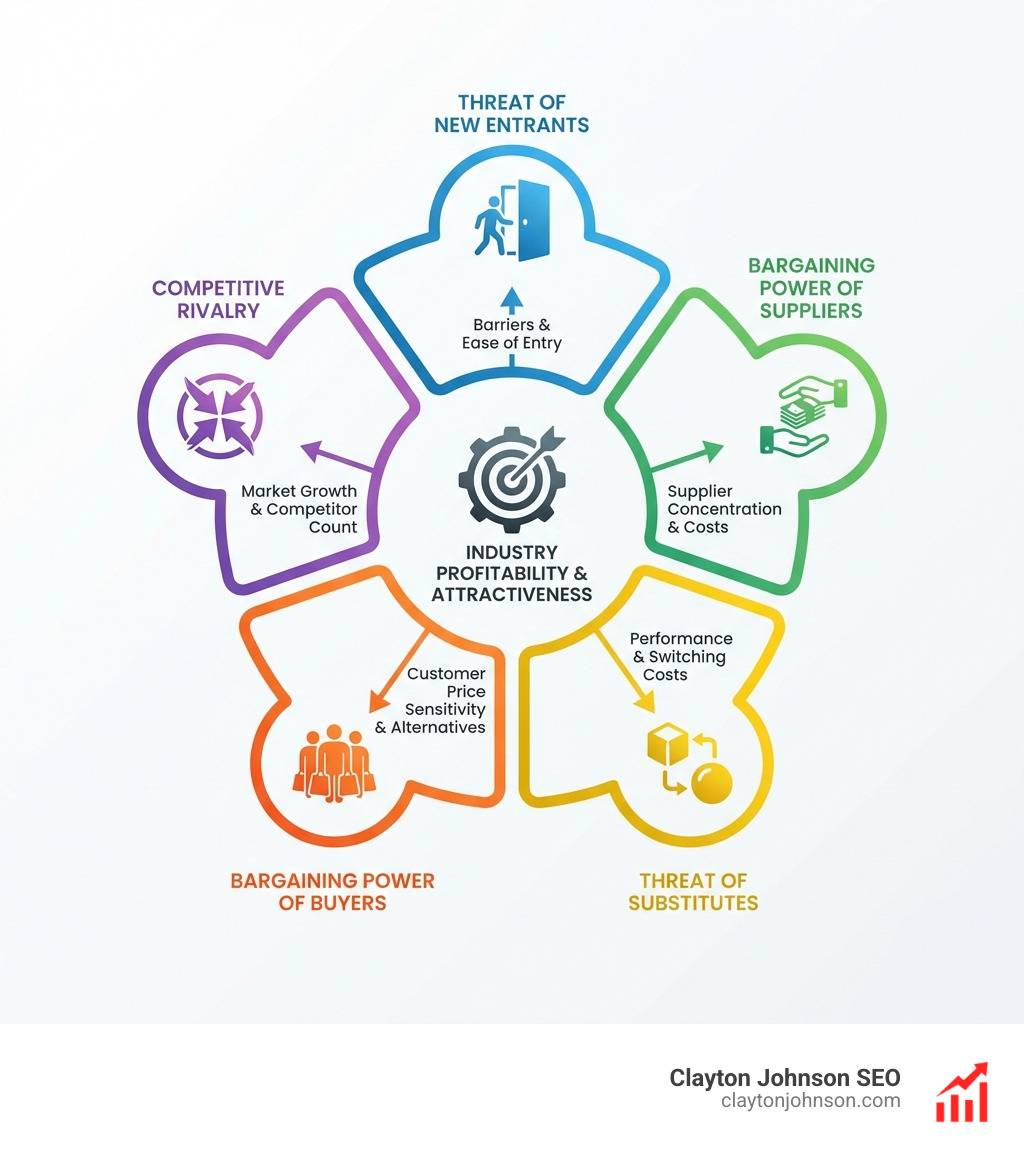
The 5 forces of competition is a framework developed by Harvard Business School professor Michael Porter that explains why some industries generate exceptional returns while others struggle to break even. Average return on invested capital across U.S. industries has historically ranged from zero or negative to more than 50%—a spread that can’t be explained by market cycles or technology alone.
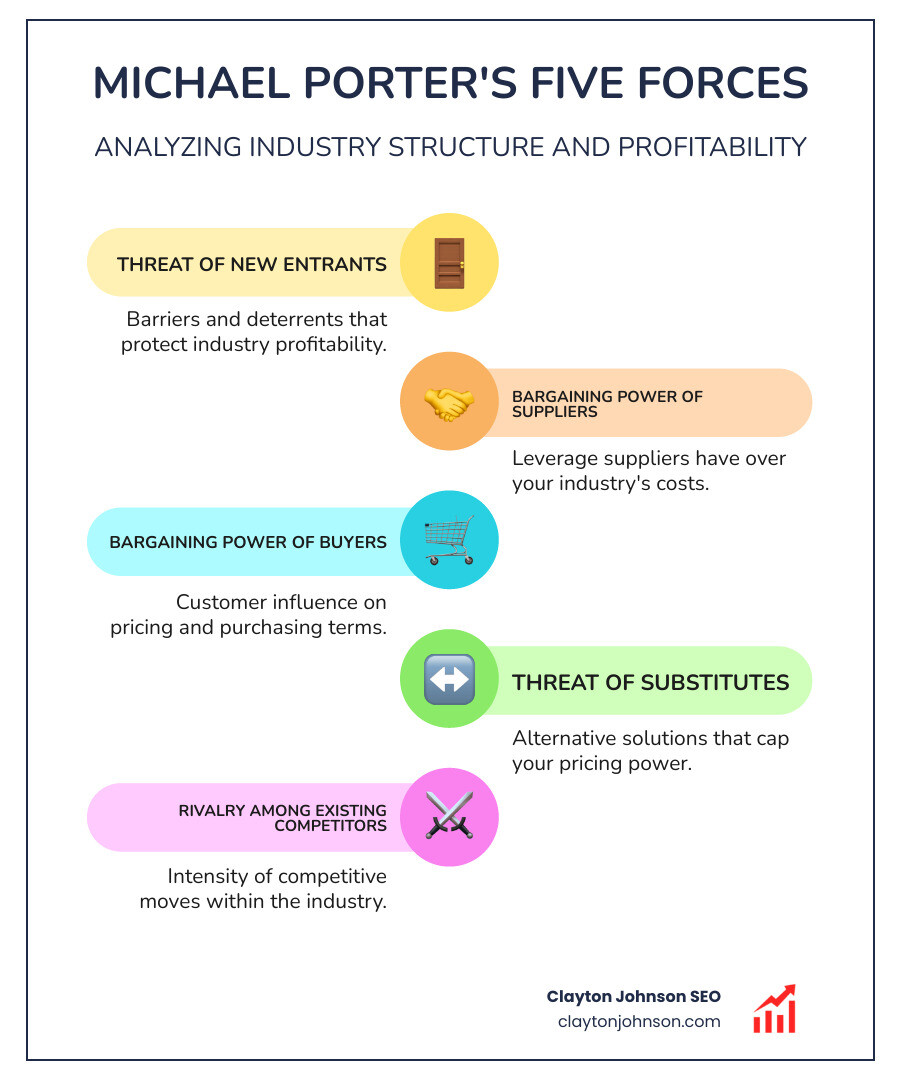
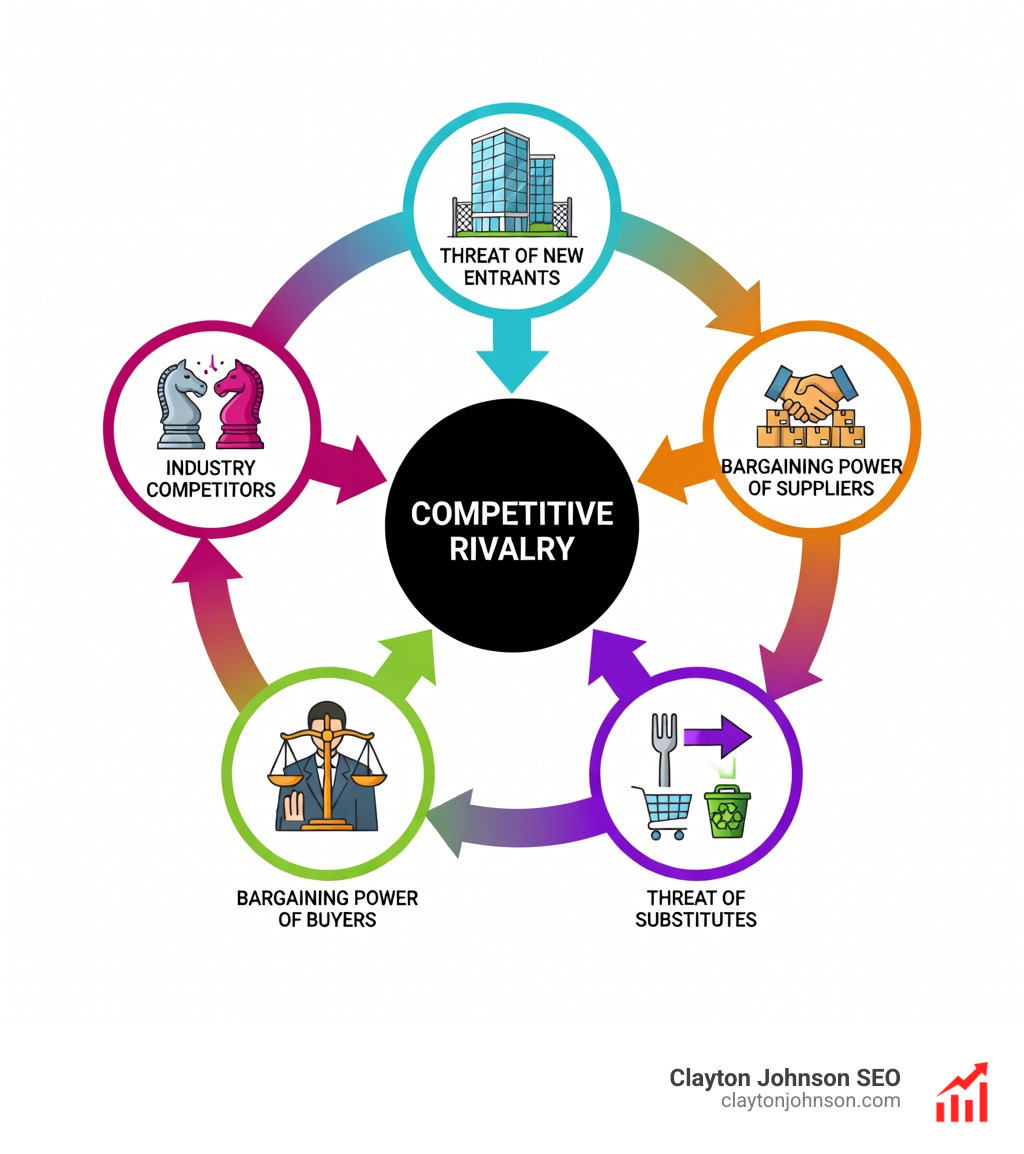
The five competitive forces are:
- Threat of New Entrants – barriers and deterrents that protect industry profitability
- Bargaining Power of Suppliers – how much leverage suppliers have over your costs
- Bargaining Power of Buyers – customer influence on pricing and terms
- Threat of Substitutes – alternative solutions that cap your pricing power
- Rivalry Among Existing Competitors – intensity of competitive moves within the industry
These forces collectively determine industry structure, which sets profitability in the medium and long run. Industries like soft drinks and prepackaged software have historically been significantly more profitable than airlines—not because of better management, but because of more favorable competitive structure.
Most strategists define competition too narrowly. They focus on direct rivals and miss the broader ecosystem of forces that actually determine who captures value. Competition for profits extends beyond established industry players to include customers, suppliers, potential entrants, and substitute products. The extended rivalry from all five forces defines industry structure and shapes competitive interaction.
Understanding these forces isn’t just academic—it’s the foundation for positioning your company, anticipating industry shifts, and actively shaping competitive dynamics in your favor. The strongest force or forces determine industry profitability and become the most important inputs for strategy formulation.
I’m Clayton Johnson, and I’ve spent over a decade helping founders and marketing leaders diagnose competitive environments and build structured growth architectures using the 5 forces of competition as a foundational framework. Rather than reacting to market changes, the companies that succeed build strategies around structural understanding of where power lies and how value flows in their industry.
The Origins and Purpose of the 5 Forces of Competition
The 5 forces of competition model didn’t just appear out of thin air. It was introduced by Michael E. Porter in his seminal article, The Five Competitive Forces That Shape Strategy, published in the Harvard Business Review. Porter’s work bridged the gap between academic industrial organization economics and practical business strategy.
Before Porter, many managers used SWOT analysis, which he criticized for its lack of analytical rigor. He wanted to understand why some industries were “sexy” and profitable while others were “death traps” for capital. The answer lies in the Return on Invested Capital (ROIC).
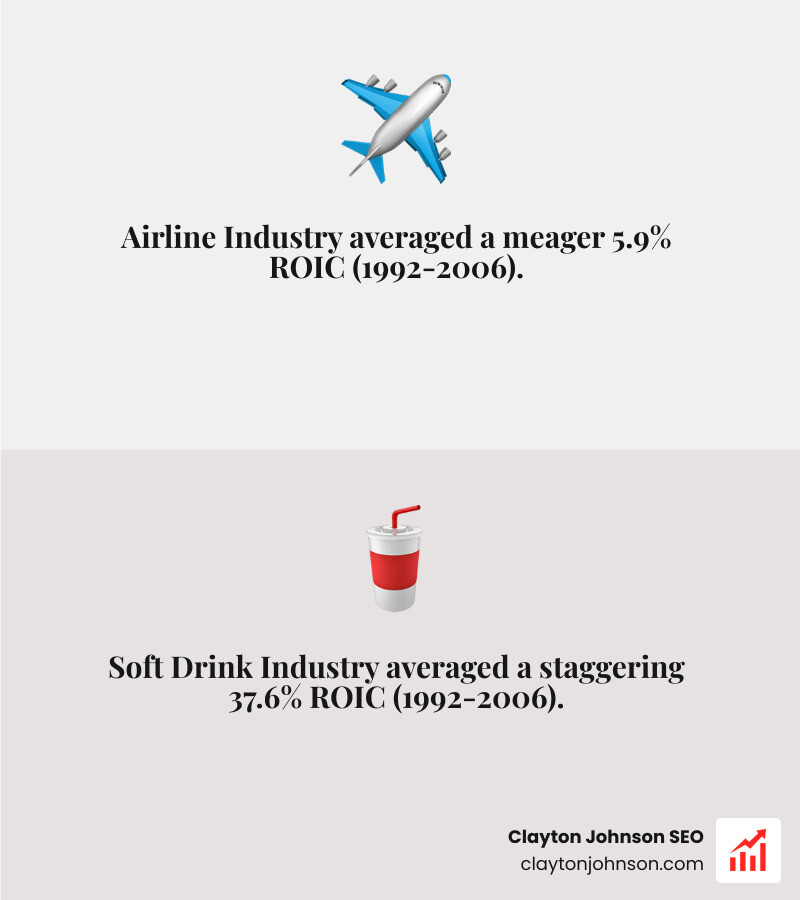
Research shows that the average ROIC in U.S. industries varies significantly by sector. However, the disparity is massive:
- The Airline Industry: Has historically averaged a meager 5.9% ROIC.
- The Soft Drink Industry: Has historically averaged a staggering 37.6% ROIC.
- Prepackaged Software: Also sees returns significantly higher than airlines.
Why the difference? It isn’t just “good luck.” It’s structure. For example, the heavy truck manufacturer Paccar has remained profitable for decades, earning a long-run return on equity above 20%. They achieved this not by being the biggest, but by focusing on a specific segment (owner-operators) where the 5 forces of competition were less intense.
Breaking Down the Five Competitive Forces
To master these forces, we must first look at the “microenvironment.” This isn’t just about the weather or the economy (the macroenvironment); it’s about the specific actors that interact with your business every day.
We distinguish between horizontal competition (new entrants, substitutes, and rivals) and vertical competition (the power play between you, your suppliers, and your buyers).
| Force Type | Components | Key Focus |
|---|---|---|
| Horizontal | New Entrants, Substitutes, Rivals | Market share and price ceilings |
| Vertical | Suppliers, Buyers | Profit margin and value capture |
Correctly defining your industry is the first step. If you define it too broadly (e.g., “transportation” instead of “short-haul trucking”), your analysis will be too vague to be useful.
Threat of New Entrants as one of the 5 forces of competition
The threat of entry isn’t just about who actually enters the market; it’s the threat itself that keeps a lid on profits. If it’s easy for a new player to jump in, incumbents must keep prices low or investment high to deter them.
Key barriers to entry include:
- Supply-side economies of scale: Larger firms have lower costs per unit because they can spread fixed costs over more volume.
- Demand-side benefits of scale (Network Effects): Think of eBay; buyers go where the sellers are, and sellers go where the buyers are.
- Customer switching costs: The “pain” of moving to a new provider. For example, moving from one ERP system to another is incredibly expensive and risky.
- Capital requirements: It’s much harder to start an airline than a lawn-mowing business.
- Incumbency advantages: Brand loyalty, proprietary technology, or better geographic locations.
- Access to distribution channels: If you make a new soda, getting shelf space at a grocery store is a nightmare because incumbents like Coke and Pepsi already own it.
For companies looking to scale, understanding these barriers is essential for SEO services and digital authority building, which can create a modern “incumbency advantage” through organic search dominance.
Bargaining Power of Suppliers and Buyers
This is a tug-of-war over who gets to keep the profit.
Suppliers are powerful if:
- They are more concentrated than the industry they sell to (e.g., Microsoft’s power over PC makers).
- They don’t depend heavily on the industry for their revenue.
- Switching costs to change suppliers are high.
- There are no good substitutes for what they provide.
Buyers (Customers) are powerful if:
- There are few of them, or they purchase in large volumes (e.g., Walmart’s power over its vendors).
- The industry’s products are standardized or undifferentiated.
- They face low switching costs.
- They can credibly threaten to “backward integrate” (produce the product themselves).
Understanding buyer power is critical for conversion optimization services, as reducing price sensitivity often requires increasing the perceived value or uniqueness of your offering.
Threat of Substitutes and Rivalry in the 5 forces of competition
Substitutes are the silent killers. They aren’t your direct competitors; they are products that perform the same function by different means. Email was a substitute for express mail; videoconferencing is a substitute for business travel. The threat is high if the substitute offers an attractive price-performance trade-off or if the buyer’s switching cost is low.
Competitive Rivalry is what most people think of when they hear “competition.” It takes the form of price discounting, new product launches, and heavy advertising. Rivalry is most destructive when it gravitates solely to price, which transfers profits directly from the industry to the customers.
Factors that intensify rivalry include:
- High exit barriers: Specialized assets that are hard to sell keep “zombie” companies in the market, dragging down prices for everyone.
- Slow industry growth: When the pie isn’t growing, firms must fight for a larger slice.
- Perishable products: If your product expires (like a hotel room or a tomato), you’re tempted to slash prices to sell it before it’s worthless.
For a deeper dive into these dynamics, we highly recommend Understanding Michael Porter: The Essential Guide to Competition and Strategy.
Strategic Application: Factors, Pitfalls, and AI
A common mistake is confusing factors with forces. Industry growth rate, technology, and government policy are not forces themselves; they are factors that influence the five forces.
For example, Technology and Innovation can be a double-edged sword. In the music industry, digital distribution (a technological shift) decimated the power of record labels by lowering entry barriers and creating new substitutes. The number of major record companies dropped significantly as the industry structure shifted due to digital disruption.
AI and the 5 Forces of Competition
In the modern AI sector, we see these forces playing out in real-time:
- Supplier Power: High for companies providing massive datasets or specialized hardware (like Nvidia).
- New Entrants: While many startups are entering, the capital requirements for training large models create a massive barrier.
- Substitutes: AI is becoming a substitute for human-led services in coding, writing, and customer support.
Strategic leaders must look past the “hype” of technology and ask: “How does this change the power of my buyers or the barriers to entry?” This is a core part of the International Air Transport Association Vision analysis, which looks at how structural concepts will shape the future of flight.
Step-by-Step Guide to Industry Analysis
To conduct a thorough Five Forces analysis, follow a structured process: define the industry boundaries, map the key players, and quantify what you can. Then go beyond a checklist by identifying the drivers behind each force (e.g., switching costs, scale advantages, concentration) and how they shape pricing power and long-run profitability.
- Define the Relevant Industry: Be specific about the product and geographic scope.
- Identify the Players: Group them into the five categories (Buyers, Suppliers, Rivals, etc.).
- Assess the Drivers: Why is the power of buyers high? Is it because they are large, or because your product is a commodity?
- Determine Overall Structure: Which forces are the strongest? These are the ones that will limit your profitability.
- Analyze Recent and Future Shifts: How is AI or regulation changing these forces?
- Identify Influenceable Aspects: Can you use structured growth architecture to reshape the industry in your favor?
Frequently Asked Questions about Industry Dynamics
How does Porter’s Five Forces differ from SWOT analysis?
SWOT (Strengths, Weaknesses, Opportunities, Threats) is often a “snapshot” and can be quite subjective. Porter’s framework is grounded in industrial economics. While SWOT looks at the individual firm, the 5 forces of competition look at the industry’s underlying structure. It provides the “why” behind the “what.”
Is there a “sixth force” in competition?
Some strategists suggest “Complementary Products” (like apps for a smartphone) should be a sixth force. Porter argues that complements are a factor that influences the five forces, rather than a standalone force that determines industry profitability. Government is also a factor—it can increase entry barriers (through licensing) or empower buyers (through transparency laws).
What are common pitfalls when applying the model?
- Defining the industry too broadly: Analyzing “the internet” instead of “cloud-based accounting software.”
- Making lists instead of analysis: Simply listing competitors isn’t enough; you need to understand why they have power.
- Ignoring structural changes: Treating the analysis as a one-time task rather than a dynamic map.
- Confusing cyclical with structural: Don’t mistake a temporary recession for a permanent shift in buyer power.
Conclusion
Mastering the 5 forces of competition is about more than just surviving; it’s about finding—or creating—a position where your company can thrive despite the competitive heat. At Demandflow.ai, we believe that clarity leads to structure, and structure leads to leverage.
Most companies don’t lack tactics; they lack a structured growth architecture. By using these frameworks, you can move from reactive marketing to a compounding growth model. Whether you are looking for a SEO consultant or building a full-scale competitive intelligence system, the goal is the same: understand the forces, then shape them.
Ready to build your growth infrastructure? Let’s get to work.