The Art of Being Different and Better

Why Strategic Innovation & Positioning Defines Market Winners
Strategic Innovation & Positioning is the deliberate approach organizations use to create competitive advantage by aligning what they make, what they know, and how they innovate—ultimately making competitors irrelevant rather than simply trying to beat them.
Quick definition:
- Strategic Innovation = A process-driven method for developing transformative ideas, products, or business models that drive significant growth and long-term success
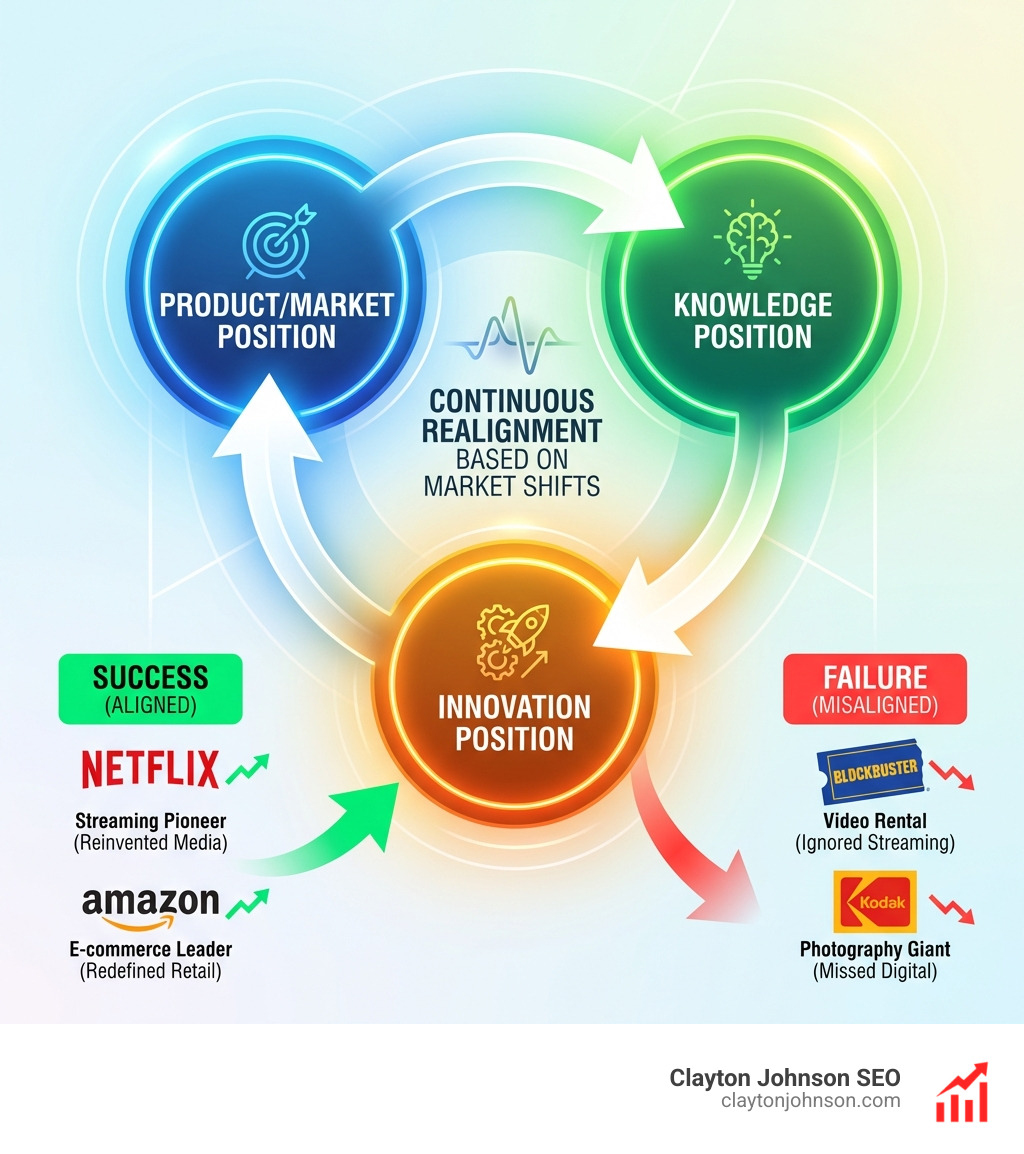
- Strategic Positioning = The alignment of three core elements: product/market position (what you offer and to whom), knowledge position (what you know that competitors don’t), and innovation position (how you create and capture value)
- Why it matters = 88% of leading innovators embed innovation in their top three strategic priorities, and companies that align all three positions achieve sustained revenue growth and market leadership
The difference between companies that sprint to industry leadership and those that stagnate is stark. Some businesses—Apple willing smartphones into existence, Netflix transforming media consumption, Amazon redefining retail—continuously reinvent themselves through value innovation. They don’t just improve incrementally; they fundamentally shift how entire markets operate.
Yet most organizations struggle. After a decade of downsizing and intense competition, profitable growth remains elusive. Senior executives find it difficult to conceptualize strategic adjustments and explain them to employees, leading to confusion about objectives and fragmented execution. The root problem? They treat innovation as a department rather than a strategy, and they focus on product positioning alone while ignoring the knowledge and innovation dimensions that truly differentiate market leaders.
As generations-old business models collapse across retail, financial services, and countless other sectors, companies must continuously adjust their strategic positioning to survive. This isn’t about prediction—it’s about positioning: building resilience, preserving flexibility, and moving with purpose in an extraordinarily unpredictable environment.
I’m Clayton Johnson, and I’ve spent years building structured SEO and growth systems that help companies operationalize strategy through measurable frameworks. Strategic Innovation & Positioning sits at the core of my work—translating complex competitive dynamics into actionable systems that drive compounding growth.
Defining Strategic Innovation & Positioning
To master Strategic Innovation & Positioning, we first have to clear up some common jargon. Most people think “innovation” means a better widget, but in a strategic context, it’s about the fundamental logic of your business.
Value Innovation: Making Competitors Irrelevant
At its heart, strategic innovation is about “Value Innovation.” Conventional strategy tells us to beat the competition by being slightly better or cheaper. Value innovation, however, focuses on making the competition irrelevant by creating a leap in value for buyers and your company. Instead of fighting for a slice of an existing pie, you bake a whole new pie.
Incremental vs. Disruptive vs. Strategic Innovation
We often see companies get stuck in the “incremental” trap. Here is how they differ:
- Incremental Innovation: Small, continuous improvements to existing products (e.g., adding a fifth blade to a razor).
- Disruptive Innovation: Introducing a simpler, cheaper solution that targets underserved customers or “non-consumers” at the low end of the market, eventually moving up to displace incumbents.
- Strategic Innovation: A deliberate, process-based approach to changing the rules of the game. It often involves Disruptive Innovation Strategy but goes further by aligning the entire business model with a new market reality.
The “Jobs-to-be-Done” Framework
Why do customers buy? They don’t just buy products; they “hire” them to do a job. If we understand the fundamental problem a customer is trying to solve, we can identify disruptive opportunities that incumbents—who are too focused on their existing product features—completely miss.
Before you can innovate, you need a clear picture of where you stand. This requires deep Market Analysis to understand the forces at play in your specific industry.

The Triple Alignment of Product, Knowledge, and Innovation
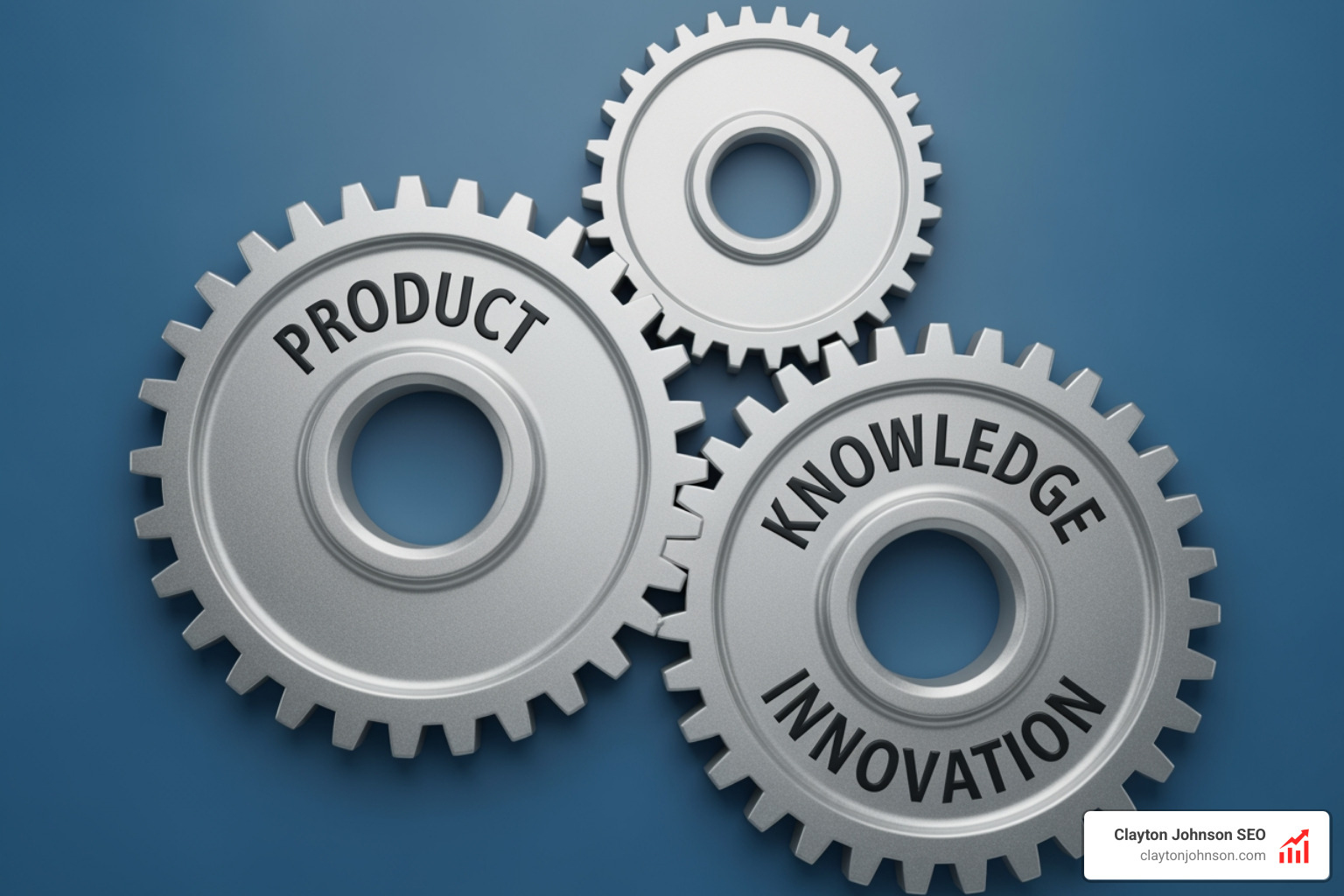
Most companies fail because they only focus on one piece of the puzzle: what they sell. But research shows that truly successful Strategic Innovation & Positioning requires the alignment of three distinct gears.
1. Product/Market Positioning
This is the visible part of the iceberg. It’s who your customers are and what you offer them. For example, Porsche positions itself for wealthy enthusiasts, while Kia positions itself for value-conscious drivers.
2. Knowledge Positioning
This is the hidden part of the iceberg. It’s what your organization knows. Knowledge isn’t just “data”; it’s the unique insights and capabilities that allow you to execute your strategy. We often see “knowledge competitors” who don’t sell the same product as you but have the same expertise—and they are often your biggest stealth threats. Think of how food companies and pharmaceutical companies now compete over “functional foods” like cholesterol-lowering spreads.
3. Innovation Style
How do you innovate? Is it internal R&D, or do you collaborate with customers? Is it radical or incremental? Your innovation style must support your product and knowledge positions.
Closing the Strategic Knowledge Gaps
A “strategic knowledge gap” occurs when there is a mismatch between what you need to know to execute your strategy and what you actually know. A classic example is a photography company that understands chemistry but fails because it lacks knowledge in digital imaging. To avoid this, you must conduct a thorough SWOT Analysis that looks at your internal knowledge assets as much as your external threats.
By Integrating Innovation Style and Knowledge Into Strategy, we ensure that our innovation efforts aren’t just “shots in the dark” but are backed by the capabilities needed to win.
Building a Process-Driven Innovation Engine
One of the biggest myths in business is that innovation is the result of a lone “hero” or a sudden “eureka” moment. In reality, leading innovators treat it as a disciplined process.
Sustaining vs. Disruptive Innovation: A Comparison
| Feature | Sustaining Innovation | Disruptive Innovation |
|---|---|---|
| Target Audience | Existing, profitable customers | Underserved or “low-end” customers |
| Product Performance | Higher performance, more features | “Good enough” performance, simpler |
| Business Model | High margins, established processes | Low margins, high volume, new processes |
| Risk Profile | Lower (predictable returns) | Higher (initially uncertain) |
The 10-Step Strategic Innovation Process
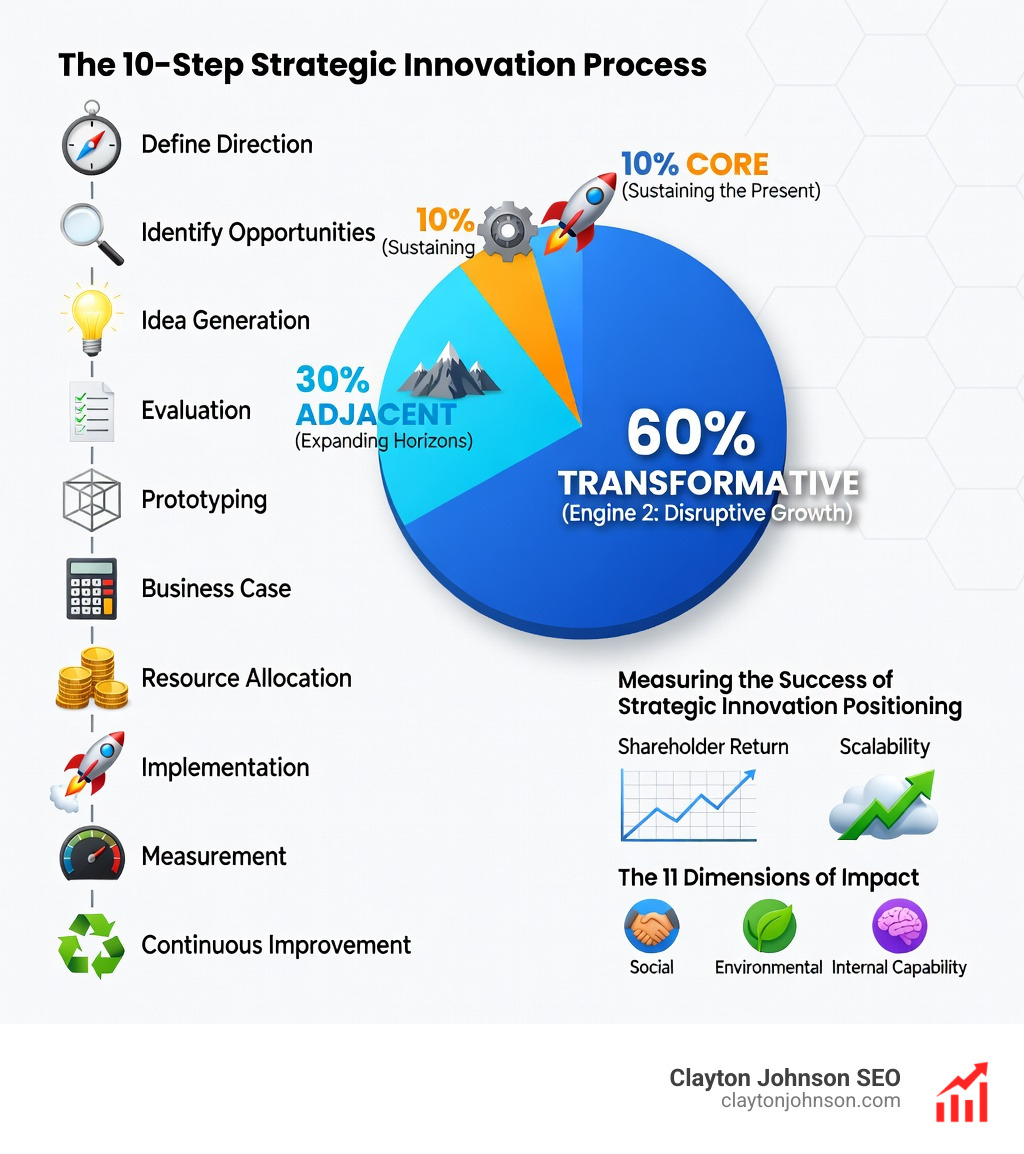
To move beyond “Innovation Theater”—where companies hold hackathons and pitch days that lead nowhere—we recommend a structured 10-step approach:
- Define Direction: Set clear strategic goals.
- Identify Opportunities: Use “Jobs-to-be-Done” to find gaps.
- Idea Generation: Foster bottom-up creativity.
- Evaluation: Screen ideas for feasibility and alignment.
- Prototyping: Build minimum viable products (MVPs).
- Business Case: Develop the profit formula.
- Resource Allocation: Move the money where it matters.
- Implementation: Execute with agility.
- Measurement: Track KPIs beyond just ROI.
- Continuous Improvement: Iterate based on feedback.
Out-Allocating the Competition
Leading innovators don’t necessarily outspend their rivals on R&D they out-allocate them. While the average company spends most of its budget on sustaining its core business, the top innovators devote more than 60% of their R&D to transformative or disruptive innovation. This is what we call “Engine 2” growth—building the future while running the present.
For those looking to digitize this process, we often use Digital Innovation via the Business Model Canvas to map out how new ideas affect every part of the organization.
Measuring the Success of Strategic Innovation Positioning
How do you know if your efforts are actually working? We can’t just look at next quarter’s revenue. We use a multi-dimensional impact assessment:
- Shareholder Return: 8 out of 10 top innovators outperform their sector in total shareholder return.
- Scalability: Can the new business model grow without a linear increase in costs?
- The 11 Dimensions of Impact: This includes measuring things like social impact, environmental sustainability, and internal capability building.
- Speed to Market: How quickly can you go from “idea” to “prototype”?
Effective Strategic Design ensures that these metrics are baked into the project from day one.
Navigating Uncertainty and Disruptive Shifts
Uncertainty is the only constant. Whether it’s tariffs, AI, or shifting consumer habits, we have to move away from “predicting” and toward “positioning.”
Defining Your Strategic Posture
When the future is foggy, you have to decide how you will lean. We categorize strategic moves into three buckets:
- No-Regrets Moves: Actions that make sense regardless of how the future unfolds (e.g., improving operational efficiency).
- Options: Small investments that give you the right, but not the obligation, to move quickly later (e.g., a pilot program in a new market).
- Big Bets: Large-scale commitments that involve high risk but high reward (e.g., building a new factory for an unproven technology).
Scenario Planning and Resilience
Instead of one “official” forecast, we use scenario planning to pressure-test our assumptions. We ask: “Where are we exposed?” and “What happens if our core assumptions are wrong?” This helps us build a organization that doesn’t just survive Competitive Pressure but thrives because of it.
For a deeper dive into these frameworks, we highly recommend the classic Strategy Under Uncertainty research.

The Role of Leadership in Strategic Innovation Positioning
Leadership is the “secret sauce” of innovation. Expert Bill Fischer notes that adopting an “outside-in” innovation mindset is a leadership question, not a technical question.
Innovation Doctrines
Fischer recommends developing “innovation doctrines”—shared principles that create the conditions for breakthroughs. This means moving away from a “hero” culture where only the CEO has the big ideas, and toward a culture where everyone is empowered to challenge assumptions.
Psychological Safety
Academic research on innovation culture shows that psychological safety is the #1 predictor of team success. If people are afraid to fail, they will never suggest the “crazy” ideas that lead to Strategic Innovation & Positioning breakthroughs.
Frequently Asked Questions about Strategic Innovation
What is the difference between strategic and incremental innovation?
Incremental innovation makes a better version of what you already have. Strategic innovation changes the business model or the market logic entirely to create a new competitive advantage.
How do you identify a strategic knowledge gap?
Look at your desired product/market position and list the capabilities required to win there. If your current team lacks those skills or insights, you have a gap.
Why do most innovation initiatives fail?
Usually, it’s because of “Innovation Theater” (focusing on optics over outcomes) or a lack of alignment between the innovation project and the company’s core strategic posture.
Conclusion: Turning Strategy into Growth
Strategic Innovation & Positioning isn’t a one-time event; it’s a continuous cycle of evolution. When 94% of leading innovators are planning to enter new sectors, sitting still is the riskiest move you can make.
At Clayton Johnson SEO, we help founders and marketing leaders move beyond “ticking boxes.” We provide the actionable frameworks and interactive tools needed to diagnose growth problems, choose a winning strategy, and execute with measurable results. Whether you’re looking for an SEO Consultant to dominate search or a growth strategist to rethink your market positioning, we’re here to help you build a business that is both different and better.
Let’s stop trying to beat the competition. Let’s make them irrelevant.