The Best AI SEO Workflow Systems for Modern Marketers

Why Modern Teams Need AI SEO Workflow Systems
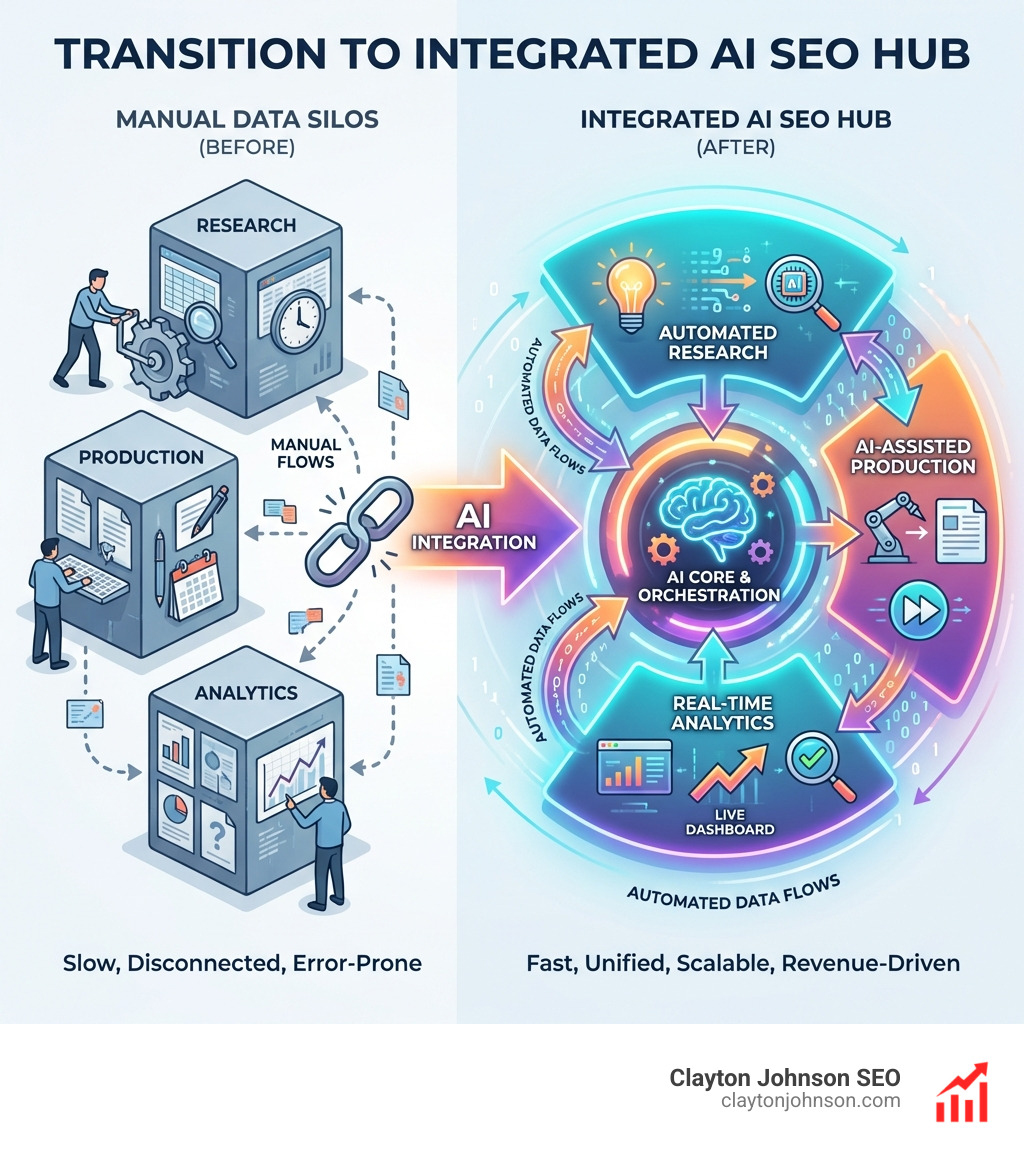
AI SEO workflow systems are structured, repeatable operating models that use artificial intelligence to automate and accelerate every stage of SEO — from keyword research and content briefs to technical optimization and performance reporting.
Here is a quick breakdown of how they work:
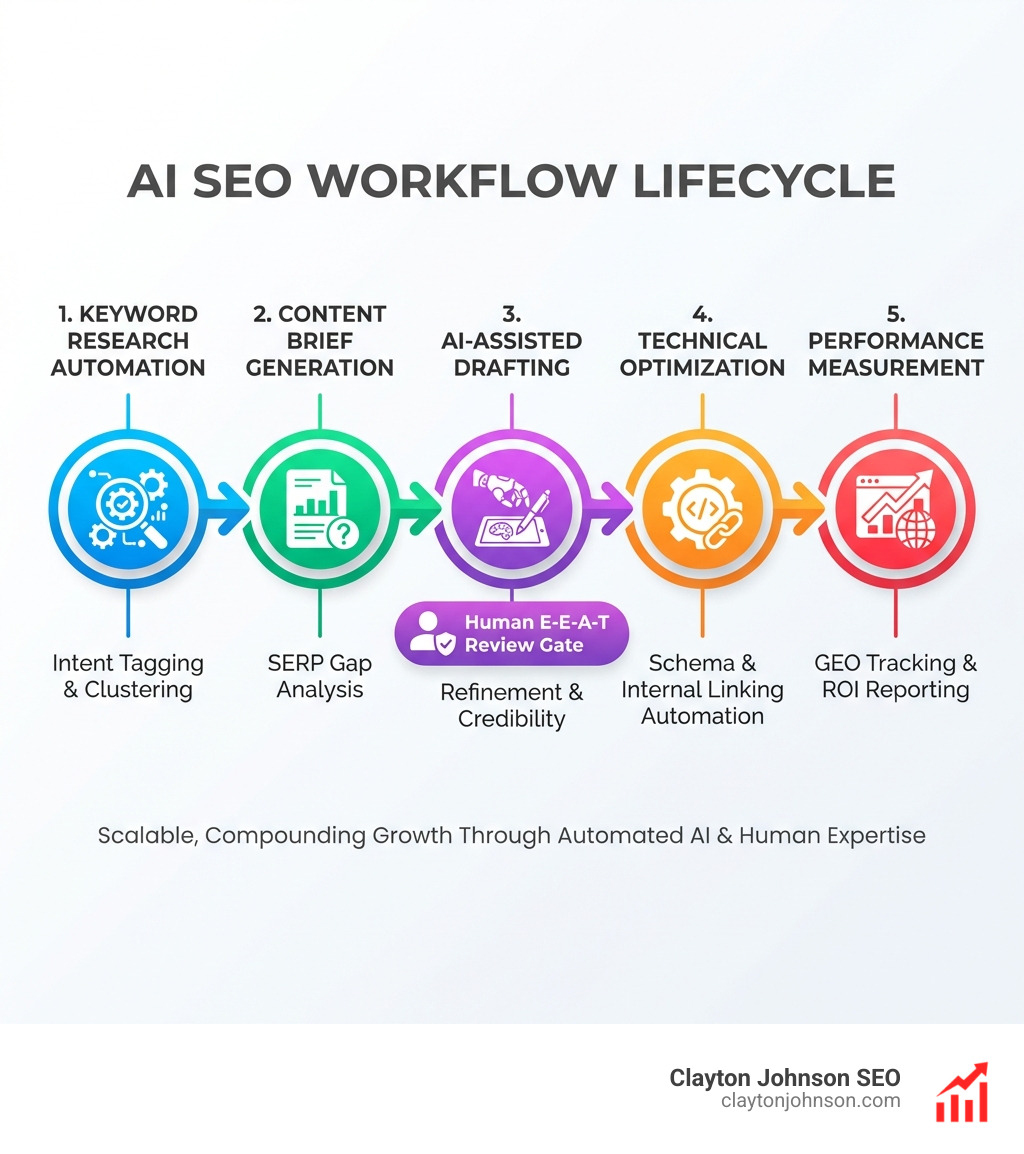
- Research — AI expands seed keywords, clusters by intent, and scores opportunities automatically
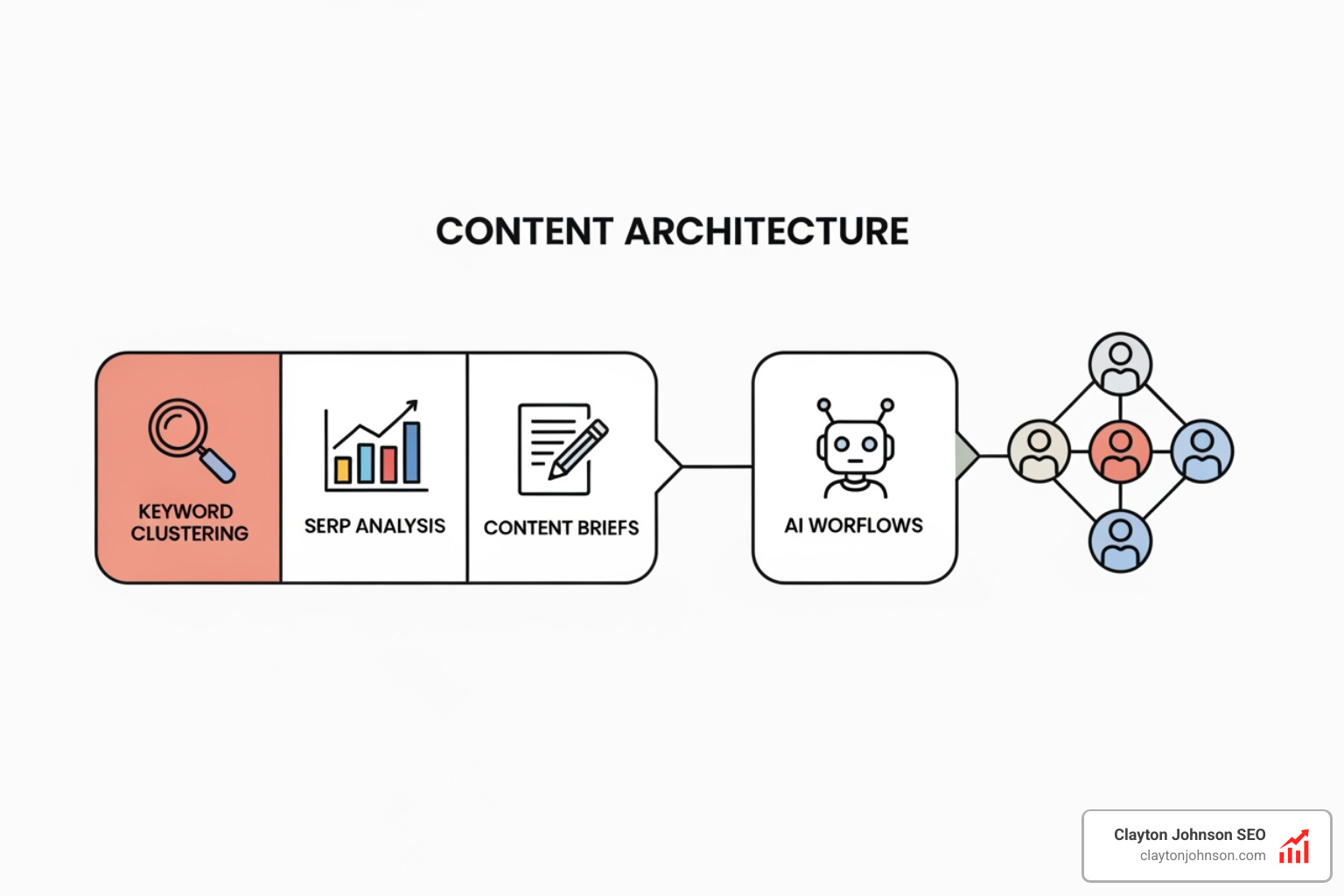
- Planning — AI generates data-backed content briefs with SERP gap analysis built in
- Production — AI drafts content frameworks; humans refine for brand voice and E-E-A-T depth
- Optimization — AI automates schema, internal linking, and indexing tasks
- Measurement — AI surfaces performance signals, content decay, and ROI attribution in real time
The result: faster publishing, fewer bottlenecks, and SEO that compounds instead of stalls.
Most SEO teams are not losing because of bad strategy. They are losing because of broken execution.
Marketing teams publish content. Developers push updates. Calendars stretch across quarters. Yet months later, pages sit on page three while competitors hold the top spots. The gap is not strategy or talent — it is execution.
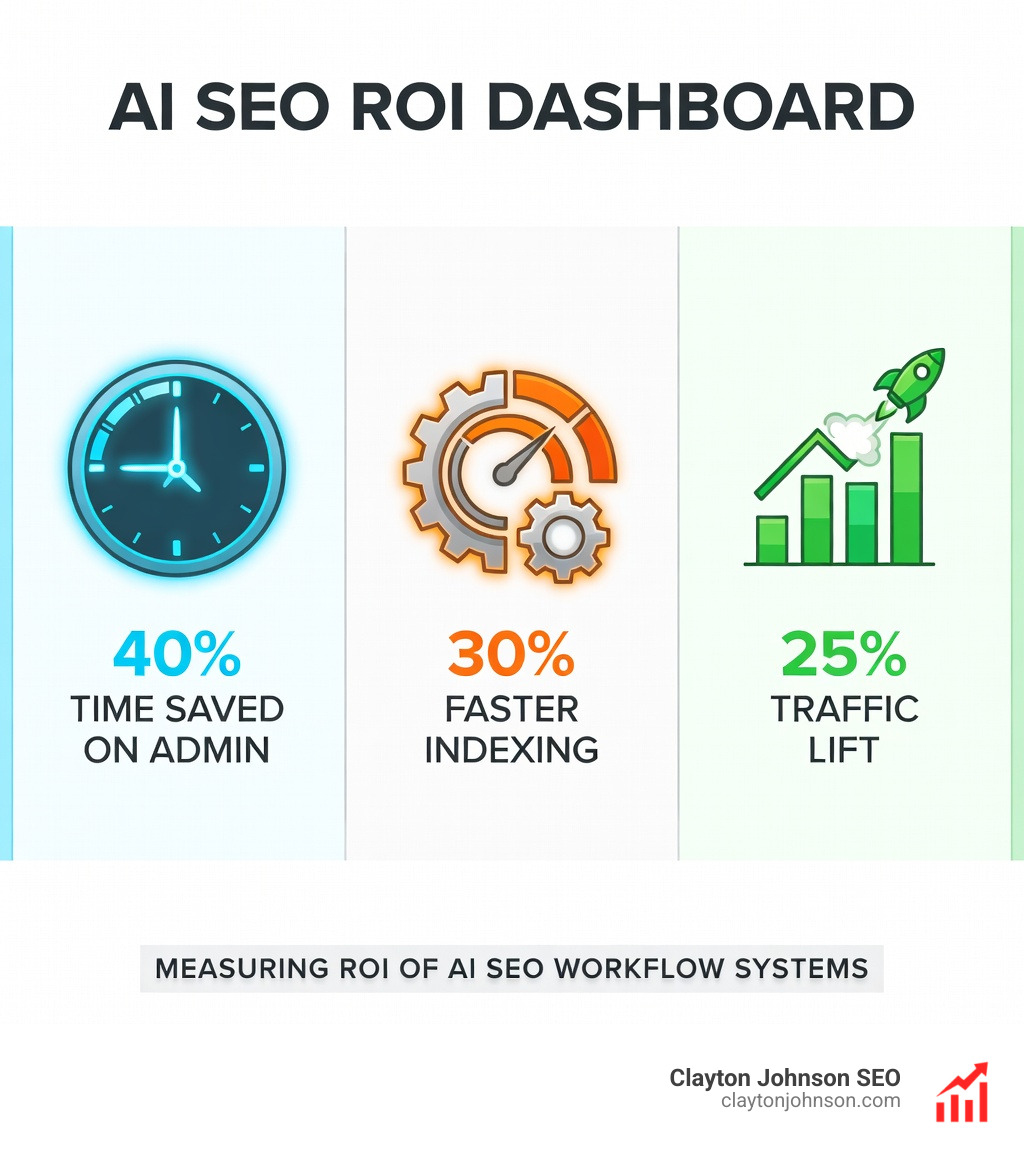
Manual SEO workflows simply do not scale. Research takes hours. Briefs take days. And by the time a page publishes, the SERP has already shifted. Consider this: workflow automation can reclaim up to 40% of SEO specialists’ time spent on administrative tasks. Pages launched with structured, AI-assisted briefs index 30–40% faster and require fewer post-publish revisions.
AI SEO workflow systems solve this by turning fragmented SEO tasks into a coordinated, largely automated operating model — without removing the human judgment that makes content credible.
I’m Clayton Johnson, an SEO strategist and growth operator specializing in building AI SEO workflow systems that transform fragmented marketing efforts into scalable, compounding growth engines. I architect taxonomy-driven content systems, AI-augmented workflows, and structured SEO frameworks for founders and marketing leaders who need measurable results, not vanity metrics.
Key ai seo workflow systems vocabulary:
- AI assisted SEO workflows
- SEO AI workflow automation
- AI SEO strategy framework
Search has moved beyond the “ten blue links.” Today, we are navigating a landscape dominated by AI Overviews, hyper-personalization, and conversational queries. According to McKinsey research, marketing and sales use cases account for 40% of the total value captured by generative AI. For SEO teams, this value isn’t just in writing text; it’s in solving the “execution gap.”
Traditional workflows are often plagued by operational friction. A specialist finds a keyword, a manager approves it, a writer drafts it, and an editor reviews it—all in separate silos. By the time that content is live, a competitor has already published five better-optimized pieces.
Modern ai seo workflow systems provide the speed and scale necessary to compete. We are seeing teams that deploy these systems report a 40% rise in productivity within the first year. This shift allows an SEO consultant to move from being a “task doer” to a “system architect.”
| Feature | Manual SEO Workflow | AI-Assisted SEO Workflow |
|---|---|---|
| Brief Creation | 2–3 hours per brief | 30 minutes or less |
| Keyword Clustering | Manual spreadsheet sorting | Automated semantic grouping |
| Review Cycles | 3–5 days | 1–2 days |
| Time-to-Publish | 2+ weeks | 3–5 days |
| Scalability | Linear (more people needed) | Exponential (system-driven) |
Core Components of a Scalable SEO Operating Model
To build a system that actually drives revenue, we focus on four primary pillars:
- Intent Modeling: Moving beyond “high volume” to “high intent.” AI classifies keywords into Informational, Commercial, or Transactional buckets instantly.
- Semantic Clustering: Grouping keywords by topical meaning rather than exact-match stems. This prevents cannibalization and builds topical authority.
- Entity-Based Hubs: Structuring your site around “entities” (concepts) that AI search engines can easily parse and cite.
- Governance Gates: Human-in-the-loop checkpoints that ensure brand voice and E-E-A-T (Experience, Expertise, Authoritativeness, Trustworthiness) remain intact.
PwC’s AI Predictions highlight that 73% of executives who adopted AI in marketing realized a positive ROI in under 12 months. This is only possible when you treat SEO content marketing as a structured infrastructure rather than a series of one-off blog posts.
Automating Keyword Research within AI SEO Workflow Systems
The foundation of any great system is data. We no longer spend days staring at spreadsheets. Instead, we use tools like the Ahrefs AI Content Helper and custom agents to automate the heavy lifting.
- Seed Expansion: AI takes a single “seed” concept and generates hundreds of long-tail variations based on real user questions.
- Opportunity Scoring: We use a formula (OpScore) that balances search volume, business value, and difficulty to tell us exactly which clusters to prioritize.
- Similarity Thresholds: By setting a clustering similarity of 0.75 to 0.80, we ensure that our content covers an entire topic without overlapping with other pages.
Content Planning and Brief Generation
A content brief is the “blueprint” for your page. If the blueprint is flawed, the house will fall. AI seo workflow systems use data-driven briefs that pull directly from current SERP leaders.
Using Clearscope, we can analyze the top-ranking competitors to see exactly which subtopics they cover and which “gaps” they’ve missed. This allows us to create content that isn’t just “more text,” but “more valuable text.” The AI identifies missing entities and suggests the ideal word count and heading structure to satisfy both users and search algorithms.
Top Tools for Integrated AI SEO Workflow Systems
Building a workflow requires an orchestration layer—a way to make different tools “talk” to each other. Here are the heavy hitters currently leading the market:
- Writesonic: An all-in-one platform for researching, writing, and optimizing content. It’s particularly strong for teams that need to produce high volumes of factual, SEO-ready drafts quickly.
- AirOps: This is the “Swiss Army Knife” of SEO automation. It allows you to build custom workflows that connect your brand kit to live SERP data. You can automate everything from brand audits to content gap analysis.
- SE Ranking: A comprehensive suite that includes a powerful AI Overview tracker. It helps you see not just where you rank in the “ten blue links,” but whether you are appearing in Google’s AI-generated summaries.
- Alli AI: Focuses on “on-page” automation. It can scan your site and apply technical fixes (like meta tags or schema) across thousands of pages in minutes.
- Surfer SEO: The gold standard for real-time content optimization. Its AI analyzes the SERP to give you a “score” and a list of terms to include as you write.
Technical Optimization and Indexing Automation
The most brilliant content in the world is useless if Google doesn’t index it. Traditional indexing can take weeks. With Indexly, we can automate submissions to the Google Indexing API, often getting new pages discovered in under 30 minutes.
Beyond indexing, we use Linknavigator to automate internal linking. This ensures that every new post is connected to your core “pillar” pages, reducing crawl depth and spreading authority across the site. Automating JSON-LD schema generation is another critical step; it provides the structured data that AI search engines need to understand your entities and include you in AI Overviews.
Measuring ROI of AI SEO Workflow Systems
You cannot manage what you cannot measure. Modern reporting has moved beyond simple rank tracking. We use Whatagraph to build unified dashboards that pull data from GSC, Ahrefs, and your CRM.
Agencies like Maatwerk Online have reported saving 100 hours a month on reporting by using AI to summarize performance and surface insights. Additionally, Rankscale.ai allows us to track “GEO” (Generative Engine Optimization) metrics—showing us how often we are cited in Perplexity or ChatGPT.
Maintaining Quality with Human-in-the-Loop Governance
The biggest mistake teams make is hitting “generate” and “publish” without a human check. AI is a “drafter,” not a “publisher.” To maintain E-E-A-T and avoid the dreaded “AI hallucination,” you must implement review gates.
For instance, the team at Opinion Stage uses AI to audit existing pages and identify gaps, but the final polish is always handled by a subject matter expert (SME). This ensures that the content includes:
- Real-world anecdotes and case studies.
- Unique brand “hooks” and tone.
- Verified facts and citations.
- Internal expert opinions that AI cannot replicate.
By using a “Human-AI collaboration” model, you get the speed of the machine with the soul of the expert.
Frequently Asked Questions about AI SEO Workflows
Can AI SEO replace human experts entirely?
No. While AI can automate 80% of the workload (research, clustering, drafting), it lacks the strategic intuition, empathy, and unique experience of a human expert. AI provides the “leverage,” but humans provide the “clarity” and “direction.”
How long does it take to see results from automated workflows?
Workflow efficiency is immediate—you’ll notice time savings in week one. Ranking and traffic gains typically follow within 4 to 12 weeks as your increased publishing velocity and topical depth begin to compound in the eyes of search engines.
What are the common pitfalls in implementing AI SEO systems?
The most common pitfall is “over-automation”—relying too heavily on AI-generated text without human oversight. Other issues include using poor-quality data sources, failing to update prompts, and neglecting technical SEO basics like site speed and mobile-friendliness.
Conclusion
The future of search belongs to those who build systems, not just those who write articles. AI seo workflow systems are the infrastructure that allows modern marketers to scale their expertise, dominate topical clusters, and remain visible across both traditional and generative search engines.