Why a Pay Per Click Advertising Strategy Is Your Fastest Path to Measurable Growth
A strong pay per click advertising strategy can put your brand in front of high-intent buyers almost instantly — no waiting months for SEO to kick in.
Here’s what an effective PPC strategy looks like at a glance:
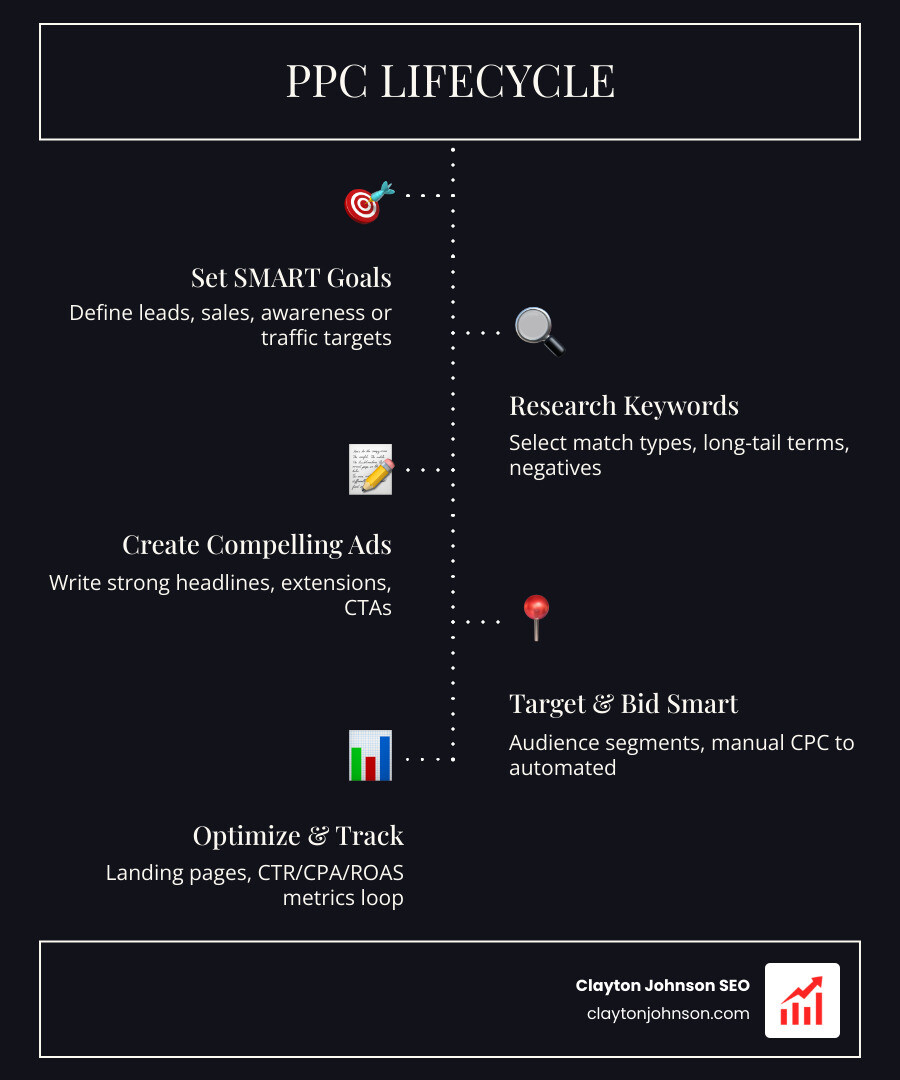
- Define SMART goals — leads, sales, awareness, or traffic
- Research keywords — match types, long-tail terms, negative keywords
- Build compelling ads — strong headlines, extensions, clear CTAs
- Target the right audience — demographics, geography, remarketing
- Set smart bids and budgets — manual CPC to start, automated as data grows
- Optimize landing pages — message match, fast load, mobile-ready
- Track and iterate — CTR, CPA, ROAS, Quality Score, conversion rate
The numbers back it up. Businesses earn an average of $2 for every $1 spent on Google Ads — and some campaigns return as high as $8 per dollar. Google commands over 90% of global search market share, making it the dominant arena for paid search.
But here’s the catch: most businesses waste their budget by jumping in without a real system.
Clicks are easy to buy. Profitable clicks require architecture.
Without a structured strategy, PPC quickly becomes an expensive guessing game — high spend, low return, no clear path forward. That’s not a budget problem. It’s a strategy problem.
I’m Clayton Johnson — SEO strategist and growth architect behind Demandflow. I’ve built and optimized pay per click advertising strategies across competitive markets, aligning paid channels with content systems and demand infrastructure to drive compounding, measurable results. This guide gives you the exact framework I use — built for founders and marketing leaders who want leverage, not guesswork.
The Mechanics of PPC: Auctions, Quality Score, and Ad Rank
To master a pay per click advertising strategy, we first need to understand that we aren’t just “buying” space. We are participating in a high-speed, algorithmic auction that happens in milliseconds every time a user hits “Enter” on a search bar.
How the Auction Works
Unlike a traditional auction where the highest bidder always wins, the Google Ads auction rewards relevance. It’s part of the broader search engine marketing (SEM) basics that balance user experience with advertiser goals.
When a search occurs, Google looks at all eligible advertisers and calculates an Ad Rank. This score determines where your ad appears (or if it appears at all). Ad Rank is primarily driven by:
- Your Bid: The maximum amount you’re willing to pay for a click.
- Quality Score: A metric (1-10) that measures the relevance of your keywords, ad copy, and landing page.
- Ad Extensions & Context: The expected impact of your ad formats and user signals like location, device, and time of day.

The Power of Quality Score
Quality Score is the “great equalizer.” A high Quality Score can actually allow you to rank higher than a competitor who is bidding more money. This is why we view PPC as one of our Digital Marketing Pillars; it rewards those who provide the best answer to the user’s question.
- CPC (Cost Per Click): Most search ads use this model. You only pay when someone actually interacts.
- CPM (Cost Per Mille): Common in display ads, where you pay per 1,000 impressions.
By focusing on auction-time signals and user context, we ensure our ads aren’t just seen—they’re clicked by the right people at the right moment.
Building Your Pay Per Click Advertising Strategy: A Step-by-Step Framework
Jumping into an ad dashboard without a plan is like throwing your marketing budget into a black hole. We use a structured framework to ensure every dollar is an investment in data and growth. Our Paid Advertising Services are built on this very foundation.
Choosing Your Ad Type
Not all ads are created equal. Depending on where your customer is in the funnel, you’ll choose different formats:
| Ad Type | Best For | Key Characteristic |
|---|---|---|
| Search Ads | High-intent sales/leads | Text-based; appears on SERPs |
| Display Ads | Awareness/Remarketing | Visual banners on websites |
| Shopping Ads | E-commerce sales | Features product image and price |
Defining Goals for Your Pay Per Click Advertising Strategy
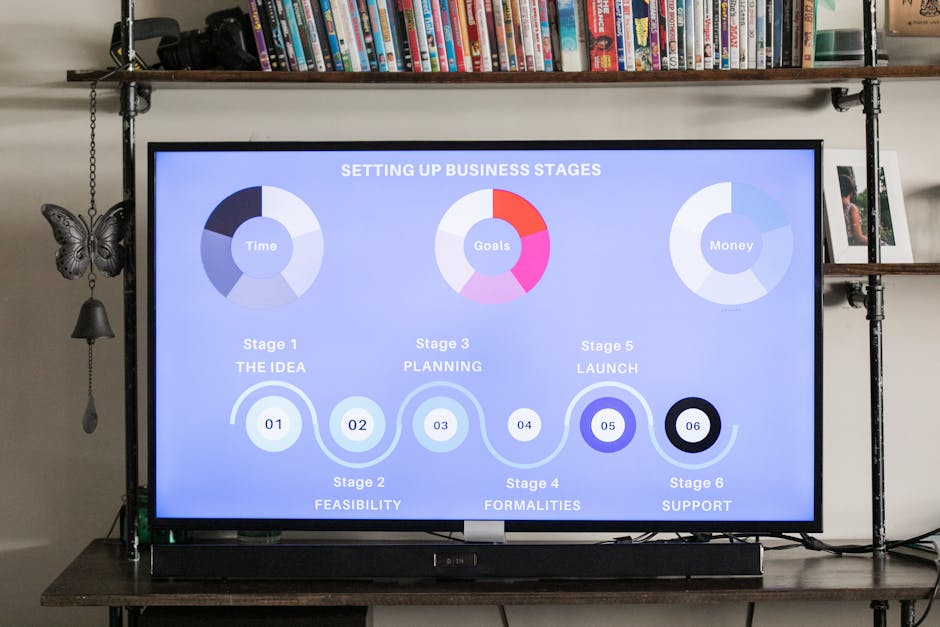
Every successful campaign starts with a SMART goal. “I want more sales” is a wish; “I want to generate 75 qualified leads per month at a CPA under $65” is a strategy.
Whether you are focused on lead generation or building a brand awareness engine, your goals must align with your business objectives. For many of our clients, this involves An Essential Guide to Demand Generation to ensure the traffic we buy actually converts into long-term revenue.
Keyword Research and Match Types
Keywords are the bridge between a user’s problem and your solution. We start by brainstorming core topics and then use tools like Google Keyword Planner to find volume and cost data.
To keep your pay per click advertising strategy efficient, you must master match types:
- Broad Match: Reaches the widest audience but can include irrelevant searches.
- Phrase Match: Offers a balance of reach and control.
- Exact Match: The most restrictive and usually the highest converting.
- Negative Keywords: This is your “secret weapon.” By adding Negative Keywords, you prevent your ads from showing for terms like “free,” “cheap,” or “jobs,” saving you from wasting budget on non-buyers.
We also prioritize long-tail keywords. While they have lower search volume, they often have much higher intent and lower competition. Someone searching for “best noise-cancelling headphones under $200” is much closer to buying than someone just searching for “headphones.”
Crafting High-Converting Ad Copy and Landing Pages
Your ad gets the click, but your landing page gets the sale. Following search ads best practices, your copy should be benefit-driven and include emotional triggers.
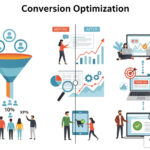
However, the “click” is only half the battle. We integrate Growth Systems: Conversion Optimization to ensure a seamless “message match.” If your ad promises a “50% discount on Strollers,” but the landing page shows “Full Price Cribs,” the user will bounce instantly.
Landing Page Essentials:
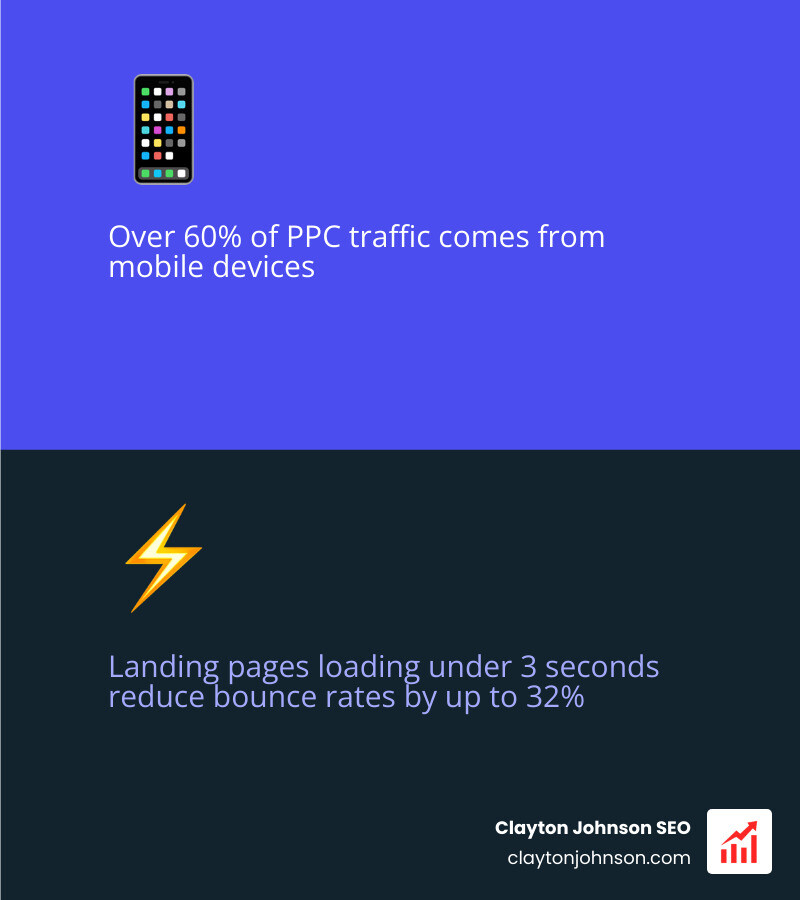
- Mobile Optimization: Over 60% of PPC traffic comes from mobile devices. If your page takes more than 3 seconds to load, you’re losing money.
- Clear CTA: Don’t make them hunt for the “Buy” or “Sign Up” button.
- Trust Signals: Include testimonials or reviews to reduce friction.
Advanced Optimization: Bidding, Targeting, and Metrics
Once your campaigns are live, the real work begins. A “set-and-forget” approach is the fastest way to fail. We use Traffic Strategy Frameworks to navigate the road to high performance.
Bidding Strategies: Manual vs. Automated
For beginners, we often recommend Manual CPC. It gives you the most control and teaches you the “feel” of the market. However, once you reach 15-20 conversions per month, Automated Bidding (or Smart Bidding) can leverage AI to optimize for conversions or ROAS (Return on Ad Spend) in real-time.
Audience Remarketing
Remarketing is one of the most profitable parts of a pay per click advertising strategy. It targets people who have already visited your site but didn’t convert. Remarketing campaigns often achieve 50-100% higher conversion rates than cold traffic because you are speaking to a “warm” audience.

Key Metrics to Track
You can’t manage what you don’t measure. Focus on these KPIs:
- CTR (Click-Through Rate): 6-7% is a solid benchmark for search.
- CPA (Cost Per Acquisition): How much does it cost to get one customer?
- ROAS: A 4:1 ratio is generally considered a healthy baseline.
- Quality Score: Keep this high to keep your costs low.
Scaling Your Pay Per Click Advertising Strategy
Scaling isn’t just about spending more money; it’s about finding more leverage. We look at Growth Systems: Traffic Generation to expand into new keywords, audiences, and platforms like Microsoft Advertising or Amazon PPC.
Platform Nuances and Common Mistakes to Avoid
Every platform has its own “personality.”
- Google Ads: The gold standard for search intent.
- Amazon PPC: Crucial for e-commerce, where we focus on TACoS (Total Advertising Cost of Sales) to drive organic growth.
- Microsoft Advertising: Often overlooked, but it commands nearly 30% of US desktop search traffic and usually offers lower CPCs.
Common Pitfalls
- Ignoring Negative Keywords: You’ll end up paying for “window shoppers.”
- Poor Mobile UX: If your site isn’t mobile-friendly, you’re lighting money on fire.
- The “Set-and-Forget” Trap: PPC requires weekly, if not daily, refinement.
- No Conversion Tracking: If you don’t know which keyword led to the sale, you can’t optimize.
Frequently Asked Questions about Pay Per Click Advertising Strategy
What is the difference between PPC, SEO, and SEM?
Think of SEO as a marathon and PPC as a 500-meter dash. SEO builds long-term organic authority, while PPC provides instant visibility. SEM (Search Engine Marketing) is the umbrella term that includes both.
How much should a small business spend on PPC?
The beauty of PPC is that there is no minimum. You can start with as little as $5-$10 a day. We recommend starting with a modest budget to test your keywords and landing pages before scaling.
Why is Quality Score important for my ad costs?
Quality Score directly impacts your Ad Rank and your actual CPC. A higher Quality Score means you pay less for a better position. It’s Google’s way of rewarding advertisers who provide a great user experience.
Conclusion
A winning pay per click advertising strategy is more than just a series of ads; it is a structured growth architecture. By aligning your bids, keywords, and landing pages with clear business goals, you create a system that doesn’t just spend money—it generates revenue.
At Clayton Johnson and Demandflow.ai, we believe that clarity leads to structure, and structure leads to compounding growth. If you’re ready to stop guessing and start growing, explore our Paid Advertising Services to see how we can build your high-performance PPC blueprint.