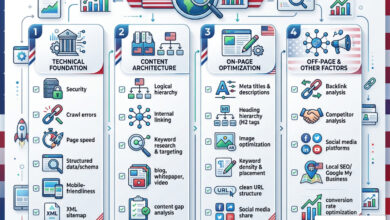
The Giant’s Guide to Enterprise Level SEO Fundamentals


What Enterprise SEO Optimization Actually Means (And Why It’s Different)
Enterprise SEO optimization is the practice of managing search engine optimization at massive scale — across thousands or even millions of web pages, multiple teams, and complex technical systems — to drive organic visibility, qualified traffic, and measurable revenue growth.
Here’s a quick breakdown of what sets it apart:
- Scale — Enterprise sites manage thousands to millions of pages across multiple domains
- Complexity — Changes require coordination across engineering, legal, marketing, and product teams
- Governance — Systems and standards must be built so SEO works by default, not by individual effort
- Tooling — Dedicated platforms (costing $30,000–$200,000+ per year) replace basic SEO tools
- ROI focus — Success is measured in organic revenue and pipeline, not just rankings
This is not simply “regular SEO on a bigger website.” It’s a fundamentally different discipline — one where structure, systems, and organizational alignment matter more than any single optimization.
The stakes are real. A single template-level mistake can de-index millions of pages overnight. A poorly executed site migration can wipe out 30–60% of organic traffic. But when enterprise SEO is done right, the returns compound — the most mature programs attribute hundreds of millions in annual organic revenue.
Mastering enterprise seo optimization at Scale
When we talk about an enterprise website, we are essentially talking about what some experts call an “800-pound gorilla.” These are sites that don’t just have a few hundred blog posts; they have tens of millions of pages. At this level, enterprise seo optimization isn’t about tweaking a meta tag on a single page. It’s about building a system where the right meta tags are generated automatically across five million product pages.
To master this, we have to move from “page-level” thinking to “system-level” thinking. In a massive organization, the biggest hurdle isn’t usually a lack of SEO knowledge — it’s the red tape. We have to navigate internal politics, diplomacy, and stakeholder buy-in just to get a single line of code changed.
Success at this scale requires two things: governance and alignment. Governance means setting the rules of the road so that when a developer creates a new page template, it’s already optimized for search. Alignment means making sure the legal team, the product team, and the marketing team are all pulling in the same direction.
The reward for this coordination is massive. Research shows that SEO leads have a 14.6% close rate, which is significantly higher than the 1.7% close rate from outbound leads. In the enterprise world, that 8.5x difference in efficiency can translate to millions of dollars in saved marketing spend. If you want to dive deeper into how we structure these high-level plans, check out more info about enterprise SEO strategy.
Defining the Core Pillars of enterprise seo optimization
To understand how to manage this “gorilla,” we need to look at the three pillars that support every successful enterprise program: scalability, team collaboration, and data management.
- Scalability: We can’t manually optimize a million pages. We use programmatic SEO, template-level enhancements, and automation to ensure every page meets a baseline quality score (aiming for at least 50% or higher).
- Team Collaboration: We often work with remote teams across different time zones. We need clear workflows and a “Single Source of Truth” (like an enterprise SEO platform) so everyone knows what the priorities are.
- Data Management: Enterprise sites generate mountains of data. We aren’t just looking at one keyword; we’re analyzing millions of data points to find patterns in user behavior and competitor movements.
To help visualize the difference between the SEO you might do for a local bakery versus a global tech giant, look at this comparison:
| Feature | Standard (SMB) SEO | Enterprise SEO |
|---|---|---|
| Site Size | 10 – 500 pages | 10,000 – 10,000,000+ pages |
| Primary Focus | Keyword rankings & local traffic | Organic revenue & market share |
| Implementation | Same-day or same-week | 2 – 8 week (or longer) sprint cycles |
| Team Size | 1 person (often part-time) | 5 – 50+ full-time specialists |
| Budget | $1,000 – $10,000 / month | $100,000 – $2.5M+ / year |
| Risk Level | Low | High (Mistakes impact millions in revenue) |
If you’re still getting your feet wet with the basics before tackling the big leagues, you can find more info about core SEO to build your foundation.
Navigating Technical Complexity and Crawl Budget

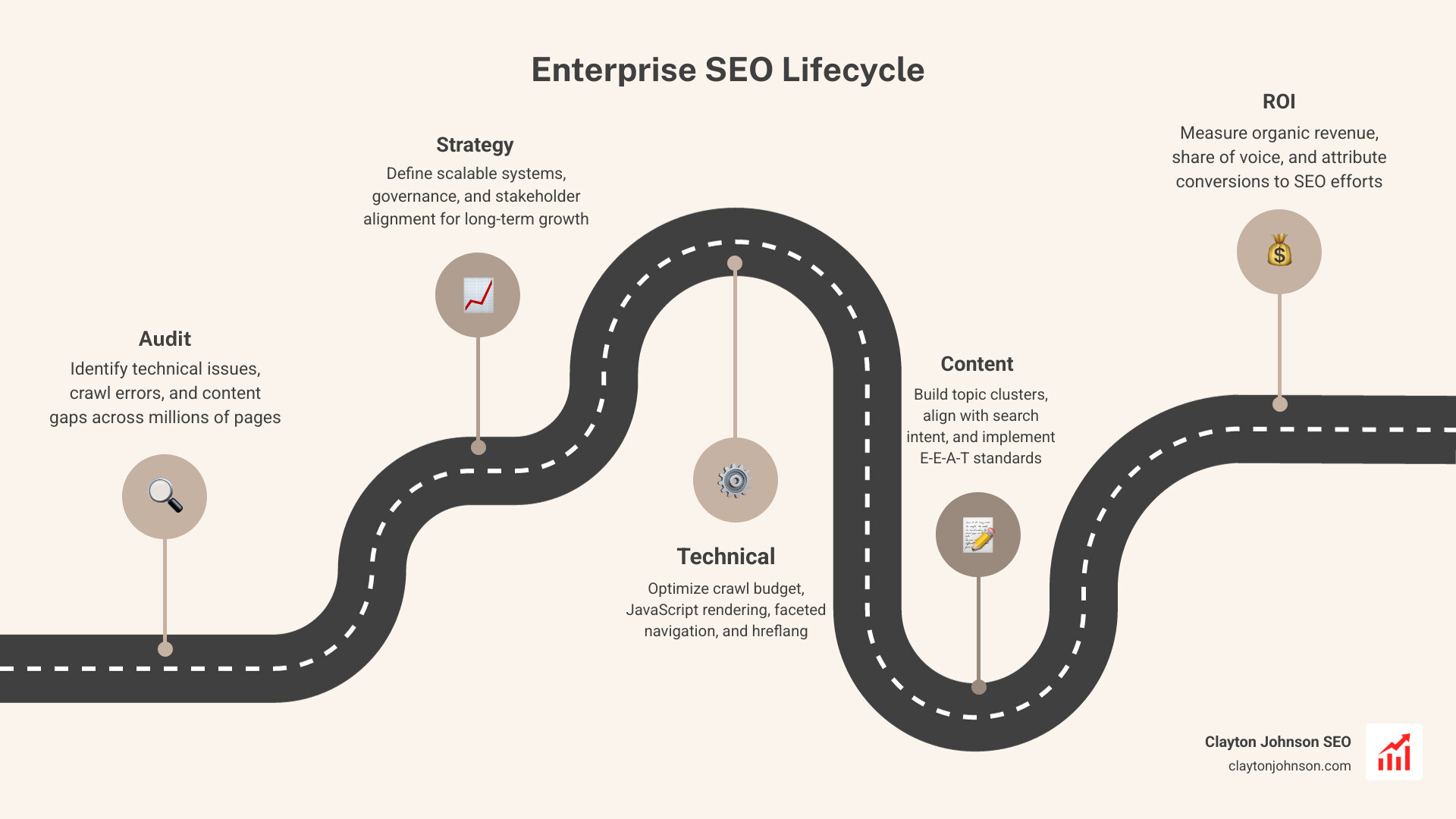
In enterprise seo optimization, technical SEO is the engine room. When you have over a million pages, you have to worry about “crawl budget.” This is the limited amount of time and resources search engines like Google spend on your site. If your site is bloated with low-value pages, Google might never find your most important revenue-generating content.
Common technical “budget-killers” include:
- Faceted Navigation: Those helpful filters on e-commerce sites can create millions of duplicate URLs if not handled with canonical tags or robots.txt directives.
- JavaScript Rendering: Large enterprise stacks often use heavy JS. If Google can’t render it efficiently, your content won’t rank.
- Hreflang Complexity: For global brands, managing language variants is a nightmare. Apple, for example, uses 137 different language/location variations. One mistake here can lead to the wrong version of a site showing up in the wrong country.
We rely heavily on tools like Google Search Console to monitor crawl errors and indexation status. Because the volume of data is so high, we also use more info about AI-driven SEO audits to spot regressions before they become catastrophes.
Strategic Content Operations and AI Integration
Content at the enterprise level isn’t about “blogging.” It’s about content operations. We need a repeatable, quarterly playbook that combines technical foundations with content production.
We focus on:
- Topic Clusters: Building authority by covering a subject exhaustively, rather than just targeting single keywords.
- Search Intent: Mapping keywords to specific stages of the sales funnel (Awareness, Consideration, Decision).
- E-E-A-T: Demonstrating Experience, Expertise, Authoritativeness, and Trustworthiness. This is crucial because Google prioritizes content that feels human and expert-led.
AI is also changing the game. We’re moving toward Generative Engine Optimization (GEO) — optimizing our content so it gets cited by AI answer engines like ChatGPT or Google’s AI Overviews. This requires “entity consistency,” making sure our brand information is the same across the entire web. To see how we use these advanced tools, explore more info about AI SEO services.
Building a Durable Framework for Long-Term Success
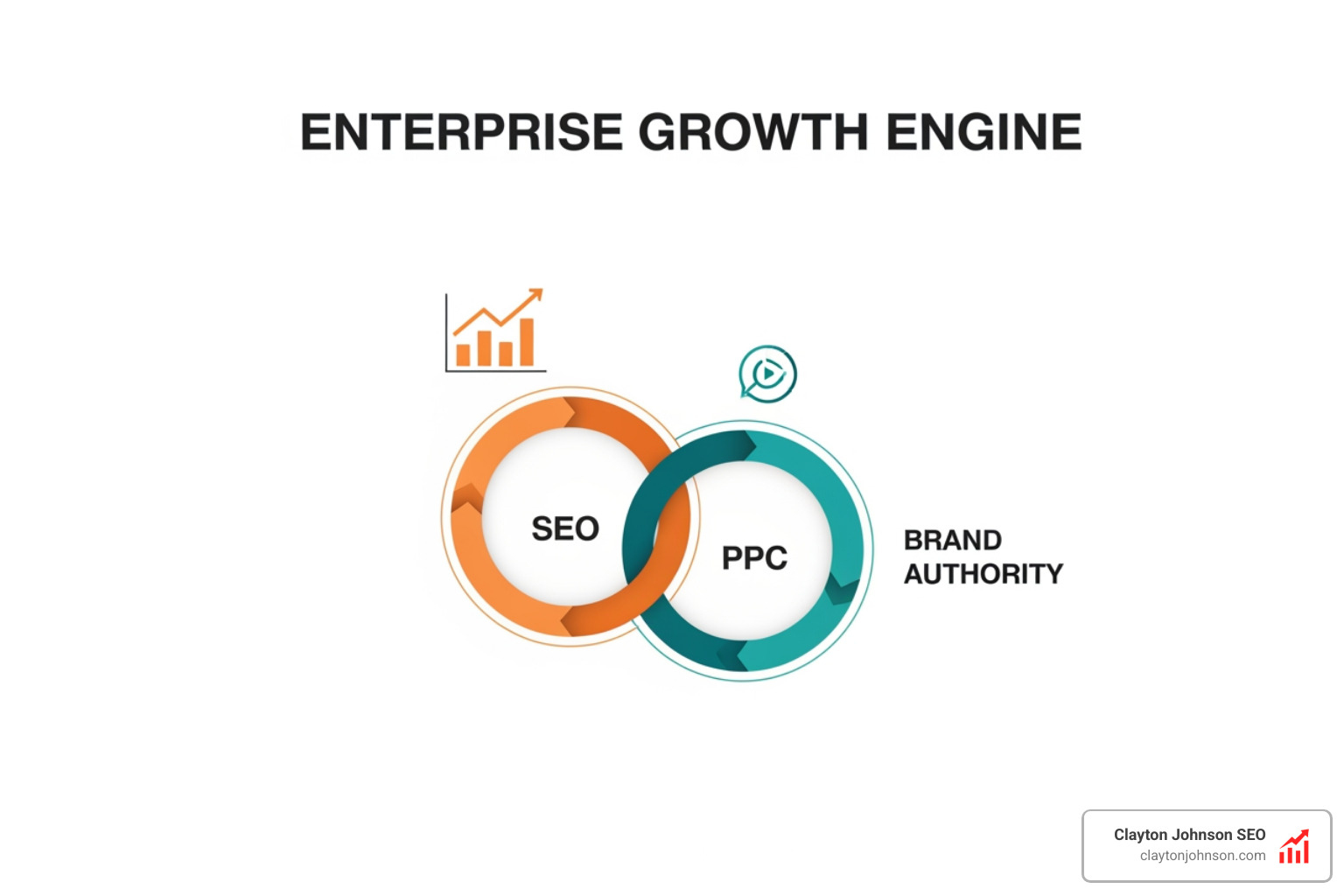
To win at enterprise seo optimization, we can’t just chase the latest algorithm update. We have to build a durable framework. This means treating SEO as a growth engine that compounds over time.
One of our favorite strategies is to productize what works. If a specific type of content performs well for one product line, we build a template to roll that out across every other segment and market. This “template-level” thinking allows us to scale wins without scaling the manual labor.
We also have to integrate SEO with other marketing channels. For instance, we can use PPC data to identify high-converting keywords and then prioritize those for organic optimization. This “consolidated search” approach ensures that we aren’t wasting budget on keywords we already dominate organically. For a look at how we blend these strategies, check out more info about SEO content marketing.
Selecting the Right enterprise seo optimization Platforms
You wouldn’t try to build a skyscraper with a hand-drill, and you shouldn’t try to run enterprise SEO with a basic tool. True enterprise platforms are unified data environments. They connect your technical health, your content performance, and your competitor’s movements into one dashboard.
When we evaluate platforms, we look for:
- Automation: Can it alert us the second a “noindex” tag is accidentally added to a million pages?
- Workflow Integration: Does it play nice with our CMS (like Adobe or Salesforce) and our project management tools?
- AI Built for Business: Does it offer unique recommendations based on our data, not just generic suggestions?
Enterprise platforms typically cost between $30,000 and $200,000+ annually, depending on your scale. While that sounds like a lot, even a 1% improvement in organic traffic for a billion-dollar company can generate hundreds of thousands in new revenue. We specialize in building these AI-driven SEO systems to make sure that investment pays off.
Proving ROI and Managing Stakeholder Expectations
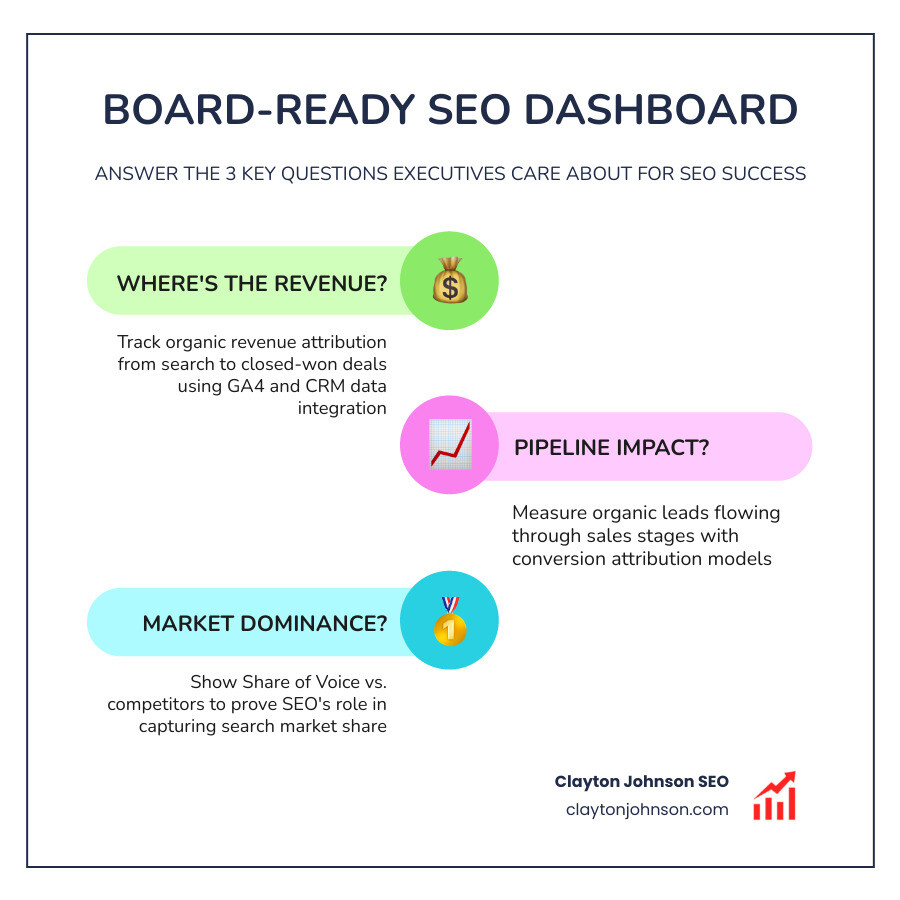
The quickest way to lose funding for an enterprise SEO program is to talk about “rankings” to a CFO. Executives care about revenue, pipeline, and market share.
We use Share of Voice (SoV) to show how much of the “search pie” we own compared to our competitors. We also blend data from Google Analytics and our CRM to prove that a visitor who started with an organic search eventually turned into a high-value customer.
A “board-ready” dashboard should answer three questions:
- How much revenue did organic search generate this quarter?
- How much did we save compared to paid search (PPC)?
- Are we gaining or losing ground against our top three competitors?
If a metric can’t be tied to pipeline or revenue within two clicks, it probably doesn’t belong on the main dashboard. For more on the math behind this, see more info about financial metrics in SEO.
The Future of Search: AEO and Agentic AI
The future of enterprise seo optimization is “searchless discovery.” We are moving toward a world where users get answers directly from AI assistants without ever clicking a link. This is why Answer Engine Optimization (AEO) is the next frontier.
We are also seeing the rise of Agentic AI — autonomous systems that can perform multi-step SEO tasks. Imagine an AI agent that monitors your site for broken links, writes the redirect code, and submits it to the engineering team for approval, all while you’re sleeping. This isn’t science fiction; it’s the systems we are building today.
At Clayton Johnson SEO, we believe in a simple philosophy: Clarity → Structure → Leverage → Compounding Growth. We don’t just give advice; we build the systems that operationalize growth.
If you’re ready to turn your “800-pound gorilla” of a website into a streamlined revenue machine, you can find more info about the ultimate guide to AI-driven SEO strategy or contact us for enterprise SEO services today. Let’s build something that scales.