The Root Causes of Failure for AI Projects

Why Most AI Investments Fail to Deliver Real Business Value
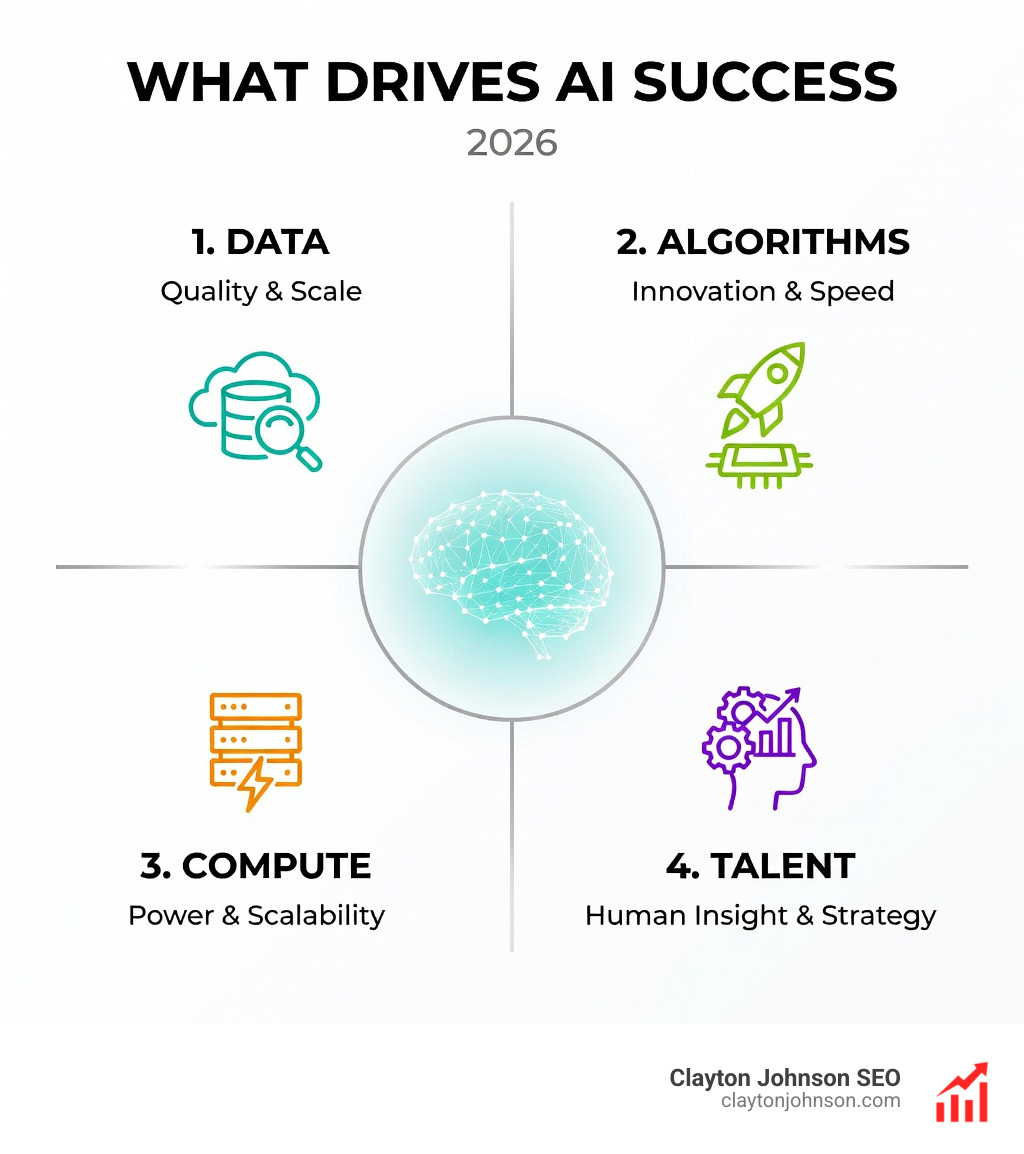
What drives AI success is one of the most important questions any founder or marketing leader can ask right now — and the answer is not what most people expect.
Here is the short version:
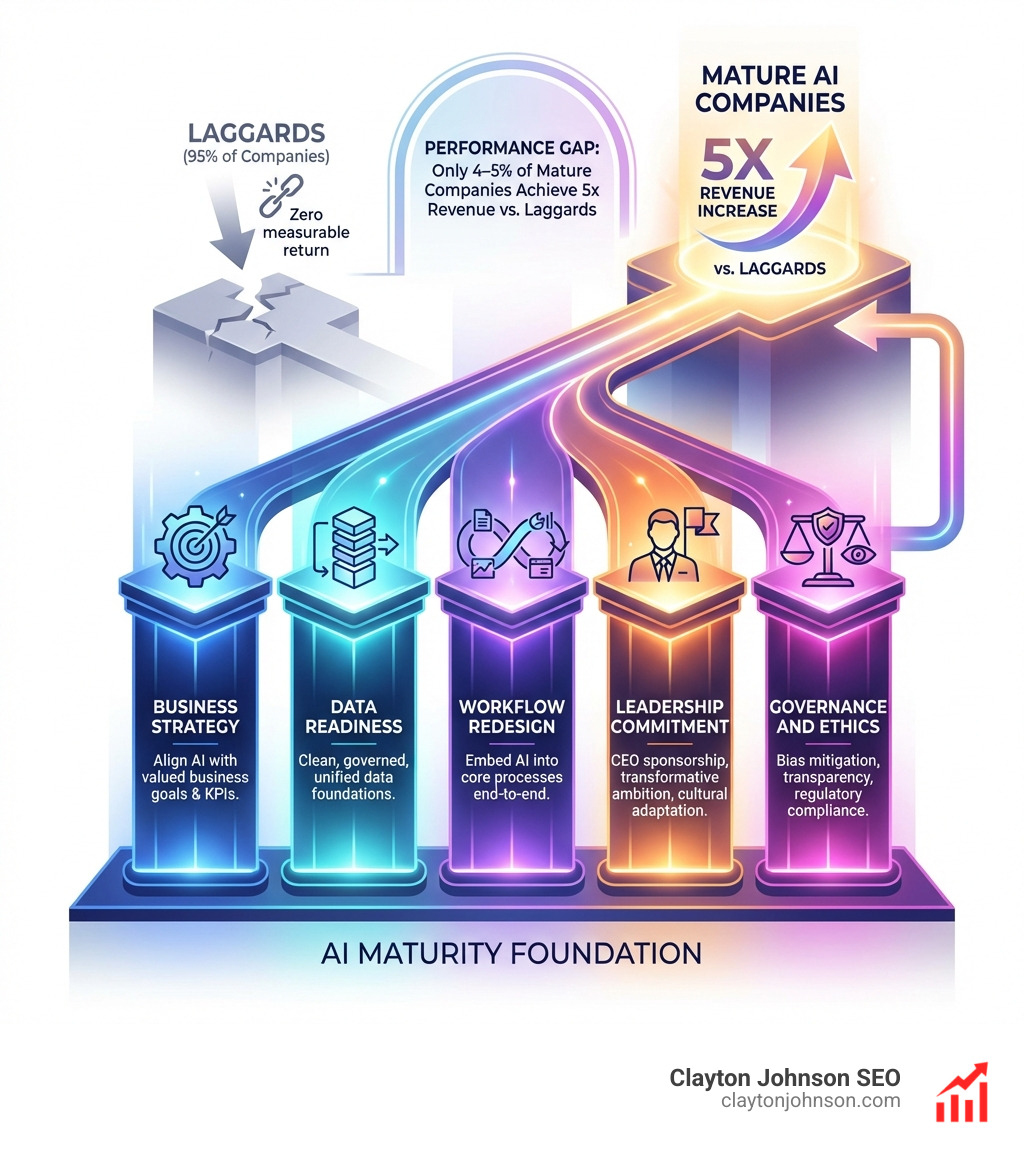
What drives AI success comes down to five core factors:
- Business strategy first — AI must align with clear, valued business goals
- Data readiness — clean, governed, accessible data is non-negotiable
- Workflow redesign — embedding AI into core processes, not bolting it on
- Leadership commitment — senior ownership and transformative ambition
- Governance and ethics — bias controls, transparency, and human oversight
Despite massive investment, roughly 95% of AI pilot programs generate zero measurable return. The gap is not about access to technology. Almost every organization has that. The real gap is organizational — weak data foundations, misaligned objectives, and a failure to move beyond experimentation into enterprise-wide execution.
Only 4–5% of companies have reached a mature level of AI implementation. Those that do are seeing 5x revenue increases and 3.6x shareholder returns compared to those falling behind. The difference is not which AI tools they use. It is how they build the systems around those tools.
I’m Clayton Johnson, an SEO strategist and growth operator who has spent years building AI-assisted marketing systems and structured growth frameworks for founders and marketing leaders. Understanding what drives AI success — and why most organizations miss it — sits at the core of how I help teams turn fragmented AI experiments into compounding business results.
What drives AI success terms simplified:
The Strategic Gap: Why 95% of AI Pilots Fail
It is a staggering statistic: nearly 95% of generative AI pilot programs fail to generate a measurable return on investment. According to the MIT Media Lab/Project NANDA report, most organizations are trapped in what we call the “Pilot Trap.” They launch exciting experiments, but those experiments never graduate to the production line.
Why does this happen? We see a consistent “GenAI Divide” emerging. On one side, you have the 5% of elite performers who treat AI as a fundamental business transformation. On the other, you have the 95% who treat it as a shiny new toy. The failures are rarely technical. Instead, they stem from misaligned objectives, where the “problem” being solved isn’t actually a priority for the business.
Furthermore, many companies suffer from a technology-first bias. They buy the software before they have the strategy. This leads to a leadership disconnect where executives authorize budgets but don’t understand the domain context required to make the tools work. Without a bridge between technical staff and business leaders, AI projects become perpetual proofs-of-concept that eventually run out of steam.
Overcoming the “Jagged Frontier” of Productivity
One of the most fascinating insights into what drives AI success is the concept of the “jagged technological frontier.” Research shows that AI can boost a highly skilled worker’s performance by up to 40% when used within its capabilities. However, performance can actually drop by 19 percentage points when the same worker uses AI for tasks outside its “frontier.”
To succeed, we must move beyond blind adoption. Successful organizations encourage “cognitive effort.” This means using expert judgment to validate AI outputs rather than accepting them at face value. By keeping a “human-in-the-loop,” teams can navigate the boundaries of what AI can and cannot do, ensuring that productivity gains don’t come at the cost of accuracy.
What Drives AI Success: The Five Pillars of Maturity
If you want to move from a laggard to a leader, you need a foundation. Microsoft’s guide on Building a Foundation for AI Success outlines a framework that we use to help our clients structure their growth.
| Feature | AI Leaders (Front-Runners) | AI Laggards (Experimenters) |
|---|---|---|
| Primary Goal | Growth and Innovation | Efficiency and Cost-Cutting |
| Investment Focus | 70% People & Process, 20% Tech | 80% Tech, 20% People |
| Workflow Status | Fundamentally Redesigned | Existing Workflows with AI “Bolted On” |
| Data Strategy | Unified, Governed, and Scalable | Siloed and Manually Cleaned |
| Leadership | CEO-Led Transformation | IT-Led Experiments |
Defining Business Strategy as the First Step
The very first pillar of what drives AI success is business strategy. You cannot automate a process you don’t understand. We advise founders to start by defining and prioritizing “valued business needs.” This means pinpointing high-impact use cases that align with your North Star metrics.
Successful implementation requires more than just a “thumbs up” from the board; it requires active executive sponsorship. When leaders define clear KPIs and own the AI roadmap, the organization moves with purpose.
Establishing Robust AI Governance and Ethics
Trust is the currency of the AI era. Without robust governance, AI can become a liability. This involves bias mitigation, where you actively check models for unfairness, and “red teaming,” where you simulate adversarial attacks to find weaknesses. An ethical compass isn’t just a “nice to have”—it’s a regulatory requirement and a key driver of long-term value.
From Pilots to Profits: Prioritizing High-Impact Use Cases
Organizations that follow a portfolio management plan are 2.4 times more likely to reach “mature” levels of AI implementation. Rather than chasing every top generative AI use case, elite performers focus on a few “strategic bets.”
How to Build a Portfolio Management Plan for AI
A successful portfolio balances “quick wins” (short-term efficiency gains) with “strategic bets” (long-term transformative projects). This approach diversifies risk. If one experimental model fails, the entire AI strategy doesn’t collapse. We help leaders optimize their resources by focusing on the 20% of use cases that will drive 80% of the impact.
What Drives AI Success Through Rigorous Use Case Evaluation
We use a scorecarding system to evaluate every potential AI project. The criteria are simple but strict:
- Business Impact: Does this move a core KPI?
- Feasibility: Do we have the data and the tech to do this now?
- Time-to-Value: How quickly can we see a result?
- Measurability: Can we quantify the ROI in dollars or hours?
- Scalability: Can this be rolled out across the entire department?
The Human Element: Redesigning Workflows and Culture
Here is a secret that most tech vendors won’t tell you: What drives AI success is 70% about people and processes, 20% about technology, and only 10% about the algorithms themselves.
If you just give your team ChatGPT and tell them to “be more productive,” you will fail. You must fundamentally redesign workflows. This means looking at an end-to-end process—like content creation or customer support—and asking how AI changes every single step.

Workforce Strategies for Scalable Adoption
Upskilling is not a one-time workshop; it is a continuous learning culture. We see success when companies use “skills inference”—using AI to analyze employee data and identify who is ready for new roles. By creating “career lattices” rather than rigid ladders, you allow your talent to move into AI-augmented roles that didn’t exist a year ago.
What Drives AI Success in Leadership Commitment
High performers are three times more likely to say their senior leaders demonstrate ownership of AI initiatives. This isn’t just about signing checks. It’s about “transformative ambition.” Leaders must be willing to change the company’s operating model to capture the 5x revenue advantages that AI offers.
Building the Foundation: AI Infrastructure and Data Strategy
You can’t build a skyscraper on a swamp. To scale, you need a modern AI data stack. This includes specialized GPU server hosting and high-performance networking like InfiniBand, which supports throughput up to 400 Gbps.
Why Successful AI Depends on Data Strategy
The “garbage in, garbage out” rule has never been more relevant. Many AI pilots succeed because they use “hand-cleaned” data in a lab. But when they hit the real world, they crumble because the underlying data strategy is weak.
What drives AI success in the long term is a “single source of truth.” This requires:
- Unified Taxonomy: Everyone agrees on what “a customer” or “a lead” actually is.
- Unstructured Data Governance: Governing the emails, PDFs, and chat logs that GenAI feeds on.
- Data Stewardship: Assigning clear ownership to data domains so quality is maintained.
Technical Components for Scalable Success
As you scale, you’ll need more than just a standard database. Vector databases are essential for managing the complex embeddings used in large language models. Additionally, you must implement model monitoring to detect “drift”—when an AI’s performance starts to degrade because the incoming data has changed.
Measuring the True ROI of AI Initiatives
Measuring the return on AI investment is about more than just counting hours saved. While 80% of companies set efficiency as their primary objective, the elite performers prioritize growth and innovation.
Quantifying Value Beyond Efficiency
To understand what drives AI success, you have to look at the “360-degree value” lens:
- EBIT Impact: How much does this actually add to the bottom line?
- Revenue Growth: Are we reaching new markets or increasing customer lifetime value?
- Shareholder Returns: Mature AI companies see 3.6x higher returns than laggards.
- Customer Experience: Are we solving problems faster and with more personalization?
Frequently Asked Questions about What Drives AI Success
What are the primary reasons AI projects fail to scale?
Most projects fail because they lack a solid data foundation and fail to redesign workflows. A “pilot” often uses manually cleaned data, but enterprise-wide scaling reveals deep-seated issues with data quality and organizational silos. Without a clear business strategy, these projects eventually lose executive support.
How do high-performing AI organizations differ from laggards?
High performers invest significantly more in people and processes (the 70/20/10 rule). They are also three times more likely to aim for “transformative change” rather than just incremental efficiency. They don’t just use AI; they redesign their entire business around it.
What role does agentic AI play in future value creation?
Agentic AI—systems that can plan and execute multi-step tasks autonomously—is the next frontier. While currently a smaller portion of the market, it is projected to grow from 17% of AI value to nearly 29% in the coming years. Success here requires an even stronger data foundation, as these agents act on the data they are given.
Conclusion
At the end of the day, what drives AI success isn’t a secret algorithm or the biggest GPU cluster. It is structure.
Most companies don’t lack the tactics or the tools; they lack the structured growth architecture to make those tools work at scale. This is exactly why we built Demandflow.ai. We help founders and marketing leaders move past the “pilot trap” by providing actionable strategic frameworks and taxonomy-driven SEO systems that turn AI into a lever for compounding growth.
If you are ready to stop experimenting and start scaling, it’s time to build your foundation.
Explore our AI tools and frameworks to see how we can help you build a high-performance growth engine.