AI Marketing for Radiologists Companies: The Future of Practice Growth


Why AI Marketing for Radiologists Companies Is a Growth Imperative
AI marketing for radiologists companies is one of the fastest-moving opportunities in healthcare technology right now. With over 1,000 radiology AI vendors competing for the same buyers, the companies that win are not always the ones with the best technology — they are the ones that market it most effectively.
Here is a quick overview of what AI marketing for radiology AI companies involves:
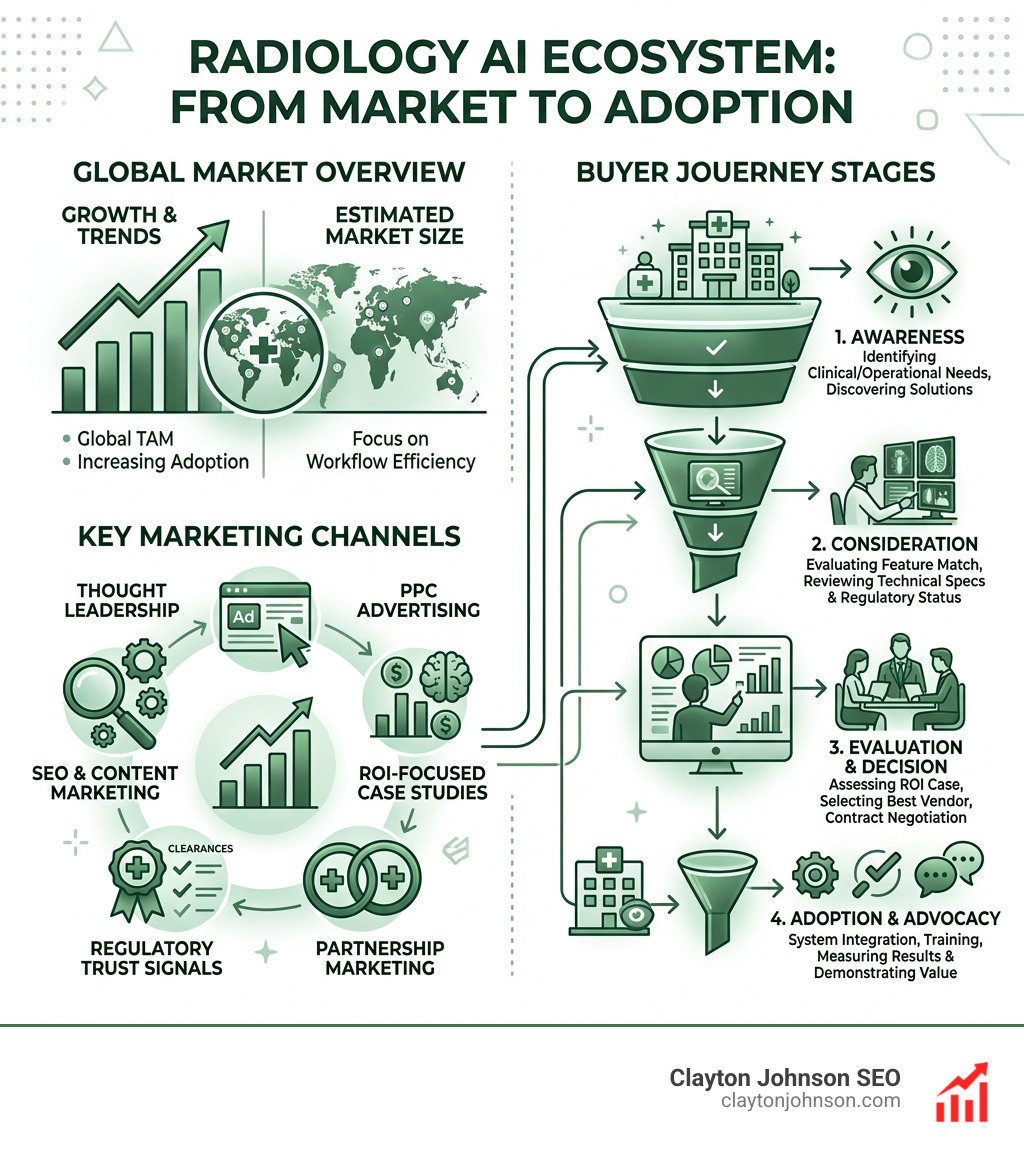
| Strategy | What It Does |
|---|---|
| SEO & Content Marketing | Attracts hospitals and health systems searching for AI solutions |
| PPC Advertising | Captures high-intent buyers ready to evaluate vendors |
| Thought Leadership | Builds credibility with radiologists and clinical decision-makers |
| ROI-Focused Case Studies | Demonstrates measurable clinical and operational value |
| Regulatory Trust Signals | Leverages FDA clearance and CE-marks to reduce buyer hesitation |
| Partnership Marketing | Uses collaborations with major health systems to build social proof |
The radiology AI space is genuinely dynamic. Platforms like Aidoc analyze 60 million scans per year, Harrison.ai processes more than 35% of all chest X-rays in NHS England, and tools like Rad AI Impressions save radiologists 60+ minutes per shift. These are powerful results. But strong clinical outcomes alone do not fill a sales pipeline.
The real challenge is visibility. Most radiology AI companies have a product that works — but potential buyers cannot find them, do not trust them yet, or cannot see a clear path to ROI.
That is exactly where smart, targeted marketing changes everything.
I’m Clayton Johnson, an award-winning SEO strategist and AI marketing expert who has spent nearly two decades helping companies in competitive technical markets build visibility and generate qualified leads through data-driven SEO and demand generation — including ai marketing for radiologists companies. In the sections below, I’ll walk you through the specific strategies that move the needle in this space.
Strategic AI Marketing for Radiologists Companies
In a market where over 1,000 companies are vying for the attention of hospital administrators and Chief Medical Information Officers (CMIOs), “random acts of marketing” simply won’t cut it. We need a system. The goal of ai marketing for radiologists companies is to move from being a “cool tool” to becoming a mission-critical clinical partner.
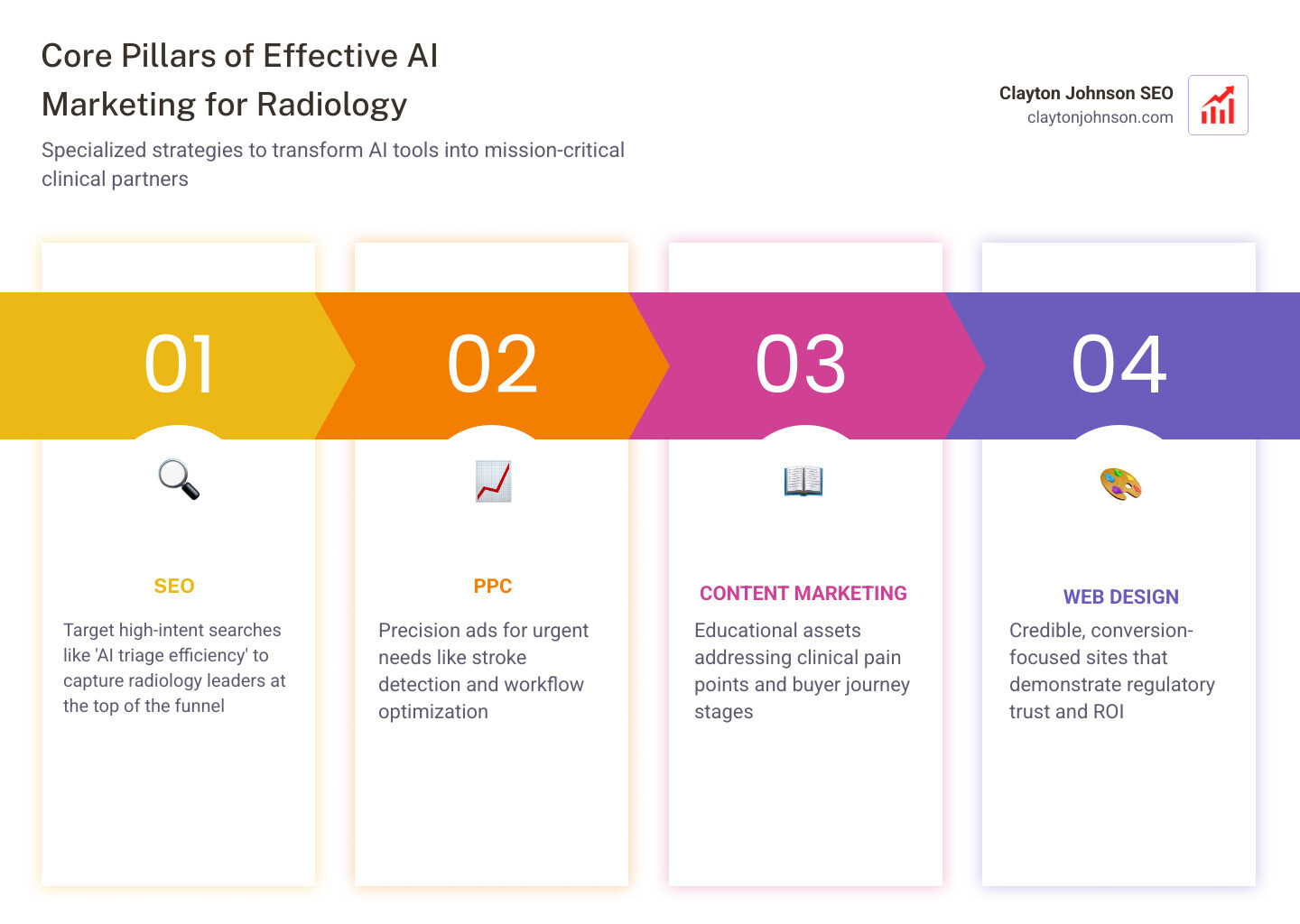
Effective marketing in this sector relies on four core pillars: SEO, PPC, web design, and content marketing. While these might sound like standard digital marketing terms, their application in radiology is highly specialized. You aren’t just selling software; you are selling a reduction in physician burnout, improved patient safety, and operational throughput.
To build a machine that generates leads, you need AI Marketing Software That Actually Sells. This means using data to understand which hospitals are currently researching triage efficiency or stroke care coordination and meeting them exactly where they are. By building The Ultimate Guide to AI Content Systems, we can ensure that every white paper or blog post serves a strategic purpose in the buyer’s journey.

Leveraging SEO and Content in AI Marketing for Radiologists Companies
SEO is the bedrock of long-term growth. When a radiology department head searches for “automated radiology impressions” or “AI for intracranial hemorrhage detection,” your company needs to be the first answer they see. This requires a deep dive into search intent—understanding whether the user is looking for research (educational intent) or a solution to buy (transactional intent).
Technical SEO and content architecture are where we find the biggest wins. By using the Best AI SEO Services, we can build a site structure that signals authority to search engines. It’s about more than keywords; it’s about answering the complex clinical questions that radiologists actually ask. For instance, knowing How to Use AI for On-Page SEO That Actually Ranks allows us to optimize technical documentation and clinical study summaries so they appear in “Position Zero” on Google.
Beyond the website, thought leadership on platforms like LinkedIn is non-negotiable. When leaders like Tom Valent at Aidoc share insights about tackling physician burnout, it builds a layer of trust that paid ads can’t buy. Social proof in the medical world is built through peer-to-peer validation and high-level commentary on industry trends.
Demonstrating ROI and Clinical Value in AI Marketing for Radiologists Companies
The biggest hurdle in closing a deal with a health system is proving the financial and clinical “Why.” We have seen that Aidoc Always On Healthcare AI succeeds because it doesn’t just interpret images; it connects points of care. To market this effectively, we must use metrics that speak the language of hospital CFOs.
Consider the difference between a “point solution” (an algorithm that only looks at one type of scan) and an “enterprise platform” (a system that integrates into the entire workflow).
| Metric | Point Solution | Enterprise AI Platform |
|---|---|---|
| Integration | Fragmented / Multiple Logins | Unified aiOS / Seamless |
| Workflow Impact | Often adds “extra clicks” | “Always On” / Zero extra clicks |
| Scalability | Difficult to manage | Rapid across all departments |
| ROI Proof | Isolated to one finding | Enterprise-wide efficiency gains |
Marketing should highlight specific wins: a 5.2-day reduction in turnaround time or the fact that 7 out of 10 radiologists report increased confidence when using assistive AI. Tools like Rad AI Impressions are winning the marketing war by focusing on a single, painful problem: burnout. When you can tell a radiologist they will save 60+ minutes per shift, the marketing practically does itself.
Navigating Regulatory Approval and Trust
In healthcare, trust is the ultimate currency. If your website looks like it was built in the late 90s, you’ve already lost. Research shows that 94% of a person’s first impression of a medical practice comes from its website design, and 75% of credibility comes from that same design. For ai marketing for radiologists companies, your digital presence must reflect the precision of your technology.
Trust is also built through regulatory transparency. Highlighting FDA clearances and CE-marks is not just a legal requirement; it is a marketing asset. When Harrison.ai markets its solutions, it leans heavily on its clearance in 40+ countries. This signals to the buyer that the product is “safe” and “proven.”
We recommend featuring clinical studies prominently. With over 230+ clinical studies published on certain top-tier solutions, the data provides a shield against skepticism. Your marketing should bridge the gap between “high-tech” and “high-touch,” showing how AI improves actual patient outcomes, such as faster time to treatment for stroke or pulmonary embolism.
Future Trends and Scaling Growth Systems
The future of radiology AI is moving away from simple detection and toward multimodal models. We are seeing a shift toward systems like MAIRA-1, which combines vision encoders with large language models to generate high-quality radiological reports automatically. This is a massive leap from just flagging a finding to actually helping write the report.
As a marketing professional, you should be highlighting these “next-gen” capabilities. The conversation is shifting from “Does this find a lung nodule?” to “How does this fit into our enterprise-wide digital transformation?” We help companies stay ahead by showing them How to Build AI Marketing Workflows That Actually Work so they can scale their message as fast as their tech evolves.
The Shift from Point Solutions to Integrated Platforms
The “App Store” model for radiology AI is struggling. Health systems don’t want to manage 50 different vendors. This is why the concept of an aiOS (AI Operating System) is so powerful. By marketing a unified platform, you solve the “fragmentation problem” for the hospital IT department.
Take the partnership between Houston Methodist and Aidoc as an example. They didn’t just buy one algorithm; they implemented a “stack” of solutions. This integrated approach allows for better care coordination, moving beyond image interpretation to actually alerting the right surgical team at the right time.
Key benefits of an integrated platform approach include:
- Centralized Data: One source of truth for all AI insights.
- Reduced Cognitive Burden: No switching between different interfaces.
- Workflow Efficiency: Integrated directly into PACS and EHR systems.
- Scalability: Add new clinical modules without new IT hurdles.
Platforms like RadioView.ai are also gaining traction by combining AI reporting with cloud-based PACS, showing that the future is all about the “all-in-one” experience. We believe that AI Strategy and Implementation for People Who Hate Jargon is the best way to communicate these complex platform benefits to a non-technical audience.
Building Credibility through Partnerships and Community
Marketing shouldn’t happen in a vacuum. The most successful radiology AI companies are building communities. The Aidoc Insider Community is a prime example of using “community-led growth” to foster loyalty and gather feedback for product roadmaps.
Partnerships are also a massive marketing engine. When a prestigious institution like Houston Methodist or a major NHS Trust adopts your technology, it provides a “halo effect” for your brand. Smaller vendors like Radloop are finding success by focusing on niche but critical problems—like closing the loop on actionable findings—and partnering with larger entities to solve specific quality reporting challenges (MIPS/QCDR).
Don’t ignore the power of being present. Industry events like ECR in Vienna or Röntgenveckan in Sweden are where the handshakes happen. Use these events not just to demo products, but to capture content, record interviews with happy users, and fuel your digital marketing for the rest of the year.
Implementing Scalable Growth with Clayton Johnson SEO
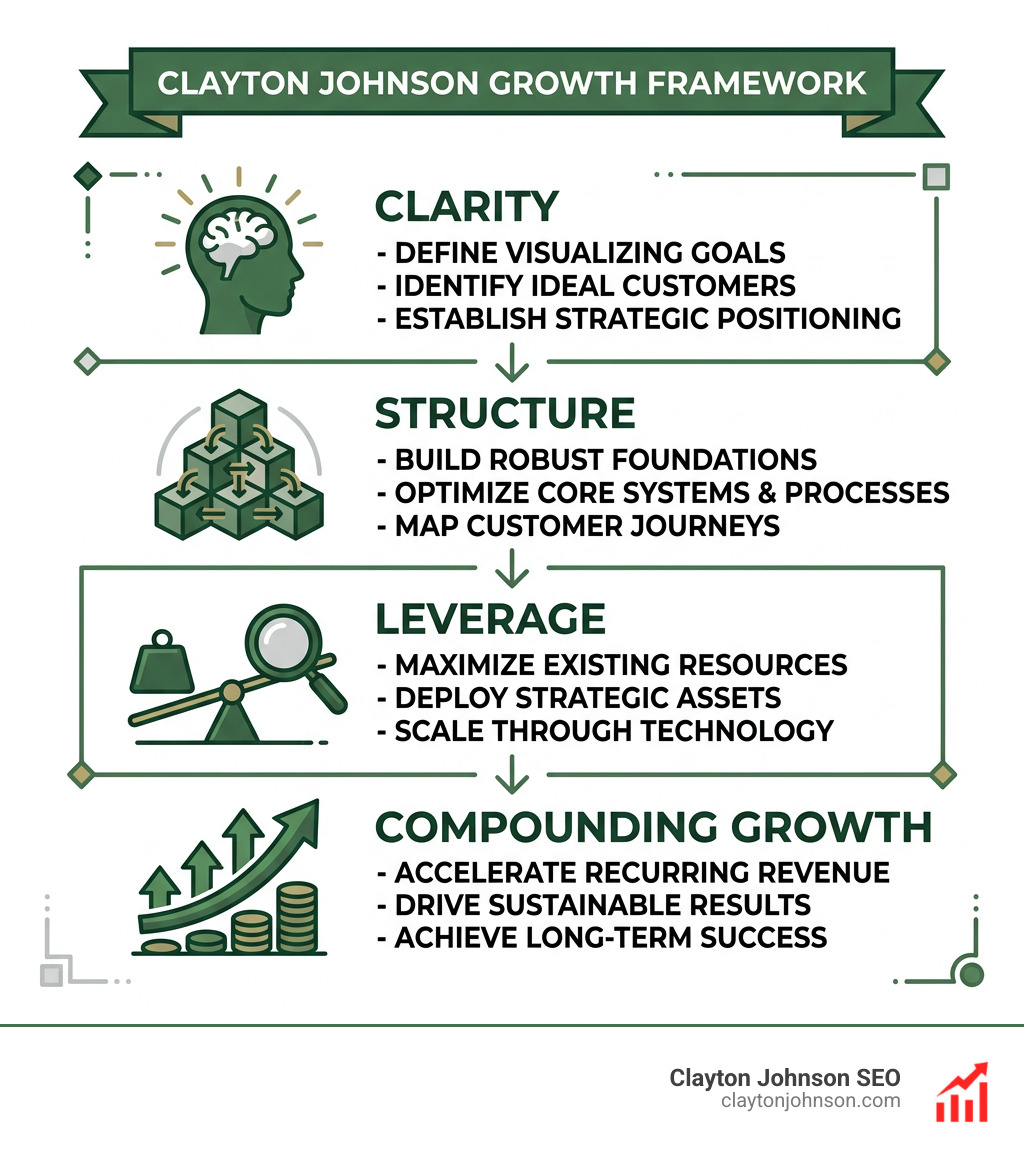
At Clayton Johnson SEO, we don’t just “do SEO.” We build durable growth engines. For companies in the radiology AI space, this means moving away from chasing vanity metrics and focusing on systems that compound over time. We look at your business through the lens of Clarity → Structure → Leverage → Compounding Growth.
Our approach to ai marketing for radiologists companies involves:
- Intent Modeling: Mapping out exactly what your buyers are searching for at every stage of the funnel.
- Taxonomy-Driven Content: Building a content ecosystem that establishes you as the topical authority in your specific niche (e.g., neuro, vascular, or oncology AI).
- AI-Augmented Workflows: Using the latest AI tools to produce high-quality, technically accurate content at scale, without losing the human touch.
- Strategic Positioning: Ensuring your brand isn’t just another name in a list of 1,000, but a clear leader in a specific category.
If you are tired of fragmented marketing efforts that don’t result in a measurable business impact, it’s time to build a system. Whether you need SEO Services or a full growth framework, we specialize in turning technical complexity into market dominance.
The radiology AI market is crowded, but it is far from saturated for the companies that know how to tell their story. By focusing on ROI, clinical integration, and a system-level approach to SEO, you can ensure that your technology doesn’t just exist—it leads.
Let’s build a system that works as hard as your algorithms do. Reach out to us to start building your custom growth framework today.