Why AI SEO is Reshaping How Content Gets Discovered
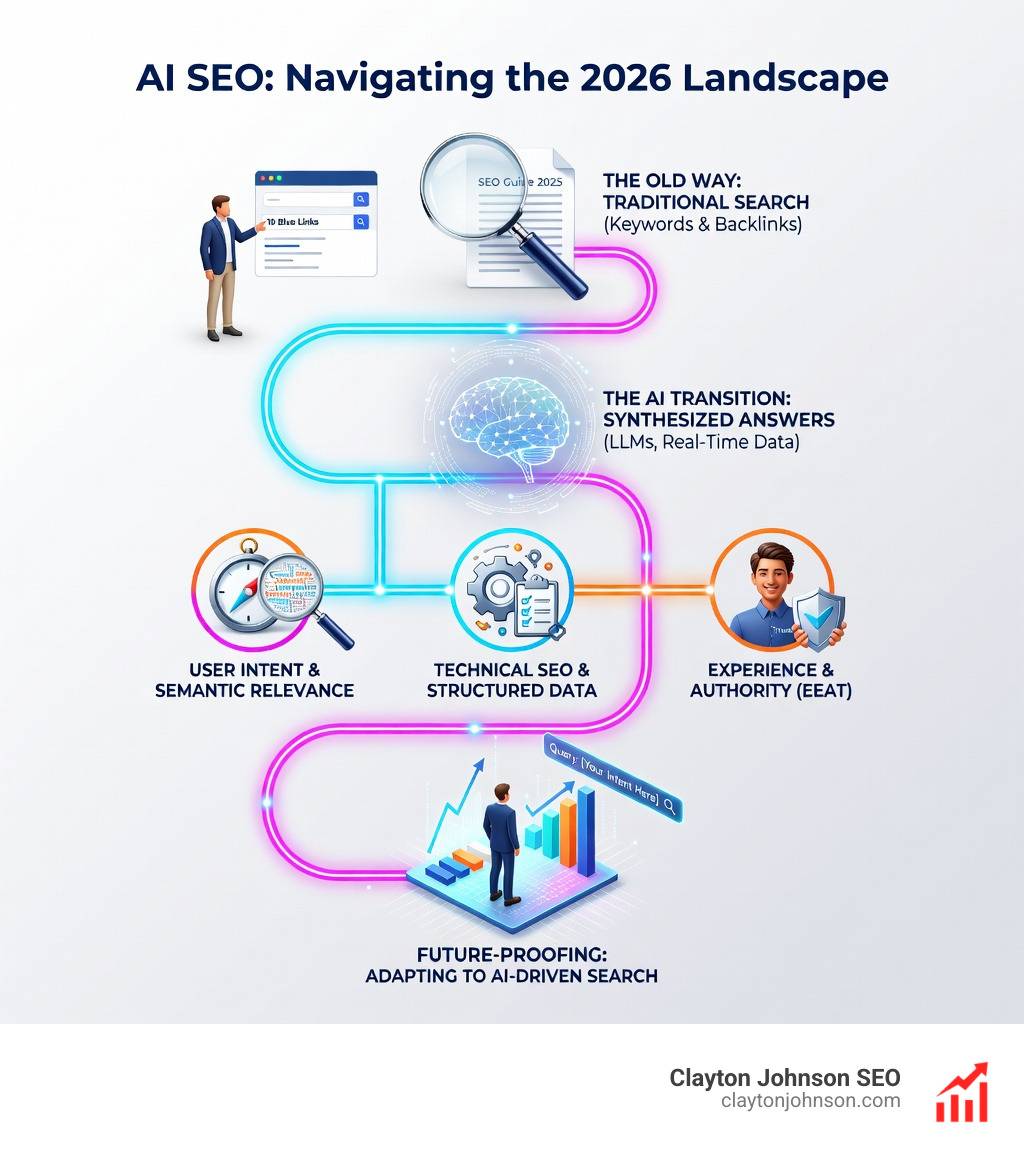
AI SEO is the practice of optimizing content to be discovered, understood, and cited by artificial intelligence systems—including Google’s AI Overviews, ChatGPT, Perplexity, and other large language models. Unlike traditional SEO, which focuses on ranking web pages in search results, AI SEO prioritizes being selected, extracted, and referenced when AI systems generate answers.
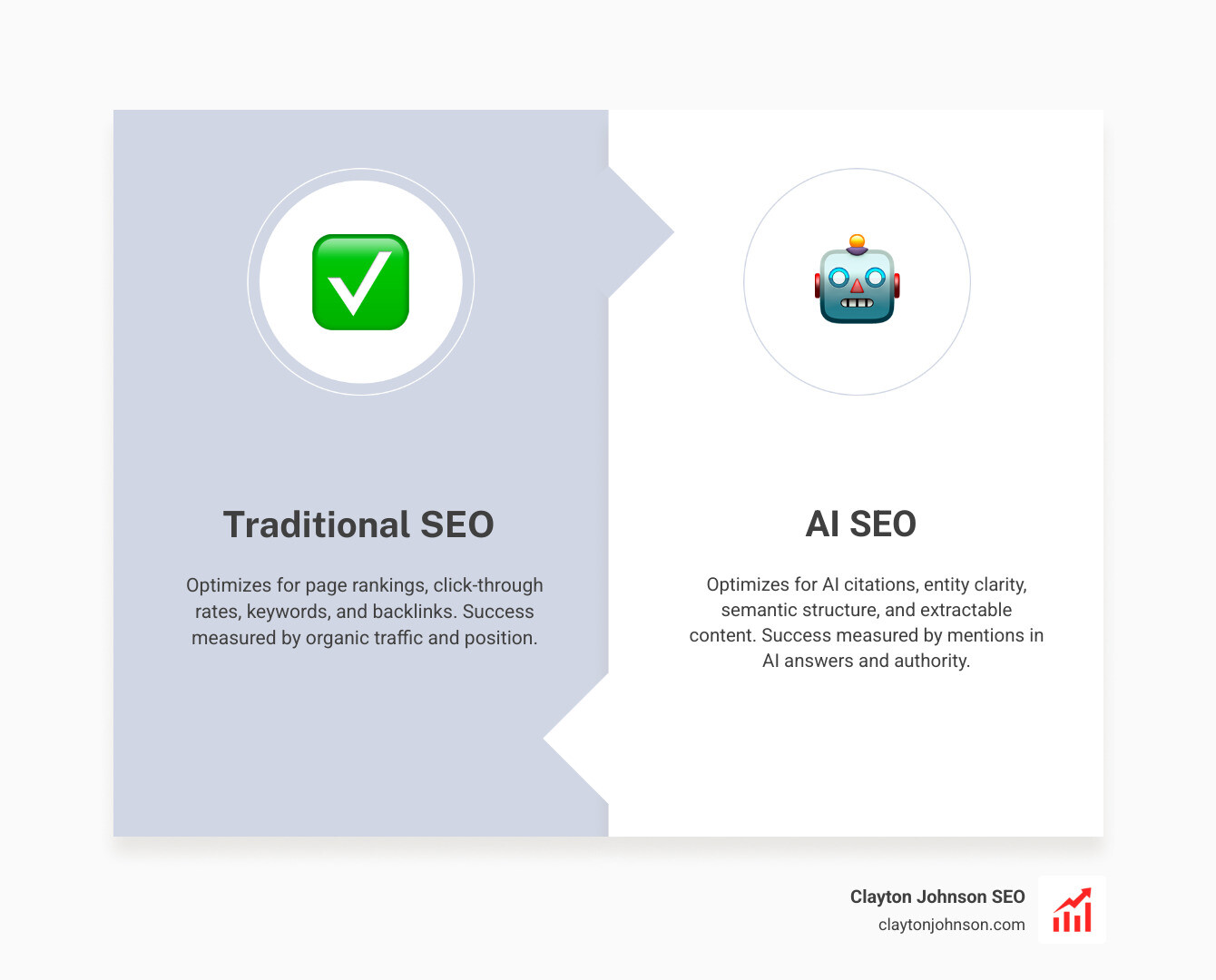
Key differences between traditional SEO and AI SEO:
- Traditional SEO: Optimizes for page rankings and click-through rates
- AI SEO: Optimizes for mentions, citations, and answer inclusion
- Traditional SEO: Focuses on keywords and backlinks
- AI SEO: Emphasizes entity clarity, semantic structure, and extractable content
- Traditional SEO: Success measured by traffic and rankings
- AI SEO: Success measured by visibility in AI-generated answers and brand authority
The shift is dramatic. AI referrals to top websites spiked 357% year-over-year, reaching 1.13 billion visits in June 2025. Meanwhile, 58.5% of Google searches in the United States ended without a click in 2024. Google’s AI Overviews now trigger in approximately 13.14% of all search queries as of March 2025—nearly doubling from 6.49% in January 2025.
This isn’t the death of SEO. It’s evolution.
Search engines now pull answers directly from AI models, synthesize information from multiple sources, and prioritize clear, authoritative entities over simple keyword matches. The brands that win are those creating content that AI systems can easily parse, confidently cite, and accurately represent.
The fundamentals haven’t disappeared—crawlability, metadata, structured data, and backlinks still matter. But the mechanism of visibility has changed. Content must now be designed for both human readers and machine interpretation. A single well-structured passage can be lifted word-for-word into an AI Overview. A clear Q&A section can become the definitive answer across multiple platforms. Authority signals from third-party mentions now influence whether your brand gets cited at all.
I’m Clayton Johnson, and I’ve spent years building scalable SEO systems at the intersection of technical optimization, strategic content architecture, and AI-assisted workflows. Throughout this guide, I’ll show you exactly how AI SEO works, what signals matter most, and how to adapt your content strategy to thrive in this new landscape.
Similar topics to AI SEO:
What is AI SEO and How It Redefines Search
To master AI SEO, we first have to understand the technical shift from “matching keywords” to “understanding intent.” In the old days, search engines were glorified librarians looking for specific words on a page. Today, they are sophisticated reasoning engines.
This evolution is driven by several core disciplines:
- Generative Engine Optimization (GEO): The process of optimizing content specifically to be featured in generative AI responses, like Google’s AI Overviews or ChatGPT search.
- Answer Engine Optimization (AEO): Focusing on providing direct, concise answers to user queries, often for voice search or snippet selection.
- Large Language Model Optimization (LLMO): Ensuring your brand and data are accurately represented within the training sets and retrieval-augmented generation (RAG) processes of models like GPT-4 or Claude.
Google has been laying the groundwork for this for years. RankBrain, launched in 2015, was their first major machine-learning system to interpret queries. It now processes over 15% of Google’s 8.5 billion daily searches. Then came BERT in 2019, which helped Google understand the nuance of context, and MUM in 2021, which is 1,000 times more powerful than BERT and can answer complex, multidimensional queries.
Modern search engines use natural language processing (NLP) to understand the meaning behind a search. This means we are moving away from “keyword density” and toward “semantic clarity”—where the relationship between entities (people, places, things) matters more than how many times you type a specific phrase.
The Rise of Zero-Click Search and AI Overviews
We are currently witnessing the “Zero-Click” era. According to a 2024 study by Rand Fishkin of SparkToro, 58.5% of Google searches in the U.S. ended without a single click to a website. Why? Because the AI provides the answer right on the results page.
The prevalence of these summaries is nearly doubling from 6.49% in January 2025 to over 13% just two months later. This changes user behavior fundamentally. Instead of browsing three different websites to compare products, users read a synthesized summary.
For brands, this means “discovery” is happening within the AI interface. If your brand isn’t mentioned or cited in that summary, you essentially don’t exist for that user. However, there is a silver lining: while traffic volume may decrease, the users who do click through are often much further down the funnel. They’ve read the summary, they know you’re a top choice, and they are visiting your site to convert. If you need help navigating this shift, exploring professional SEO Services can help bridge the gap between traditional rankings and AI visibility.
Core Pillars of an Effective AI SEO Strategy
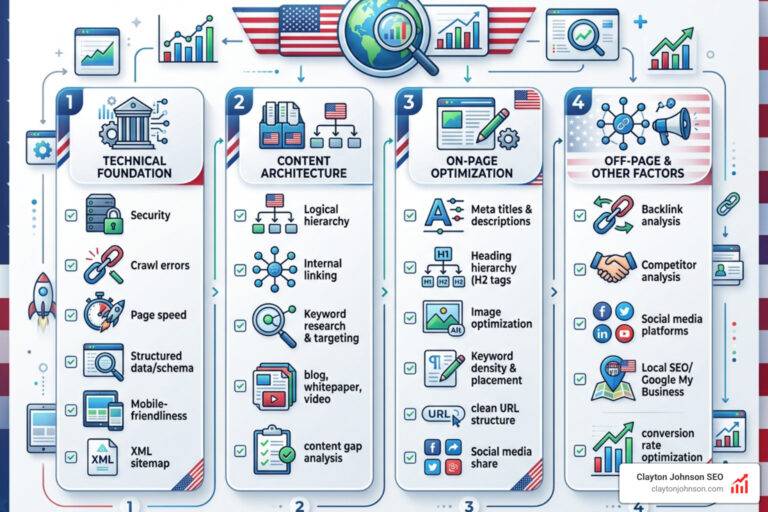
If we want to win in the age of AI SEO, we have to focus on what makes a machine “trust” our content. It comes down to four main pillars:
- Entity Clarity: Clearly defining who you are and what you do. AI doesn’t just see “keywords”; it sees “entities.” You want to be the definitive entity for your niche.
- Topical Depth: Gone are the days of 500-word “fluff” posts. AI rewards topical authority—the sense that your site covers every facet of a subject comprehensively.
- E-E-A-T Signals: Experience, Expertise, Authoritativeness, and Trustworthiness are the currency of AI citations. AI models prefer citing sources with verifiable human expertise.
- Technical Site Health: If a bot can’t crawl your site efficiently, it won’t index your data. Improve your Google Rankings by ensuring your technical foundation is rock solid.
Leveraging Schema Markup for AI SEO
One of the most powerful tools in our arsenal is schema.org. Think of Schema as a “translator” for AI. While humans see a beautiful webpage, AI sees a script. By using JSON-LD format, we can label our content so that AI systems don’t have to guess.
Google recommends including all relevant properties in your markup. For example, using author and Person or Organization schema helps AI connect your content to a real human expert, which is a massive trust signal. This backend code optimization ensures that when an AI system looks for a “price,” “rating,” or “expert opinion,” it finds it instantly in your code.
Writing for AI SEO Visibility
Writing for AI is about being “extractable.” AI models look for “information gain”—unique value that doesn’t exist elsewhere. We’ve found that ranking for 68% more long-tail keywords is possible simply by shifting to topic clusters that answer specific user questions.
Using a conversational tone improves comprehension and usability, which helps AI models summarize your work. We recommend using dedicated Q&A formats. If you ask a question in an H2 and answer it directly in the first sentence of the following paragraph, you make it incredibly easy for an AI to “lift” that answer into an AI Overview. For more on this, check out our guide on SEO Content Marketing.
Content Structure: Optimizing for Extraction and Selection
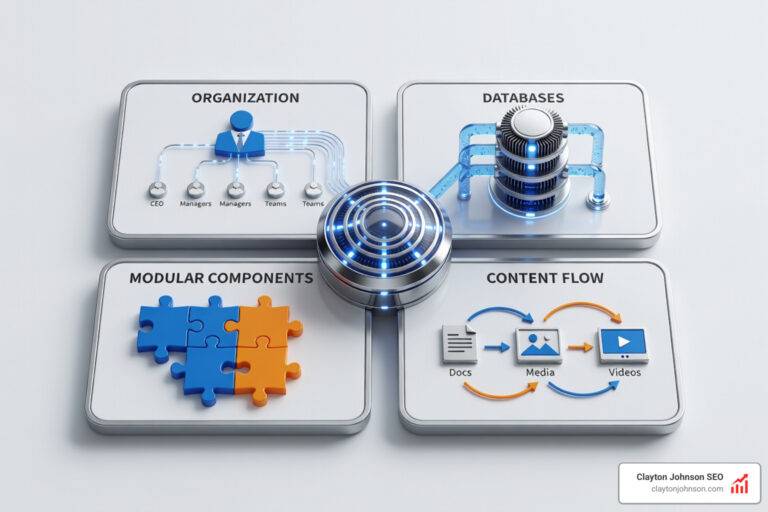
AI systems don’t read like humans; they “parse.” They break your content into modular pieces. If your page is a “wall of text,” the AI will likely ignore it because it’s too hard to extract a specific answer.
| Feature | Traditional SEO Content | AI-Ready Content |
|---|---|---|
| Structure | Linear, narrative-driven | Modular, block-based |
| Headings | Catchy, creative | Descriptive, question-based |
| Data | Embedded in paragraphs | Tables, lists, and bolded facts |
| Formatting | Long paragraphs | Bullet points and Q&A blocks |
| Intent | Keyword-focused | Answer-focused |
To ensure your site is readable for these systems, you need to maintain a strict H1-H3 hierarchy. Furthermore, technical performance metrics like the CLS score (Cumulative Layout Shift) matter because they reflect the stability of the page. For JavaScript-heavy websites, ensuring the content is rendered properly is vital, as AI crawlers may struggle with content hidden behind complex code. We often use tools like Screaming Frog to audit these structures and ensure every “modular piece” of content is discoverable.
Measuring Success in the Age of Answer Engines
How do we know if our AI SEO strategy is working? Traditional rankings are no longer enough. We need to look at “Mention Share” and “Entity-Level Presence.”
Using tools like Semrush Enterprise AIO, we can track how often our brand is mentioned in ChatGPT or Gemini responses. We also look at “passage-level extractability”—how often are our specific sentences being used as the definitive answer in Google Overviews?
Success is also measured through brand sentiment. Does the AI speak about us positively or negatively? Because AI models learn from the “consensus” of the internet, our reputation on third-party sites (like Reddit, Quora, or industry journals) is just as important as our own website. If you’re feeling overwhelmed by these new metrics, you can Consult with an SEO Expert to build a custom tracking dashboard.
Common Mistakes and Future Trends
The biggest mistake we see is treating AI SEO as a separate silo. It’s not. It’s an extension of good marketing. Another common pitfall is publishing high volumes of low-quality AI spam. Search engines are getting better at “throttling” low-value content. If there is no “information gain,” the AI has no reason to cite you.

Looking forward, several trends will shape the landscape:
- Predictive Intent: AI will start providing answers before the user even finishes typing, based on their past behavior.
- Computer Vision: As search becomes more visual, computer vision will allow AI to “see” and interpret your images and videos, making Alt-text and video transcripts more critical than ever.
- Personalized Search: Generative AI will create USD 4.4 trillion in value by personalizing the search experience for every individual user.
The “Universal Ranking” is essentially dead. Your #1 result for a “financial analyst” will look different than the #1 result for a “college student.” If you want to stay ahead of these shifts, it’s time to Work with an SEO Consultant who understands agentic workflows and AI-assisted operations.
Frequently Asked Questions about AI SEO
What is the difference between traditional SEO and AI SEO?
Traditional SEO focuses on ranking a specific URL in a list of links (the SERP). AI SEO focuses on having your information selected and synthesized into a direct answer generated by an AI model. Traditional SEO is about “where you rank”; AI SEO is about “how you are cited.”
How do I make my content more “AI-ready” for Google Overviews?
Focus on semantic structure. Use clear, question-based headings (H2s and H3s). Provide direct, 1-2 sentence answers immediately following those headings. Use Schema markup to define your entities and ensure your site is technically fast and accessible.
Will AI SEO replace traditional search engine rankings?
No, they work together. AI assistants like ChatGPT and Gemini use “grounding,” which means they perform a traditional web search to find the facts they use in their answers. If you don’t rank well in traditional search, the AI won’t find you to cite you in the AI answer.
Conclusion
At Clayton Johnson SEO, we believe that AI SEO is the single greatest opportunity for brands to gain an edge in a crowded market. By focusing on entity clarity, modular content structure, and authoritative human expertise, you can ensure your brand isn’t just “found”—it’s “chosen.”
Whether you are in Minneapolis or operating globally, our growth strategy focuses on actionable frameworks and measurable results. We don’t just chase traffic; we build systems that drive organic revenue. If you’re ready to modernize your approach and dominate the new search landscape, explore our Minneapolis SEO Services and let’s start building your AI-ready future today.