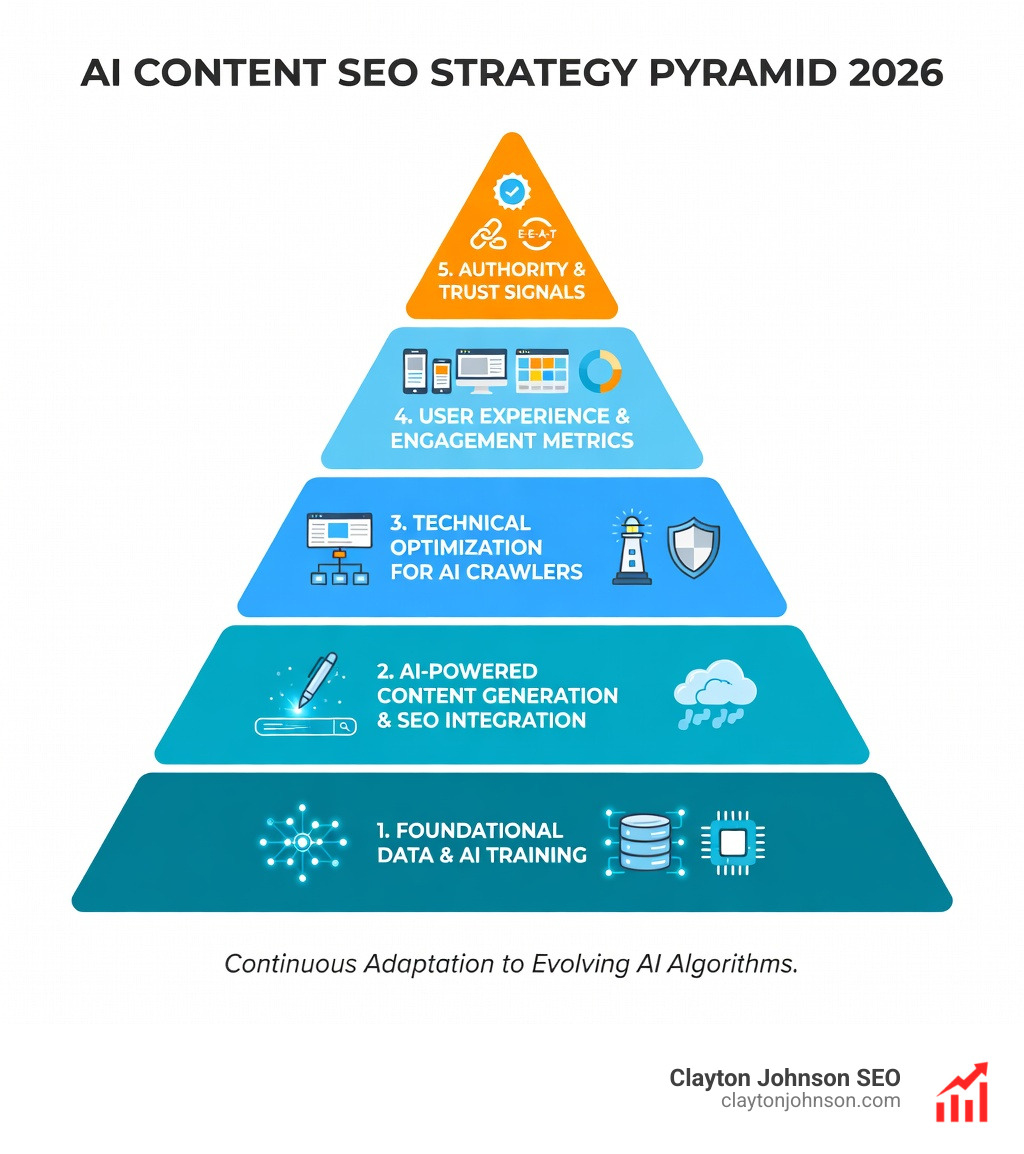
Why AI Content SEO Strategy Is No Longer Optional
An AI content SEO strategy is the framework that combines artificial intelligence tools with search optimization to create, optimize, and distribute content that ranks in both traditional search results and AI-generated answers. Here’s what you need to know:
Core Components of an Effective AI Content SEO Strategy:
- Use AI tools for keyword research, content generation, and technical optimization
- Maintain human oversight through fact-checking, editing, and adding unique insights
- Optimize for AI search visibility by structuring content for citations in ChatGPT, Perplexity, and Google AI Overviews
- Build topical authority through hub-and-pillar content architecture
- Track AI-specific metrics like citation frequency and brand mentions, not just traditional traffic
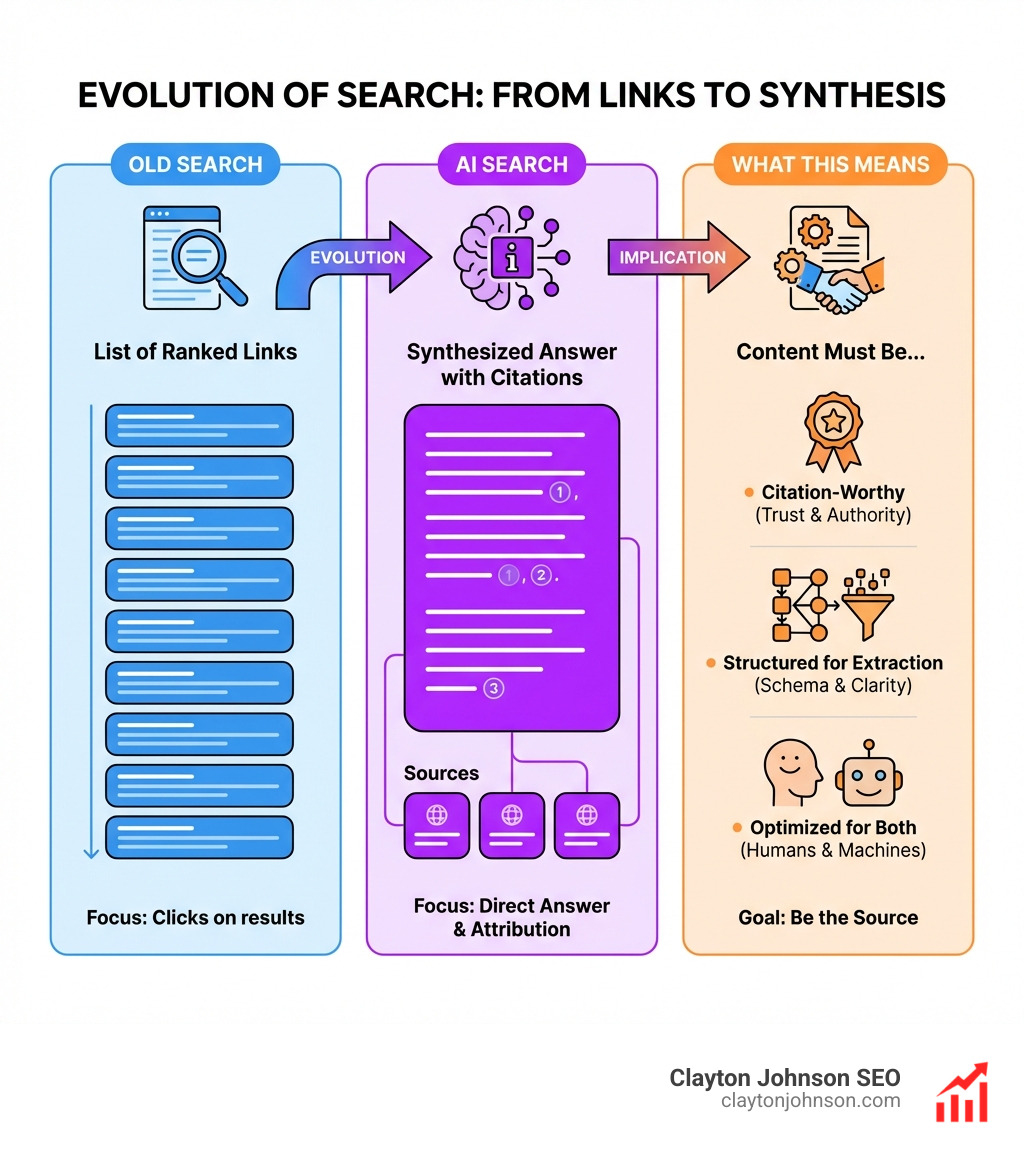
The search landscape has fundamentally changed. When a generative AI summary appears on the SERP, users click traditional result links only about 8% of the time. Meanwhile, 88% of businesses worry about losing organic visibility in AI-driven search. The problem isn’t whether to adopt AI—it’s that most teams are either ignoring it entirely or chasing unproven tactics like llms.txt files that show zero measurable impact.
The reality is simpler: AI is now the baseline. Seventy-three percent of marketers plan to implement or expand AI-integrated SEO solutions within the next year. But success requires more than just using ChatGPT to write blog posts. It demands a systematic approach that addresses how AI systems actually discover, evaluate, and cite content.
I’m Clayton Johnson, and I’ve built structured AI content SEO strategies for companies across multiple industries, focusing on measurable outcomes through search intent modeling, technical architecture, and AI-assisted workflows. Over the past two years, I’ve developed frameworks that combine traditional SEO rigor with AI-optimized content systems—because the best approach isn’t choosing between human expertise and AI tools, it’s knowing exactly how to combine them.
AI content SEO strategy word roundup:
Defining the Modern AI Content SEO Strategy
In the past, SEO was often a battle of silos. The content team wrote the blogs, the tech team fixed the tags, and the marketing leaders hoped it all worked together. Today, an AI content SEO strategy acts as the connective tissue for your entire marketing department.
When we talk about The Truth About AI SEO and Why It Matters, we are referring to the ability of artificial intelligence to unify disparate systems. Currently, 82 percent of marketers find the inability to improve organic search results and the lack of unified systems to be a major challenge. Furthermore, 62 percent of marketers say their marketing tech stack is too complex.
AI doesn’t just add another tool to the pile; it offers a way to empower overstretched marketers to unify disparate data. By using AI to connect systems, we can move from “guessing” what works to “knowing” how our content interacts with search engines. In fact, 66 percent of marketers expect SEO tool capabilities to significantly transform their marketing outcomes moving forward.
| Feature | Traditional SEO | AI-Integrated SEO |
|---|---|---|
| Keyword Research | Manual volume & difficulty checks | Automated entity mapping & intent clustering |
| Content Creation | Human-only drafting (slow) | AI-assisted drafting + human oversight (12x faster) |
| Optimization | Static keyword density | Real-time semantic relevance & NLP analysis |
| Visibility Goal | Rank in the “Ten Blue Links” | Earn citations in AI Overviews & Chatbots |
| Technical SEO | Periodic site audits | Continuous monitoring & predictive trend analysis |
Simplifying Complexity and Transforming Outcomes
The beauty of a modern AI content SEO strategy is how it makes specialized skills accessible. You no longer need a data scientist to find content gaps. Tools like Conductor and other AI-integrated platforms can analyze competitor market share and identify top-performing keywords in seconds.
By following SEO 101 principles through an AI lens, we reduce the friction between “having an idea” and “ranking for that idea.” With 73 percent of marketers adopting these solutions, the goal is to break down silos and create a common language for growth.
Navigating Google’s Policies and the Risks of AI Content
A common fear among founders is that Google will “punish” them for using AI. Let’s clear the air: Google Search’s guidance about AI-generated content explicitly states that they reward high-quality content, regardless of how it is produced. They focus on quality over origin.
However, this isn’t a license to spam. If you use AI to produce large volumes of low-value, thin content solely to manipulate rankings, you will get hit. Google’s algorithms are designed to surface helpful content that demonstrates E-E-A-T (Experience, Expertise, Authoritativeness, and Trustworthiness).
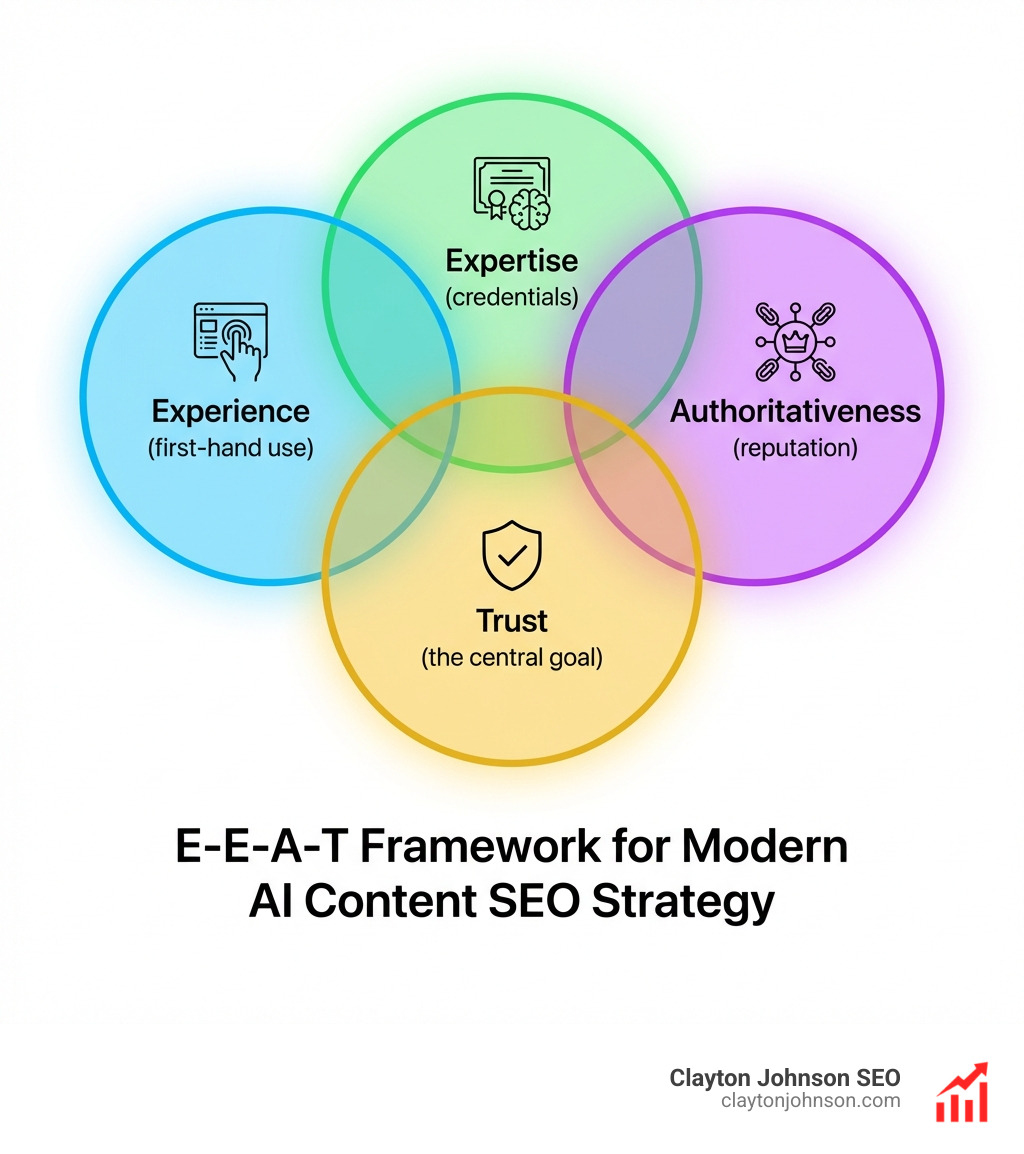
To stay safe, follow our AI content optimization guide: From Zero to Hero. The risk isn’t the AI itself; it’s the lack of SEO content depth. Generic, “mirage content” that says nothing new will fail to rank because it lacks the “Experience” part of the E-E-A-T equation.
Avoiding Penalties with Human Oversight and E-E-A-T
Marketers must establish clear ethical boundaries when using these tools. We recommend a “hybrid approach”: AI for the heavy lifting (outlining, initial research, drafting) and humans for the strategic oversight.
Every piece of content must go through Content Auditing for Humans Who Use Robots. This process includes:
- Fact-checking: AI is known to hallucinate. Always verify data.
- Brand Voice: AI often defaults to a generic tone. Inject your unique personality.
- SME Review: Have a Subject Matter Expert review the content to ensure it provides genuine value.
- Bias Review: Ensure the AI hasn’t encoded any skews or excluded minority viewpoints.
The Prioritized GEO Framework: Optimizing for AI Search Visibility
If you want to win in the age of ChatGPT and Perplexity, you need to understand Generative Engine Optimization (GEO). Traditional SEO focuses on links; GEO focuses on citations.
Our testing at Clayton Johnson SEO has shown a 77 percent correlation between ranking on Google’s first page and showing up in ChatGPT responses. For the top 3 positions, that number jumps to 82 percent. This means that traditional rankings are still the foundation of AI visibility.
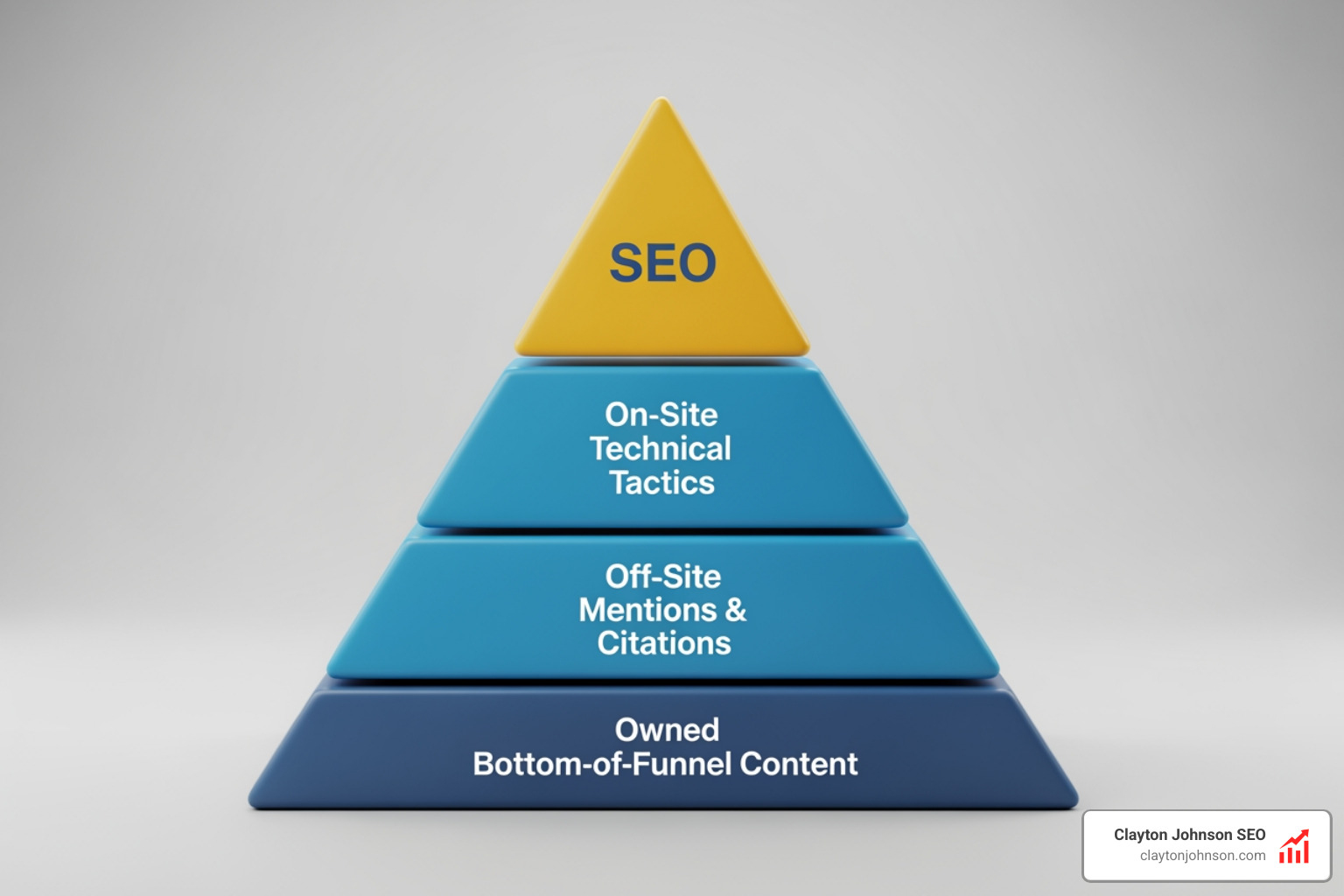
Using tools like Traqer.ai or Traqer, we can monitor whether a brand is being cited as a source. To get cited, you must build “citation-worthy” pages. These are not generic blog posts; they are ultimate guides, statistics pages, and original research reports that The Future of Search with AI-Powered Keyword Research identifies as high-priority.
For a step-by-step roadmap, we often point teams toward A 90-day SEO playbook for AI-driven search visibility.
Building an AI Content SEO Strategy for Bottom-of-Funnel Keywords
One of the biggest mistakes we see is teams focusing on top-of-funnel “educational” content for AI. Why? Because AI models are great at answering “What is content marketing?” without needing to cite you. They just give the answer, and the user never clicks.
Instead, we focus on Bottom-of-Funnel (BOFU) keywords. These include:
- Category Keywords: “Best CRM for small business”
- Comparison Pages: “Product A vs. Product B”
- Jobs-to-be-Done (JTBD): “How to automate payroll for remote teams”
Data shows that industry-specific sites are cited 86 percent of the time for product-related queries, while generic sites like Reddit are cited only 16 percent. By using an Anthropic Claude SEO Strategy: Ranking in the Age of AI, you can position your brand as the definitive answer for high-intent buyers.
Structural Shifts: Hubs, Pillars, and Machine-Readable Content
AI search engines don’t just “read” your site; they “parse” it. This requires a shift in how we structure our Organizing content for AI search: A 3-level framework.
We use The Ultimate Guide to AI Content Systems to build machine-readable hubs. One company, LS Building Products, saw a 540 percent increase in AI Overview mentions by simply optimizing their pillar pages for extraction.
Key structural tactics include:
- Answer-First Layouts: Provide the direct answer to the user’s question in the first 50 words.
- Structured data: Use FAQ, Article, and Organization schema to help AI bots understand your context.
- Predictable Linking: Follow a Hub ↔ Pillar ↔ Cluster pattern.
- Experimental Standards: While LLMs.txt is still experimental, adopting it early can give you more control over how Perplexity and other crawlers use your data.
Implementing Your AI Content SEO Strategy: Tools and Workflows
Execution is where the magic happens. Content creation becomes 12x faster when you stop staring at a blank page. We use AI-Driven SEO Audits to identify technical bottlenecks, such as site speed or crawl errors, that might prevent AI bots from indexing your best work.
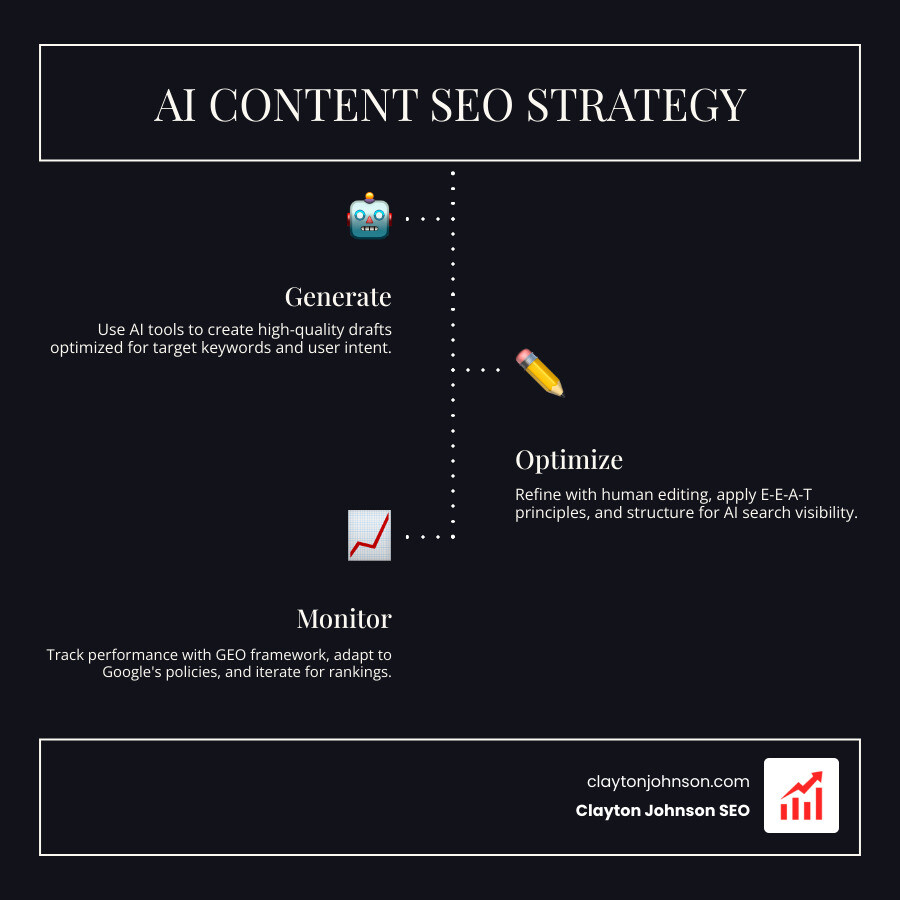
You can Level Up Your Writing with the Best AI Content Tools by integrating them into your daily workflow. For example, you can use Google Gemini to cluster keywords by intent or Automate Your Success Using AI-Driven Keyword Optimization to find semantically related terms that your competitors missed.
Don’t forget the technical SEO basics. If your site is a mess of JavaScript that AI crawlers can’t render, all the great content in the world won’t save your rankings.
Measuring Performance in an AI-First Landscape
Traditional metrics like “total traffic” are becoming less reliable. As AI-mediated discovery grows, we see more “zero-click searches.”
To understand your true impact, you need The Best Ways to Get a Free AI SEO Audit Today. We track:
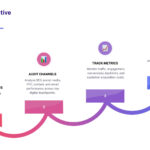
- Citation Frequency: How often is your brand mentioned in AI Overviews?
- Share of Voice: What percentage of responses for your target keywords include your brand?
- Assisted Conversions: Are users visiting your site after seeing you in ChatGPT?
Users click traditional links only about 8% of the time when a generative summary is present. This means your goal isn’t just the click—it’s being the source the AI trusts. We use tools like Traqer.ai to bridge this attribution gap.
Frequently Asked Questions about AI Content SEO
Does Google penalize AI-generated content?
No, Google does not penalize content simply because it was made by AI. Their Google Search’s guidance about AI-generated content emphasizes that they reward high-quality, helpful content that follows E-E-A-T principles. They only penalize content that is low-quality, spammy, or created solely to manipulate search rankings.
How does AI search change keyword research?
AI search shifts the focus from simple query strings to entities and topics. Instead of just looking for “best running shoes,” you need to map out the entire “entity” of running gear. The Future of Search with AI-Powered Keyword Research involves analyzing conversational prompts—the actual questions users ask ChatGPT—to ensure your content provides direct, extractable answers.
What are the best tools for an AI content SEO strategy?
We recommend a balanced stack. Semrush is excellent for traditional keyword data and AI-driven writing assistance. Traqer is essential for monitoring your visibility in LLM responses. For more options, check out our guide: Stop Guessing and Start Ranking with These AI SEO Tools.
Conclusion
The transition to an AI content SEO strategy isn’t just about efficiency—it’s about survival in a landscape where the “front door” to the internet is changing. At Clayton Johnson SEO, we serve as growth strategists for brands looking to navigate this shift. Whether you are in Minneapolis or scaling a global B2B SaaS platform, the fundamentals remain the same: build authority, structure for machines, and write for humans.
We provide actionable frameworks and content systems that help founders diagnose growth problems and execute with measurable results. Why Your Brand Needs an AI Growth Strategy Right Now is clear: the revenue shift toward AI discovery is already happening.
Ready to future-proof your search presence? Get started with our SEO Services and let’s build a content engine that wins in both the Google and AI eras.