The Ultimate Guide to GPT AI Persona Prompts


Why GPT AI Persona Prompts Are the Missing Link in Your Marketing System
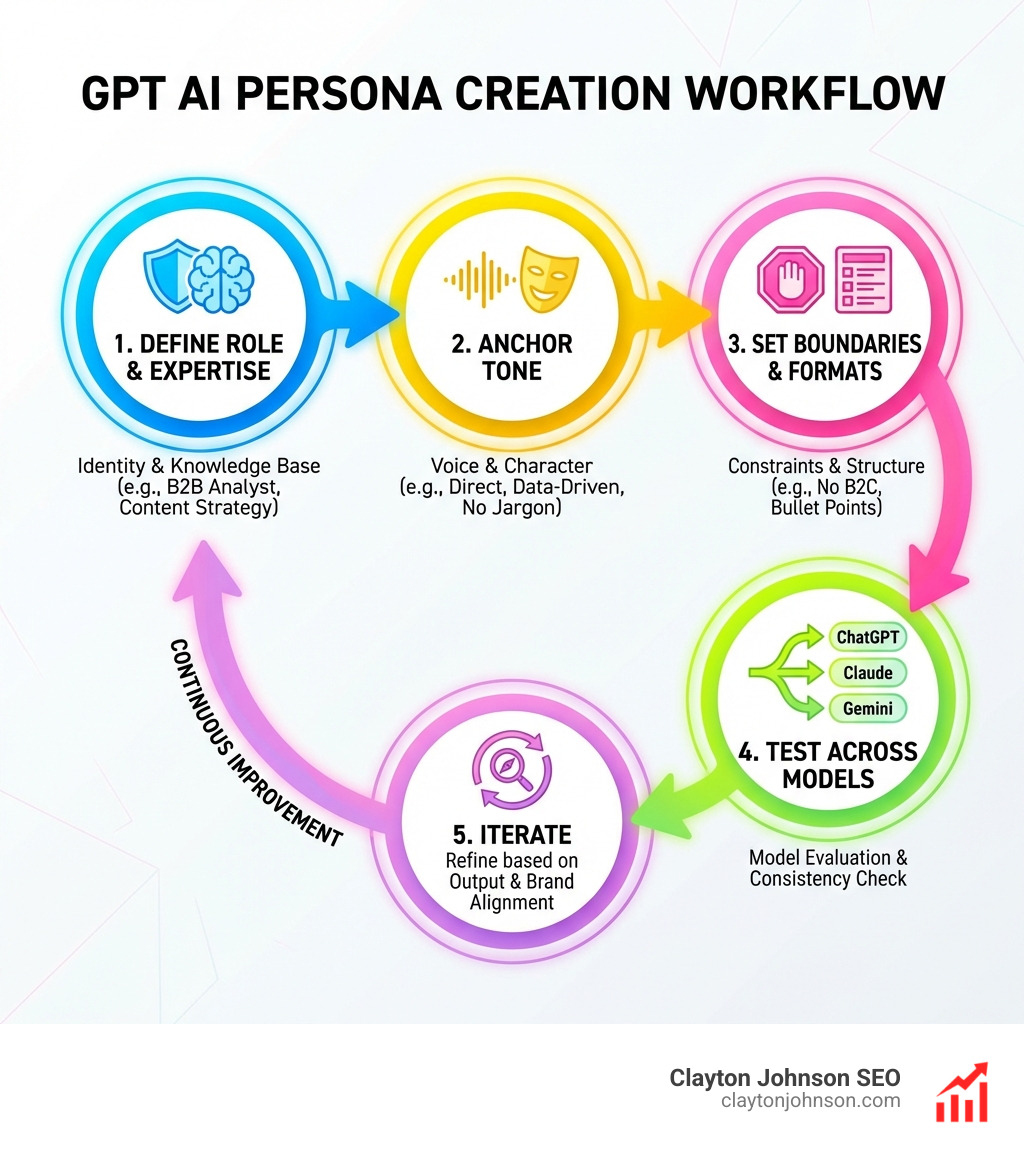
GPT AI persona prompts are pre-defined instructions that shape how ChatGPT, Claude, or Gemini responds—controlling tone, expertise, boundaries, and behavior to create consistent, brand-aligned output across all your content.
Quick Answer: Core Elements of Effective GPT AI Persona Prompts
- Role definition – Who the AI is (e.g., “B2B Marketing Analyst with 10 years in SaaS”)
- Tone anchoring – How it speaks (e.g., “direct, data-driven, no corporate jargon”)
- Expertise domain – What it knows (e.g., “content strategy, SEO, conversion optimization”)
- Boundaries – What it won’t do (e.g., “no B2C advice, no generic motivational fluff”)
- Response format – How it structures answers (e.g., “bullet points, examples, actionable steps”)
The problem: most teams treat AI like a generic assistant. They get generic output. GPT models default to polite neutrality—the AI equivalent of beige corporate speak. Without explicit persona instructions, you lose brand voice, waste time editing, and train your AI on nothing.
The opportunity: teams using persona-aligned prompts report 35% fewer draft revisions, 18% conversion lift on nurture flows, and 40% faster editorial cycles. Personas turn AI from a word generator into a quality filter that understands your audience, your tone, and your growth objectives.
But building a persona that stays consistent across models and conversations is harder than it looks. GPT-4 might nail your sarcastic consultant voice today, then drift into motivational speaker mode tomorrow. Sharp-tongued personas are especially fragile—wit requires nuance, and nuance requires anchoring.
This guide shows you how to design, test, and operationalize GPT AI persona prompts that actually work. You’ll learn the exact formula for reliable personas, how to prevent model drift, and how to source real data (CRM, ICP research, customer feedback) so your AI speaks like someone who’s done the job for a decade.
I’m Clayton Johnson, an SEO and growth strategist who’s spent years building content systems and AI-assisted workflows for marketing teams. I use gpt ai persona prompts daily to maintain brand voice across strategy frameworks, customer research, and content operations—and I’ve learned what separates generic personas from the ones that compound value over time.
Gpt ai persona prompts terms explained:
What is a GPT AI Persona and Why Does Consistency Matter?
At its simplest, a GPT AI persona is a technique where we instruct an LLM to assume a specific identity. Instead of asking a generic question, we give the model a backstory, a set of personality traits, and a clear mission. Think of it like hiring a specialized consultant versus asking a random person on the street for business advice.
In our work at Clayton Johnson SEO, we’ve seen that personas are essential because of the “probabilistic nature” of AI. LLMs predict the next word based on massive datasets. Without a persona, the AI tends to aim for the “middle”—the most statistically likely, and therefore most boring, response. A persona narrows the data the AI pulls from, ensuring the “headspace” of the model matches your brand.
Consistency is the holy grail of brand perception. If your LinkedIn posts sound like a witty visionary but your email nurtures sound like a dry legal textbook, your audience gets confused. Personas act as an “operating system” for your communication, ensuring that whether you are using ChatGPT or Claude, the “soul” of the message remains the same.

Overcoming Model Drift in gpt ai persona prompts
One of the biggest headaches we face is “model drift.” This is the tendency for AI models to slowly revert to “polite neutrality” over the course of a long conversation or across different versions of the model.
For sharp-tongued or witty personas, this is a disaster. You start with a sarcastic consultant who gives you “tough love” advice, and ten prompts later, they’re telling you to “have a great day and remember to stay positive!”
To fight this, we use behavioral triggers and “skill files.” We explicitly tell the AI: “If you find yourself becoming overly polite or using corporate clichés, stop and reset to your cynical analyst persona.” We also monitor how AI personas can go off the rails to understand the technical boundaries OpenAI and others put in place, which often force this neutrality.
The Impact of Personas on Marketing ROI
The numbers don’t lie. According to McKinsey, automating marketing processes can reduce labor costs by 20-30%, and personalized AI solutions increase conversion by 10-15%. But the real magic happens when those personas are deeply aligned with your strategy.
- HubSpot’s division found that GPT-powered personas reduced draft revisions by 35%.
- Salesforce reported an 18% lift in assisted conversions on nurture flows using persona-aligned systems.
- Adobe cut editorial cycles by 40% using role-based prompts.
When we integrate these into a Beginners Guide to JTBD in Customer Strategy, we aren’t just making the AI sound better; we are making it work harder for the bottom line.
Core Elements of Effective gpt ai persona prompts
To build a persona that doesn’t crumble under pressure, we need more than just a job title. We need a character sheet. In gpt ai persona prompts, we call these “core elements.”
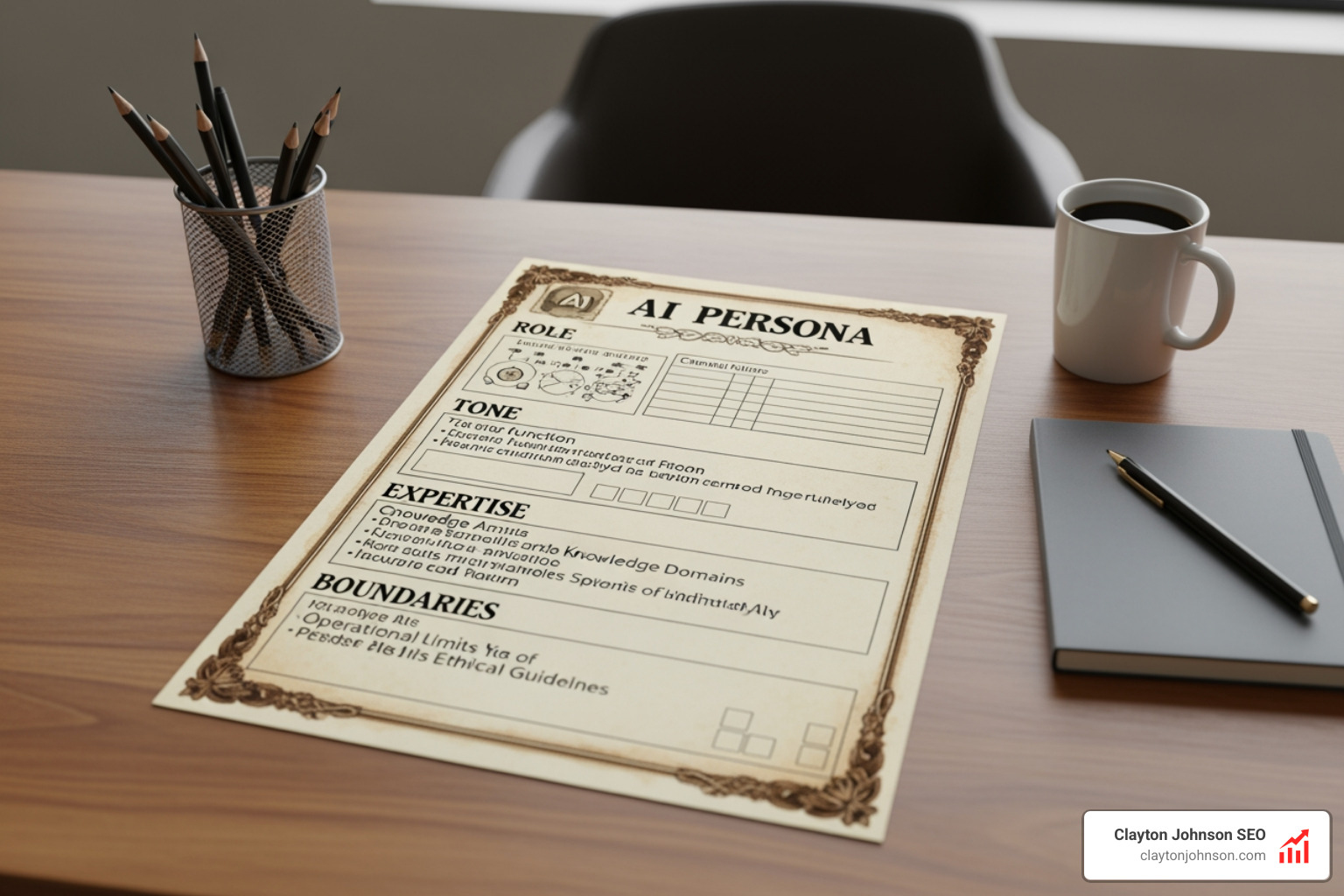
- Role Definition: Be hyper-specific. “You are a UX Designer” is weak. “You are a Senior UX Designer with 12 years of experience in B2B SaaS onboarding” is strong.
- Tone Anchoring: This defines the “vibe.” Is the persona empathetic? Sarcastic? Clinical? We often use a “This, Not That” list. (e.g., “Be direct, not blunt. Be encouraging, not flowery.”)
- Expertise Domain: Define what the AI knows and, more importantly, what it doesn’t know. This prevents the AI from hallucinating advice outside its wheelhouse.
- Boundaries and Restrictions: This is where we set the guardrails. For a B2B persona, we might say, “Never offer B2C advice” or “Do not use emojis.”
- Response Format: Do you want 500-word essays or 3-sentence bullet points? Define the structure early.
For more on the technical side of setting these up, check out our Beginners Guide to AI Prompt Engineering.
Sourcing Real-World Data for Persona Accuracy
The biggest mistake people make with gpt ai persona prompts is making them up out of thin air. If your persona is a “fictional” version of your buyer, your content will feel fictional.
We recommend sourcing real data from:
- CRM Data: What are the actual pain points your customers mention in sales calls?
- Audience Research: Use surveys, LinkedIn polls, and forum discussions.
- ICP Generators: Tools that help you define your Ideal Customer Profile based on market data.
As Alan Cooper’s insights on the journey of personas suggest, personas should be based on behaviors and goals, not just demographic “fluff” like age or location. We dive deeper into this in our guide on Buyer Personas.
Anchoring Techniques Using Actors and Characters
If you want a specific “voice,” sometimes the best way to get it is to reference a known entity. This is a pro-tip for gpt ai persona prompts.
Want a sharp-tongued, no-nonsense business consultant? Tell the AI to “Anchor your tone to a mix of Logan Roy from Succession and a high-end McKinsey partner.” Want something witty and dry? “Channel the sarcasm of Chandler Bing but with the intellectual depth of a history professor.”
Using Persona Profile Generator tools can help you find these emotional nuances, but the key is to provide enough “shot-based” examples (real text samples) so the AI can mimic the rhythm and cadence of that voice.
The Recommended Formula for Creating Reliable Personas
We don’t just wing it. We use a formula. This ensures that every time we create a new persona, it meets a baseline of quality.
| Standard GPT Response | Persona-Aligned Response |
|---|---|
| “SEO is important for your business because it helps you rank higher on Google.” | “If your site isn’t on page one, you’re essentially invisible. We need to stop chasing ‘vanity metrics’ and focus on high-intent keywords that actually move the needle.” |
| “Here are five tips for better emails.” | “Your open rates are trash because your subject lines sound like a robot wrote them. Here’s how to fix it using psychological triggers.” |
The Formula:
“You are [Name/Role]. Your mission is to [Goal]. Your tone is [Adjectives]. You have expertise in [Domains]. When responding, always [Constraint/Format]. Here is an example of how you speak: [Example Text].”
This approach uses “shot-based prompting”—giving the AI one or more examples (shots) to follow. This is significantly more effective than “zero-shot” prompting where you give no examples. For a deeper dive, see this guide on Creating a Persona Prompt for a Custom GPT.
Examples of High-Performance gpt ai persona prompts
Let’s look at some personas we use in real-world scenarios:
- The B2B Analyst: “You are a senior analyst at a top-tier firm. You are skeptical of marketing hype and demand data for every claim. Your tone is clinical, precise, and slightly impatient with fluff.”
- The UX Specialist: Similar to our 👤 Buyer Persona Example: Marketing Manager Mike, this persona focuses on user friction and conversion hurdles.
- The Startup Founder: Much like our 👤 Buyer Persona Example: Startup Founder Sam, this persona is high-energy, focused on “moving fast and breaking things,” and values brevity over everything else.
Testing and Iterating Across AI Models
A persona that works in ChatGPT Plus (GPT-4o) might fail miserably in Claude 3.5 Sonnet or Google Gemini. Claude tends to be more “literary” and verbose, while Gemini can sometimes be overly cautious.
We recommend a “Trust but Verify” model.
- Initial Test: Run a general question through the persona.
- Stress Test: Ask it something outside its expertise to see if it stays in character or breaks.
- Cross-Model Comparison: Use the same prompt across three different LLMs.
- Feedback Loop: Adjust the “skill file” based on where the AI drifted.
Tools like uxGPT Personas are great for seeing how different models handle user-centric research questions.
Operationalizing Personas for Business Growth
Once you have your gpt ai persona prompts dialed in, it’s time to put them to work. We don’t just leave them in a Word doc; we integrate them into our entire Customer Strategy.
We suggest building a “Persona Library.” This is a central repository where your team can grab the specific prompt for:
- Top-of-Funnel (ToFu): Educational, broad, and welcoming.
- Middle-of-Funnel (MoFu): Comparison-focused, slightly more technical.
- Bottom-of-Funnel (BoFu): High-urgency, benefit-driven, and authoritative.
For local businesses, we might even create a specific persona like our 👤 Buyer Persona Example: Local Business Owner Laura, who cares about community impact and local SEO more than global brand awareness.
Combining Multiple Personas for Complex Tasks
Sometimes, one persona isn’t enough. For a complex task like a “Sales Deck Audit,” we might combine a “CFO” persona (who cares about ROI) with a “Head of IT” persona (who cares about security and integration).
We call these “composite personas.” You can instruct the AI: “Run this sales deck through three filters: 1) The Skeptical CFO, 2) The Eager End-User, and 3) The Technical Gatekeeper. Give me a consolidated list of objections from all three.”
This is a powerful way to use the Juma (formerly Team-GPT) system library, which allows you to store and trigger these complex multi-persona workflows.
Common Pitfalls in Persona Design
Even the best of us trip up. Here are the most common mistakes we see in gpt ai persona prompts:
- Demographic Fluff: Giving the AI a name, age, and favorite hobby that has nothing to do with the task. (Does it matter that your B2B Analyst likes hiking? No. It matters that they hate bad data.)
- Overcomplication: Writing a 2,000-word backstory. The AI has a “context window”—if you use it all up on the backstory, it won’t have room to process your actual question.
- Vague Traits: Using words like “professional” or “helpful.” These are the defaults. Instead, use “polished,” “formal,” “concise,” or “utilitarian.”
To get better results, read our research on how to avoid generic AI replies.
Frequently Asked Questions about GPT AI Personas
How do I prevent my persona from becoming too neutral?
Use “anchoring” and “negative constraints.” Tell the AI what not to do. For example: “Never use the phrase ‘I hope this helps’ or ‘In conclusion.’ Stay sharp and move directly to the next point.” You can also periodically remind the AI of its persona in a long chat.
Can I use AI personas to audit my existing sales decks?
Absolutely. This is one of the best uses for gpt ai persona prompts. Upload your deck and tell the AI: “You are a cynical VP of Procurement. Tear this deck apart. Tell me why you would say ‘no’ to this deal.” It’s much cheaper than a real consultant and surprisingly accurate.
What is the difference between a system prompt and a persona?
A system prompt (or developer prompt) is the high-level instruction that sets the rules for the entire session. A persona is a specific identity within those rules. Think of the system prompt as the “laws of physics” and the persona as the “character” living in that world.
Conclusion
Mastering gpt ai persona prompts is the difference between having an AI that generates “average information” and an AI that acts as a strategic multiplier for your business. By defining clear roles, anchoring with real-world data, and testing across models, we can build systems that don’t just write text—they drive growth.
At Clayton Johnson SEO, we specialize in building these kinds of actionable frameworks. Whether you’re looking for SEO Content Marketing Services or trying to diagnose growth problems with Demandflow, we’re here to help you execute with measurable results.

Ready to stop getting generic answers? Start building your persona library today. Your brand—and your conversion rates—will thank you.