Top Strategic Frameworks Every Business Strategist Must Know


Why Strategic Frameworks Are the Foundation of Every Winning Business Strategy
Strategic frameworks are structured tools that help businesses analyze their environment, set goals, and execute plans with clarity. Here are the most widely used ones:
| Framework | Best For |
|---|---|
| SWOT Analysis | Internal/external position assessment |
| Porter’s Five Forces | Industry attractiveness and competition |
| Balanced Scorecard | Strategy execution across four perspectives |
| OKRs | Goal-setting and quarterly performance cycles |
| PESTEL | Macro-environment scanning |
| Ansoff Matrix | Growth and market expansion decisions |
| Blue Ocean Strategy | Innovation and uncontested market creation |
| Jobs to Be Done | Customer need identification and product fit |
Strategy sessions that start with big ideas and end in confusion are incredibly common. Teams brainstorm, debate, and then… nothing sticks. The plan sits in a PDF. Execution drifts. 🤔
The root problem? Most organizations lack a structured way to think, prioritize, and act.
That’s exactly what strategic frameworks solve.
They don’t hand you answers. They help you ask better questions — about your market, your competitors, your resources, and your goals. Whether you’re diagnosing a growth problem, planning a market expansion, or aligning a cross-functional team, the right framework turns ambiguity into a clear path forward.
And the stakes are real. Research shows organizations with mature strategic planning capabilities are 3.7x more likely to achieve their objectives — and see up to 167% higher market performance.
Strategy has also fundamentally changed. The old model — a static five-year plan gathering dust — no longer works in fast-moving markets. Today, strategy is a dynamic, collaborative, and continuously evolving process. The frameworks you choose need to support that kind of agility.
I’m Clayton Johnson, an SEO strategist and growth operator who has built structured strategic frameworks into the foundation of scaling businesses across content architecture, competitive positioning, and AI-assisted workflows. In this guide, I’ll walk you through the most essential frameworks every business strategist needs in their toolkit — and exactly when to use each one.
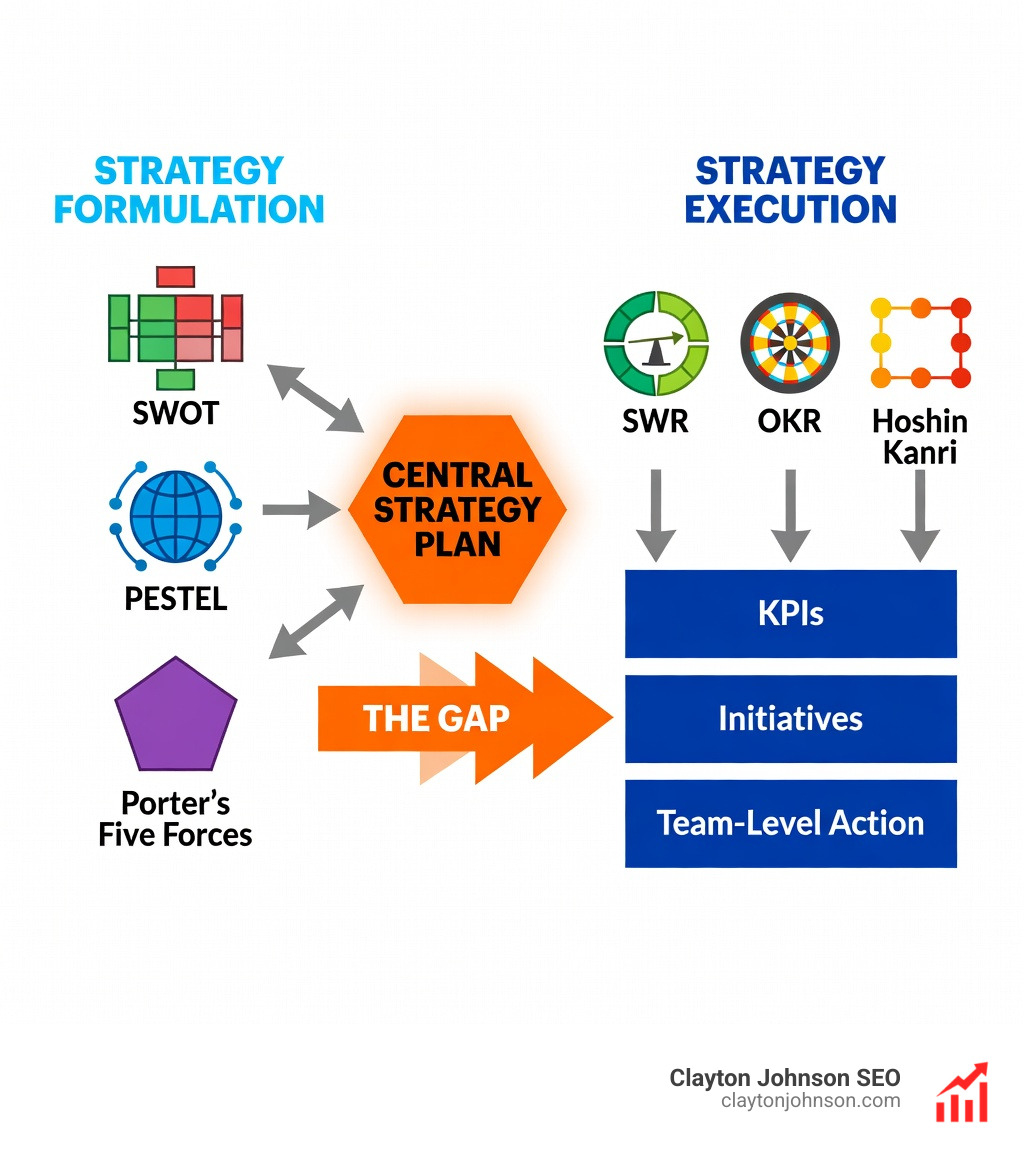
Understanding Strategic Frameworks and Their Role in Modern Business
To build a great business, we need a solid foundation. Think of your strategy as a building. Without a scaffold, you’re just stacking bricks and hoping they don’t fall on your head.

A strategic framework is a tool that helps us focus on and fill specific elements of our business plan. It’s the “how” behind the “what.” While many people use the terms “model” and “framework” interchangeably, there is a helpful distinction.
As Tom Wright, CEO of Cascade Strategy, explains in this blog post, a strategic planning model is like an airport blueprint—it shows the high-level connections between roads, terminals, and gates. A framework, however, is the specific tool used to optimize the flow of passengers through security or manage the baggage handling system. You need the model for the big picture, but you need the framework to get the work done.
By using Strategic Frameworks, we move away from “winging it” and toward structured thinking. This structured approach is the operating system of top-tier management consulting because it turns ambiguous problems into defensible recommendations.
Why Strategic Frameworks are Essential for Agility
In today’s volatile market, we can’t afford to be static. Organizations that thrive use what we call an “Always-On Strategy.” This means bridging the gap between current business outcomes and desired ones through continuous feedback.
Frameworks are essential for:
- Resource Allocation: Ensuring we spend money and time on the 20% of activities that drive 80% of the results (the Pareto principle).
- Decision Speed: Making high-stakes choices faster with fewer blind spots.
- Continuous Adaptation: Shifting tactics without losing sight of the long-term mission.
If you’re looking to dive deeper into how to structure these plans, you can access this free strategy formulation e-book to help sharpen your approach.
The Evolution of Strategic Thinking
Strategy used to be a heavy, top-down affair. Executives would retreat to a mountain (or a boardroom in Minneapolis), write a 50-page document, and then tell everyone to follow it for five years.
Today, strategy is collaborative. It’s about creating shared mental models. When everyone in the organization understands the framework being used—whether it’s a SWOT or a Balanced Scorecard—they can prioritize their own work with clarity. To see how these conversations happen in the real world, check out the HBS Online YouTube channel for expert strategy insights.
Essential Frameworks for Strategy Formulation and Analysis
Before we can execute, we have to analyze. We need to look outside at the market and inside at our own capabilities.

External Analysis: PESTEL and Porter’s Five Forces
To understand the world around us, we use PESTEL Analysis. This scans the macro-environment across six lenses: Political, Economic, Social, Technological, Environmental, and Legal. It’s the ultimate “heads-up” tool to ensure we aren’t blindsided by a new regulation or a shift in consumer culture.
Once we know the macro-landscape, we zoom in on our industry using Porter’s Five Forces. This framework assesses:
- Threat of New Entrants: How easy is it for someone to start a competing business?
- Bargaining Power of Suppliers: Can our suppliers hike prices easily?
- Bargaining Power of Buyers: Do our customers have the power to drive our prices down?
- Threat of Substitutes: Can customers “hire” a different type of product to do the same job?
- Competitive Rivalry: How intense is the fight for market share?
Using a Five Forces Template helps determine if an industry is actually attractive before we commit resources to it.
Internal Analysis: SWOT and VRIO Frameworks
Now we look in the mirror. SWOT Analysis is the classic starting point. But a “lazy SWOT” is just a list of generic guesses. A rigorous SWOT uses data—like “72% aided brand recall” instead of just “strong brand.”
To dig deeper into whether our strengths actually provide a sustainable advantage, we use the VRIO Framework. We ask four questions about our resources:
- Value: Does this resource allow us to exploit an opportunity or neutralize a threat?
- Rarity: Is it controlled by only a few firms?
- Imitability: Is it expensive or difficult for others to copy?
- Organization: Are we organized to capture the value of this resource?
If you answer “yes” to all four, you’ve found your “secret sauce.” You can use a VRIO Template to audit your internal assets systematically.
Leading Frameworks for Strategy Execution and Performance
Analysis is great, but execution is where the money is made.
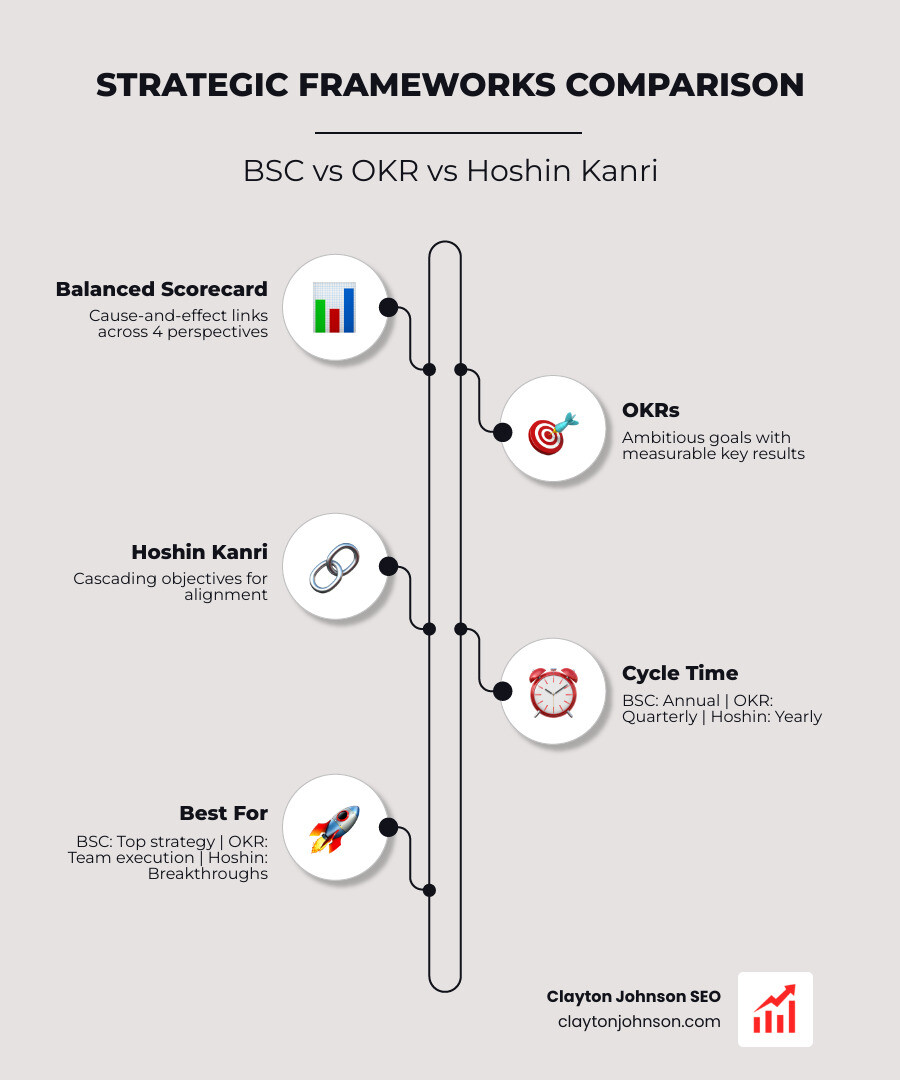
The Balanced Scorecard (BSC)
The Balanced Scorecard is one of the most widely used strategic frameworks in history. It prevents “tunnel vision” by forcing us to look at the business through four distinct perspectives:
- Financial: To succeed financially, how should we appear to our shareholders?
- Customer: To achieve our vision, how should we appear to our customers?
- Internal Business Processes: To satisfy our shareholders and customers, at what business processes must we excel?
- Learning and Growth: To achieve our vision, how will we sustain our ability to change and improve?
By connecting these with a strategy map, we can see the cause-and-effect relationship between training our staff (Learning) and increasing our profit (Financial).
Objectives and Key Results (OKRs)
While the BSC is great for top-level long-term planning, OKRs are built for agility and execution. Originally used at Intel and popularized by Google, OKRs consist of:
- Objectives: Memorable, qualitative descriptions of what you want to achieve (e.g., “Dominating the Minneapolis SEO market”).
- Key Results: A set of 3-5 metrics that measure progress toward the Objective (e.g., “Secure 25+ five-star reviews by the end of Q2”).
OKRs typically run on quarterly cycles, making them perfect for Change Management and rapid Process Improvement. You can download an OKR Template to start setting more ambitious, measurable goals today.
Specialized Strategic Frameworks for Growth and Innovation
Sometimes the standard tools aren’t enough. When we need to grow or disrupt a market, we turn to specialized Innovation Models.
Blue Ocean Strategy and the Value Stick
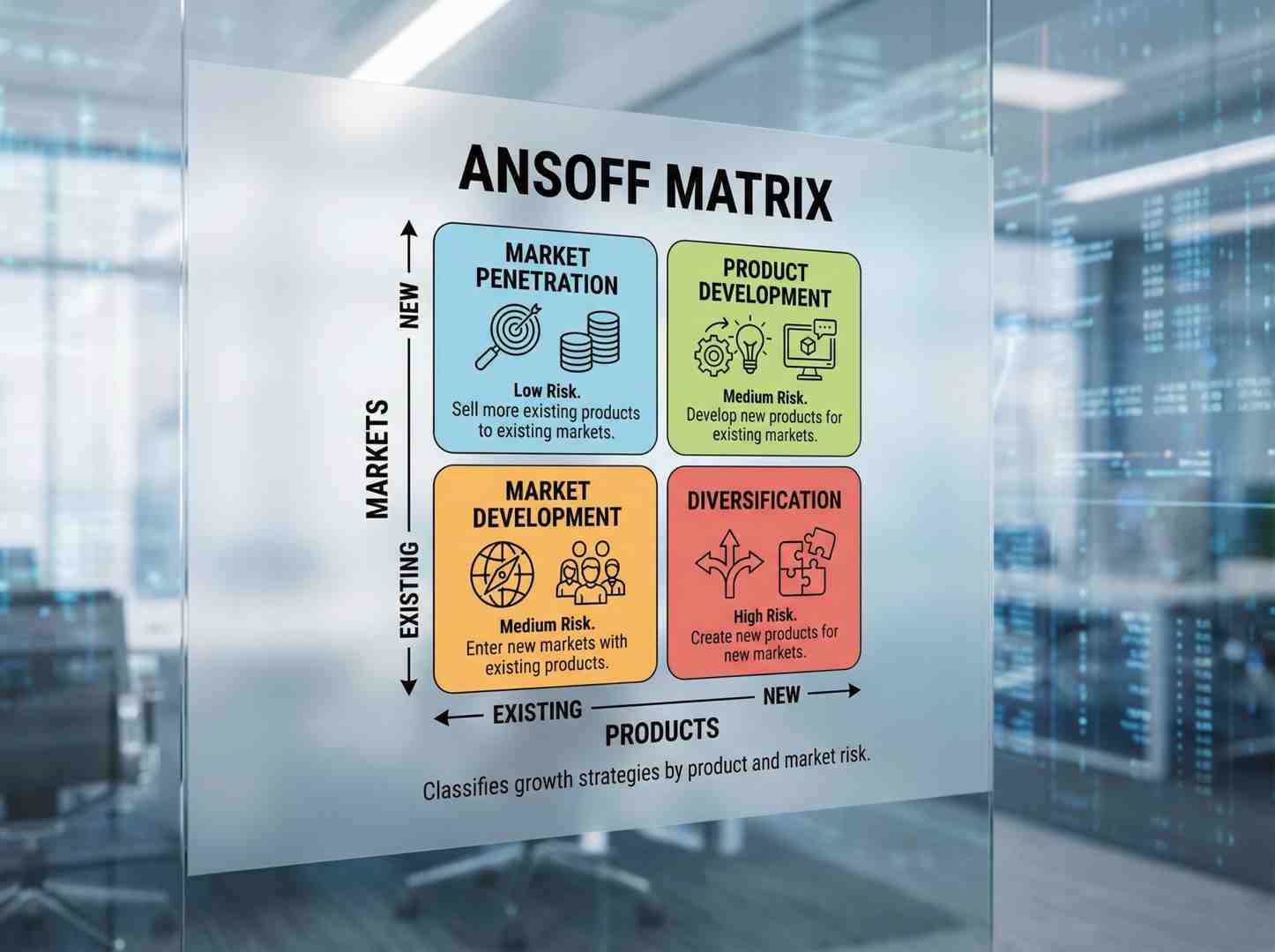
The Ansoff Matrix helps us decide where to grow, but Blue Ocean Strategy helps us decide how to win. Instead of fighting in a “Red Ocean” of bloody competition, we look for “Blue Oceans”—uncontested market spaces where the competition is irrelevant.
To test these ideas, we can use the Value Stick. This tool visualizes the relationship between:
- Willingness to Pay (WTP): The maximum a customer will pay.
- Price: What we actually charge.
- Cost: What it costs us to produce.
- Willingness to Sell (WTS): The minimum suppliers/employees will accept.
The goal is to expand the “value gap” by either increasing WTP or decreasing WTS through innovation.
Jobs to Be Done (JTBD) and Disruptive Innovation
The Jobs to Be Done framework changes how we look at customers. People don’t just buy products; they “hire” them to do a job.
For example, Kind Snacks’ breakfast bars aren’t just food; they are “hired” to solve the job of “giving me a healthy, one-to-go meal that keeps me full until lunch.” When we understand the “job,” we can design better products and more effective Business Model Canvases.
This often leads to Disruptive Innovation, a term coined by Clayton Christensen. This happens when a smaller company with fewer resources successfully challenges established incumbents by targeting overlooked segments (low-end disruption) or creating a new market entirely.
Frequently Asked Questions about Strategic Planning
What is the difference between a strategy model and a strategy framework?
Think of a model as the “what” and a framework as the “how.” A model provides the high-level structure and logic of your plan—like a blueprint. A framework provides the detailed tools and categories to fill in that plan. As we mentioned earlier, the airport analogy is the easiest way to remember this: the model is the blueprint of the whole airport; the framework is the specific system that optimizes passenger flow.
How do organizations choose the right strategic framework?
The choice depends on your goal and your maturity level.
- If you’re starting from scratch, use a Strategic Roadmap to frame your purpose.
- If you’re in a highly competitive market, use Porter’s Five Forces.
- If you’re struggling with execution, move toward OKRs.
Don’t use 10 frameworks at once; pick 2-3 that address your biggest current questions.
Can multiple frameworks be combined effectively?
Absolutely! In fact, the best strategists sequence them. You might start with a PESTEL to understand the world, feed those insights into a SWOT, and then use the McKinsey 7S Framework to ensure your internal organization is aligned to execute that new strategy. The key is to ensure they all point toward the same mission.
Conclusion
At Demandflow, we believe that most companies don’t lack tactics—they lack structured growth architecture. Strategy shouldn’t be a mystery or a “gut feeling.” It should be a repeatable system that leads to compounding growth.
By mastering these strategic frameworks, you move from reactive firefighting to proactive leadership. You gain the clarity to say “no” to the wrong opportunities and the structure to execute the right ones flawlessly.
Ready to find the right path for your specific goals? You can download this free strategy flowchart to see which HBS Online course or framework path is right for you. For more deep dives into building a structured growth engine, explore our full Strategic Frameworks Guide.
Let’s stop winging it and start building. 🚀