Why Your Business Needs Better Personas and How to Build Them

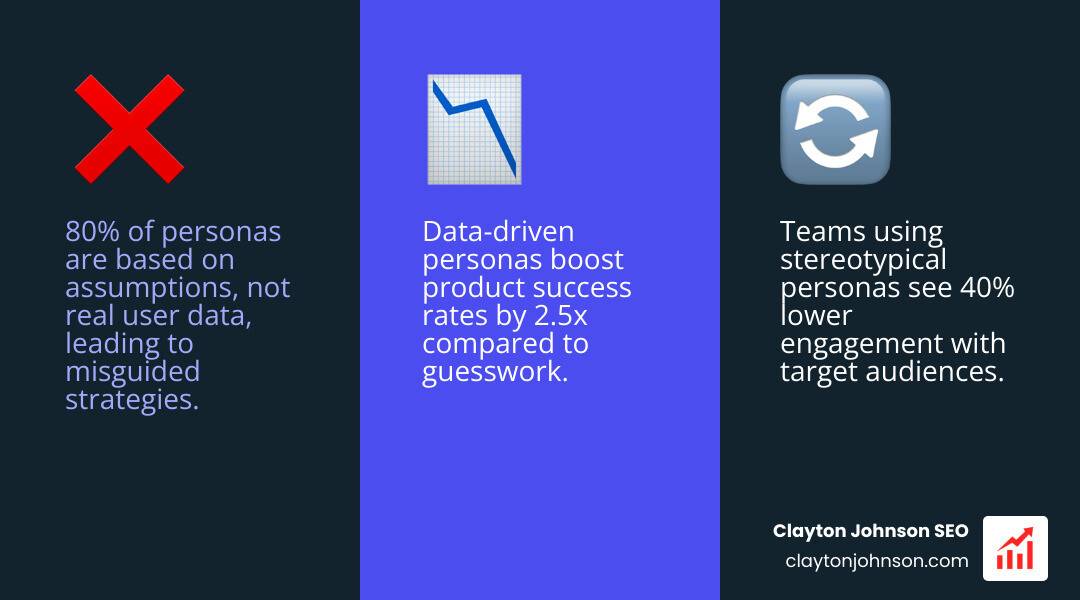
Best practices for personas are the difference between a research artifact that collects dust and a strategic tool that drives every design and content decision your team makes.
Here is a quick summary of what effective persona best practices look like:
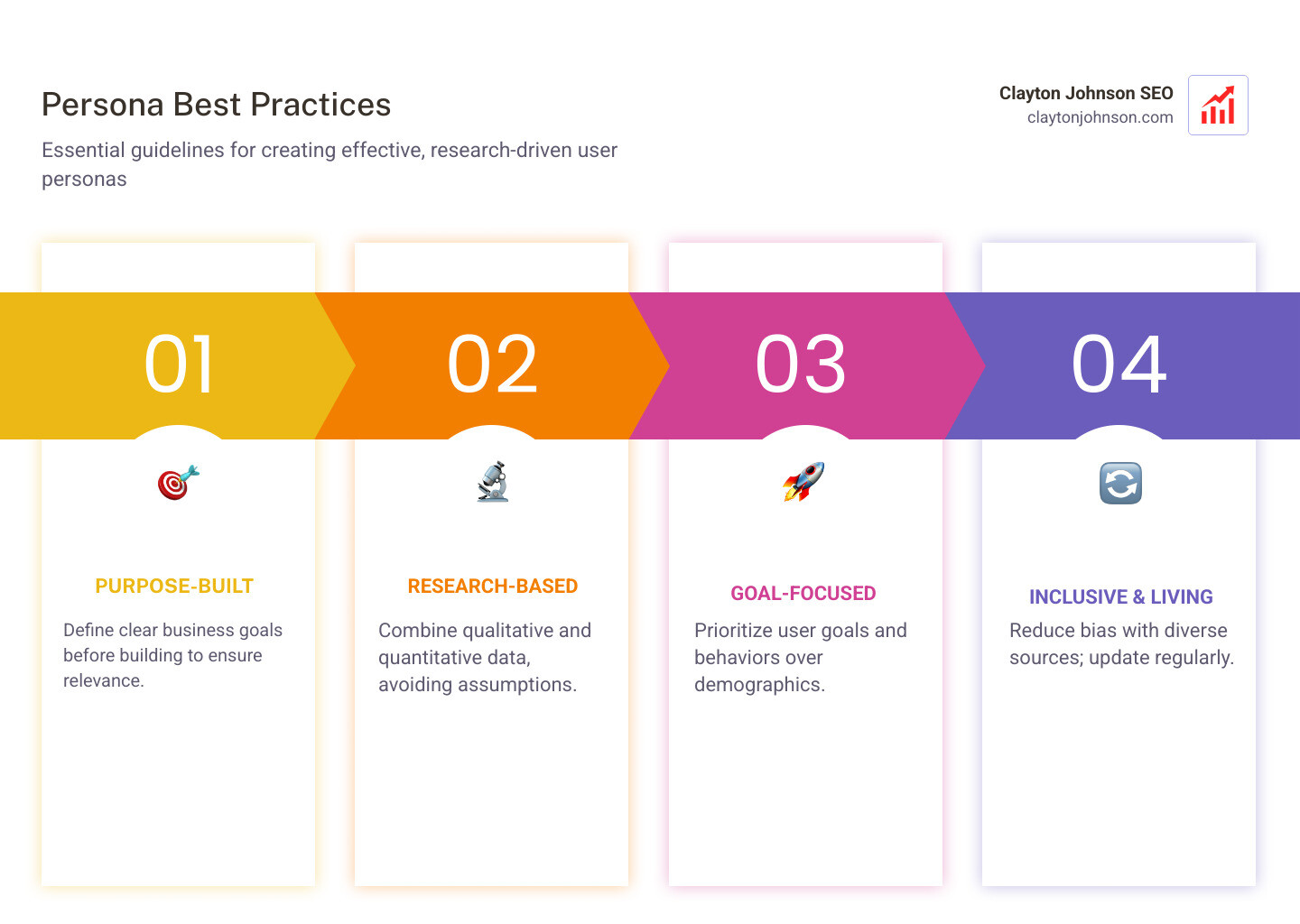
- Make them purpose-built – Define a clear business goal before you start building
- Base them on real research – Use a mix of qualitative and quantitative data, not assumptions
- Focus on goals and behaviors – Prioritize what users want to accomplish, not just demographics
- Keep them inclusive – Actively reduce bias by using diverse data sources and representative profiles
- Treat them as living documents – Revisit and refine personas as your product and users evolve
- Involve your team – Co-create personas to increase buy-in and consistent usage
- Keep them concise – Include only details that directly inform design decisions
Most organizations have personas. Few use them well. As research from Forrester makes clear, the problem is rarely the concept itself — it is the execution. Personas built on assumptions, bloated with irrelevant data, or created without a clear purpose end up ignored. Meanwhile, teams keep designing for a vague, imaginary user that satisfies no one.
The cost is real. Without accurate personas, design decisions get made by whoever speaks loudest in the room — not by what your actual users need. That leads to products that miss, content that does not convert, and growth that stalls.
The good news: fixing your personas is not complicated. It just requires the right process.
I’m Clayton Johnson, an SEO strategist and growth systems architect who has helped founders and marketing leaders build structured, research-driven frameworks — including the best practices for personas that align teams and drive measurable outcomes. In the sections ahead, I will walk you through exactly how to build personas that actually get used.
The Strategic Value of User-Centered Personas
At its core, a persona is a user archetype—a fictional but realistic representation of a segment of your audience. These are not just “profiles”; they are empathy-building tools. When we talk about best practices for personas, we are talking about moving away from flat statistics toward a deep understanding of human needs.
The concept was popularized by Alan Cooper in his seminal book, The Inmates Are Running the Asylum. He argued that if you try to design for everyone, you end up designing for no one. By focusing on a specific, well-researched character, you create a “north star” for your team.
In design thinking, personas serve as a common vocabulary. Instead of saying, “I think the user wants a bigger button,” a team member can say, “Would ‘Marketing Manager Mike’ find this button intuitive while he’s rushing between meetings?” This shift in language prevents personal bias from dictating the product roadmap.
According to research from the Nielsen Norman Group, personas make users memorable. Humans are wired to remember stories and specific faces much better than they remember spreadsheets. By humanizing your data, you ensure that the user’s voice is present in every meeting, even when they aren’t in the room. This ties directly into our beginners guide to jtbd in customer strategy, where we focus on the “jobs” users are trying to get done.
Distinguishing Design Personas from Marketing Segments
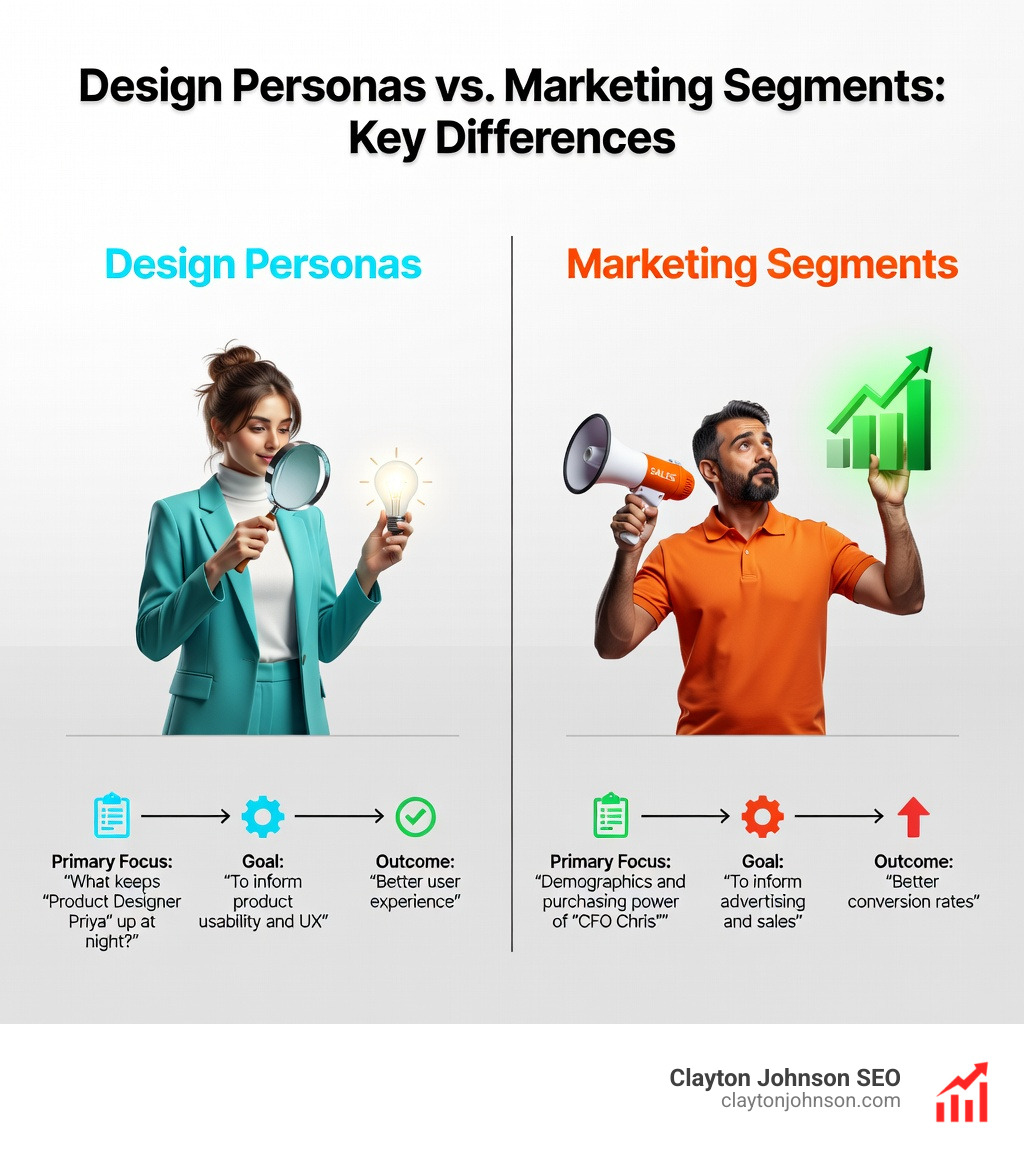
A common mistake we see is using marketing segments as a substitute for design personas. While they share some DNA, their purposes are fundamentally different.
Marketing segments focus on buying behavior, demographics, and marketability. They answer the question: “Who is likely to pay for this?” Design personas, on the other hand, focus on interaction behavior. They answer: “How will this person use the product to achieve their goal?”
| Feature | Design Personas | Marketing Segments |
|---|---|---|
| Primary Focus | Goals, tasks, and pain points | Demographics and purchasing power |
| Goal | To inform product usability and UX | To inform advertising and sales |
| Data Source | Contextual inquiry and observations | Surveys and transactional data |
| Outcome | Better user experience | Better conversion rates |
Best practices for personas: Moving Beyond Stereotypes
If your persona looks like a stock photo with a list of hobbies like “loves hiking” and “drinks craft beer,” you’ve probably built a stereotype, not a strategic tool. To truly implement best practices for personas, your archetypes must be:
- Purpose-built: Why are you creating this? Are you trying to improve a specific feature or align the entire company on a new market?
- Insights-based: Every detail must be traceable back to real user research.
- Goal-oriented: Focus on what the user is trying to achieve. What is their “definition of done”?
- Inclusive: Avoid falling into the trap of the “default” user. Ensure your personas represent a diverse range of abilities, backgrounds, and contexts.
As highlighted by the Interaction Design Foundation, research-backed personas are the only way to avoid the “elastic user”—a user whose needs magically change whenever a stakeholder wants to push a certain feature.
Applying Best practices for personas in User Research
You cannot build a great persona from the comfort of an office chair. It requires getting out into the field. Here are three methodologies we recommend:
- Grounded Theory: Approach your research without a preconceived hypothesis. Let the patterns emerge from the data itself.
- User Observations: People are notoriously bad at reporting their own behavior. Watching a user struggle with a checkout process provides more insight than an hour-long interview where they say the process was “fine.”
- Triangulation: Use multiple data sources. If your qualitative interviews suggest a pain point, validate it with quantitative data (like heatmaps or click-through rates) to ensure it’s a widespread issue.
A Step-by-Step Process for Creating Data-Driven Personas
Building a persona is a process of synthesis. You are taking mountains of raw data and distilling it into a narrative that your team can actually use.
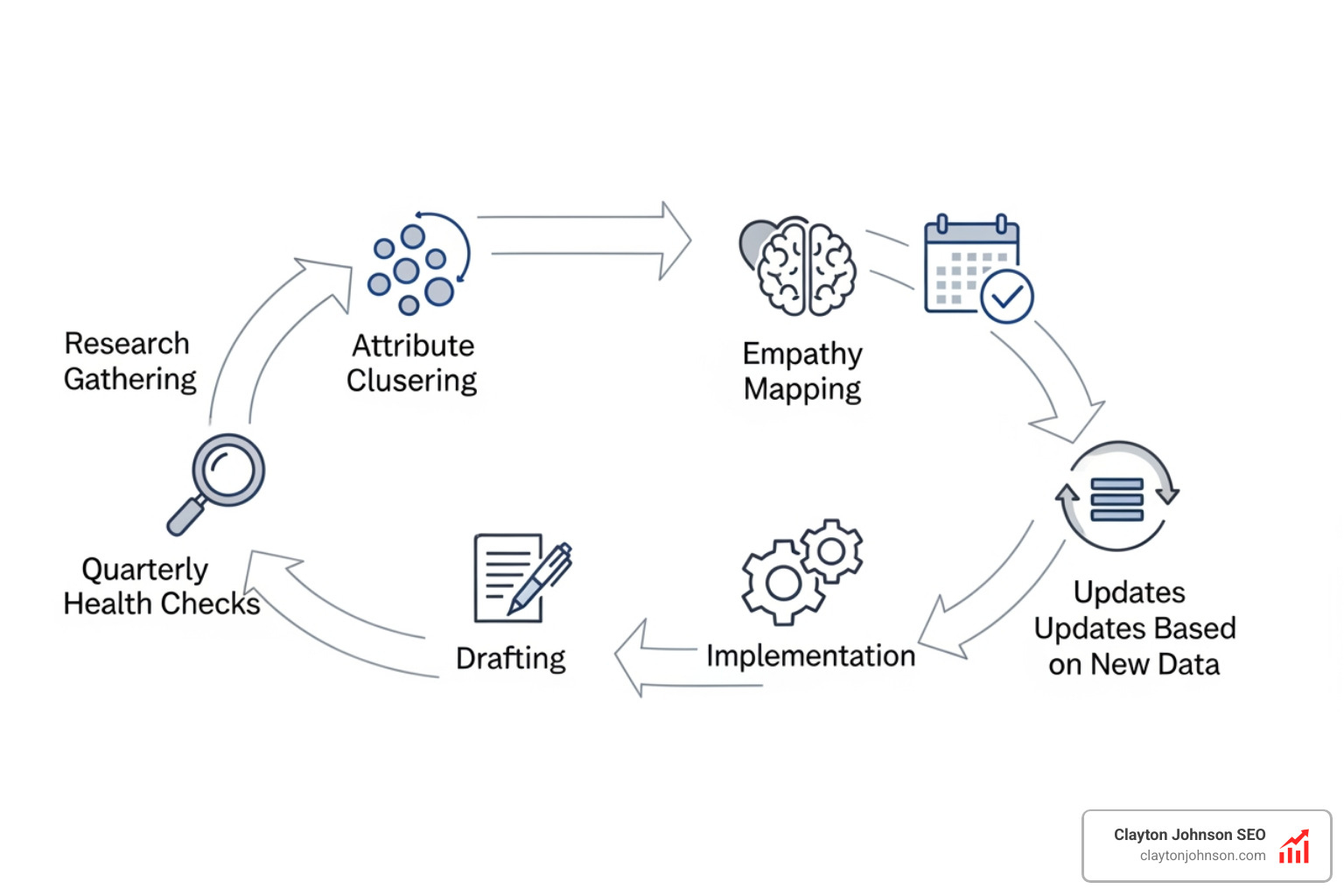
Step 1: Research Gathering
Start with what you know, but quickly move to what you don’t. Conduct field studies, stakeholder interviews, and look at your current analytics. If you are just starting, you might create “proto-personas” based on internal assumptions, but these should only be used as a starting point for further research.
Step 2: Attribute Clustering & Affinity Diagrams
Take your research notes and look for patterns. We like to use affinity diagrams—grouping observations into clusters based on shared behaviors or goals. Don’t group by job title; group by meaning. For example, a “Small Business Owner” and a “Freelance Consultant” might share the exact same pain point regarding tax compliance software.
Step 3: Empathy Mapping
An empathy map helps you dive deeper into the persona’s world. What are they thinking? What are they feeling? What are they hearing from their peers? This move from “what they do” to “why they do it” is critical for creating an engaging persona.
Step 4: Drafting the Persona
Give your persona a name, a photo (avoiding real interviewees), and a “day-in-the-life” narrative. Include their goals, frustrations, and the technical environment they operate in. You can find excellent persona templates in Figma/Figjam to help visualize this. For more inspiration, check out our examples like buyer persona example startup founder sam or buyer persona example marketing manager mike.
Maintaining Best practices for personas Over Time
A persona is not a “set it and forget it” deliverable. It is a living document. As the market shifts and your product evolves, your users will change too.
We recommend a quarterly “persona health check.” Use analytics segmentation to see if your real-world users are still behaving like your personas. If you notice a disconnect, it’s time for a round of fresh research. This ensures your buyer personas remain an accurate reflection of reality.
Different Types of Personas and When to Use Them
Not all personas are created equal. Depending on your project, you might need a different “flavor” of persona:
- Goal-directed Personas: These focus on the workflow. What is the most efficient way for the user to complete a task? This is the classic Alan Cooper approach.
- Role-based Personas: Common in enterprise SEO and B2B software. These focus on the user’s position within an organization and how that role dictates their behavior.
- Engaging Personas: These lean heavily into storytelling. By creating a rich, psychological profile, you help the design team emotionally invest in the user’s success.
- Fictional Personas: These are based on the team’s collective experience rather than deep research. While they are better than nothing for early-stage brainstorming, they should never be used for final design decisions.
Choosing the right type depends on your specific customer segmentation product insight. If you’re designing a complex CRM, role-based personas are essential. If you’re building a meditation app, engaging personas that focus on emotional states will be more effective.
Common Pitfalls and How to Ensure Inclusivity
Even with the best intentions, bias can creep into your personas. If every one of your personas is a middle-aged, able-bodied person living in a tech hub, you are missing a massive part of the human experience.
Bias Mitigation
Avoid using demographics as the primary driver for your personas. Instead, use an archetype approach. Focus on the behavior first. If you need to include demographic info to make the persona feel “real,” ensure you are pulling from a diverse pool of data.
Data Overload
A 10-page persona document is a document that no one will read. Stick to the “Minimum Viable Persona.” Only include details that directly impact a design or content decision. If their favorite color doesn’t change how they use your software, leave it out.
Accessibility
One of the best best practices for personas is to include a persona with a disability. This keeps accessibility at the forefront of your team’s mind. Whether it’s a permanent disability or a situational one (like a parent trying to use an app one-handed while holding a baby), designing for these constraints often makes the product better for everyone.

Frequently Asked Questions about Personas
What is the difference between a persona and a user profile?
A user profile is often a summary of a specific individual’s data (like what you might see in a CRM). A persona is a synthesized archetype representing a group of users who share similar goals and behaviors. Profiles are for sales; personas are for strategy and design.
How many personas should a small project have?
For most small projects, we recommend focusing on one primary persona. If you try to please everyone, you dilute the product’s effectiveness. You might have one or two secondary personas, but there should always be one “primary” that takes precedence when design conflicts arise.
Why should personas be based on research rather than assumptions?
Assumptions are just “educated guesses” that often reflect the team’s internal biases. If you build a persona based on what you think users want, you’re just designing for yourself. Research-backed personas provide the objective truth needed to build a successful product.
Conclusion
Building better personas isn’t just a UX exercise—it’s a critical component of your growth architecture. At Clayton Johnson SEO, we believe that clarity leads to structure, and structure leads to compounding growth. By moving away from vague “users” and toward well-researched, goal-oriented personas, you create the foundation for a more effective SEO strategy and content architecture.
Our platform, Demandflow.ai, is designed to help founders and marketing leaders implement these exact types of structured strategy systems. From taxonomy-driven SEO to competitive positioning models, we provide the growth operating system needed to win in a crowded market.
If you’re ready to stop guessing and start building with precision, it’s time to refine your approach to user archetypes. Use these best practices for personas to align your team, sharpen your design decisions, and ultimately, better serve the people who matter most: your users.
Ready to take your strategy to the next level? Learn more about AI prompt engineering and how it can augment your marketing workflows for faster, data-driven results.