Why Your Customers Do What They Do and How to Predict It

Why Understanding Customer Decision Making Frameworks is the Foundation of Strategic Growth
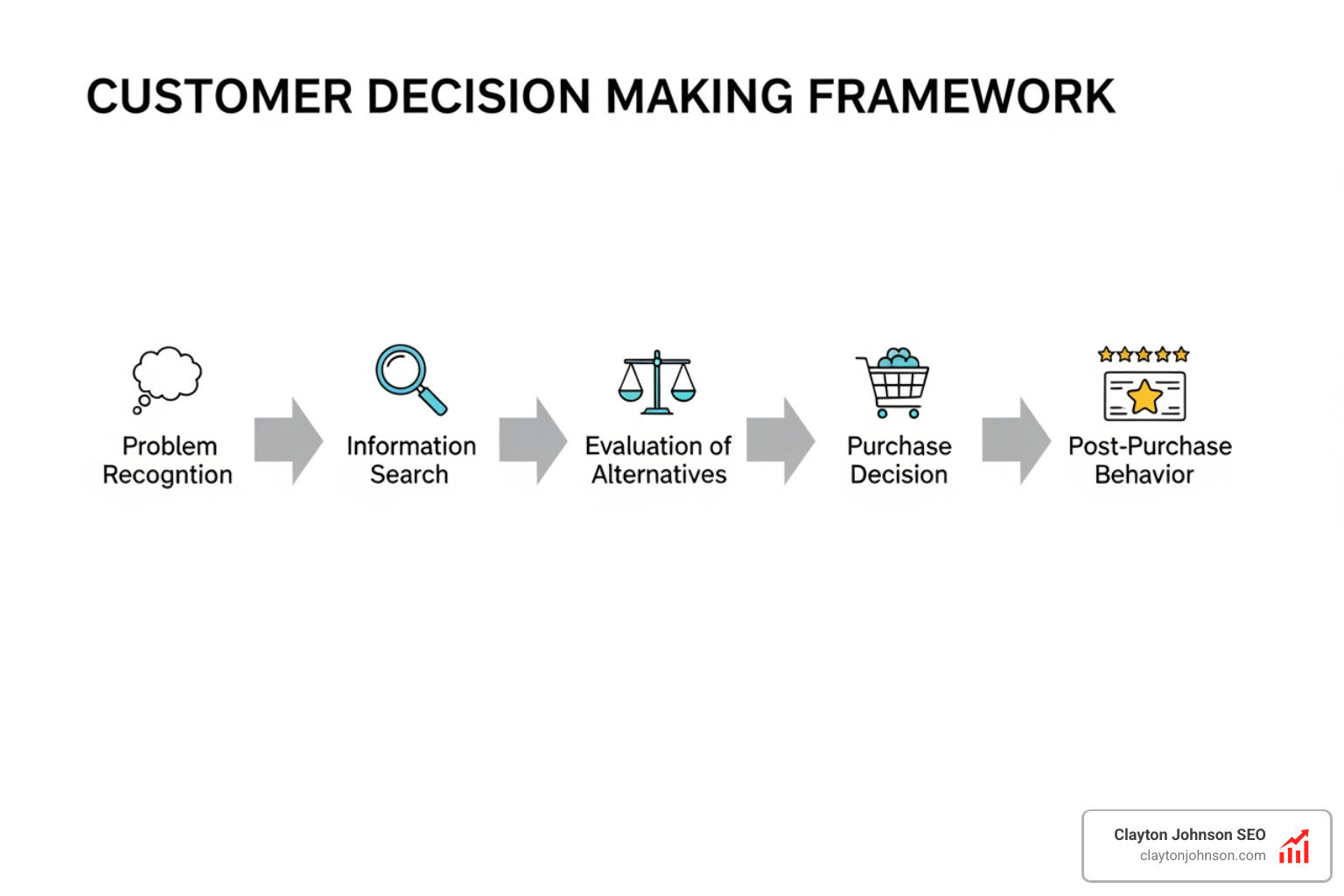
A customer decision making framework is a structured model that explains how buyers move from recognizing a need to making a purchase and evaluating their choice. The most common frameworks include:
- Traditional 5-Stage Model: Problem Recognition → Information Search → Evaluation of Alternatives → Purchase Decision → Post-Purchase Evaluation
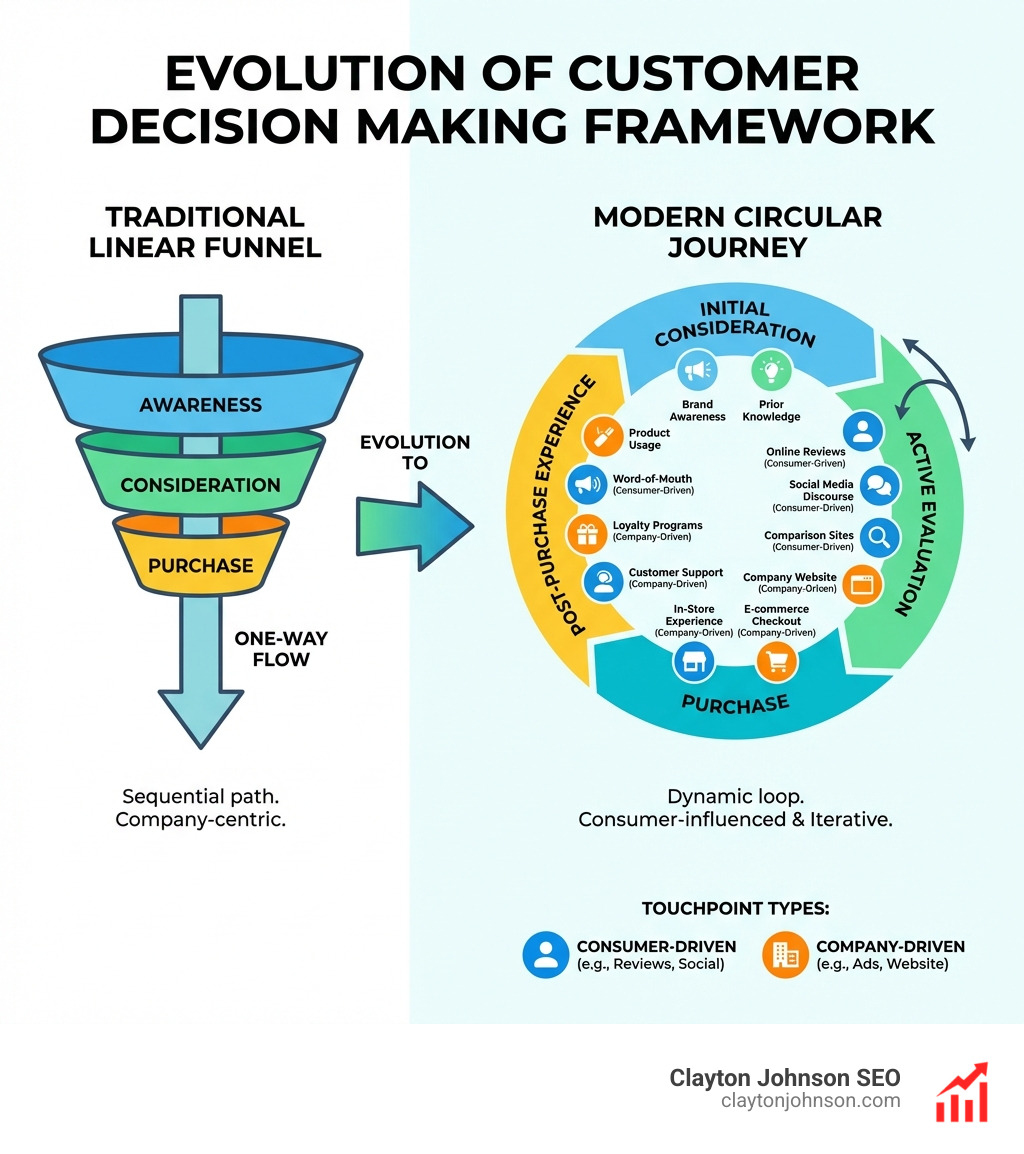
- McKinsey Consumer Decision Journey: A circular model with Initial Consideration, Active Evaluation, Purchase, and Post-Purchase Experience
- BCG 4S Behaviors: Streaming, Scrolling, Searching, Shopping — capturing modern digital touchpoints
- 4 Minds Framework: Ideal Point, Market Comparison, Local Comparison, and Image Mind — predicting decision-making approaches
- Customer Buying Hierarchy: Function, Reliability, Convenience, Price — prioritizing criteria by market maturity
Every purchase decision follows a pattern. But most companies still build marketing strategies around a funnel that assumes customers move in a straight line — from awareness to consideration to purchase. The problem? That’s not how people actually buy anymore.
Research shows that two-thirds of the touch points during active evaluation involve consumer-driven marketing like reviews, word-of-mouth, and independent research. Traditional company-controlled messaging accounts for only one-third. Meanwhile, up to 40 percent of consumers change their minds at the point of purchase based on what they see, learn, or do in the moment.
The traditional funnel fails because it doesn’t capture the dynamic, non-linear reality of modern decision-making. Customers don’t evaluate brands sequentially — they expand and contract their consideration sets, loop back through research, and rely heavily on peer validation. Brands that don’t adapt to this new journey risk being filtered out before they even get a chance to compete.
Understanding customer decision making frameworks isn’t just academic theory. It’s the difference between showing up at the right moment with the right message — and being invisible when it matters most. The companies that win today aren’t just optimizing for clicks or rankings. They’re engineering decision journeys that guide buyers toward a purchase, then turn that purchase into long-term loyalty.
I’m Clayton Johnson, and I’ve spent years building customer decision making frameworks that align SEO, content architecture, and competitive positioning to create measurable pipeline growth. This guide will walk you through how modern buyers actually make decisions — and how to build systems that influence those decisions at every stage.
Customer decision making framework vocab explained:
- Customer Strategy & JTBD
- Customer Journey Pain Points
- Jobs to be Done Methodology
The Evolution of the Customer Decision Making Framework
To predict what a customer will do next, we have to understand the history of how we’ve mapped their minds. For decades, the gold standard was John Dewey’s five stages of decision-making. This linear path suggested a neat, orderly progression from realizing you have a problem to buying a solution.
Contemporary frameworks like the Engel-Kollat-Blackwell (EKB) model and insights from marketing experts such as Philip Kotler built on this, adding layers like digital influence and feedback loops. However, the digital transformation has completely shattered the “straight line.”
Today, we look at the BCG 4S behaviors to understand the modern, always-on consumer:
- Streaming: Media consumption is constant and personalized.
- Scrolling: Discovery happens during “window shopping” on social feeds.
- Searching: Intent is driven by conversational AI and visual tools.
- Shopping: Transactions are nonlinear and expected to be frictionless.
If you want to capture attention in this environment, you need more than just a website; you need a strategy that meets users where they are scrolling and searching. That is why many brands invest in SEO content marketing services to ensure they are discoverable during these fragmented moments.
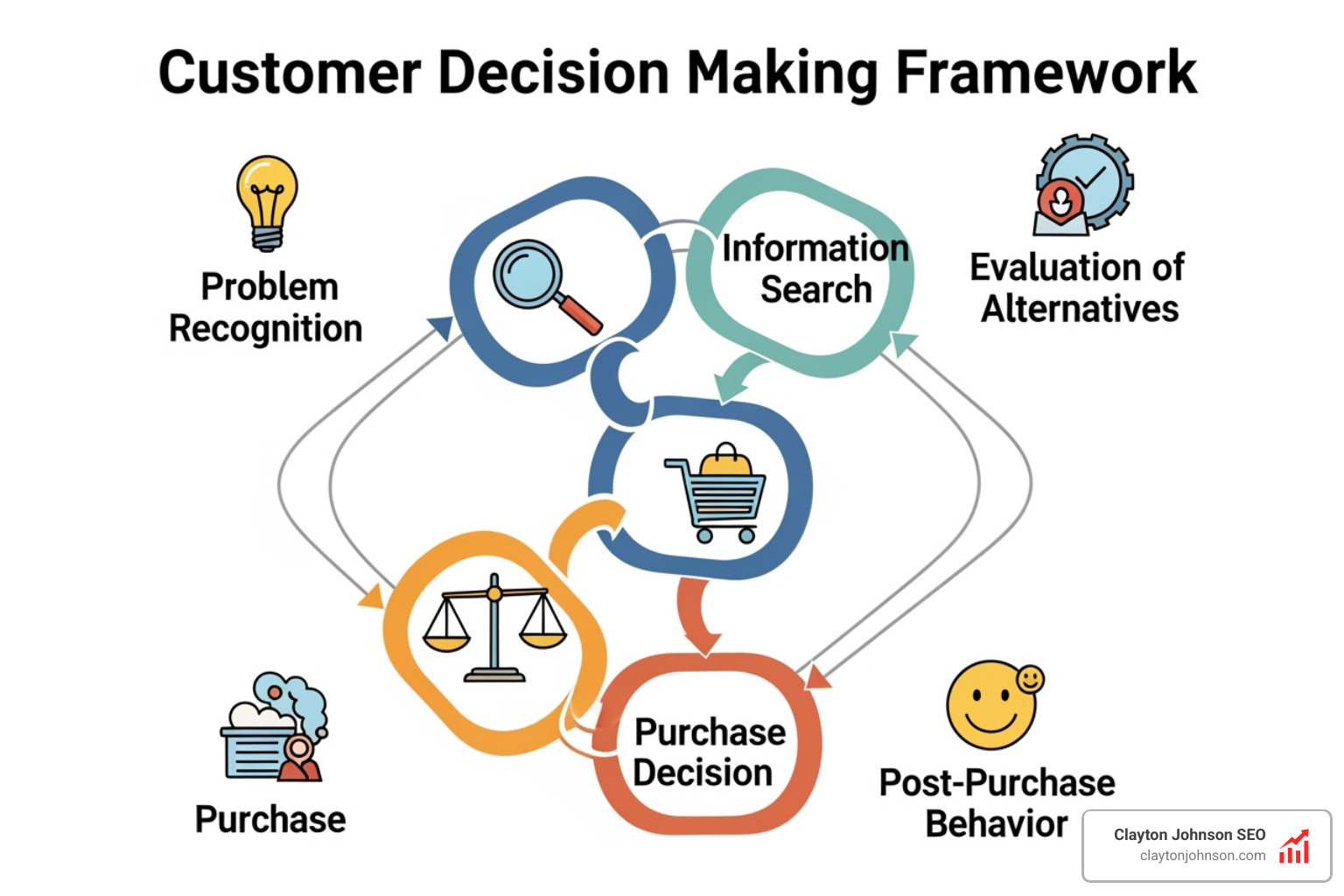
The Shift from Linear Funnels to Circular Journeys
The McKinsey Consumer Decision Journey (CDJ) changed the game by introducing a circular model. Instead of a funnel that narrows down, the CDJ suggests that the number of brands under consideration can actually expand during the active evaluation phase.
Why does this happen? Because consumers are empowered. Two-thirds of the touchpoints in this phase are consumer-driven (reviews, social proof, word-of-mouth), while only one-third are company-driven marketing. This means if you aren’t managing your reputation and peer-to-peer influence, you are losing control of the journey.
Psychological Triggers and the 4 Minds of the Customer
Every journey starts with a spark: problem recognition. This happens when a consumer perceives a difference between their current state and a desired state. These needs can be functional (my laptop is slow), emotional (I want to feel successful), or social (I want to fit in with my peers).
As marketers, we can trigger this stage. Have you ever noticed scratches on your car only after seeing a commercial for car polish? That’s an external stimulus triggering a latent need. To find out what your customers are actually asking, tools like AnswerThePublic are invaluable. They allow us to see the exact “how,” “why,” and “what” questions people are typing into search engines, helping us align our content with their specific search intent.
However, not all customers think the same way. The 4 Minds of the Customer framework provides a diagnostic tool to understand these variations:
- Ideal Point Mind: The customer has a specific “perfect” solution in mind.
- Market Comparison Mind: They are looking at the broad market to see what’s available.
- Local Comparison Mind: They are comparing a few specific options against each other.
- Image Mind: The decision is driven by how the brand reflects on their own identity.
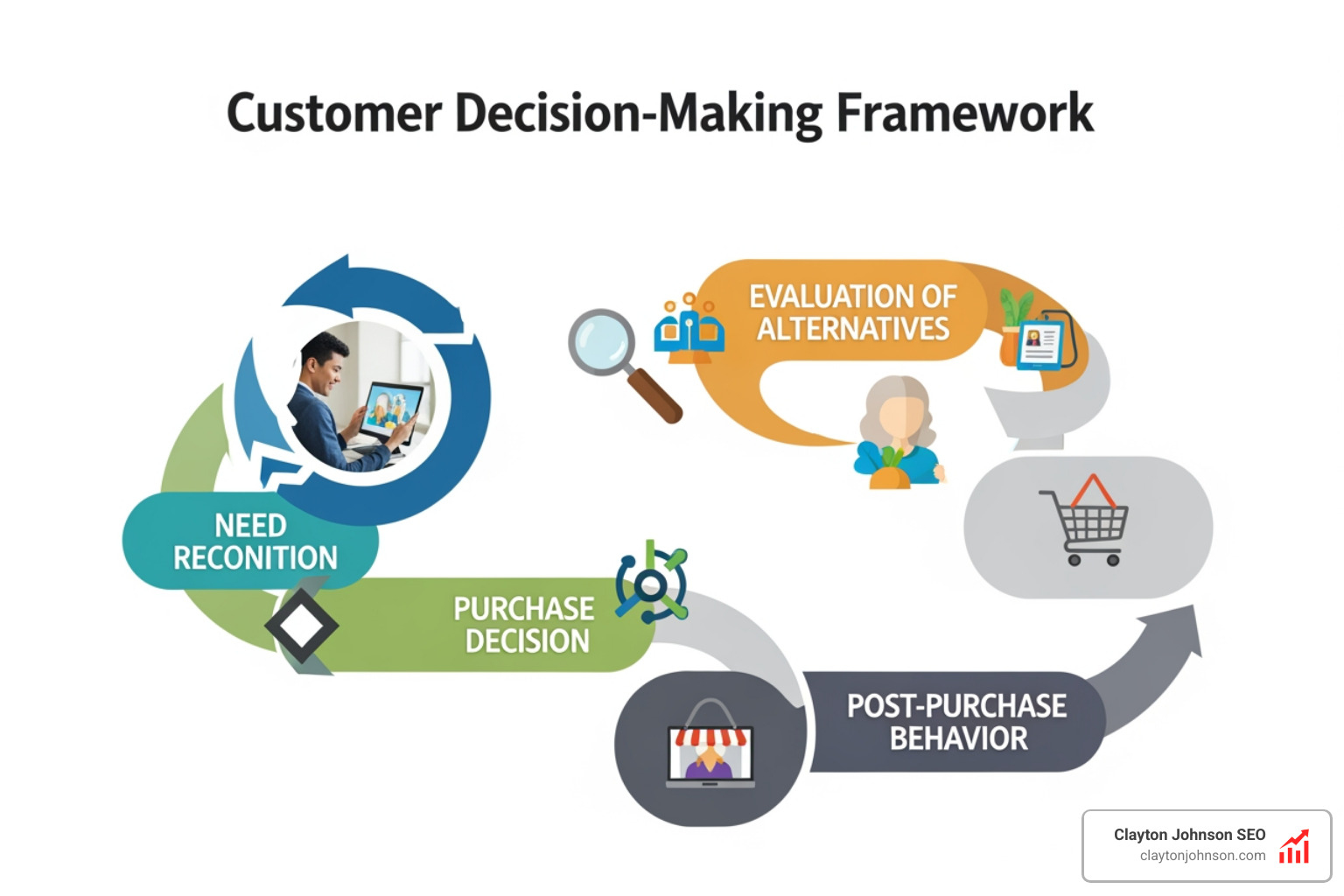
Evaluating Alternatives: Strategies for Competitive Advantage
Once the need is established, the “active evaluation” begins. This is where the customer decision making framework gets tactical. Consumers use different strategies to narrow their choices:
- Compensatory Strategies: A buyer might accept a higher price if the product has better reliability (trading one attribute for another).
- Non-compensatory Strategies: A buyer has “must-haves.” If a software doesn’t have a specific integration, it’s out, no matter how cheap it is.
- Lexicographic Rules: The buyer picks the brand that is best in the single most important attribute (e.g., “I just want the fastest shipping”).
To win here, you must understand the Customer Buying Hierarchy: Function, Reliability, Convenience, and Price. In fast-growth markets, Function wins. In mature, hostile markets, Reliability and Price take center stage.
For B2B companies, the B2B Elements of Value from Bain & Company shows that value goes far beyond just “logic.” It includes things like “reduced anxiety” and “network expansion.”
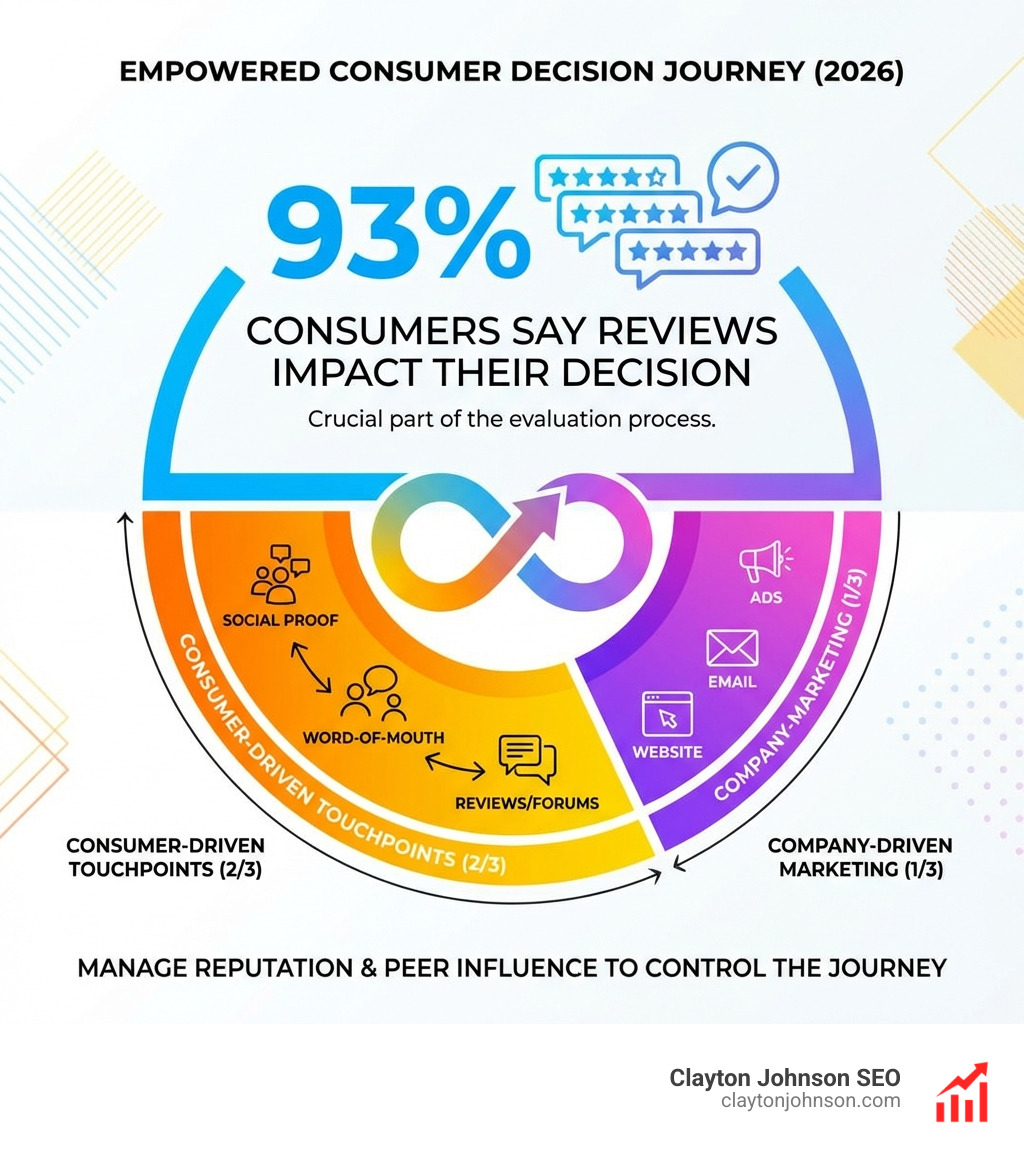
Social proof is the ultimate tie-breaker. Research shows that 93% of consumers say reading reviews is a crucial part of their decision process. For tech and service companies, having a presence on sites like G2 or Capterra isn’t optional—it’s where the evaluation actually happens.
Applying the Customer Decision Making Framework in B2B
B2B decision-making is a different beast. It rarely involves a single person. Instead, you are dealing with a “buying committee” of stakeholders, each with their own criteria.
- ROI Focus: The decision must be justified to finance.
- Risk Mitigation: No one wants to be the person who bought the software that crashed the system.
- Long Sales Cycles: Relationships and trust are built over months, not minutes.
- Third-Party Validation: Independent research from firms like Gartner and Forrester often carries more weight than your own sales deck.
Closing the Loop: Purchase Decisions and Post-Purchase Growth
The “moment of truth” happens at the purchase decision. But don’t get comfortable—up to 40% of consumers change their minds at the point of purchase due to something they see or experience, like a complicated checkout or a last-minute objection.
This is where sales enablement and conversion optimization services become critical. If your checkout is clunky or your sales reps are using outdated case studies, you’re bleeding revenue at the finish line.
The journey doesn’t end at the “Thank You” page. Post-purchase evaluation determines whether a customer becomes an advocate or a detractor.
- Cognitive Dissonance: Also known as buyer’s remorse. You can mitigate this with immediate “success” emails and clear onboarding.
- The Loyalty Loop: Customers who receive post‑purchase follow‑up are 50% more likely to make another purchase and spend an average of 138% more.

Measuring Success within your Customer Decision Making Framework
Top performers don’t just guess; they measure the entire journey. They use automation to deliver personalized experiences at scale. By integrating data from platforms like HubSpot or Salesforce, and using feedback tools like AskNicely to track Net Promoter Scores (NPS), you can identify exactly where customers are dropping off.
Are you losing people during information search? (SEO problem). Are they dropping off during evaluation? (Content/Social Proof problem). Or are they churning after the purchase? (Product/Customer Success problem).
Frequently Asked Questions about Customer Decision Making
What are the 5 stages of the consumer decision-making process?
The traditional stages are:
- Problem Recognition: Realizing a need exists.
- Information Search: Researching options (internal and external).
- Evaluation of Alternatives: Comparing brands based on specific criteria.
- Purchase Decision: The actual act of buying.
- Post-Purchase Evaluation: Assessing if the product met expectations.
How has digital transformation changed the customer journey?
It has made the journey non-linear. Consumers now have 24/7 connectivity and access to endless information. They move between “scrolling” for discovery and “searching” for intent, often looping back to the research phase multiple times before buying. Power has shifted from the marketer to the consumer.
What is the difference between B2B and B2C decision making?
B2C is often driven by individual impulse and emotional appeal, with shorter cycles. B2B involves group consensus, rational logic (ROI), higher contract values, and a heavy focus on risk mitigation and long-term relationship depth.
Conclusion: Building Your Structured Growth Architecture
Understanding a customer decision making framework is only half the battle. The other half is building the infrastructure to influence it. At Demandflow, we believe that most companies don’t lack tactics—they lack a structured growth architecture.
We help founders and marketing leaders in Minneapolis and beyond move from “random acts of marketing” to a compounding growth engine. By combining taxonomy-driven SEO, competitive positioning, and AI-augmented workflows, we ensure your brand is the obvious choice at every stage of the buyer’s journey.
Ready to stop guessing and start predicting? Work with me to build your structured growth infrastructure today.