Why Mastering Canvas Workshop Facilitation Changes Everything
Canvas workshop facilitation guide refers to the structured methodology for leading collaborative sessions using visual canvases—like the Business Model Canvas, Culture Change Canvas, or Lean Canvas—to drive alignment, decision-making, and strategic clarity across teams.
Quick Answer: Essential Components of Canvas Workshop Facilitation
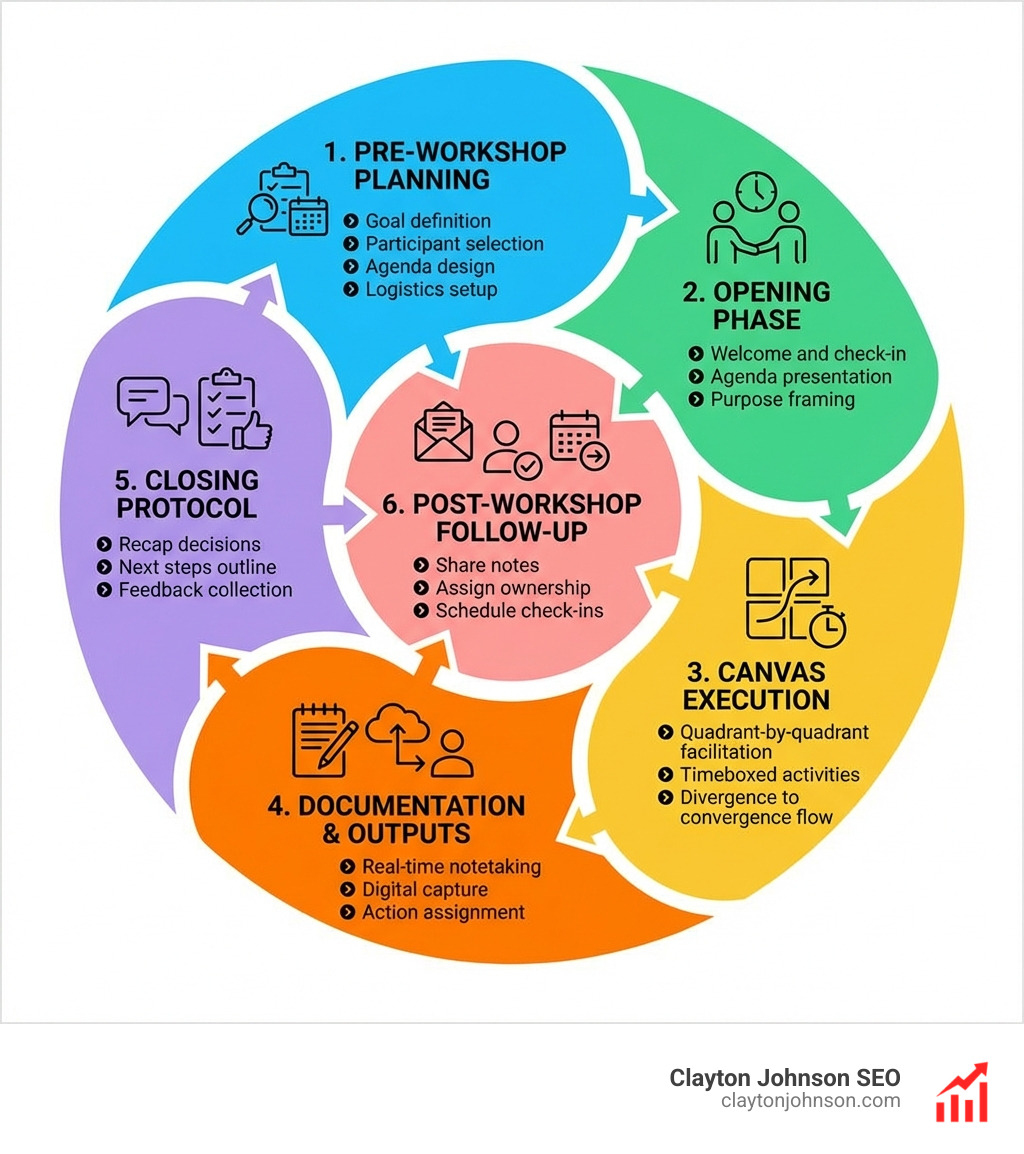
- Pre-Workshop Planning – Define goals, select 5-12 participants, design agenda with timeboxed activities
- Opening Rituals – Welcome with check-in questions, present visual agenda, frame purpose clearly
- Facilitation Techniques – Use divergence-emergence-convergence flow, 1-2-4-All method, parking lot for tangents
- Canvas Structure – Work through quadrants sequentially (e.g., Preserve → Accept → Create → Eliminate)
- Time Management – Apply timeboxing, plan for double prep time vs. session length, hold closing sacred
- Documentation – Designate notetaker, capture outputs in shared docs, assign action ownership
- Closing Protocol – Recap key decisions, outline next steps, gather one-breath feedback
Here’s why this matters: one in three people admit to falling asleep during meetings. But canvas-based workshops flip that script entirely. They transform passive audiences into active contributors through structured visual collaboration.
The difference between a productive canvas session and a wasted afternoon comes down to preparation and technique. Most facilitators wing it—scrolling through Miro templates at 11pm, hoping for the best. That approach fails because workshops require architectural thinking, not improvisation.
Canvas frameworks provide the structure. Your facilitation brings them to life.
Whether you’re steering culture change, mapping business models, or running design sprints, the facilitation layer determines whether your canvas generates clarity or confusion. Get the preparation wrong and participants check out. Rush the closing and action items evaporate.
The good news? Effective canvas facilitation follows repeatable patterns. Preparation time should roughly double your workshop duration—four hours of prep for a two-hour session. Group size matters: aim for 5-12 participants to balance diverse perspectives with active engagement. And structure beats spontaneity every time.
I’m Clayton Johnson, and I’ve spent years engineering growth systems that turn fragmented strategy into executable architecture—including designing and facilitating canvas workshops that drive measurable outcomes. This Canvas workshop facilitation guide distills what actually works when leading teams through visual collaboration frameworks.
Canvas workshop facilitation guide terms simplified:
Understanding the Canvas Workshop Facilitation Guide and Its Purpose
At its core, a Canvas workshop facilitation guide is a roadmap for navigating the “Diamond of Facilitation.” It moves a group from a state of individual opinions to a state of collective commitment. Unlike a standard meeting, which often feels like a series of disjointed monologues, a canvas workshop uses a visual anchor to ground the conversation.
The primary purpose of these guides is to facilitate digital innovation via the Business Model Canvas and other frameworks by providing a “low-floor, high-ceiling” environment. This means the tools are simple enough for anyone to use immediately, but deep enough to solve complex architectural problems.
When we use structured frameworks, we achieve:
- Visual Collaboration: Ideas aren’t trapped in someone’s head; they are on the wall (or the digital board).
- Team Alignment: Everyone literally sees the same picture, reducing the “I thought you meant X” syndrome.
- Decision-Making: Canvases force teams to prioritize. You can’t fit 50 sticky notes into a single quadrant without realizing you lack focus.
By learning how to visualize your business with BMC mapping, facilitators can guide teams toward strategic clarity. At Demandflow, we believe that clarity comes from structure. Without a guide, a canvas is just a drawing; with one, it becomes a growth engine.
The Culture Change Canvas: Steering Team Evolution
Culture is often seen as “the way we do things around here,” but it isn’t static. It can be designed. The Culture Change Canvas is a specific tool used within a Canvas workshop facilitation guide to help teams re-evaluate and steer their internal environment.
This canvas leverages principles of Appreciative Inquiry, a positive psychology approach that focuses on what is already working rather than just “fixing” what is broken. It uses a steering wheel metaphor: you aren’t just trying to stop the car; you’re trying to navigate toward a better destination.
Meaningful culture change often fails because of “fixer mindsets” or burnout. As the Heath brothers explain in their book Switch, what often looks like resistance to change is actually exhaustion. By using The Wheel of Change principles, we can move from a deficit-based model (what’s wrong?) to an abundance-based model (what’s possible?).
The Four Quadrants of a Culture Change Canvas Workshop Facilitation Guide
To steer culture effectively, we divide the workshop into four critical quadrants. Each represents a different movement of energy:
- Preserve: What positive elements, rituals, or decision-making ways should we keep? This builds on existing strengths.
- Accept: What are the unchangeable realities we must make peace with? Accepting these frees up energy that would otherwise be wasted on frustration.
- Create: What new behaviors or processes do we need to invent to reach our goals?
- Eliminate: What is holding us back? This is vital for overcoming burnout—you must stop doing old things to make room for the new.
This structured approach ensures psychological safety. By starting with “Preserve,” you validate the team’s current value before asking them to “Eliminate” habits. This mirrors the importance of mastering BMC channels and relationships in a business context—you must understand what connects people before you can change the system.
Preparing for High-Impact Facilitation
Preparation is the silent engine of a successful workshop. If you wing it, you waste the most expensive resource in the room: collective time.
First, you must define clear goals. Are you mastering the Lean Startup Model Canvas for New Ventures or trying to solve a specific departmental bottleneck? Once the goal is set, move to participant selection.
The Golden Rule of Group Size: Aim for 5-12 participants. Fewer than five often lacks diversity of thought; more than twelve makes it difficult for everyone to be heard without the session devolving into a lecture.
Essential preparation steps include:
- Agenda Design: Work backward from your goal. If you want a finished canvas by 4 PM, what needs to happen by noon?
- Template Setup: Don’t start from a blank page. Duplicate this essential workshop template to give yourself a head start.
- Logistics & Room Setup: Whether physical or virtual, the environment dictates the energy. In-person facilitators often show up early just to move tables into a “huddle” or “circle” format to encourage participation.
- The Prep-to-Session Ratio: Spend double the time preparing as you do facilitating. A 2-hour session requires 4 hours of architectural planning. This is the DIY guide to not failing your design sprint.
Executing the Workshop: From Opening to Closing
Execution is where the “guide on the side” philosophy comes into play. You aren’t there to provide the answers; you’re there to protect the process.

Effective execution relies on three pillars:
- Timeboxing: Every activity has a countdown. This prevents the group from getting stuck in “analysis paralysis.”
- The Parking Lot: When off-topic (but important) ideas arise, “park” them on a separate board to be addressed later. This honors the participant without derailing the agenda.
- 1-2-4-All: A classic Liberating Structure. Participants reflect individually (1 min), then in pairs (2 mins), then in fours (4 mins), before sharing with the whole group. This ensures introverts are heard and extroverts don’t dominate.
We also embrace Open Space Technology principles, specifically the idea that “whoever comes are the right people.” If key stakeholders miss the session, don’t stall. Move forward with those present and share the documentation afterward. This maintains momentum and reinforces frameworks that actually work for business innovation.
Opening Your Canvas Workshop Facilitation Guide Session
The first fifteen minutes set the tone for the entire day. A weak opening leads to a distracted group.
- Welcome & Check-in: Use an “icemelter” question. Ask something low-stakes but personal, like “What is one thing you love about our current team culture?”
- Framing the Purpose: Why are we here? What happens if we fail to reach a decision today?
- Setting Expectations: Define the “rules of the road”—no laptops (unless it’s a virtual workshop), “yes and” thinking, and timeboxing.
- Visual Agenda: Show the group exactly where they are going. A digital whiteboard with “frames” for each section helps participants visualize the journey.
Facilitation Techniques and Time Management
During the “messy middle” of the workshop, you will navigate the Diamond of Facilitation:
- Divergence: Generating as many ideas as possible. No judging allowed.
- Emergence: The “groan zone.” This is where ideas conflict and the group feels frustrated. Your job is to keep them moving through the discomfort.
- Convergence: Narrowing down the ideas into actionable steps.
Manage cognitive load by providing clear, step-by-step instructions. If participants are confused about the “how,” they can’t focus on the “what.” the metrics that make or break your canvas often depend on how well you’ve facilitated the convergence phase.
Documenting Outcomes and Closing Effectively
A workshop without documentation is just a conversation. You need a dedicated notetaker (ideally not the facilitator) to capture the “why” behind the sticky notes.
| Feature | Digital Notetaking (Miro/Mural) | Physical Notetaking (Post-its/Paper) |
|---|---|---|
| Speed | Instant sharing and export | Requires manual transcription |
| Engagement | Good for remote/hybrid | High tactile energy for in-person |
| Longevity | Easy to revisit and edit | Risk of losing physical notes |
| Clarity | Searchable text | Can be hard to read handwriting |
Closing the workshop is a sacred ritual. Never rush it.
- Recap: Summarize the 3-5 key decisions made.
- Action Ownership: Who is doing what by when? Use the essential guide to BMC customer discovery logic: every insight must lead to a specific task.
- One-Breath Feedback: Give everyone 20 seconds to share one thing they are taking away. It provides a sense of accomplishment and closure.
Frequently Asked Questions about Canvas Facilitation
How much time should I spend on preparation?
You should spend roughly double the workshop duration on preparation. If you are leading a 2-hour session, expect to spend 4 hours on stakeholder alignment, material gathering, and agenda design. This ensures you aren’t “winging it” when the clock is ticking and the room is full of expensive talent.
How do I handle participants who don’t show up?
Adopt the mindset from Open Space Technology: “Whoever comes are the right people.” Don’t waste the energy of those present by lamenting those who are absent. Proceed with the workshop, document everything thoroughly, and share the results immediately afterward to keep the “no-shows” in the loop.
What are the best tools for virtual canvas workshops?
For virtual sessions, Miro and Mural are the industry standards for visual whiteboarding. Combine these with Zoom breakout rooms for small group work and a digital timer to keep activities on track. Always do a “tech check” or a practice round before the live session to ensure your frames and permissions are set correctly.

Conclusion
Facilitation is a superpower. It is the bridge between a good idea and a great outcome. By following a structured Canvas workshop facilitation guide, you move away from the “drudgery of meetings” and toward a growth operating system that actually delivers.
At Demandflow, we believe that most companies don’t lack tactics—they lack structured growth architecture. Clarity leads to structure, which leads to leverage, and eventually, compounding growth. Whether you are mapping a new business model or evolving your team culture, the framework you use is only as good as the facilitation behind it.
Ready to take your strategic execution to the next level? Work with me to build your growth infrastructure and turn your team’s potential into measurable progress.