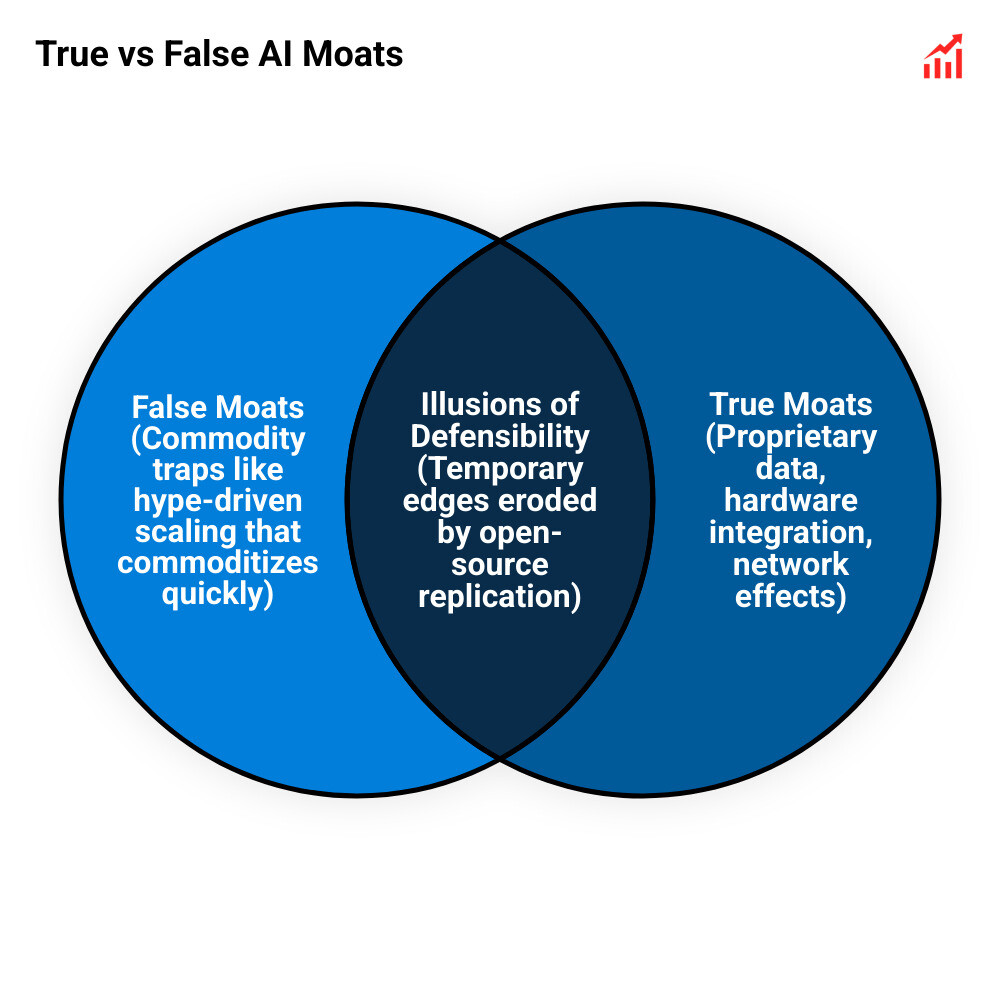
Advanced AI moat analysis is the systematic evaluation of which competitive advantages in artificial intelligence are genuinely defensible versus those that erode within weeks. Here’s what separates real moats from mirages:
| False Moats (Erode Fast) | True Moats (Compound Over Time) |
|---|---|
| Access to latest model versions | Proprietary training data with feedback loops |
| Prompt engineering libraries | Deep workflow integration creating switching costs |
| First-mover timing | Data network effects that improve with usage |
| Feature parity via APIs | Domain expertise encoded in systems |
| Model performance alone | Platform cost curve control |
The fundamental challenge is this: 79% of organizations report competitors making similar GenAI investments, yet only 23% believe they’re building sustainable advantages. The gap exists because most companies chase tactical wins—implementing the newest model, refining prompts, or racing to deploy first—while missing the structural elements that actually create defensibility.
The shift from traditional AI to generative AI has fundamentally changed competitive dynamics. In traditional AI, moats came from algorithm sophistication and technical expertise. In the GenAI era, the commoditization paradox means that core capabilities now diffuse in days, not years. What looked like a differentiating feature yesterday ships as a checkbox in a hyperscaler release tomorrow. First-mover advantages from adopting new model versions last an average of 6-8 weeks.
Real moats in AI aren’t about having something proprietary—they’re about building compounding systems that get stronger with usage. Organizations that prioritize strategic GenAI applications (even with longer development timelines) achieve 3.5x higher long-term value capture compared to those chasing quick tactical wins. The difference lies in constructing closed-loop data rights, instrumentation that captures learning signals, and integration depth that embeds your solution into the customer’s workflow architecture.
I’m Clayton Johnson, and I’ve spent the past decade building structured growth systems that help founders move from fragmented execution to defensible market position, with recent focus on advanced AI moat analysis as generative models reshape competitive landscapes. This guide synthesizes research from frontier AI development, strategic frameworks like Hamilton Helmer’s 7 Powers, and real-world deployment patterns to give you a systematic approach to evaluating and strengthening your AI competitive position.

In the heat of the AI gold rush, many leaders mistake a “mirage” for a “moat.” They see a temporary spike in productivity or a flashy new feature and assume they’ve built a barrier to entry. However, according to McKinsey’s AI research, while nearly 80% of organizations are investing, only a tiny fraction are seeing sustainable differentiation.
The most common “false moats” include:
- Model Access: Thinking that because you have an enterprise license to the latest frontier model, you are ahead.
- Prompt Engineering: Believing your “secret sauce” is a 2,000-word prompt. As models get smarter, they require less hand-holding, making complex prompts the modern equivalent of thinking your Excel formulas are a trade secret.
- First-Mover Advantage (Generic): Being the first to add a “Chat with your PDF” button in your industry provides a window of about two months before every competitor does the same via a simple API integration.
True advanced AI moat analysis requires us to look past these tactical wins. If a competitor can replicate your entire AI feature set by signing up for an OpenAI or Anthropic API key and hiring a freelancer for a weekend, you don’t have a moat—you have a head start that is rapidly evaporating.
Why Model Access is Not an Advanced AI Moat Analysis Factor
Relying on a specific model (like GPT-4 or GPT-5) as your primary advantage is a losing game. We call this the “Model-Switch Latency” problem. If your entire value proposition is that you use a better model than your competitor, your moat is only as deep as the time it takes for them to update their API endpoint—usually a matter of minutes.
Harvard Business Review research suggests that advantages gained purely from adopting new model versions last an average of 6 to 8 weeks. Furthermore, as models become more commoditized, the “Competitive Parity Cost” drops. In traditional AI, rebuilding a capability might take 18 months of custom modeling; in GenAI, it takes a credit card and an API call.
The Pillars of a Defensible AI Strategy
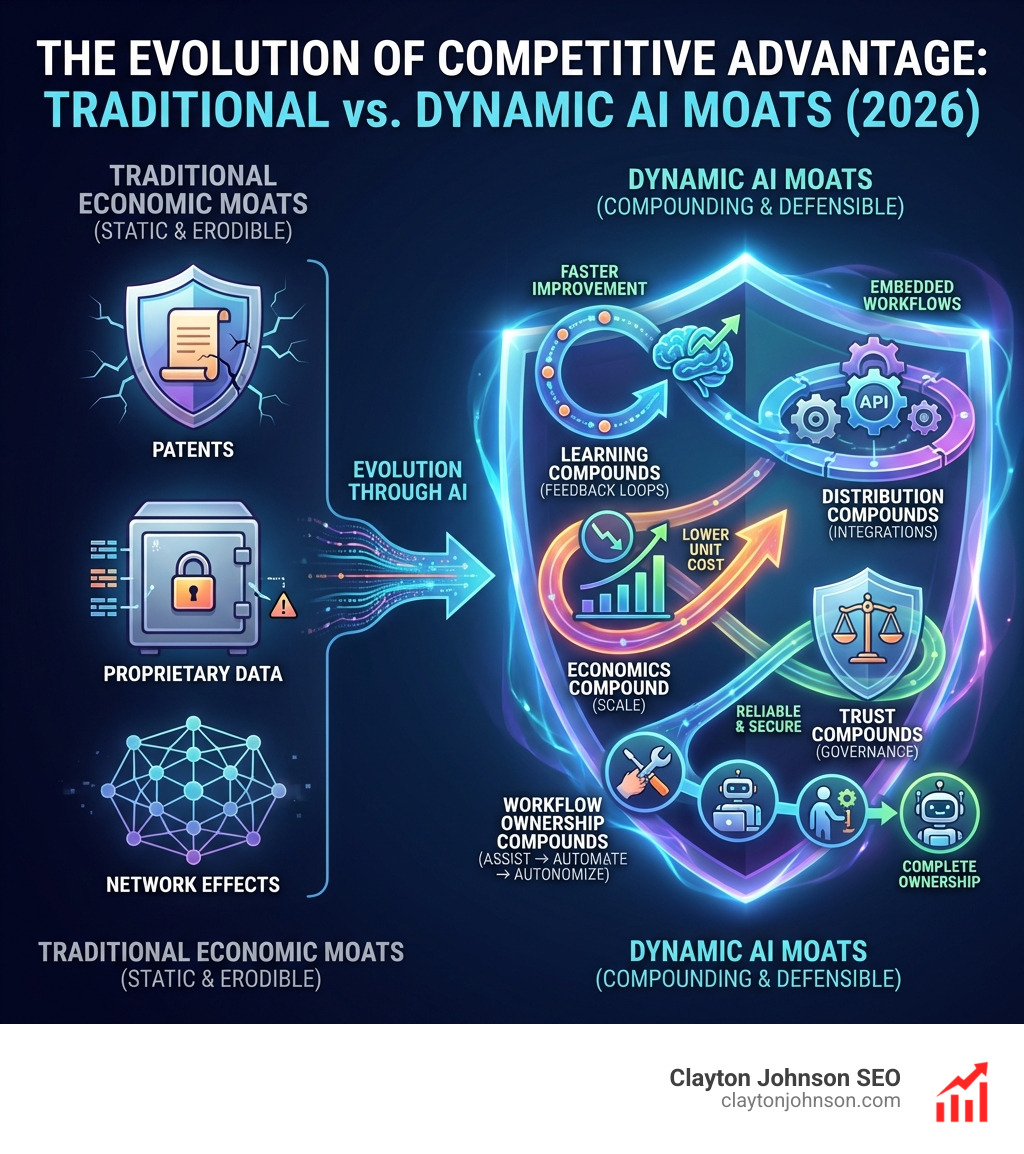
To build a moat that actually holds water, we must shift from “artifacts” (the model itself) to “systems” (how the model interacts with your unique business environment).
| Static Moats (Old Way) | Dynamic Compounding Systems (AI Way) |
|---|---|
| Patents and IP Filings | Learning Loops (Evals & Feedback) |
| Large Static Datasets | Distribution via Deep Integrations |
| High Switching Costs (Locked Data) | Workflow Ownership (Assist → Autonomize) |
| Brand Recognition | Trust & Governance Maturity |
A data moat plays a crucial role in generative AI by providing the proprietary “fuel” that competitors cannot buy off the shelf. But it isn’t just about possessing data; it’s about the Feedback Loop.
Leveraging Proprietary Data for Advanced AI Moat Analysis
The most defensible data moats are “closed-loop.” This means:
- Collection: You have unique ways to gather data (e.g., IoT devices, specialized sensors, or unique user interactions).
- Instrumentation: You track how users interact with AI outputs—did they accept the suggestion? Did they edit it?
- Feedback: That interaction data is fed back into the system to refine the model’s performance for that specific domain.
This creates a Data Network Effect: as more people use your tool, your domain-specific accuracy improves, making the tool more valuable, which attracts more users. This is significantly more defensible than a static dataset, which can eventually be mimicked by synthetic data generation.
Hardware and Compute: The Physical Layer of Defensibility

While software and data are the focus for most, we cannot ignore the “Physical Layer.” For the giants of the industry, compute power itself has become a moat. Nvidia’s Data Center revenue reached $26.3 billion in Q2 FY25, a 154% increase year-over-year, largely because they control the “shovels” in this gold mine.
Established players like Nvidia maintain their lead through:
- Supply Chain Control: Contracting for over 70% of TSMC’s advanced packaging capacity.
- Software Lock-in: CUDA has decades of accumulated code and human capital that makes switching to other chips incredibly expensive.
- Performance-per-Watt: In an era where datacenters are projected to consume 21% of global energy by 2030, efficiency is an economic moat.
For the rest of us, advanced AI moat analysis means understanding our “Compute-Bound” limits. Can we achieve the same results with smaller, specialized models?
Architectural Innovation as an Advanced AI Moat Analysis Metric
Innovation isn’t just about more chips; it’s about better architecture. The Evolved Transformer study found that Neural Architecture Search (NAS) required nearly 1,500 times the final-training compute cost. This highlights the “R&D Moat.”
OpenAI’s compute expenditure for 2024 was around $4B. This level of spending creates a “Capital Expenditure Moat” that few can cross. However, for mid-market companies, the moat often lies in Model-Agnostic Architecture. By building a system that can swap models easily (using adapters and evaluators), you protect yourself from being “handcuffed” to a single provider whose moat might be narrowing.
Strategic Frameworks for Advanced AI Moat Analysis

To objectively analyze a company’s durability, we look to Hamilton Helmer’s 7 Powers framework, adapted for the AI age:
- Scale Economies: Can you spread high AI R&D costs across a massive user base (e.g., Netflix’s $17B content/AI budget)?
- Network Economies: Does the product become more valuable as more people use it?
- Counter-Positioning: Does your AI business model paralyze incumbents (e.g., a startup offering “AI-only” service at 1/10th the cost of a legacy firm’s manual service)?
- Switching Costs: Are you so embedded in the customer’s workflow (ERP/CRM integration) that removing you would break their business?
- Branding: Do customers trust your AI’s safety and accuracy more than a generic alternative?
- Cornered Resources: Do you have the world’s top 10 experts in a specific niche of AI?
- Process Power: Do you have a “Toyota Production System” for AI—a culture of rapid experimentation that competitors can’t copy?
Using AI to Audit Your Competitive Position
Ironically, one of the best ways to perform an advanced AI moat analysis is to use AI itself. AI excels at pattern recognition and removing human confirmation bias. You can prompt a frontier model to act as a “skeptical strategy consultant,” demanding evidence for each of the 7 Powers.
By scoring your business on a scale of 0-70 (10 points per power), you can move from “vibe-based” strategy to data-driven positioning. A score below 15 suggests you are in a commodity trap; a score above 40 indicates a “legendary” monopoly potential.
Frequently Asked Questions about AI Moats
What defines a true data moat in the age of LLMs?
A true data moat isn’t just a big database. It is proprietary, high-quality, and constantly refreshing data that is tied to a feedback loop. If the data is publicly available on the web, it is already in the training set of the frontier models, and therefore, it is not a moat.
How does open-source software impact AI defensibility?
Open-source (or “open-weights”) models like Llama or DeepSeek-V3 act as a “moat-eroder” for companies that rely purely on model performance. However, they are a “moat-builder” for companies that use them to lower their own platform costs and avoid vendor lock-in.
Can small organizations build moats against hyperscalers?
Yes, by focusing on Workflow Ownership. Hyperscalers build horizontal tools (broad and shallow). Small organizations can build vertical “full-stack” solutions that are narrow and deep, solving specific industry problems (like legal discovery or medical coding) with such precision that a general-purpose AI cannot compete.
Conclusion: Building Your Structured Growth Architecture

Building a moat in the AI era is no longer about building a static wall. It is about building a compounding growth engine. At Demandflow.ai, we believe that clarity leads to structure, and structure leads to the leverage required for compounding growth.
Most companies don’t lack AI tactics; they lack a structured growth architecture. They have a “Chat” button but no data feedback loop. They have an API integration but no workflow ownership.
To survive the next wave of commoditization, you must move beyond the mirage of model access. You need to build your AI-enhanced execution system that prioritizes adaptability, proprietary feedback, and deep integration.
The question isn’t just “Do you have an AI moat today?” but rather, “Will your system be smarter, cheaper, and more embedded by the time the next model drops?” If the answer is yes, your moat is holding water. If you’re ready to move from tactical experiments to a structured growth engine, let’s get to work.