How to Acquire Clients for Wealth Management Without Losing Your Assets


Why Client Acquisition Is the Core Challenge in Wealth Management
How to acquire clients for wealth management is one of the most searched questions among financial advisors — and for good reason. Building a steady pipeline of qualified clients is what separates a thriving practice from one that stagnates.
Here are the most effective ways to acquire wealth management clients:
- Build a structured referral program with incentives for existing clients and centers of influence (COIs) like CPAs and estate attorneys
- Optimize your website for SEO so high-net-worth prospects can find you organically
- Show up consistently on LinkedIn and other relevant social platforms
- Host educational events and webinars on topics like retirement planning or tax strategy
- Niche down to a specific client segment (executives, business owners, medical professionals)
- Use a CRM to manage leads, automate follow-ups, and track your pipeline
- Target next-generation clients inheriting wealth through digital-first engagement
Most advisors know they should be doing these things. The hard part is doing them consistently — and doing them well.
The stakes are high. Cerulli projects that $124 trillion will transfer between generations by 2048, with $105 trillion going directly to heirs. Advisors who build strong acquisition systems now are positioned to capture a significant share of that wealth.
But the gap between advisors with a plan and those without is already showing. Advisors with a defined marketing strategy onboarded 41 new clients in the last 12 months — compared to just 17 for those without one.
This guide breaks down exactly how to build that system.
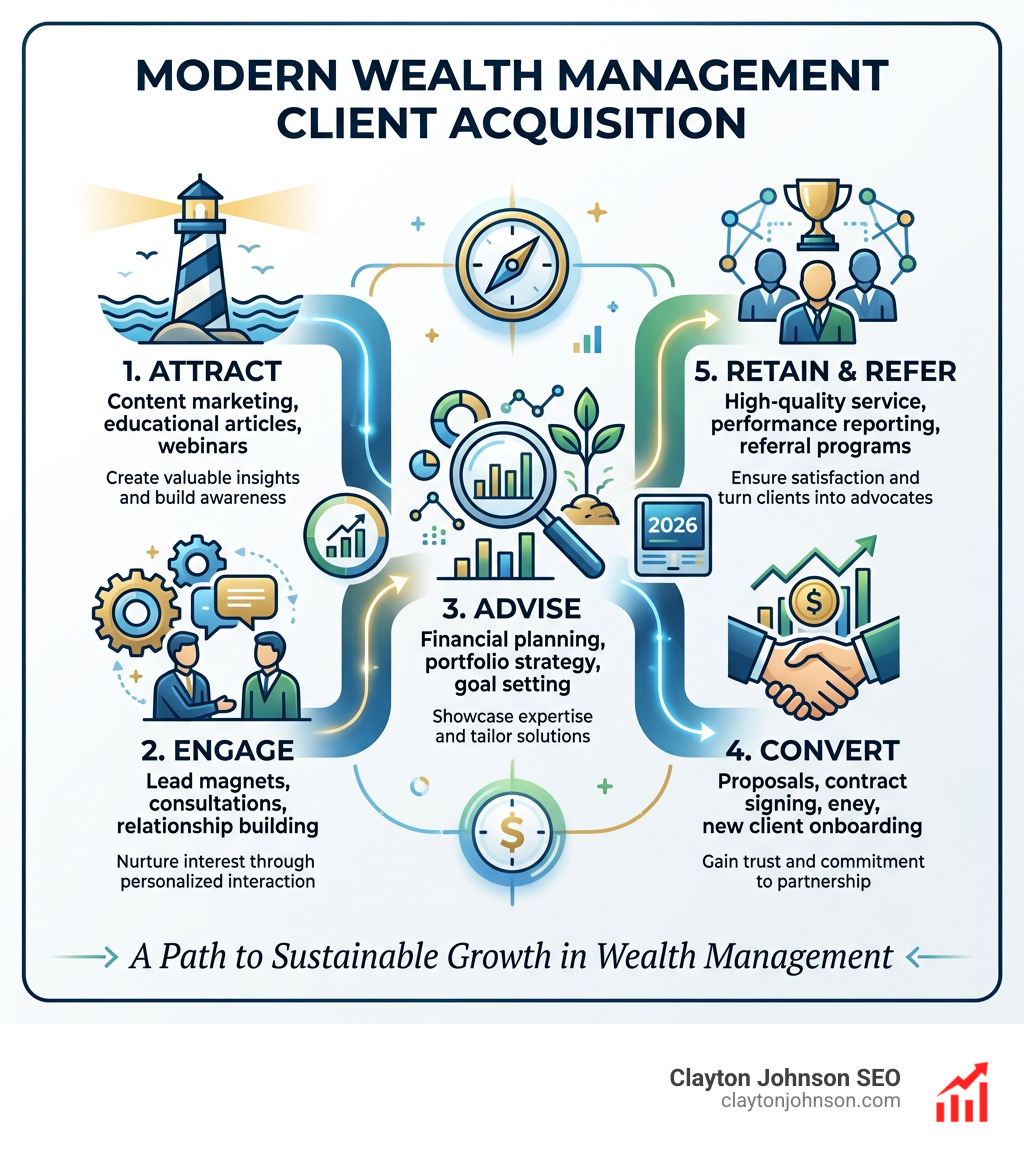
Building a High-Conversion Referral Engine and COI Network

While digital tools are evolving, the “warm introduction” remains the gold standard for high-net-worth (HNW) acquisition. Research shows that referred clients have a lifetime value that is 16% higher than those acquired through other channels. However, top advisors don’t just wait for the phone to ring; they build a structured referral program.
Instead of a passive “let me know if you know anyone” approach, we recommend a proactive system. This includes sending quarterly emails to your best clients offering a “complimentary portfolio second opinion” for their friends or family. This frames the referral as a value-add for the friend rather than a favor for you.
Leveraging Centers of Influence (COIs)
Your most powerful allies are often other professionals serving the same clients: CPAs and estate attorneys. These Centers of Influence are already in the room when major financial decisions are made. To build a winning COI network:
- Focus on Revenue-Sharing or Reciprocity: Some elite advisors use formal revenue-sharing agreements (where compliant), while others rely on a strict “one-for-one” referral exchange.
- Personal Introductions: Never just swap business cards. A personal introduction—perhaps over a lunch or a three-way Zoom call—prevents misunderstandings and adds that essential human touch.
- Niche Networking: Joining groups like BNI (Business Network International) or local alumni associations can provide a steady stream of outbound tactics.
While some modern advisors shy away from older methods, outbound tactics like targeted direct mail or even disciplined cold calling into specific business directories can still work if you have the “grit” to handle the numbers game.
How to Acquire Clients for Wealth Management Through Digital Marketing
In today’s market, your website isn’t just a digital brochure; it’s your storefront. Before a prospect ever calls you, they will Google you. If you want to know how to acquire clients for wealth management at scale, you have to master Search Engine Optimization (SEO).
At Clayton Johnson SEO, we’ve seen how specialized SEO strategies can transform a firm’s growth. Wealth management is a high-trust industry, and appearing at the top of search results for terms like “estate planning for business owners” or “wealth manager near me” builds immediate authority.
| Lead Generation Type | Average Cost | Conversion Speed | Scalability |
|---|---|---|---|
| Inbound (SEO/Content) | Lower (Long-term ROI) | Slower (Builds Trust) | High |
| Outbound (Cold Call/Mail) | Higher (Labor/Postage) | Faster (Direct) | Low |
Effective financial services marketing requires a focus on local SEO. Since 27% of an average advisor’s business now comes from outside their local community, your digital reach must be broader than your physical office.
Furthermore, ensure your site is mobile-friendly. With more than half of global web traffic coming from mobile devices, a clunky mobile experience will cost you leads before they even read your bio. For a deeper dive, check out our beginners guide to wealth manager SEO.
Optimizing Your Website: The Digital Storefront for How to Acquire Clients for Wealth Management
To turn visitors into leads, your website needs a high-conversion “user experience” (UX). This means clear Calls-to-Action (CTAs) like “Book a Free Consultation” or “Download Our Retirement Guide.”
Data shows that advisors with defined marketing plans generate 168% more leads from their websites than those who “wing it.” Use “gated content”—valuable white papers or tax checklists that require an email address to download—to build your list. Finally, don’t forget social proof. Testimonials (where compliant with the SEC Marketing Rule) and logos of professional affiliations build the trust necessary for a prospect to reach out.
Leveraging Social Media for Modern Lead Generation and How to Acquire Clients for Wealth Management
Social media is no longer optional. A recent survey found that 41% of advisors have landed a client via social media.
- LinkedIn Prospecting: This is the “country club” of the digital age. Don’t just post links; share educational videos and “thought leadership” posts that solve specific problems for your niche.
- Targeted Advertising: Facebook and LinkedIn ads allow you to target prospects by job title (e.g., “Medical Director”) or interest, making your brand awareness efforts highly efficient.
Targeting High-Net-Worth Segments and the Great Wealth Transfer
The “Great Wealth Transfer” is the biggest opportunity in the history of financial advice. Cerulli projects a $124 trillion wealth transfer through 2048. If you aren’t engaging the children and grandchildren of your current clients, you are effectively managing a sunsetting business.
Younger affluent millennials are highly engaged; 79% of them review their net worth regularly. They value financial independence, ESG (Environmental, Social, and Governance) investing, and digital-first transparency.
Strategies for Acquiring Ultra-High-Net-Worth (UHNW) Clients
Acquiring UHNW clients (those with $30M+ in investable assets) requires a different playbook than the mass affluent.
- Bespoke Relationships: These are long-cycle sales (6–24 months). You aren’t selling a portfolio; you’re selling a “concierge” experience.
- Liquidity Events: Position yourself as a “deal advisor” during business sales or IPOs.
- Account-Based Marketing (ABM): Instead of broad ads, create content specifically tailored for a handful of named families or entities.
- Influence Mapping: Identify the gatekeepers—the family office directors or long-time attorneys—and win their trust first.
Generating Leads Through Educational Events and Content
Education is the best way to demonstrate expertise without sounding “salesy.” Hosting workshops or webinars on high-interest topics like “Maximizing Social Security” or “Tax-Efficient Wealth Transfer” allows you to capture leads in a low-pressure environment.
Tools like AdvisorStream can help you automate this by providing high-quality, licensed content that you can share with your audience. Personalization is key. Research from McKinsey shows that personalization can grow revenue by 10% to 15%. In fact, 42% of investors explicitly want more personalized content that caters to their specific life stage and goals.
Scaling Growth with CRM Systems and Automation Tools
As you grow, you cannot manage your pipeline on a spreadsheet. A robust CRM (Customer Relationship Management) system is the heartbeat of a modern wealth management firm. Platforms like Envestnet provide the data analytics needed to understand your client base deeply.
Lead Scoring and Automation
Using tools like SmartAsset AMP allows you to automate lead generation and follow-ups. You can implement “lead scoring” to prioritize prospects who are most likely to convert. For example, a prospect who downloads three white papers and visits your pricing page should be called immediately, whereas someone who just signed up for a newsletter might need more “nurturing.”
According to Fidelity research on client segmentation, advisors who segment their clients and use automation to deliver tailored service see significantly higher AUM growth. Tracking Key Performance Indicators (KPIs) like Customer Acquisition Cost (CAC) and ROI on your marketing spend ensures that you are investing your dollars where they actually produce results.
Frequently Asked Questions about Wealth Management Client Acquisition
How can advisors balance compliance with effective marketing?
Compliance shouldn’t be a barrier to growth. The key is to work with your legal team to create pre-approved templates for social media and email. Always ensure you are following SEC and FINRA requirements regarding archiving and disclosures. Using anonymized case studies (e.g., “How we helped a business owner save $1M in taxes”) is a great way to show results without violating privacy or testimonial rules.
What common mistakes should new advisors avoid?
The biggest mistake is relying solely on friends and family. While they might be your first clients, they often “scatter like cockroaches” when you ask for serious business. Other mistakes include:
- Lack of a Niche: If you try to serve everyone, you resonate with no one.
- Inconsistent Outreach: Marketing is a marathon, not a sprint.
- Ignoring Digital Presence: A bad website is a “no-go” for modern HNW prospects.
- Transactional Selling: Wealth management is about relationships, not just products.
How long does it take to build sustainable growth momentum?
Building a wealth management practice takes grit. Sales cycles for HNW clients typically range from 6 to 24 months. Most successful advisors say it takes about 5 years of consistent effort to reach a “compounding” point where referral velocity takes over. It’s like knocking down a tree with a hammer—it’s inefficient at first, but if you keep hitting the same spot, it will eventually fall.
Conclusion
Acquiring clients for wealth management is no longer just about who you know at the local golf course. It requires a multi-channel approach that blends old-school relationship building with modern digital precision. By niching down, optimizing your SEO, and leveraging the Great Wealth Transfer, you can build a practice that is both scalable and resilient.
Ready to take your firm to the next level? Start growing your firm with specialized SEO services and let us help you build a digital storefront that attracts your ideal high-net-worth clients.