AI Enhanced SEO Strategies: Mastering the Future of Search

Core Pillars of a Modern AI Content Strategy Framework
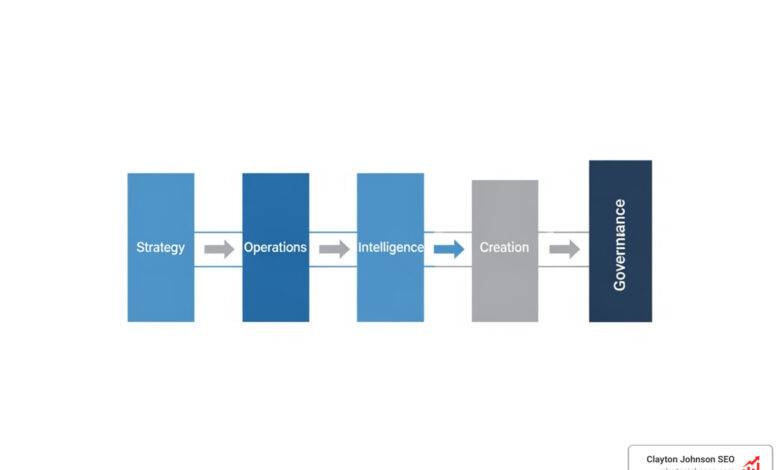
Building a scalable content engine requires more than just a subscription to an LLM; it requires a structural overhaul of how we think about content operations. A modern ai content strategy framework is built on four foundational pillars that turn chaotic drafting into an engineered system.
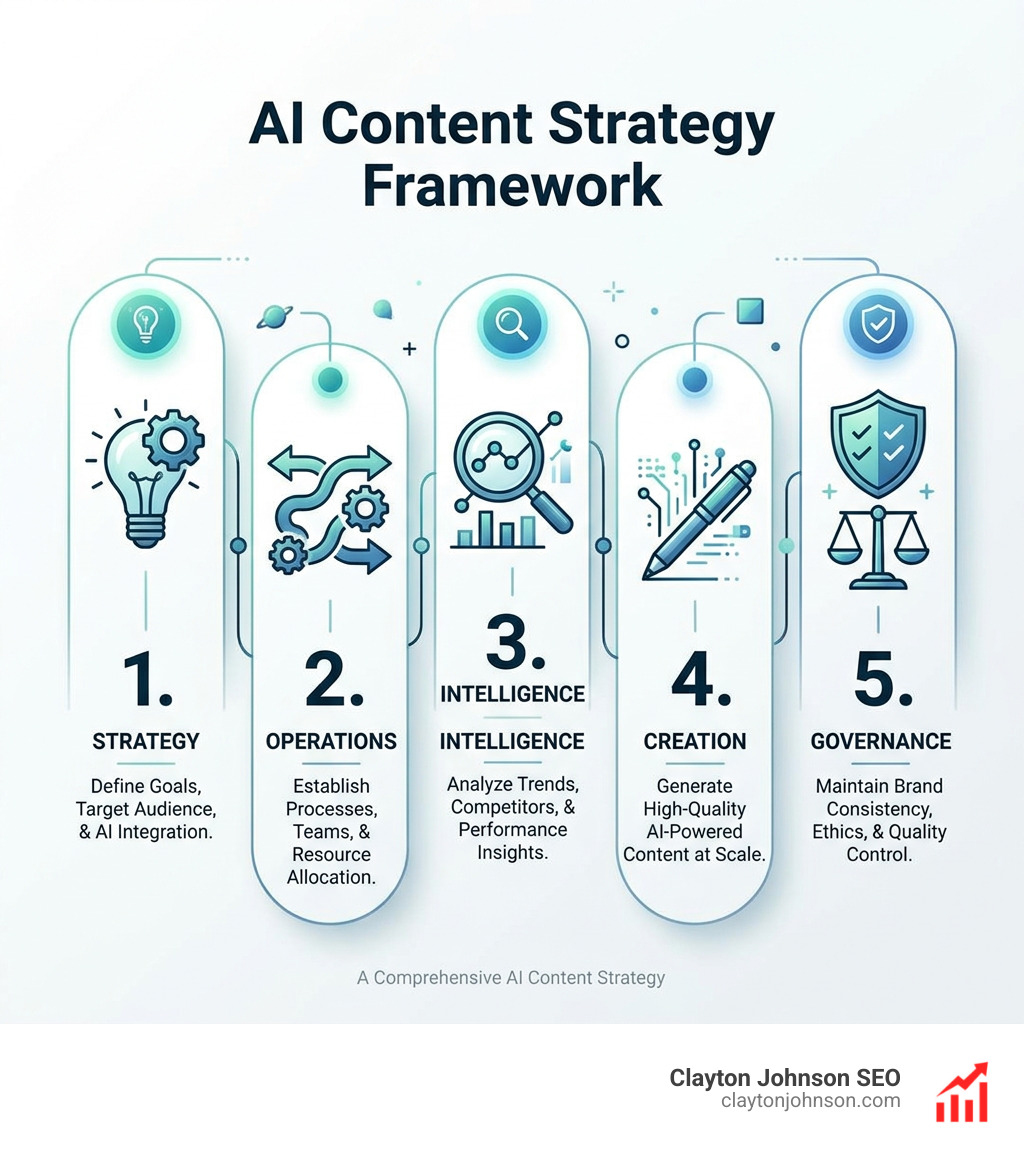
- Brand Intelligence and Guardrails: Before a single prompt is written, we must codify our brand’s DNA. This includes messaging, personas, voice, and style rules. Without these “brand intelligence” documents, AI output defaults to a generic “middle-of-the-road” tone that fails to resonate.
- Tool-Backed Decision Processes: We don’t guess what to write. We use specialized tools for each stage—from ideation to performance tracking. This ensures that our ai content strategy framework is data-driven, not vibe-driven.
- Mature Content Operations: As Colleen Jones emphasizes in The Content Advantage, content is an ongoing responsibility, not a one-time deliverable. Success in scaling AI depends more on the maturity of your content operations than on the specific AI tools you choose.
- E-E-A-T and Human-in-the-Loop: Google prioritizes Experience, Expertise, Authoritativeness, and Trustworthiness. AI cannot “experience” your product or “be” an expert. Our framework uses AI for the heavy lifting while humans provide the soul, the facts, and the final quality gate.
An impactful content strategy is essential for better search engine visibility and driving conversions. Did you know that content marketing costs 62% less than traditional marketing but generates three times as many leads? By integrating AI, we amplify these cost-savings while dramatically increasing our reach. For a deeper look at these systems, explore our ultimate guide to AI content systems.
Intelligent Planning and Research within an AI Content Strategy Framework
In the old world, research took weeks. In an AI-augmented world, it takes minutes. Intelligent planning uses predictive modeling to identify opportunities before the market becomes saturated.
- Trend Discovery: We use AI to scan social signals, news cycles, and search data to surface emerging topics.
- Competitor Gap Analysis: Tools like MarketMuse or Semrush can instantly compare our content library against competitors, highlighting exactly where we are missing high-value “answer” opportunities.
- Audience Intent Mapping: AI analyzes customer reviews, transcripts, and forums to cluster audience pain points, allowing us to map content directly to the buyer’s journey.
By treating research as an automated input, we ensure our editorial calendar is always aligned with actual search intent. If you aren’t sure where your current content stands, it’s time to look into top AI content audit tools to find your hidden gaps.
Balancing Automation and Human Oversight in the AI Content Strategy Framework
The biggest mistake teams make is the “set it and forget it” approach. AI-generated content is the new floor—it’s the baseline. To stand out, we must be better than what a basic prompt can produce.
We implement a “human-in-the-loop” workflow at every critical stage:
- The Skeleton Stage: An expert creates a detailed outline (the skeleton).
- The Muscle Stage: AI fills in the drafts based on brand guardrails.
- The Vitality Stage: A human editor adds real-world anecdotes, fact-checks every claim, and ensures the tone is perfect.
This approach mitigates risks like “hallucinations”—where AI presents false info with total confidence. According to a Forbes article, these errors are a predictable failure mode, not just a bug. We also use Semrush’s AI search study to understand how AI-generated summaries are citing sources, ensuring our human-vetted content is “cite-ready.”
Optimizing for GEO and AI-First Search Visibility
Search behavior is shifting from “list-shaped” to “answer-shaped.” This is the realm of Generative Engine Optimization (GEO). Your audience is increasingly engaging with content after it’s been processed into AI-generated answers in ChatGPT, Perplexity, or Google AI Overviews.
To master this, our ai content strategy framework focuses on:
- Micro-Explanations: Writing short, punchy answer blocks that AI models can easily “lift” and cite.
- Citations as the New Rankings: Visibility is moving from “where do we rank?” to “do we get cited?” We optimize for citations by providing unique data and evidence-backed claims.
- Entity Clarity: We use schema markup and consistent naming to help AI understand exactly who we are and what we represent in the knowledge graph.

Implementing and Scaling Your Content Engine
Scaling isn’t about doing more of the same; it’s about doing things differently. Traditional workflows are linear and slow. AI-augmented workflows are parallel and exponential.
| Feature | Traditional Workflow | AI-Augmented Workflow |
|---|---|---|
| Research | Manual, 10+ hours | Automated, < 30 mins |
| Drafting | Human-first, 4-8 hours | AI-first, 10 mins |
| Optimization | Reactive, post-publish | Predictive, pre-publish |
| Scaling | Linear (more people) | Exponential (more systems) |
| Output | 1-2 pieces/week | 5-10 pieces/week |
When we move toward building a robust AI content strategy for enterprise success, we focus on taxonomy-driven ecosystems. This means every piece of content is tagged and structured so that AI can repurpose it across social, email, and video channels instantly.
Essential Tools for the AI-Augmented Lifecycle
Your job is to build a custom toolkit. As a Gartner report highlights, there is an explosion of specialized AI applications.
- Large Language Models (LLMs): Use Claude for nuanced writing or GPT-4o for logic and data processing.
- Specialized Agents: Tools like StoryChief’s William or HubSpot’s Breeze act as 24/7 agents that audit traffic and suggest ideas.
- Brand Voice Enforcement: Use Writer.com or Grammarly’s AI Writing Assistant to ensure every writer stays on-brand.
- Visual Assets: Tools like Midjourney allow us to create memorable graphics that support our data-driven stories.
For a full breakdown of the stack, see our list of best AI content tools.
Measuring Performance and ROI of AI-Driven Content
If you can’t measure it, you can’t scale it. We move beyond vanity metrics like traffic and focus on Strategic Roadmap Alignment and Revenue Impact.
- Efficiency Metrics: Track “Time to Publish” and “Cost Per Piece.” AI should ideally reduce these by 50% or more.
- Conversion Attribution: Use CRM data to see which AI-assisted content pieces actually drive demo requests and sales.
- Citation Share: In the age of GEO, we track how often AI models reference our brand for core queries. Google positions AI Overviews as a key experience, so being present there is a major KPI.
- Data Centralization: Successful marketers, according to the Content Marketing Institute, consistently measure content ROI using unified dashboards.

Conclusion: Building Durable Systems with Clayton Johnson SEO
The future of search belongs to those who build systems, not just content. An ai content strategy framework is that system. It provides the clarity and structure needed to turn the chaotic noise of generative AI into a compounding growth engine.
At Clayton Johnson SEO, we don’t just advise on these frameworks—we build the infrastructure that makes them run. We focus on:
- Clarity: Defining your brand’s unique “Brand Intelligence.”
- Structure: Building taxonomy-driven content ecosystems.
- Leverage: Using AI to 10x your human team’s output.
- Compounding Growth: Ensuring every piece of content builds authority over time.
As Rand Fishkin puts it, “AI-generated content is the new floor. If your content isn’t better than what AI can produce, it’s not worth making.” Our goal is to ensure your content is always significantly above that floor.
Ready to stop shouting into the void and start building authority? Whether you are an enterprise looking to scale or a founder needing a roadmap, we can help. Book a consultation today to see how we can transform your content into a durable traffic system.