Deep Dive into BMC Cost Structure and Expense Management


Why BMC Cost Structure Analysis Matters for Business Viability
BMC cost structure analysis is the systematic process of identifying, categorizing, and optimizing all costs required to operate your business model. It’s the financial foundation that determines whether your business can survive, scale, and compete.
Quick Answer: Core Components of BMC Cost Structure Analysis
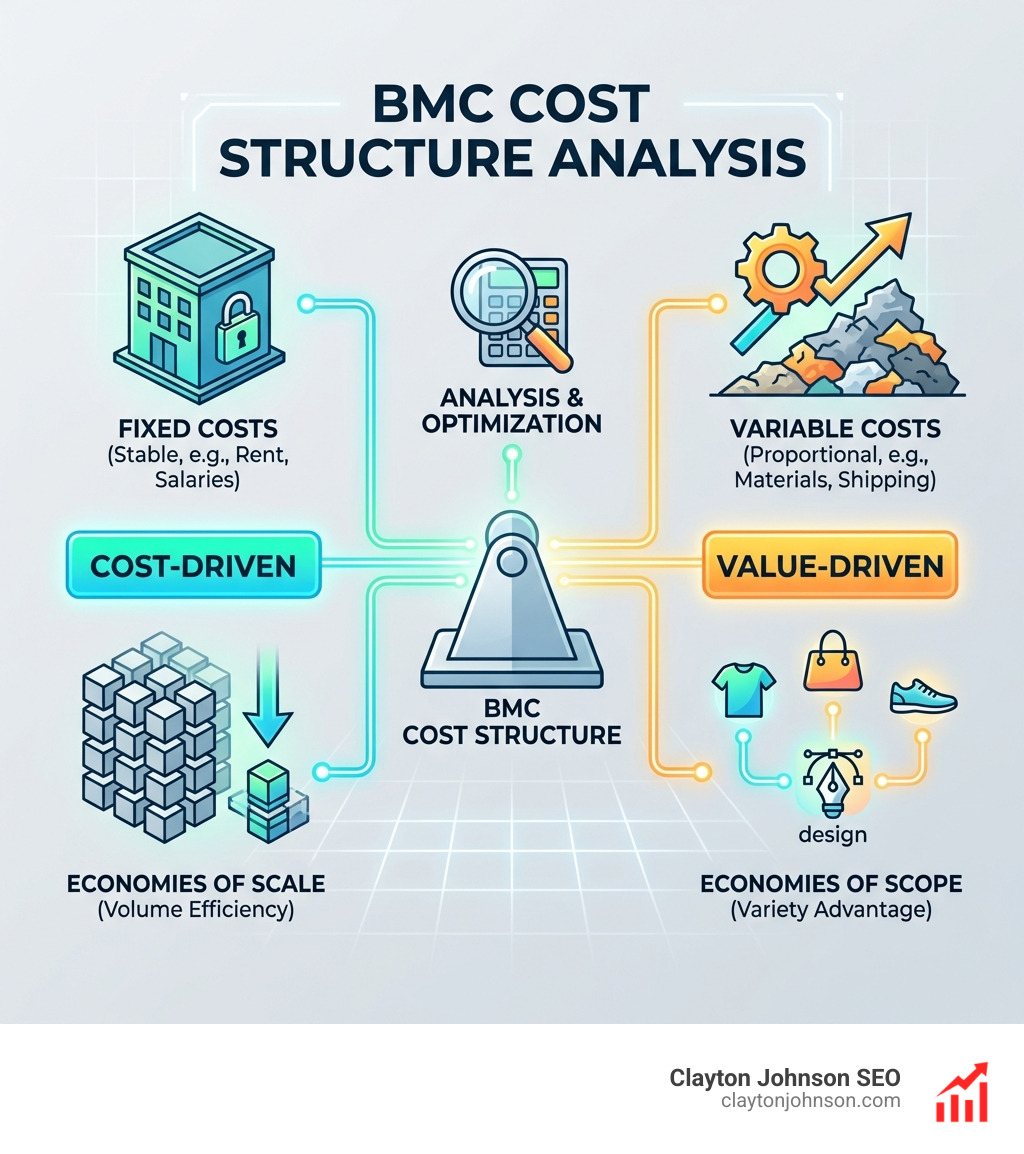
- Fixed Costs – Expenses that remain constant (rent, salaries, insurance)
- Variable Costs – Expenses that fluctuate with production (materials, commissions)
- Cost Drivers – Key activities and resources generating expenses
- Economies of Scale – Unit cost reductions as volume increases
- Cost-Value Alignment – How expenses support your value proposition
Most businesses fail not because they lack revenue potential, but because they never properly mapped their cost structure. According to research, operating costs account for 70-90% of total lifetime expenses in many industries. Yet founders and strategists often treat the Cost Structure block as an afterthought—a simple list of expenses rather than a strategic lever.
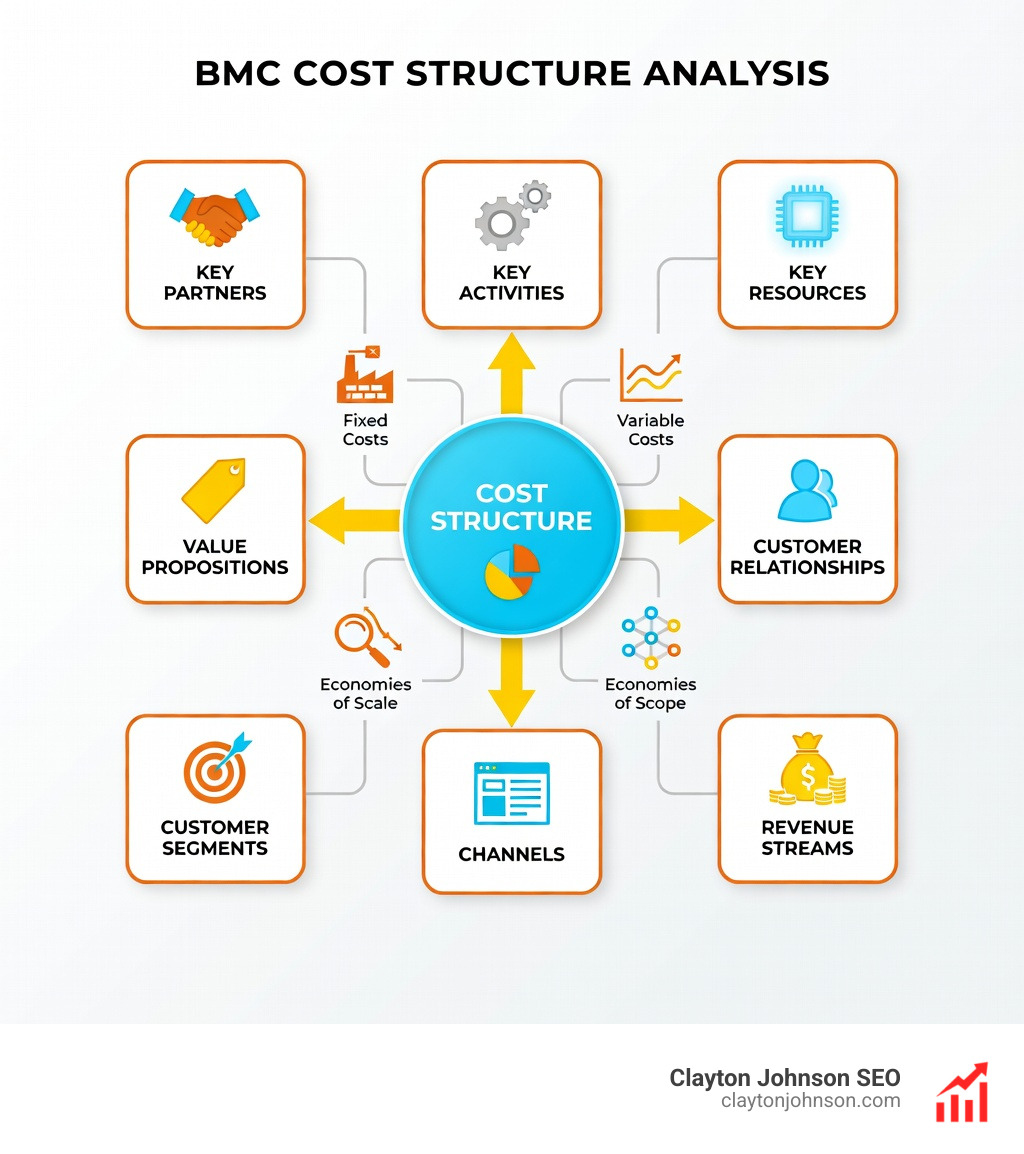
The Business Model Canvas positions Cost Structure as one of nine interconnected building blocks. It sits at the bottom right, but its influence reaches everywhere. Your costs don’t exist in isolation. They’re the monetary consequence of every strategic choice you make about resources, activities, partnerships, and value delivery.
Consider real-world examples: Zara invests less than 0.3% of sales revenue into advertising, relying instead on social media and store locations. Netflix’s algorithm cherry-picks over 80% of streamed content, making machine learning a core cost driver that also defines their competitive advantage. Vintae achieved 30% year-on-year growth by shifting vineyard ownership from Key Resources to Key Partnerships—a cost structure innovation that transformed their entire business model.
The difference between cost-driven and value-driven strategies isn’t about spending less versus spending more. It’s about strategic alignment. Are your expenses creating the value your customers pay for? Can you identify which costs are essential versus nice-to-have? Do you understand how scaling will change your cost structure?
I’m Clayton Johnson, and I’ve spent years building growth systems that connect strategic frameworks to measurable financial outcomes, including hands-on BMC cost structure analysis for companies across industries. My work focuses on turning fragmented expense data into coherent cost models that drive better decisions.
The Strategic Role of Cost Structure in Business Viability
When we look at business viability, we aren’t just looking at whether a company can make a sale. We are looking at whether the business can sustain its operations over the long haul while generating a profit. A well-designed cost structure is the “engine room” of this viability. It dictates your margins, your ability to withstand market downturns, and your capacity for Market Analysis that informs future growth.
In the Business Model Canvas (BMC) framework, the Cost Structure block helps us decide between two primary strategic directions:
- Cost-Driven Strategies: These models focus on minimizing costs wherever possible. Think of budget airlines or discount retailers. The goal is to create a lean infrastructure and offer low-price value propositions.
- Value-Driven Strategies: These models are less concerned with the absolute cost and more focused on value creation. Luxury brands or highly specialized consulting firms often fall here, where premium services and personalized experiences justify a higher cost base.
Strategic alignment means ensuring that your spending matches your promises. If you claim to offer the best customer support in the world but your cost structure doesn’t allow for high-quality labor, your model is fundamentally broken.
Defining the Cost Structure Block
In the original Strategyzer BMC Overview, Alexander Osterwalder defines the Cost Structure block as the representation of all costs incurred to operate a business model. It is the final piece of the puzzle that answers: “What are the monetary consequences of our infrastructure?”
Creating, delivering, and maintaining value propositions all cost money. Whether it’s the server costs for a SaaS app or the manufacturing overhead for a physical product, every “Key Activity” and “Key Resource” on your canvas has a corresponding line item in your cost structure.
Step-by-Step BMC Cost Structure Analysis
Conducting a thorough BMC cost structure analysis requires us to move beyond a simple list of bills. We need to categorize expenses to understand how they behave as the business changes. This is where Market, Industry, and Competitive Analysis becomes vital—you need to know if your costs are in line with industry benchmarks.
Fixed vs. Variable Costs
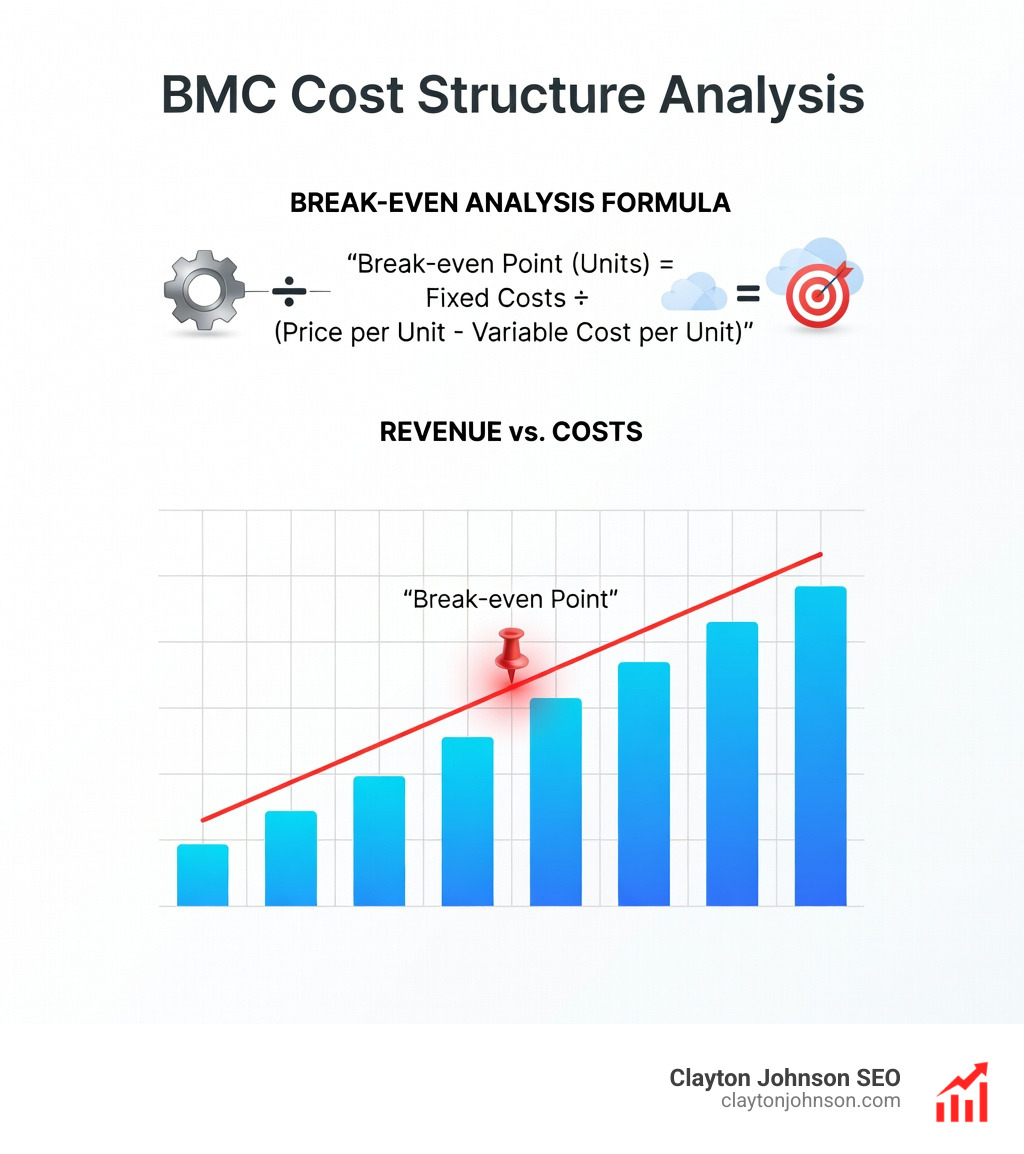
The first step is distinguishing between fixed and variable costs. This distinction is critical for understanding your “break-even” point—the moment you stop losing money and start making it.
| Cost Type | Definition | Business Impact | Examples |
|---|---|---|---|
| Fixed Costs | Expenses that remain the same regardless of volume. | Creates “operating leverage”; high fixed costs are risky but profitable at scale. | Rent, salaries, insurance, R&D. |
| Variable Costs | Expenses that increase or decrease with production. | Directly tied to sales; lower risk but can squeeze margins if not managed. | Raw materials, shipping, sales commissions. |
Economies of Scale and Scope
Beyond the basic categories, we look for efficiencies:
- Economies of Scale: These occur when your unit costs fall as your volume increases. For example, a car manufacturer might negotiate lower steel prices when ordering for 100,000 vehicles versus 10,000.
- Economies of Scope: These occur when a business gains cost advantages by offering multiple products. A software company might use the same core codebase (a Key Resource) to power three different apps, spreading the development cost across multiple Revenue Streams.
Identifying Key Drivers for BMC Cost Structure Analysis
A “cost driver” is the primary factor that causes an expense to change. To find yours, we often look at Porter’s Five Forces. For instance, if supplier power is high, your raw material costs are a major driver.
We use activity-based costing to link expenses directly to the Key Activities on your canvas. If your Key Activity is “Software Development,” your primary drivers are likely developer salaries and cloud infrastructure. By identifying these, we can focus our optimization efforts where they will have the most significant impact on operational efficiency.
Quantitative Methods for BMC Cost Structure Analysis
To make the analysis actionable, we need numbers. We often pull data from a Profit and Loss statement analysis to populate our canvas.
- Contribution Margin: This is your selling price minus variable costs. It tells us how much each sale contributes to covering your fixed costs.
- Break-Even Analysis: We calculate exactly how many units (or subscriptions) you need to sell to cover all expenses. For a tech startup, this might be the number of app downloads needed to offset high initial R&D costs.
- Unit Economics: We look at the cost to acquire a customer (CAC) versus their lifetime value (LTV). If your cost structure makes CAC higher than LTV, the business isn’t scalable.
Mapping Interdependencies Across the Canvas
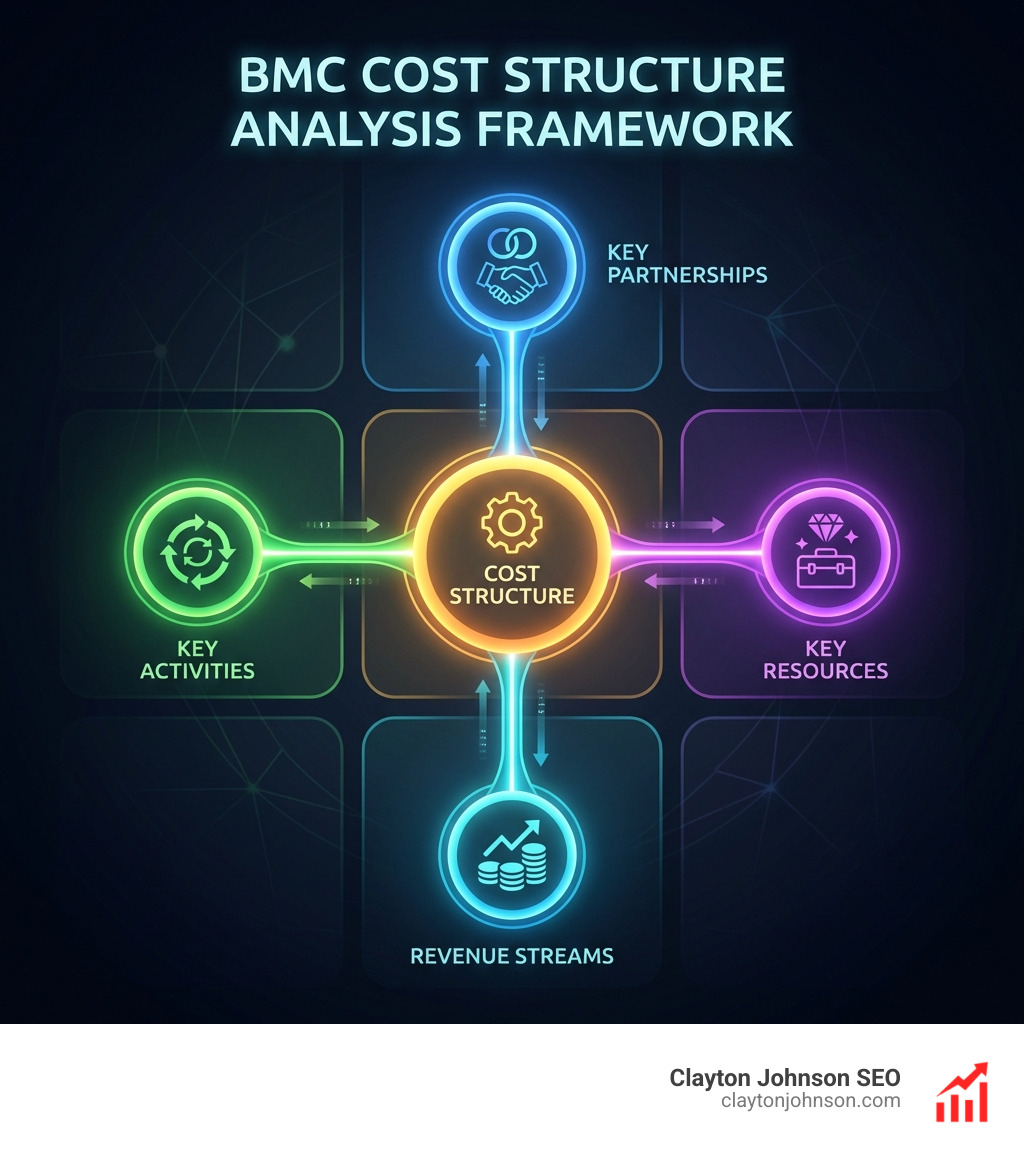
The magic of the BMC is that no block is an island. Your cost structure is the “output” of the left side of the canvas (Infrastructure) and must be balanced by the right side (Value/Revenue).
- Key Resources: If your model relies on high-end talent or expensive machinery, your fixed costs will be high.
- Key Activities: If your model requires intensive R&D or manual assembly, your labor costs will be a major driver.
- Key Partnerships: Partnerships can be a secret weapon for cost optimization. By outsourcing non-core activities, you can turn fixed costs into variable costs.
- Revenue Streams: Your pricing must reflect your cost structure. A low-margin product requires high volume, while a high-cost value proposition requires premium pricing.
We often perform a SWOT Analysis specifically on the cost structure to find “Weaknesses” (like rising vendor prices) or “Opportunities” (like automating a manual Key Activity).
Linking Infrastructure to Expenses
Are you asset-heavy or asset-light?
- Asset-Heavy: You own your factories, trucks, and equipment. This usually means high fixed costs but more control.
- Asset-Light: You lease equipment or use partners. This increases your variable costs but offers massive flexibility.
A great example of this shift is the Vintae case study on partnership shifts. Vintae, a Spanish wine producer, realized that owning vineyards was a massive overhead. By moving vineyard ownership from “Key Resources” to “Key Partnerships” (leasing instead of owning), they reduced their fixed cost base and achieved 30% growth. They used a PESTLE Analysis to understand environmental and legal factors before making this leap, ensuring their supply chain was still secure.
Real-World Applications: From SaaS to Manufacturing
Let’s look at how world-class companies manage their BMC cost structure analysis to gain a competitive edge.
Zara: The King of Efficiency
Zara’s model is legendary. While most fashion retailers spend heavily on marketing, Zara invests less than 0.3% of sales revenue into advertising. They’ve shifted that “cost” into their “Key Resources”—their flagship stores in prime locations and their lightning-fast supply chain. By keeping advertising costs low and store aesthetic high (as seen in their Zara aesthetic evolution at Hudson Yards), they maintain incredible margins.
Netflix: Algorithms as Cost Savers
Netflix is a massive infrastructure play. They account for 12.6% of global bandwidth usage, which is a staggering variable cost. However, they optimize their “Key Activities” through machine learning. Over 80% of content streamed is driven by their algorithm. This efficiency reduces the “cost” of customer churn and ensures they aren’t wasting money on content that nobody watches.
Industry-Specific Cost Structures
- SaaS/Tech: High fixed costs (developers) but near-zero variable costs for each new user. This leads to massive scalability.
- Manufacturing: High variable costs (materials) and significant overhead (factories). Success here depends on economies of scale.
- Biopharma: This is a unique beast. Biopharma COGS trends show that as we move toward “personalized medicine” (like CAR T-cell therapies), patient populations get smaller. This means volume drops, and unit costs can skyrocket. Research shows that halving production volume can increase unit costs by 40%.
Optimization Frameworks, Tools, and Pitfalls
When we sit down to optimize a cost structure, we have to be careful not to “cut our way to failure.” Over-optimization can lead to quality drops that destroy your Value Proposition.
Common Mistakes to Avoid
- The Sunk Cost Fallacy: Just because you’ve spent $1 million on a Key Resource doesn’t mean you should keep it if it’s no longer efficient.
- Oversimplification: Treating all costs as “overhead” instead of identifying the specific drivers.
- Static Snapshots: Filling out a BMC once and never looking at it again. Your cost structure should be reviewed quarterly.
- Ignoring External Shifts: A sudden rise in energy prices or a new regulation can turn a profitable model into a money-loser overnight.
Tools for Effective Analysis
We don’t have to do this on the back of a napkin anymore. Several tools make collaborative BMC cost structure analysis much easier:
- Strategyzer: The gold standard for digital BMC creation. Their software allows you to link blocks and run “what-if” scenarios.
- Confluence Whiteboards: Atlassian’s tool is fantastic for real-time team brainstorming. You can Create a business model canvas in Confluence for free and integrate it with your project management workflows.
- Templates: For those who prefer a structured document, Strategyzer templates and Google Docs BMC Templates provide a great starting point for workshops.
Frequently Asked Questions about BMC Cost Structure Analysis
What are the most common mistakes in BMC cost structure analysis?
The biggest pitfall is oversimplification. Many teams just list “Salaries” or “Rent” without linking them to the Key Activities they support. Another mistake is treating the canvas as a static snapshot. In reality, costs fluctuate with market trends, inflation, and scaling. Finally, many businesses underestimate variable costs, especially customer acquisition costs (CAC), which can balloon as you exhaust your primary marketing channels.
How does economies of scale impact the BMC cost structure?
Economies of scale allow you to reduce your unit cost as your volume grows. In the BMC, this usually manifests as a decrease in the “Cost Structure” block relative to the “Revenue Streams” block. This happens through bulk purchasing, spreading fixed costs (like a $10M factory) over millions of units, and improving labor specialization. It is a primary driver of competitive advantage for large-scale players like Amazon or Toyota.
Why is it important to link cost structure to key activities?
Linking costs to activities allows for waste elimination. If you realize a “Key Activity” is costing 40% of your budget but only contributing 5% to your “Value Proposition,” you’ve found a prime candidate for outsourcing or automation. This transparency ensures that every dollar spent is directly contributing to delivering value to the customer.
Conclusion
Mastering BMC cost structure analysis is about more than just balancing the books; it’s about strategic design. By understanding the interplay between your resources, activities, and expenses, you can build a business that isn’t just profitable today, but scalable and resilient for years to come.
Whether you are a startup trying to find your break-even point or an established enterprise looking to optimize COGS, the Business Model Canvas provides the clarity needed to make tough financial calls.
At Clayton Johnson, we specialize in these types of actionable frameworks. We help founders and marketing leaders in Minneapolis and beyond diagnose growth problems and execute strategies with measurable results. If you’re looking to refine your business model or scale your SEO and content systems, we’re here to help. More info about Clayton Johnson strategy services is available to help you take the next step in your growth journey.