Kotter 8 Step Process: From Chaos to Controlled Change

Why Change Initiatives Fail Without a Structured Framework
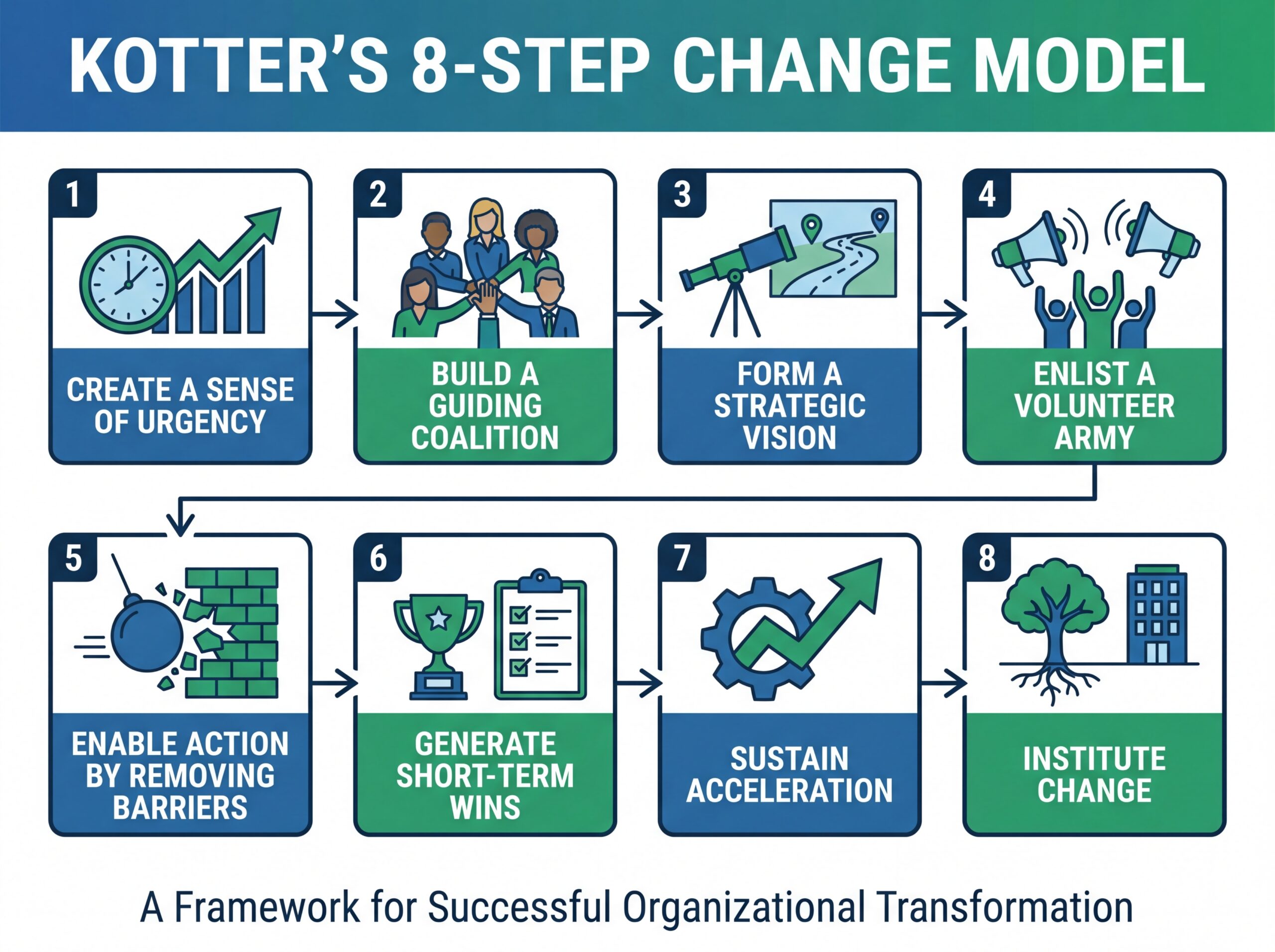
Kotter’s change management steps provide a proven roadmap for navigating organizational transformation. Here’s the complete 8-step framework:
- Create a Sense of Urgency – Identify opportunities or risks that make the status quo untenable
- Build a Guiding Coalition – Assemble influential leaders with power, expertise, and credibility
- Form a Strategic Vision – Develop a clear, compelling picture of the future
- Communicate the Vision – Share the vision repeatedly through multiple channels
- Empower Broad-Based Action – Remove obstacles and enable people to act
- Generate Short-Term Wins – Create visible successes within weeks or months
- Sustain Acceleration – Consolidate gains and drive deeper change
- Anchor New Approaches in Culture – Embed changes into organizational DNA
Research from over 100 companies observed by Dr. John Kotter reveals a stark reality: more than 70% of major change efforts fail without a structured approach. Companies from Ford to British Airways have attempted fundamental transformations under various banners—total quality management, reengineering, cultural change—yet most stumble on the same predictable pitfalls.
The problem isn’t lack of effort. It’s lack of structure.
Organizations declare victory too early. They underestimate the need for a powerful guiding team. They fail to communicate their vision beyond a single email or quarterly meeting. And when resistance emerges, they lack the framework to diagnose where the process broke down.
The cost of failed change is staggering. In a business environment where 88% of C-suite leaders believe the pace of change will accelerate, standing still means falling behind. Yet without a proven methodology, transformation efforts become expensive exercises in frustration.
Dr. John Kotter introduced his 8-step model in 1995 after analyzing dozens of change initiatives across large corporations, small firms, struggling companies, and profitable leaders. His framework addresses both the emotional and logistical aspects of transformation—recognizing that change is fundamentally about people, not just processes.
The model has been successfully applied in contexts ranging from GME recruitment programs during COVID-19 (maintaining 100% fill rates while doubling website engagement) to major organizational restructures. It works because it follows a sequential, psychological progression that builds momentum while addressing the natural human resistance to change.
I’m Clayton Johnson, and I’ve spent years building growth systems and strategic frameworks that turn fragmented efforts into coherent, measurable outcomes. Throughout my work helping organizations navigate Kotter’s change management steps, I’ve seen how the right structure transforms chaos into controlled, sustainable progress.
The Need for Structured Change Management
In a boardroom filled with C-suite leaders, the conversation often centers on one thing: speed. We are living in an era where the “status quo” has a shelf life of about five minutes. According to recent data, 88% of C-suite leaders believe that the pace of change will accelerate in the coming year.

Despite this urgency, many organizations treat change like a software update—something you just “install” and walk away from. This lack of definition is the number one reason why technology and business projects fail. Without a structured framework, “organizational antibodies” (those internal forces that fight anything new) quickly kill off even the most well-intentioned initiatives.
Using a structured approach is the second strongest predictor of successful change. When we use Kotter’s change management steps, we aren’t just following a checklist; we are building organizational resilience. This structure solves the “chaos problem” by:
- Reducing Friction: By defining roles and visions early, we avoid the “who’s in charge?” power struggles.
- Building Momentum: Short-term wins act like fuel for the long-haul journey.
- Ensuring Sustainability: It moves change from a “project” to a fundamental part of the culture.
Whether you are navigating a change in sales decision consulting or a total brand pivot, the 70% success rate associated with Kotter’s model proves that market adaptation is possible when you have a clear roadmap.
Breaking Down Kotter’s Change Management Steps
Dr. John Kotter’s 1996 framework wasn’t just a theory; it was a response to the “failed transformation” epidemic. He realized that change isn’t a single event—it’s a sequential process. If you skip a step, the whole structure collapses like a house of cards.
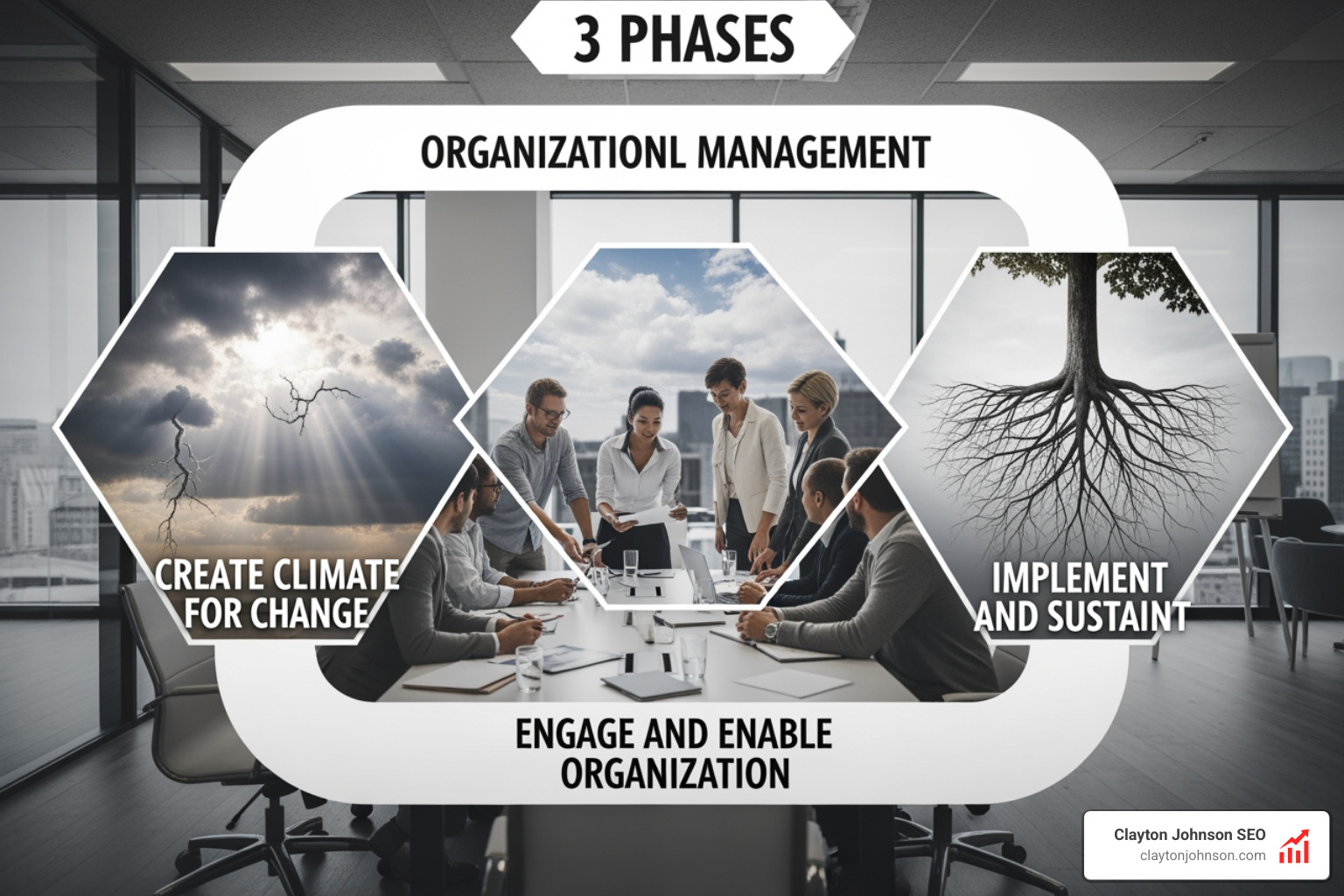
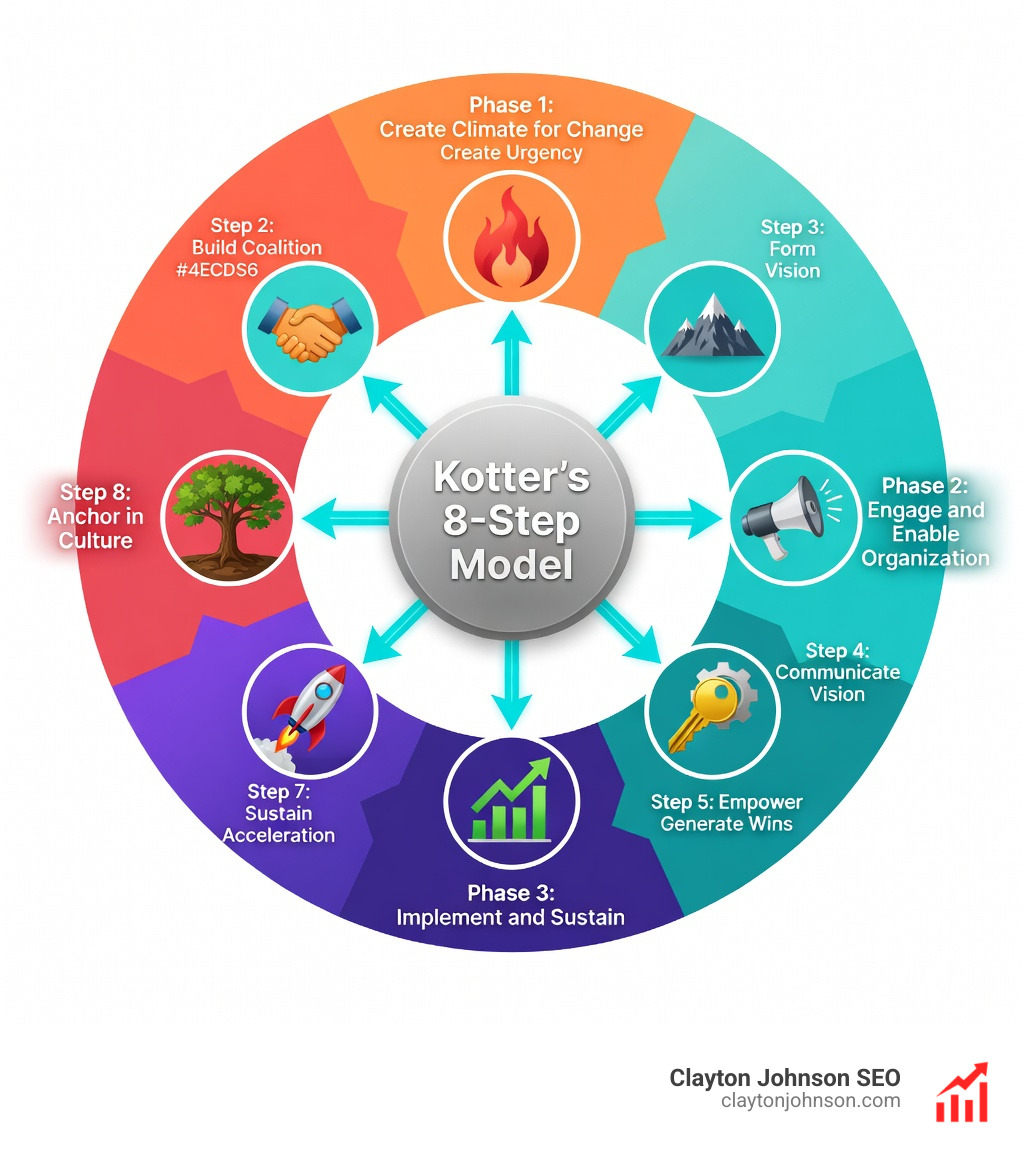
We can break the eight steps into three distinct phases. Each phase targets a specific psychological and operational hurdle.
Phase 1: Creating a Climate for Change
Before you can build the new, you have to convince people that the “old” is no longer safe. This phase is about preparation and alignment.
- Step 1: Create a Sense of Urgency. This is the “burning platform” moment. We must help others see the need for change by identifying real market risks or massive opportunities. In the medical field, scientific research on residency selection redesign showed that the COVID-19 pandemic provided a natural, high-intensity sense of urgency that forced immediate action.
- Step 2: Build a Guiding Coalition. No one can lead a transformation alone. We need a team with positional power, expertise, and credibility. Kotter found that close to 50% of agencies underestimate the importance of this team.
- Step 3: Form a Strategic Vision. A vision isn’t a 50-page document; it’s a compelling picture of the future that is easy to communicate. We use tools like mind-mapping to ensure the vision is both candidate-centered (for the customers) and resource-centered (for the staff).
Phase 2: Engaging and Enabling the Organization
Once the climate is set, we have to move the masses. This is where many leaders fail because they underestimate the volume of communication required.
- Step 4: Enlist a Volunteer Army. Change shouldn’t be “done” to people; they should want to be part of it. We look for the “early adopters” who are excited about the vision.
- Step 5: Enable Action by Removing Barriers. This is the “barrier-busting” step. Whether it’s outdated software, siloed departments, or “gatekeeper” personalities, leadership must actively clear the path. Research on virtual recruitment outcomes highlights how centralizing resources—like providing templates and videographers—removed the technical barriers that would have otherwise stalled the transition.
- Step 6: Generate Short-Term Wins. Humans need proof that the effort is worth it. We need to create visible, unambiguous successes within a short timeframe. This builds the credibility needed to tackle the harder, long-term changes.
Phase 3: Implementing and Sustaining the Transformation
The final phase is where we turn “the new way” into “the only way.”
- Step 7: Sustain Acceleration. After a few wins, there is a temptation to declare victory. Don’t. Instead, we use that momentum to tackle even bigger problems and deeper cultural issues.
- Step 8: Institute Change. Finally, we anchor the new behaviors in the culture. We show people how the new processes led to the wins they just celebrated. We make it part of the “cultural DNA” through hiring, promotions, and constant reinforcement.
Evaluating the Model: Pros, Cons, and Comparisons
No model is perfect for every scenario. While Kotter’s change management steps are the gold standard for top-down, vision-driven transformation, they have specific characteristics that might make them better or worse for your specific needs.
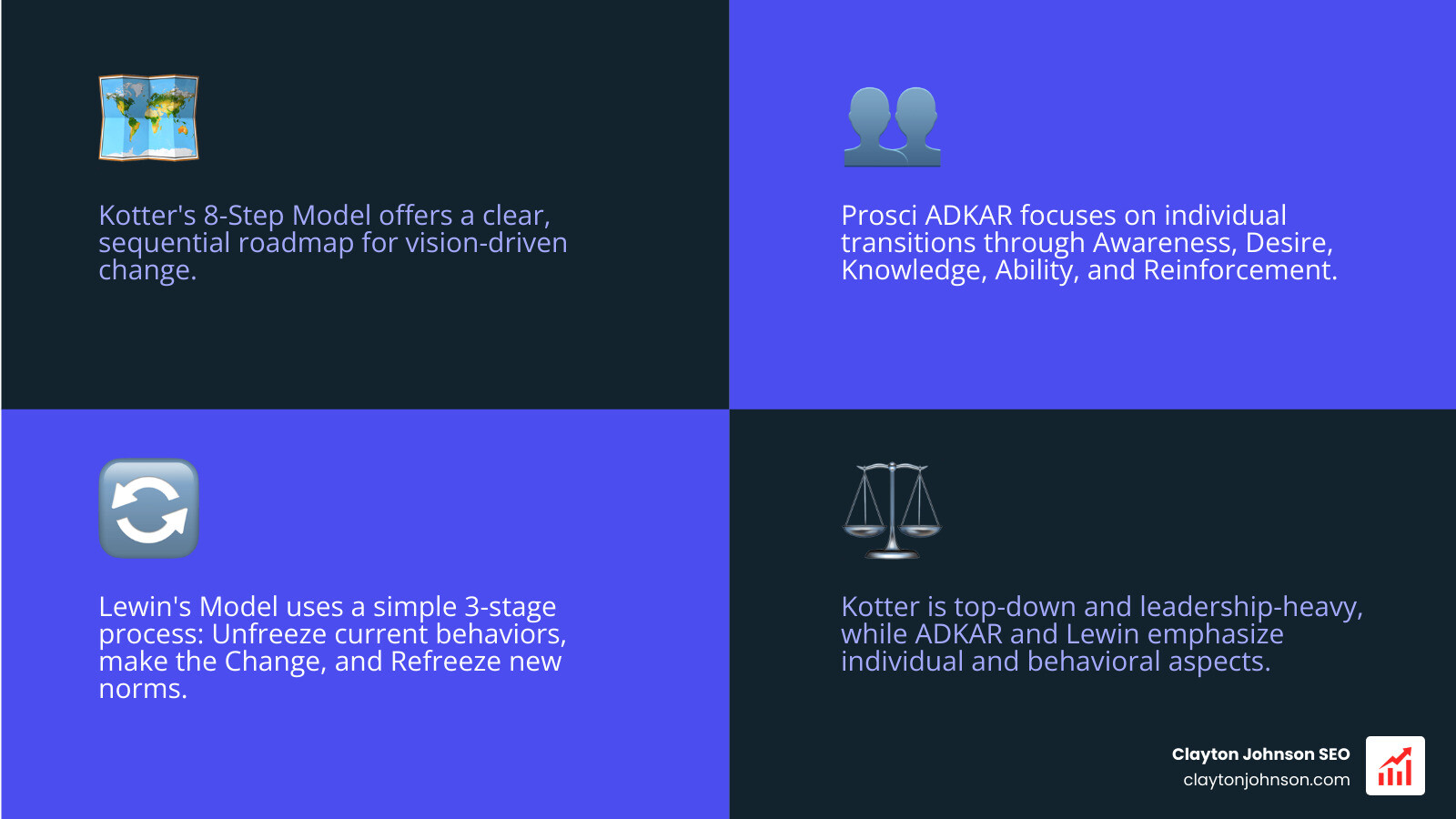
When we look at strategic growth services, we often weigh Kotter against other frameworks like the Prosci ADKAR model or Lewin’s simple “Unfreeze-Change-Refreeze” approach.
Strengths of the 8-Step Framework
- Clear Roadmap: It provides a very specific, sequential path that reduces the “what do we do next?” anxiety.
- Vision-Centric: It excels at aligning large groups of people toward a single, inspiring goal.
- Momentum Building: By prioritizing short-term wins, it prevents the “change fatigue” that kills long-term projects.
- Proactive Obstacle Management: It forces leaders to look for and remove barriers early in the process.
Limitations and Modern Criticisms
- Top-Down Bias: The model is heavily reliant on senior leadership. If the CEO isn’t “all in,” the model often stalls.
- Time-Consuming: This is not a “quick fix” model. It takes time to move through all eight steps properly.
- Linear Limitations: In modern agile environments, change is often more cyclical than linear. Kotter’s original model can feel a bit rigid for teams that need to pivot weekly.
- Evolution to 8 Accelerators: To address these criticisms, Kotter later evolved the model into the “8 Accelerators,” which focuses on a dual operating system—combining the efficiency of a hierarchy with the speed of an agile network.
Real-World Application: Kotter’s Change Management Steps in Action
The theory sounds great, but does it work when the stakes are high? Let’s look at a massive shift in Graduate Medical Education (GME).
During the COVID-19 pandemic, 15 GME programs had to move from traditional in-person recruitment to a 100% virtual model almost overnight. This wasn’t just a minor tweak; it was a total redesign of how doctors are selected.

By following Kotter’s change management steps, these programs achieved remarkable results:
- Urgency: The pandemic made the status quo (in-person interviews) impossible.
- Coalition: They formed a diverse committee of faculty and residents.
- Short-Term Wins: They launched pilot websites and social media campaigns quickly.
- Results: They maintained 100% local fill rates and doubled their peak monthly website page views from 7,000 to 15,000.
The study on GME virtual interviews proves that even in highly regulated, traditional fields, Kotter’s model provides the structure needed to navigate “wicked problems” and come out stronger on the other side.
Best Practices for Implementing Kotter’s Change Management Steps
If you’re ready to implement these steps, here are a few “pro-tips” from the trenches of organizational growth.
- Be the “Chief Repeating Officer”: You cannot over-communicate the vision. Use every channel—emails, meetings, newsletters, and Slack—to reinforce the “why” and “how.”
- Use “Two-Pizza Teams”: When removing barriers, empower small, autonomous teams to run experiments. If a team is too big to be fed by two pizzas, it’s too big to move fast.
- Leverage Technology: Platforms like Way We Do can help by creating “activated checklists.” Instead of a static manual, your change processes become part of the daily workflow. This allows for compliance auditing—making sure people aren’t slipping back into old habits.
- Avoid Premature Victory: This is the most common mistake. Just because the first pilot worked doesn’t mean the culture has changed. Keep the pressure on until the new way is the only way things are done.
As Dr. Kotter noted in his seminal work, Leading Change: Why Transformation Efforts Fail, the transition from a traditional hierarchy to a dual operating system is what allows modern companies to stay competitive.
Frequently Asked Questions about Kotter’s Model
Why do most change initiatives fail?
Most fail due to a lack of urgency or declaring victory too early. When employees don’t feel the “need” to change, they naturally resist. Additionally, many leaders fail to build a strong enough guiding coalition, leaving the weight of the change on one or two people. Without the “volunteer army,” the initiative eventually runs out of steam.
How does Kotter’s model differ for incremental vs. major transformation?
The steps are the same, but the intensity is different. For incremental change, you might just need a small team and a few emails. For “Big Bet” transformations, you need a “Single Threaded Leader” whose only job is the change, and the CEO must be intimately involved in overriding the “organizational antibodies” that try to stop progress.
Can Kotter’s 8 steps be used with the Prosci ADKAR model?
Absolutely! In fact, they are highly complementary. Kotter’s model is great for the organizational side of things (the big picture, the vision, the structure). ADKAR is perfect for the “last mile”—helping individuals through their own personal transitions of Awareness, Desire, Knowledge, Ability, and Reinforcement. Together, they provide a holistic approach to change.
Conclusion
Navigating Kotter’s change management steps is about more than just surviving a transition; it’s about building a company that is capable of constant evolution. Whether you are refining your SEO strategy or rebuilding your entire service model, having a structured framework is the difference between controlled progress and expensive chaos.
At Clayton Johnson, we focus on providing the growth frameworks and measurable results that help founders and marketing leaders diagnose problems and execute with precision. Change is inevitable, but failure doesn’t have to be. By mastering these eight steps, you can lead your organization toward a future that is not just different, but significantly better.
Master your organizational growth strategy with Clayton Johnson.