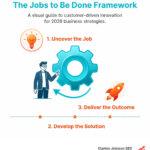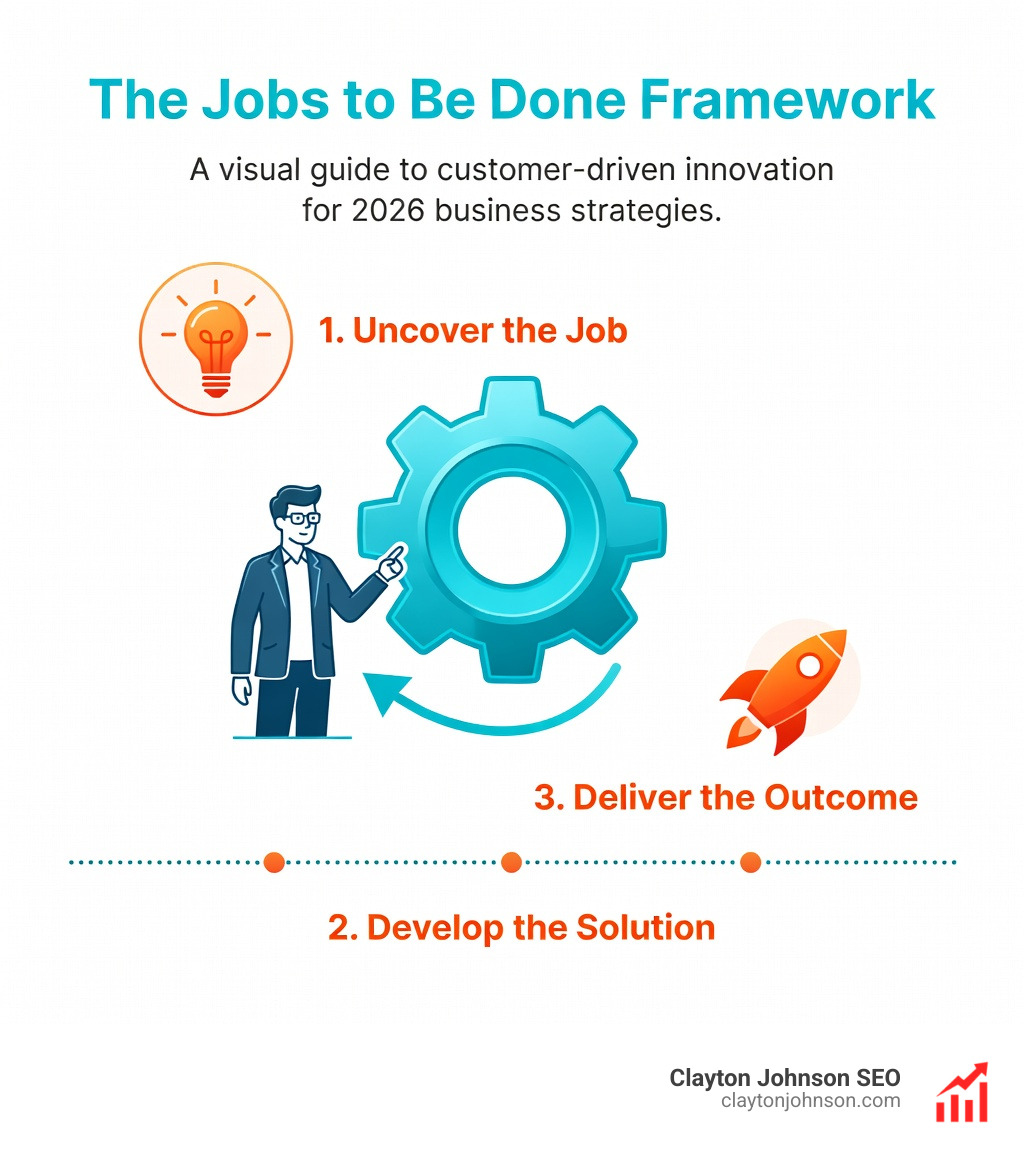
The jobs to be done methodology is a framework for understanding why customers buy products by focusing on the progress they’re trying to make in a specific situation, rather than their demographic characteristics or assumed needs.
Quick Overview:
- What it is: A theory that customers “hire” products to get specific jobs done in their lives
- Who developed it: Tony Ulwick (Outcome-Driven Innovation) and popularized by Clayton Christensen
- Core insight: Focus on the circumstance and desired progress, not customer attributes
- Key benefit: Makes innovation predictable by revealing true customer motivations
- Success rate: Companies using JTBD achieve an 86% success rate vs. industry averages
Here’s the uncomfortable truth: 84% of executives say innovation is critical to growth, but 94% are dissatisfied with their innovation performance. That’s according to McKinsey research.
The problem isn’t a lack of customer data. Most companies are drowning in it.
The problem is that they’re looking at the wrong thing.
Traditional market research asks who your customer is and what they want. Demographics. Psychographics. Feature requests. But none of this tells you why someone actually buys.
The jobs to be done methodology flips this on its head. Instead of building better features, you identify the progress customers are trying to make. Instead of segmenting by age or income, you segment by situation and circumstance.
When a building company in Detroit couldn’t sell condos to retirees despite adding features focus groups requested, they discovered the real job wasn’t about square footage or amenities. It was about transitioning lives without losing what mattered—like figuring out what to do with a dining room table that represented decades of family memories. Once they understood that job, they added moving services, storage, and a sorting room. Sales increased 25% while the industry dropped 49%.
That’s the power of understanding the job to be done.
I’m Clayton Johnson, and I’ve spent years helping companies build growth systems that align strategy with customer behavior, including applying the jobs to be done methodology to uncover what actually drives purchase decisions. This guide will show you how to use JTBD to stop guessing and start creating products people actually want to buy.
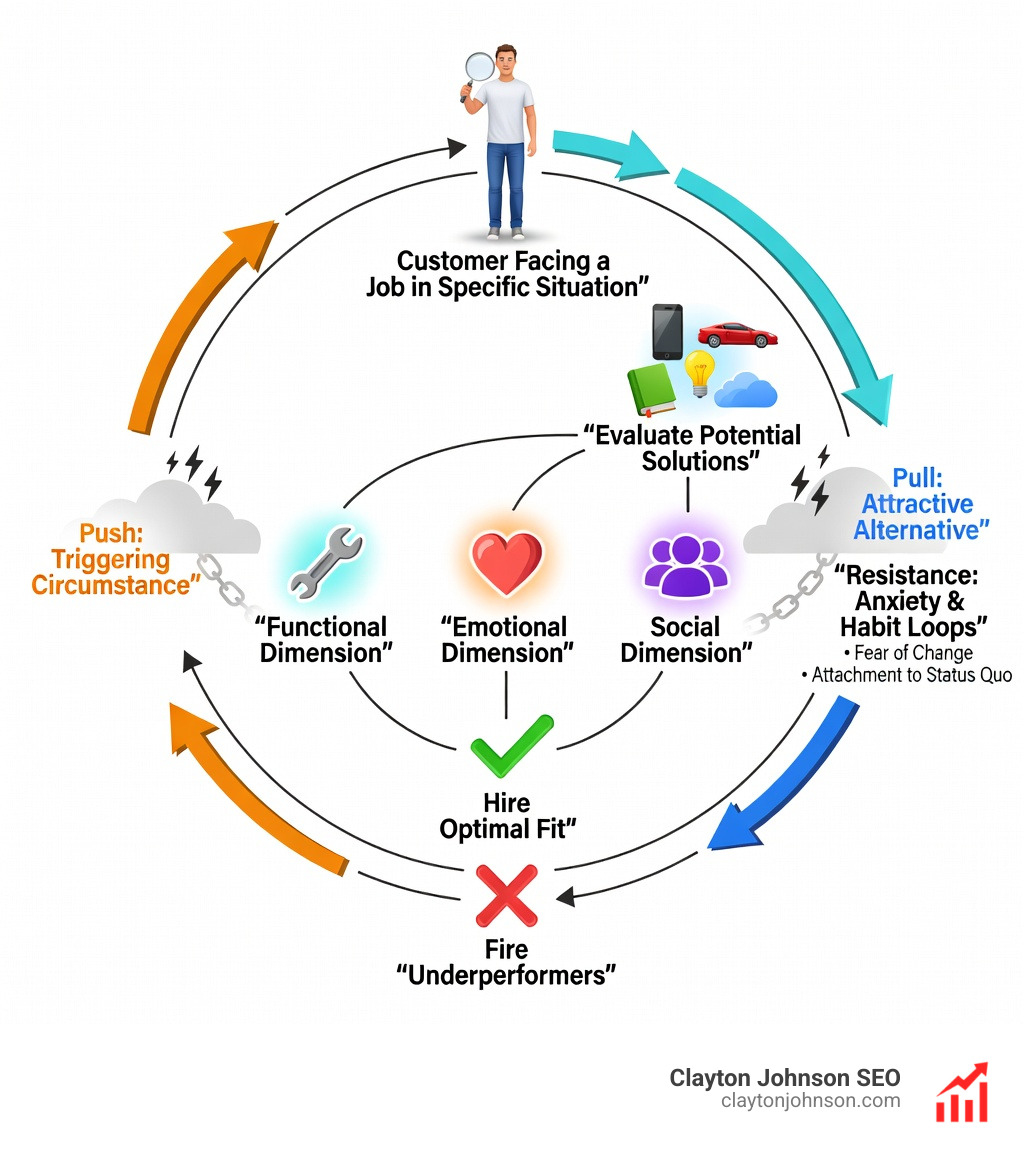
Jobs to be done methodology terms explained:
What is the Jobs to be Done Methodology?
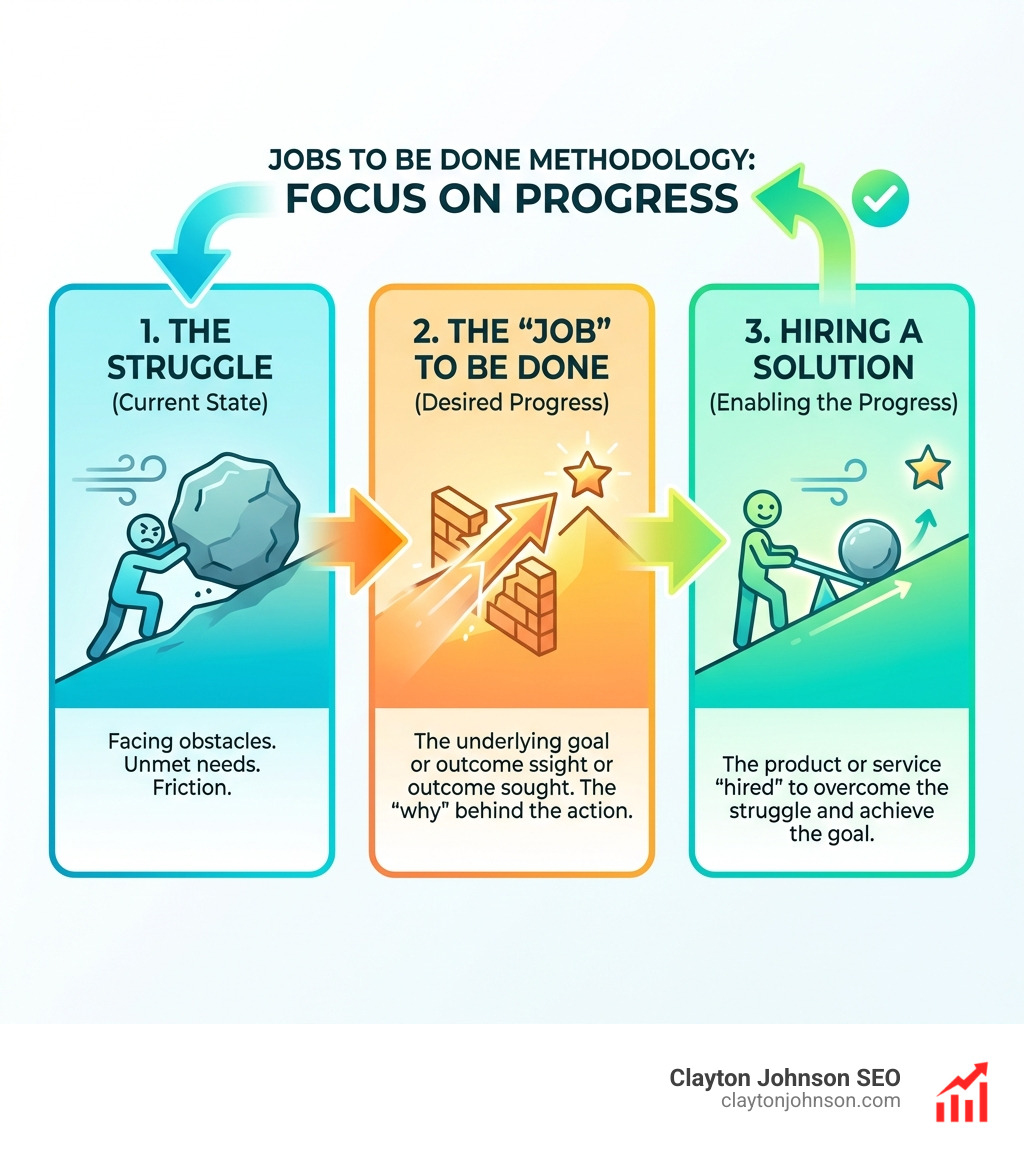
At its core, the jobs to be done methodology is a theory of causation. It explains why a customer makes the choice to “hire” a new product or “fire” an old one. Most marketing departments focus on correlation—they know that a 35-year-old male in Minneapolis who likes golf is likely to buy a certain type of watch. But his age and location didn’t cause him to buy the watch.
The “job” is the progress that individual is trying to make in a particular circumstance. As Clayton Christensen famously noted in his book Competing Against Luck, people don’t just buy products; they pull them into their lives to make a specific change.
When we use the jobs to be done methodology, we stop looking at the product as the center of the universe. Instead, the customer’s struggle becomes the center. We are looking for the “struggling moment”—that point where the current way of doing things is no longer sufficient, and the customer is looking for a better way to reach their “ideal self.”
The Evolution of Jobs Theory
The roots of this theory go back further than you might think. In the 1960s, Harvard Business School professor Theodore Levitt famously told his students, “People don’t want to buy a quarter-inch drill. They want a quarter-inch hole!” This was the first major spark of what would become the jobs to be done methodology.
In the 1990s, Tony Ulwick began developing a more structured approach called Outcome-Driven Innovation (ODI). He realized that if you could break down a “job” into its component steps, you could identify exactly where customers were struggling. You can read more about his systematic approach in Jobs to be Done: Theory to Practice. Later, Clayton Christensen, Bob Moesta, and Rick Pedi further popularized the concept, adding the narrative and emotional layers that help us understand the “why” behind the “what.”
Why Correlation is Not Causation
We often see companies getting lost in “Big Data.” They have dashboards showing every demographic detail imaginable. However, 95% of product teams don’t even agree on what a customer “need” is.
Relying on demographics is like trying to predict which movie someone will watch based on their height. It might show a correlation, but it’s not the reason they picked the film. For instance, a person might buy a newspaper to read on a plane (to pass time) or to check the March Madness scores (to stay informed). Their demographic remains the same, but the “job” changes based on the circumstance.
This is why we often argue that traditional buyer personas can be misleading if they aren’t built on a foundation of JTBD. A persona tells you what the person looks like; a Job tells you what they are trying to achieve.
| Feature | Traditional Personas | Jobs to be Done (JTBD) |
|---|---|---|
| Focus | Who the customer is | Why the customer buys |
| Data | Demographics/Traits | Situations/Circumstances |
| Goal | Empathy/Targeting | Innovation/Causation |
| Stability | Changes with trends | Highly stable over time |
The 5 Types of Jobs and Real-World Examples
To truly master the jobs to be done methodology, we have to recognize that a “job” is rarely just a functional task. If it were, we’d all be wearing the same clothes and driving the same cars. According to the 3 Keys to Understanding the Jobs to Be Done Theory, jobs have functional, emotional, and social dimensions.
1. Core Functional Jobs
This is the basic task the customer wants to accomplish.
- Example: “Get my clothes clean” or “Pass on life lessons to my children.”
2. Emotional Jobs
How the customer wants to feel when doing the job.
- Example: Feeling a sense of pride or feeling secure about one’s future.
3. Social Jobs
How the customer wants to be perceived by others.
- Example: Looking professional to colleagues or being seen as a “good parent.”
4. Consumption Chain Jobs
These are the tasks related to the product’s lifecycle, like installing, maintaining, or disposing of it.
- Example: A software team “hiring” a tool because it’s easy to integrate with their existing stack.
5. Purchase Decision Jobs
The job of actually choosing and buying the product. This involves weighing “job candidates” against each other.
The Milkshake Study: A Classic JTBD Lesson
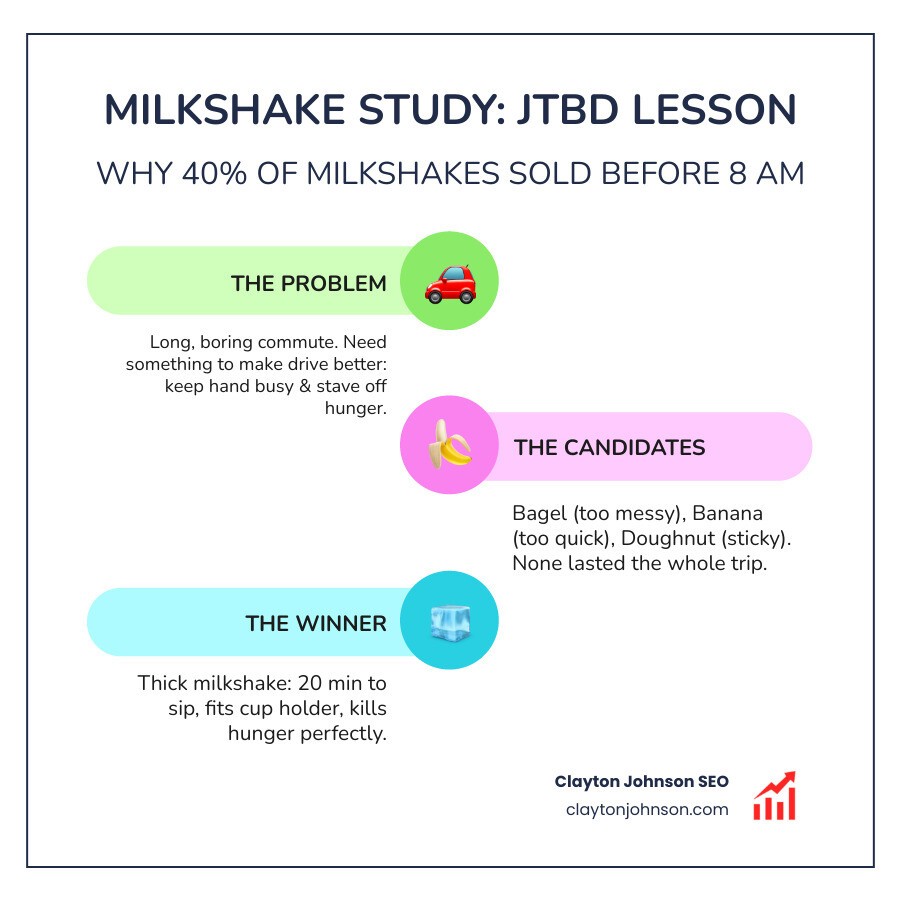
One of the most famous examples of the jobs to be done methodology is the “Milkshake Study.” A fast-food chain wanted to increase sales. They initially tried traditional methods: making shakes thicker, more chocolaty, or cheaper. Sales didn’t budge.
When researchers observed customers, they found that 40% of milkshakes were sold before 8:00 AM. They asked the customers, “What job were you trying to do when you came here to hire this milkshake?”
It turned out the customers had a long, boring commute. They needed something to keep their extra hand busy and stave off hunger until lunch. A bagel was too messy to eat while driving. A banana was gone too fast. But a thick milkshake? It took 20 minutes to finish, fit perfectly in the cup holder, and did the job better than any other “candidate.” The chain didn’t need a better milkshake; they needed a better “commute companion.”
Core Functional and Emotional Jobs
We see this play out in various industries. Take American Girl dolls. On the surface, it’s a doll company. But they don’t just sell plastic; they sell a “job” of identity validation and helping young girls articulate their feelings through history and storytelling. They’ve sold over 29 million dolls because they nail the emotional job.
Similarly, Southern New Hampshire University (SNHU) transformed its online program by realizing that older, working students weren’t “hiring” a university for the “college experience.” They were hiring it for career progress, speed, and credentials. By focusing on that specific job, they achieved a 34% compounded annual growth rate, reaching $535 million in revenue by 2016. They even reoriented their ads to show the pride of earning a degree, speaking directly to the customer segmentation that traditional schools ignored.
The Condo Story: Solving for Anxiety
One of the most powerful case studies in the jobs to be done methodology involves a Detroit-area condo developer. They were targeting “downshifters”—retirees moving from large family homes to smaller condos. Sales were flat. They added bay windows and granite countertops (based on focus group feedback), but nothing worked.
Through deep interviews, they found a common thread: the dining room table.
Prospective buyers were anxious about what to do with their large dining room tables. The table represented family gatherings and decades of memories. If they couldn’t fit the table in the condo, they couldn’t “hire” the condo to move their lives forward.
The developer realized they weren’t in the construction business; they were in the moving lives business. They responded by:
- Providing a sorting room where buyers could decide what to keep.
- Offering two years of free storage.
- Including moving services in the price.
By solving for the anxiety of the transition, they grew their business by 25% in a year when the rest of the industry was cratering. You can hear more about these types of insights in this Tony Ulwick webinar.
How to Implement JTBD in Your Business
Implementing the jobs to be done methodology isn’t just a “one-off” brainstorming session. It’s a rigorous process. Companies like Strategyn, which pioneered the Outcome-Driven Innovation (ODI) framework, have used this to achieve an 86% success rate in product development.
To get started, we recommend following our beginner’s guide to JTBD. The goal is to identify “desired outcomes”—the metrics customers use to measure success when getting a job done.
Conducting Interviews using the Jobs to be Done Methodology
The best way to uncover a job is through “Switch Interviews.” We want to talk to people who have recently “hired” your product (starters) or “fired” it (stoppers).
When we interview, we don’t ask “Why do you like our product?” We ask about the timeline of the purchase. We want to find the “switch event.” According to the User Research Academy, you should listen for four key forces:
- Push of the Situation: The pain points of the current solution. (e.g., “My old car keeps breaking down.”)
- Pull of the New: The appeal of the new solution. (e.g., “This new car has great fuel efficiency.”)
- Anxiety of the New: The fear of making a change. (e.g., “What if the monthly payments are too high?”)
- Habit of the Present: The comfort of the old way. (e.g., “I know how to fix my old car myself.”)
By understanding these forces, we can create marketing and features that address anxieties and amplify the “push” and “pull.”
Mapping the Customer Journey with a Jobs to be Done Methodology Lens
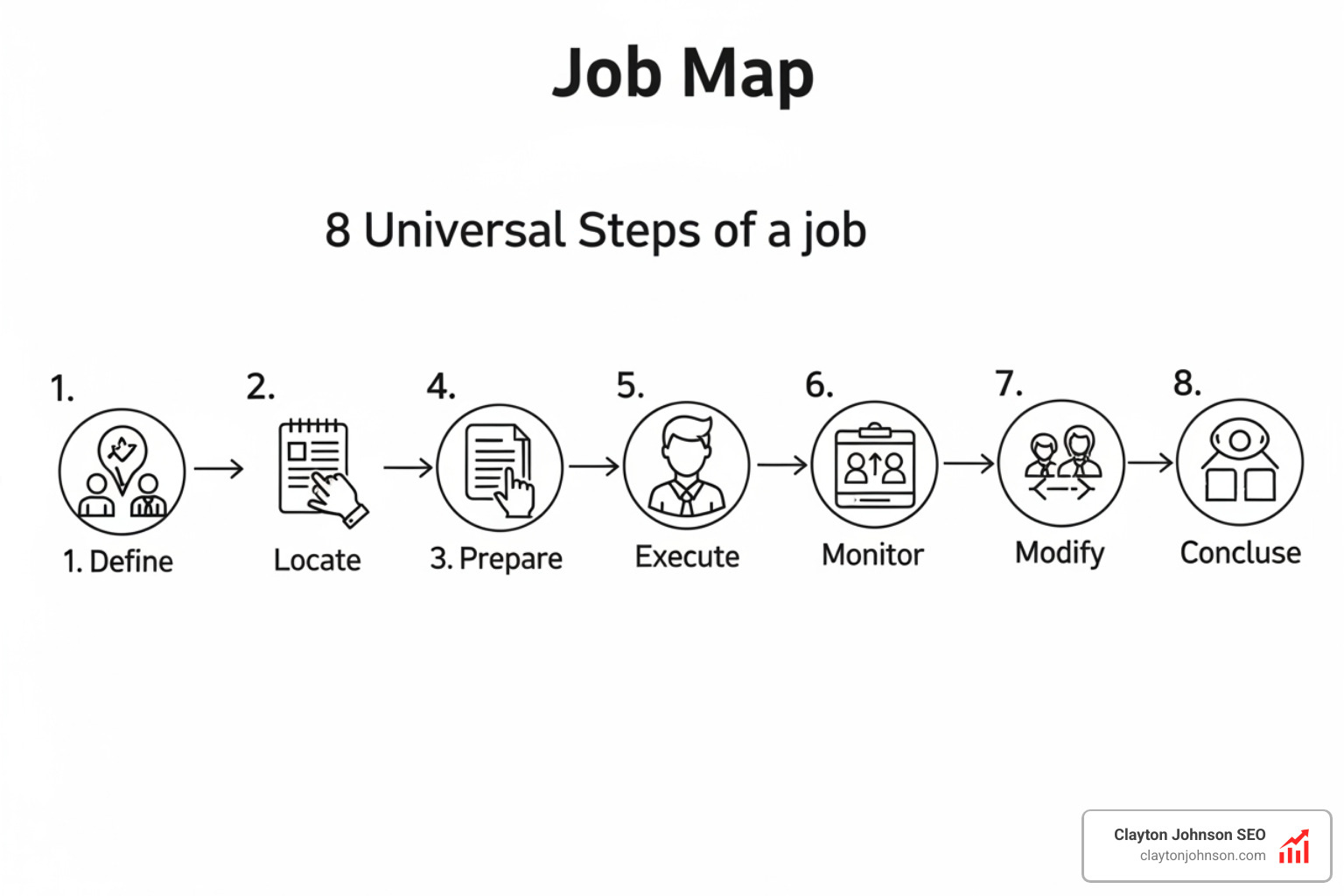
A “Job Map” is a visual tool used to break down the core functional job into its chronological steps. Unlike a customer journey map, which focuses on the product experience, a Job Map is “solution-devoid.” It describes what the customer is trying to do, regardless of the technology used.
The 8 universal steps of a Job Map include:
- Define: Determine goals and plan.
- Locate: Gather necessary inputs/information.
- Prepare: Set up the environment.
- Confirm: Verify everything is ready.
- Execute: Perform the core task.
- Monitor: Check for success or problems.
- Modify: Make adjustments if needed.
- Conclude: Finish the task and prepare for the next.
When we map these steps, we often find “gaps” where customers are struggling. This is where innovation happens. You can see how this integrates with customer segmentation to create a bulletproof product strategy.
Frequently Asked Questions about JTBD
How does JTBD differ from traditional market research?
Traditional research often relies on focus groups and demographics. The problem? Customers often can’t tell you what they want. As Henry Ford famously (might have) said, “If I had asked people what they wanted, they would have said faster horses.”
The jobs to be done methodology focuses on the situational context and causal drivers. It looks at “compensating behaviors”—the work-arounds people invent when current solutions fail. By observing these work-arounds, we find the “unmet needs” that focus groups miss.
What are the common pitfalls when applying JTBD?
The biggest mistake is thinking of a job as a “task” or “activity.” For example, “storing and retrieving music” is a task. “Enjoying music on the go” is the job. If you focus on the task, you’ll get disrupted by the next technology (like how Spotify disrupted the iPod).
Other pitfalls include:
- Ignoring emotional jobs: Only focusing on the functional task.
- Feature-first thinking: Trying to fit the job to your existing product instead of vice versa.
- Lack of team alignment: 95% of teams don’t agree on what a “need” is. JTBD provides a common language.
Can JTBD be used for B2B product development?
Absolutely. In B2B, the “customer” is often split into three roles:
- The Job Executor: The person using the tool (e.g., a surgeon using a medical instrument).
- The Support Team: People who set up or maintain the tool (e.g., nurses or bio-meds).
- The Buyer: The person who authorizes the purchase (e.g., hospital administration).
Each of these roles has different “jobs.” A surgeon wants precision (functional), while the administrator wants to improve hospital profitability (profit engine). Successful B2B companies use the jobs to be done methodology to satisfy all three.
Conclusion
At Clayton Johnson SEO, we believe that growth isn’t a game of luck. It’s about aligning your business with the reality of how your customers live and work. Whether you’re a founder in Minneapolis or a marketing leader for a global brand, the jobs to be done methodology gives you a predictable framework for value creation.
Stop guessing which features to build. Stop relying on demographic data that doesn’t explain behavior. By focusing on the progress your customers are trying to make, you can build products that they don’t just “buy,” but “hire” for life.
Ready to transform your growth strategy?
Stop guessing and start growing with a clear customer strategy through our actionable frameworks and SEO systems.