The Definitive BMC Tech Startup Template for Scalable Growth


Why Every Tech Startup Needs a Structured Business Model
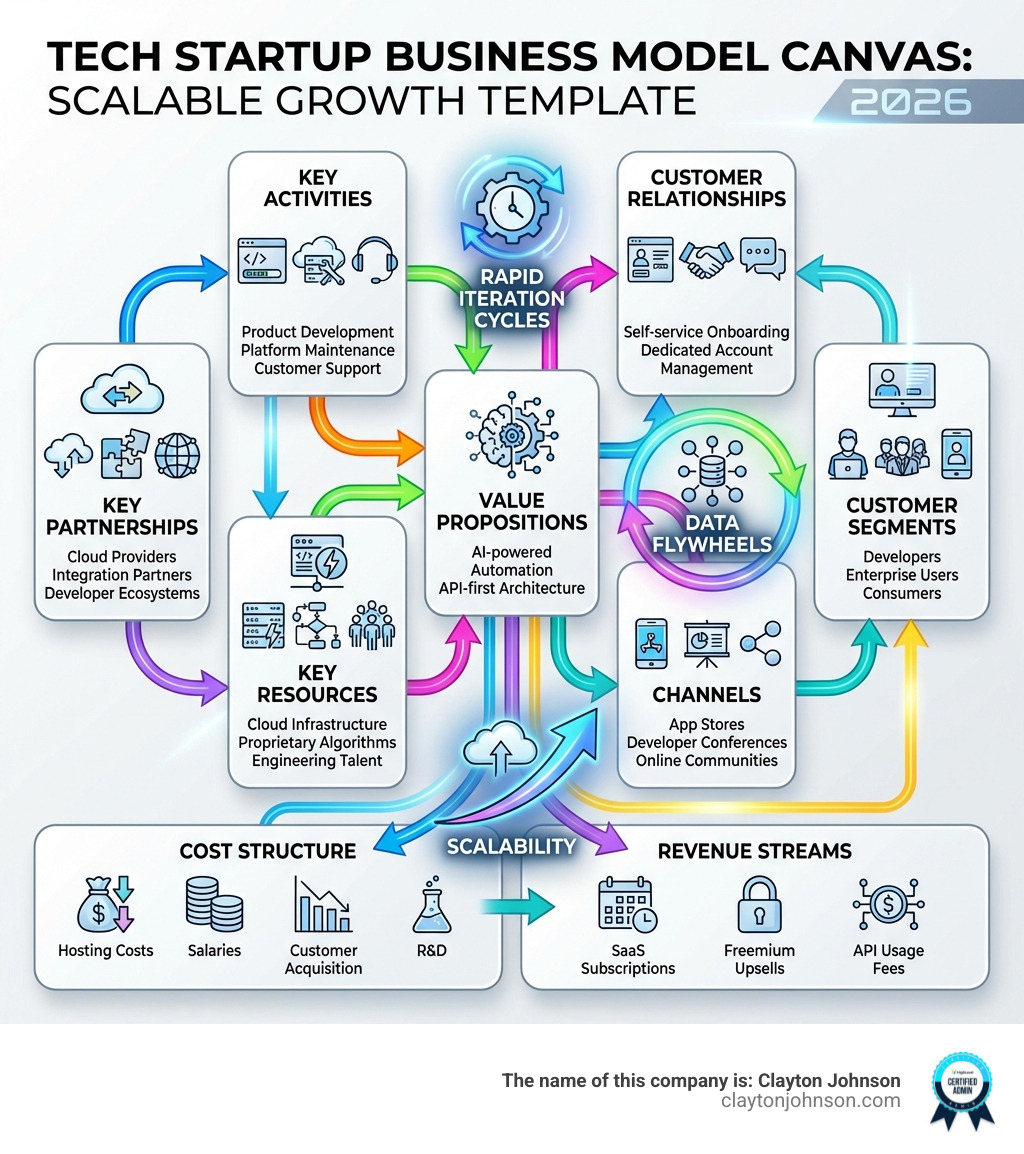
A BMC tech startup template is a one-page strategic framework that maps out how your tech venture creates, delivers, and captures value across nine essential building blocks. Here’s what it includes:
The 9 Core Components of a BMC Tech Startup Template:
- Customer Segments – Who you serve (developers, enterprises, consumers)
- Value Propositions – The specific problem you solve (e.g., “Reduce inventory overhead by 20% through AI automation”)
- Channels – How customers find and purchase (app stores, APIs, developer portals)
- Customer Relationships – How you retain users (self-service, high-touch support, community)
- Revenue Streams – How you make money (subscriptions, freemium, API usage fees)
- Key Resources – Critical assets you need (IP, cloud infrastructure, talent)
- Key Activities – What you must do daily (product development, customer support, platform maintenance)
- Key Partnerships – Strategic alliances (cloud providers, integration partners, investors)
- Cost Structure – Fixed and variable expenses (hosting, salaries, customer acquisition)
More than 80% of successful startups use the Business Model Canvas during their early stages. Unlike traditional 30-page business plans that take weeks to write and rarely get updated, the BMC gives you a visual, collaborative tool that your entire team can iterate on in real time.
Why it matters for tech founders: The tech landscape moves fast. You need a planning tool that matches that speed—one that helps you test assumptions quickly, communicate clearly with investors, and pivot when market feedback demands it. The BMC was designed by Alexander Osterwalder and Yves Pigneur specifically to break down complex business concepts into a format that encourages innovative thinking and team alignment.
The challenge? Most generic BMC templates don’t account for the unique dynamics of tech startups—things like API monetization, data flywheels, freemium conversion paths, or the infrastructure costs that scale with usage. A tech-focused BMC template addresses these gaps head-on.
I’m Clayton Johnson, an SEO and growth strategist who’s built structured frameworks for scaling startups. I’ve used the BMC tech startup template across multiple ventures to align product, go-to-market, and funding strategies under one coherent model.
Why the BMC Tech Startup Template is Essential for Founders
In the whirlwind of a Minneapolis winter, you wouldn’t head out without a coat; similarly, you shouldn’t launch a tech venture without a visual map of your survival strategy. The BMC tech startup template isn’t just a document; it’s a living system that allows for rapid iteration. Research shows that more than 80% of successful startups adopted the Business Model Canvas (BMC) during their early stages because it allows for quicker feedback and faster ideation.

For founders, the BMC serves three critical roles:
- Business Viability Check: It forces you to look at the “backstage” (infrastructure) and “front stage” (customers) simultaneously to see if the math actually works.
- Pivot Agility: If a feature fails, you don’t rewrite a 30-page plan. You swap a sticky note on the canvas.
- Investor Communication: Investors love the BMC because it shows you understand the mechanics of your business, not just the code. You can Download the official Business Model Canvas to see the foundational structure we’re building upon.
At Clayton Johnson, we emphasize strategic design because a tech product is only as good as the business model supporting it. Without a clear canvas, you’re just building expensive software that nobody knows how to buy.
Customizing the BMC tech startup template for SaaS and AI
A standard retail BMC focuses on inventory and physical storefronts. A BMC tech startup template for SaaS or AI focuses on scalability and data.
When customizing your template, consider these tech-specific nuances:
- Data Flywheels: In the “Key Resources” block, list your proprietary datasets. In “Value Propositions,” explain how your AI improves as more users join.
- API Monetization: If you’re building a headless service, your “Channels” are developer portals and GitHub, and your “Revenue Streams” might include usage-based API licensing.
- Freemium Strategies: This affects both “Customer Relationships” (automated onboarding) and “Revenue Streams” (conversion from free to paid).
- Scalable Infrastructure: Your “Cost Structure” must account for cloud hosting (AWS/Azure) that scales alongside your customer segmentation efforts.
Filling Out Your BMC tech startup template: A Step-by-Step Guide
To get the most out of your Business Model Canvas for Lean Startups, follow this order to ensure operational alignment:
- Start with the Value Proposition: What is the “painkiller” you are offering? Be specific. Instead of “Good software,” try “Reducing inventory overhead by 20% through automated restocking.”
- Identify Customer Segments: Who is the “Marketing Manager Mike” or “Startup Founder Sam” of your world?
- Map the Infrastructure: Identify your Key Partners (like cloud providers) and Key Activities (like continuous deployment).
- Calculate the Financials: Balance your Cost Structure against your Revenue Streams. If your hosting costs exceed your subscription fees, you don’t have a business; you have an expensive hobby.
Deconstructing the 9 Blocks of a Tech-Focused BMC
To truly master the BMC tech startup template, we need to look at how these blocks interact specifically for technology ventures.
| Block | Traditional Business Focus | Tech Startup Focus |
|---|---|---|
| Value Proposition | Product quality/Price | Solving a technical friction/Automation |
| Customer Segments | Local demographics | User roles (Devs, CTOs, End-users) |
| Channels | Physical stores/Distributors | App stores, APIs, SEO, Product-led growth |
| Revenue Streams | One-time sales | Subscriptions, API calls, Seat-based pricing |
| Key Resources | Physical assets/Cash | Codebase, IP, Cloud credits, Data |
Value Propositions & Customer Segments
Your value proposition is the “North Star.” For tech startups, this often involves saving time or reducing complexity. However, a common trap is designing for “everyone.” We recommend using buyer personas to narrow your focus. A niche segment like “Boutique Law Firms with 5–10 employees” is much easier to market to than “Small Businesses.”
Identifying Revenue Streams for Software Ventures
Revenue in tech isn’t just about swiping a credit card. Successful ventures often mix multiple streams:
- SaaS Subscriptions: Monthly or annual recurring revenue (MRR/ARR).
- API Licensing: Charging other companies to plug into your tech.
- Tiered Pricing: Using “Good, Better, Best” models to capture different levels of the market.
- Indirect Monetization: Data insights or marketplace transaction fees.
Having a solid sales strategy means knowing which of these streams matches your user behavior. For instance, Netflix evolved from a rental model to a SaaS provider—a classic example of revenue stream iteration.
Avoiding Common Pitfalls in Tech Business Modeling
Filling out a BMC tech startup template is easy; filling it out correctly is the hard part.
One of the biggest mistakes is treating the BMC as a “list” rather than a “system.” Every block should connect. If you have “Enterprise Corporations” as a customer segment, but your “Channels” only include “Instagram Ads,” your model is broken.
Other common pitfalls include:
- Vague Value Propositions: Avoid “high quality” or “user-friendly.” These are table stakes. Focus on measurable outcomes to beat competitive pressure.
- Mixing Present and Future: Don’t put “AI-driven insights” in your value prop if you’re currently just a manual spreadsheet tool. Use different colored sticky notes to separate what you have now from what you’re building.
- Ignoring Cost Drivers: For tech startups, the “Startup Valley of Death” is real. You must understand your variable costs (like API credits or compute power) before you scale.
Integrating the BMC with Lean Startup Methodologies
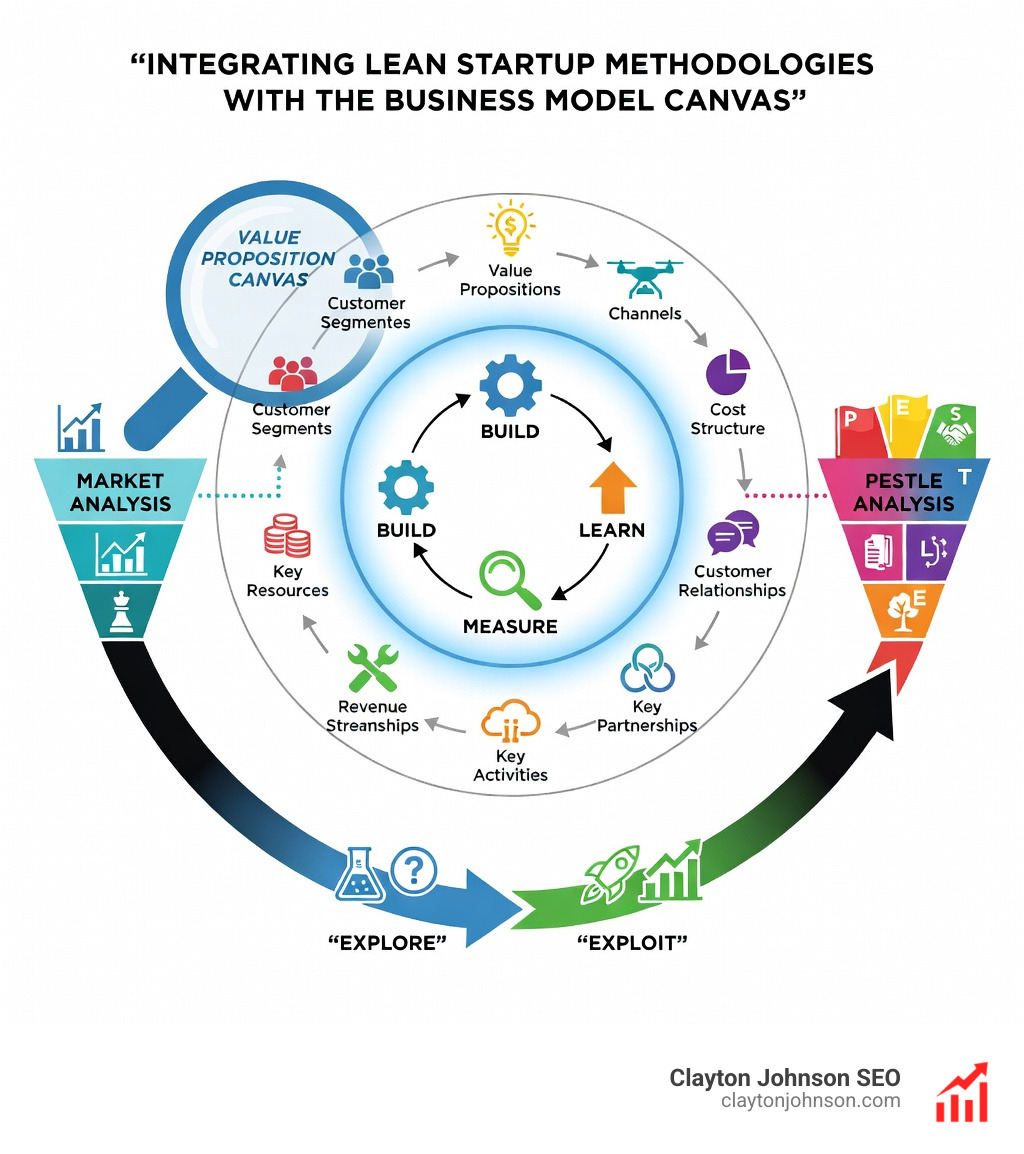
The BMC shouldn’t exist in a vacuum. It works best when paired with other tools to find product-market fit.
- Lean Canvas: Often used for very early-stage ideation, focusing more on “Problems” and “Solutions” than “Partners” and “Resources.”
- Value Proposition Canvas: A “zoom-in” tool that helps you map specific product features to customer pains and gains.
Before you finalize your model, conduct a market analysis and a PESTLE analysis to ensure external factors (like new AI regulations or economic shifts) won’t sink your ship.
Collaboration and Future Trends in BMC Tools for 2025
Strategy is no longer a solo sport. In 2025, the best BMC tech startup template is a digital, collaborative one. Tools like Miro, Figma, and Strategyzer allow remote teams to brainstorm in real-time.
What’s changing in 2025?
- AI-Assisted Generation: AI tools can now suggest potential revenue streams or customer segments based on your initial product description, helping you “fill the blank page” faster.
- Real-Time Iteration: Linking your BMC directly to your analytics and data services so the canvas updates as your user behavior changes.
- Dynamic Linking: Embedding external documents (like your technical specs or marketing plans) directly into the canvas blocks.
Frequently Asked Questions about BMCs
How often should a tech startup update its BMC?
The BMC is a dynamic tool, not a static trophy. We recommend a “light” review monthly and a “deep dive” quarterly. Major triggers for an immediate update include:
- Securing a new funding round.
- A significant shift in market conditions (e.g., a new competitor enters).
- Finding that your Customer Acquisition Cost (CAC) is higher than your Lifetime Value (LTV).
Can the BMC replace a traditional business plan for investors?
For an initial pitch? Yes. Investors often prefer a one-page BMC and a solid pitch deck over a 40-page document they won’t read. However, for late-stage funding or bank loans, you may still need a detailed execution roadmap and financial projections. Think of the BMC as the “Executive Summary” on steroids.
What is the difference between a BMC and a Lean Canvas?
While they look similar, the Lean Canvas (created by Ash Maurya) is designed for entrepreneurs in the “problem-solution” phase. It replaces “Key Partners” and “Key Resources” with “Problem” and “Solution.” The BMC is a more holistic tool that covers the entire business infrastructure, making it better for startups that are ready to scale or established tech firms looking to innovate.
Conclusion
Building a tech startup without a clear plan is like trying to code without a compiler—you might think it works, but you won’t know for sure until everything crashes. The BMC tech startup template provides the structure you need to visualize your growth, align your team, and prove your viability to the world.
At Clayton Johnson, we specialize in helping founders move from “idea” to “execution” through practical growth strategies and SEO systems. Whether you’re refining your social media marketing services or building the next great AI platform, a structured business model is your first step toward success.
Ready to fill out your canvas? Grab a stack of digital sticky notes, gather your team, and start mapping your path to scalable growth.