What Is AI SEO? How Artificial Intelligence Is Changing Search

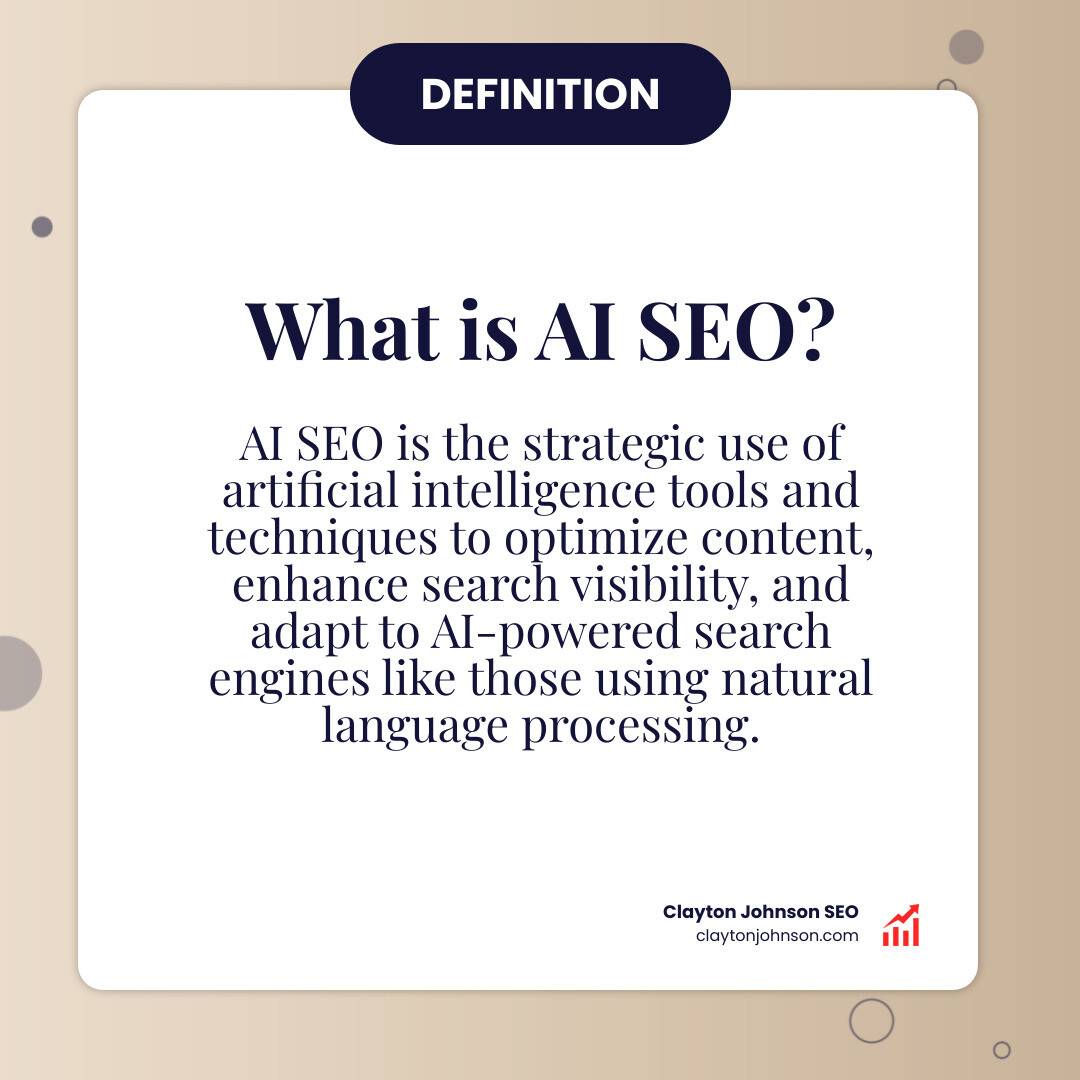
What is AI SEO? It’s the practice of optimizing content and websites for AI-powered search engines that prioritize intent, context, and semantic relevance over traditional keyword matching. AI SEO includes both using AI tools to improve your workflows and adapting your content so AI systems can accurately interpret, extract, and cite it in search results.
Quick Answer: What is AI SEO?
- Using AI in SEO workflows: Keyword research, content creation, technical audits, competitor analysis
- Optimizing for AI-powered search: Structured data, entity clarity, extractable content, conversational queries
- Key shift: From ranking pages to being cited in AI-generated answers (AI Overviews, ChatGPT, Perplexity)
- Core focus: Intent, topical authority, and trust—not just keywords
Every minute, 5.9 million searches happen on Google. That’s 8.5 billion searches per day.
And the way those searches get answered is changing fast.
AI Overviews now appear in roughly 13% of all Google queries—nearly double what it was at the start of the year. Meanwhile, 58.5% of Google searches in the U.S. end without a click. Users are getting answers directly on the SERP, often pulled from AI-generated summaries.
This isn’t a future trend. It’s happening right now.
Search engines like Google, Bing, and newer platforms like Perplexity and ChatGPT don’t just rank pages anymore—they synthesize answers from multiple sources. They understand context. They predict intent. They prioritize clarity and authority over mechanical keyword density.
That means the rules have changed.
If your SEO strategy still revolves around stuffing keywords into meta descriptions and chasing Position #1 rankings, you’re optimizing for a search landscape that no longer exists.
AI SEO is about making your content discoverable, interpretable, and citable by these intelligent systems. It’s about structuring your site so AI can extract the right answer. It’s about building topical authority so you become the source AI wants to reference.
And yes—it’s also about using AI tools to work faster, smarter, and more strategically than ever before.
But here’s the thing: AI doesn’t replace SEO fundamentals. It amplifies them.
The brands that win visibility in this new era aren’t abandoning traditional SEO—they’re evolving it. They’re combining human expertise with AI-augmented workflows. They’re optimizing for meaning instead of just keywords. They’re building content ecosystems that serve both users and machines.
This guide will show you exactly how to do that.
I’m Clayton Johnson, and I’ve spent years building structured SEO systems that adapt to algorithm shifts and scale with business growth. Throughout my work on what is AI SEO, I’ve seen how AI-driven search is reshaping discoverability—and how businesses can turn that disruption into competitive advantage. Let’s break down what’s changing, what’s staying the same, and how to build an AI-ready SEO strategy that actually works.

What is ai seo definitions:
What is AI SEO?

To truly grasp what is ai seo, we have to look past the buzzwords. At its core, AI SEO is the intersection of two forces: using artificial intelligence to perform SEO tasks more efficiently and optimizing your digital presence to be “readable” by the AI models that now power search engines.
It isn’t just about using a chatbot to write a meta description. It’s about understanding that search engines now use machine learning and natural language processing (NLP) to judge your content. They aren’t just looking for the word “apple”; they’re looking to see if you’re talking about the fruit or the tech company based on the semantic context of your entire page.
The truth about AI SEO is that it requires a shift from “trickery” to “clarity.” If a machine can’t easily summarize your page, it likely won’t feature you in an AI Overview.
Defining the Scope of what is ai seo
When we define what is ai seo, we focus on three main technical areas:
- User Intent: Moving beyond what people type to why they type it. AI models predict the next logical step in a user’s journey.
- Contextual Meaning: Using NLP to understand the relationship between words. This is why RankBrain influences all Google searches—it interprets queries Google has never seen before by connecting them to known concepts.
- Entity Relationships: Search engines now see the world as a collection of “entities” (people, places, things, brands). AI SEO involves making sure your brand is recognized as a clear, authoritative entity within your niche.
Why Businesses Must Invest in what is ai seo
The search landscape is becoming exponentially more complex. Google now uses over 200 ranking factors and makes thousands of adjustments to its algorithm every year. For a human team to keep up manually is nearly impossible.
Investing in AI SEO gives us a competitive edge by allowing us to analyze vast datasets in seconds. It provides the “structured growth architecture” needed to scale. Without these systems, you’re essentially bringing a knife to a drone fight. By focusing on core SEO foundations, we ensure that our AI efforts are built on a stable, technically sound platform that search engines can actually crawl and index.
How AI is Changing the Search Landscape

Search is no longer a simple list of ten blue links. It has become a conversational, multimodal experience. Every day, Google processes 8.5 billion searches, and a growing percentage of those are being intercepted by AI-generated features.
The most significant change is the rise of AI Overviews (formerly SGE). These are the summaries you see at the very top of the page. Because these summaries provide the answer immediately, we are seeing a massive zero-click search impact. In fact, over 58% of searches in the U.S. now end without a user ever clicking through to a website.
The Evolution of Search Algorithms
Google’s journey into AI didn’t start yesterday. It has been a steady progression:
- RankBrain (2015): Introduced machine learning to help Google process unique queries.
- BERT (2019): Revolutionized natural language understanding by looking at the context of words in a sentence.
- MUM (2021): A multitask model 1,000 times more powerful than BERT, capable of understanding information across 75 languages and multiple formats (text, images, video).
These updates have forced us to align with Google’s EEAT framework. Experience, Expertise, Authoritativeness, and Trustworthiness are the high-water marks that AI looks for when deciding which sources to cite.
The Rise of Answer Engines
We are moving from “Search Engines” to “Answer Engines.” Users now ask complex, conversational questions like, “How do I allocate my 401(k) if I’m in my 40s with kids in college?” rather than just typing “401k tips.”
To win in this environment, we use Generative Engine Optimization (GEO). This involves creating content that is highly “extractable”—meaning it contains clear, standalone answer blocks that an AI can easily lift and present to the user.
Core Pillars and Practical Workflows

At Demandflow, we believe that AI SEO is not a collection of hacks; it is a structured system. To succeed, you need to focus on topical authority and content clusters. Instead of writing isolated blog posts, you build an ecosystem of information that proves to AI that you are the ultimate expert on a subject.
Using AI content audit tools allows us to find “content gaps” where our competitors are weak and we can provide more value.
AI-Augmented Keyword and Content Strategy
The old way of doing keyword research involved looking at search volume and difficulty. The AI way involves Intent Analysis. We use AI to group thousands of keywords into “intent buckets” so we can build a comprehensive keyword strategy system.
Manual vs. AI-Augmented SEO Workflows
| Task | Manual Workflow | AI-Augmented Workflow |
|---|---|---|
| Keyword Research | Guessing intent; manual spreadsheet sorting | Automated intent clustering; semantic gap detection |
| Content Creation | Writing from scratch; slow turnarounds | AI-generated outlines; data-driven content briefs |
| Technical Audits | Manual page-by-page checks | Real-time anomaly detection; automated site crawls |
| Reporting | Static monthly PDFs | Interactive, predictive dashboards |
Technical SEO and Schema Optimization
Technical SEO is the “plumbing” of AI SEO. If your site isn’t technically sound, no amount of AI-written content will save you. Google recommends detailed schema because it provides a direct, machine-readable map of your content.
By implementing structured data, we give AI the “entities” it needs to understand who we are. We use automated SEO audits to ensure our site remains healthy, fast, and easily crawlable. If an AI agent can’t render your JavaScript, it can’t cite your content.
Optimizing for the Future: GEO and AEO
The future of visibility lies in Generative Engine Optimization (GEO) and Answer Engine Optimization (AEO). This is the art of getting cited by LLMs like ChatGPT, Claude, and Google’s Gemini.
In this landscape, being “Position #1” is less important than being the “Cited Source.” We want our brand name and our data to be the foundation of the answer the AI provides. To do this, we follow the ultimate guide to GEO, focusing on passage-level extractability.
Strategies for Generative Engine Visibility
To get cited, your content must offer Information Gain. This means adding something new to the conversation—proprietary data, unique case studies, or expert opinions that can’t be found elsewhere.
We’ve found that using natural language improves usability, which in turn helps AI models recognize our content as helpful and human-centric. Avoid generic, “fluffy” writing. Be direct. Use authoritative language. Provide the answer in the first paragraph.
Measuring Success in an AI-Driven Environment
Traditional metrics like “keyword rankings” are becoming less reliable because search results are now deeply personalized. Instead, we measure:
- Mention Share: How often is our brand cited in AI answers compared to competitors?
- Impression Share: How often does our content trigger an AI Overview?
- Conversion Quality: Are the clicks we do get more likely to buy? (AI-influenced traffic often converts better because the user is already well-informed).
We use AI-driven reporting to track these modern KPIs and adjust our strategy in real-time.
Frequently Asked Questions about AI SEO
Can AI fully replace human SEO experts?
No. While AI is an incredible “teammate,” it lacks strategic judgment, empathy, and the ability to understand a specific business’s unique goals. AI can analyze data, but humans must decide what that data means. We use AI to handle the tedious, repetitive tasks so that our experts can focus on high-level strategy and creative storytelling.
What are the most common mistakes in AI SEO?
The biggest mistake is publishing high volumes of low-quality AI content without human oversight. This leads to “hallucinations” (AI making things up) and search engine penalties. Other common errors include ignoring technical health, over-focusing on keywords instead of entity clarity, and trying to “write for the models” instead of writing for actual human beings.
Is AI SEO worth the investment for small businesses?
Absolutely. In fact, small businesses have the most to gain. AI levels the playing field, allowing a small team to produce the same volume of research and content as a large agency. It’s about efficiency and future-proofing. If you don’t adapt to what is ai seo now, you risk becoming invisible as the search landscape continues to move toward answer-based results.
Conclusion
The transition to an AI-driven search world isn’t something to fear—it’s an opportunity to build a more robust, structured growth architecture. At Clayton Johnson SEO, we don’t just chase tactics; we build systems.
Our platform, Demandflow.ai, is designed to give founders and marketing leaders a taxonomy-driven SEO system that thrives in this new era. We combine actionable frameworks with AI-augmented workflows to ensure your brand isn’t just “ranking,” but is actually compounding growth through authority and clarity.
If you’re ready to stop guessing and start building a search strategy that lasts, we’re here to help.