The Only Complete Guide to Search Engine Optimization You’ll Ever Need

Why Every Business Needs a Complete Guide to Search Engine Optimization
A complete guide to search engine optimization covers everything you need to rank higher on Google, attract more visitors, and turn that traffic into real business growth.
Here’s what SEO actually involves, at a glance:
| SEO Component | What It Covers |
|---|---|
| On-Page SEO | Content, keywords, title tags, meta descriptions, headers |
| Technical SEO | Site speed, crawlability, mobile-friendliness, HTTPS |
| Off-Page SEO | Backlinks, brand mentions, authority signals |
| Local SEO | Google Business Profile, local citations, NAP consistency |
| E-E-A-T | Experience, Expertise, Authoritativeness, Trustworthiness |
| AI Search | Structured data, entity clarity, topical authority |
There are over 1.1 billion websites on the internet right now. Nearly 252,000 more launch every single day. And less than 1% of searchers ever click past the first page of Google results.
That means if you’re not ranking on page one, you’re essentially invisible.
The good news? SEO is not magic. It’s a learnable, repeatable system. And the businesses that understand it gain a compounding advantage that paid ads simply can’t buy.
I’m Clayton Johnson, an SEO strategist with nearly two decades of experience building scalable search frameworks for businesses across competitive markets. This complete guide to search engine optimization is built on the same systems I use to help companies grow their organic visibility, attract high-value clients, and drive measurable revenue — without relying on ad spend.
The Core Pillars of a Complete Guide to Search Engine Optimization
To truly master the search landscape, we must view SEO not as a series of “tricks,” but as a set of durable pillars. When these pillars are strong, your website becomes a high-performance growth engine. If one is weak, the whole structure can topple, leaving you buried on page ten.
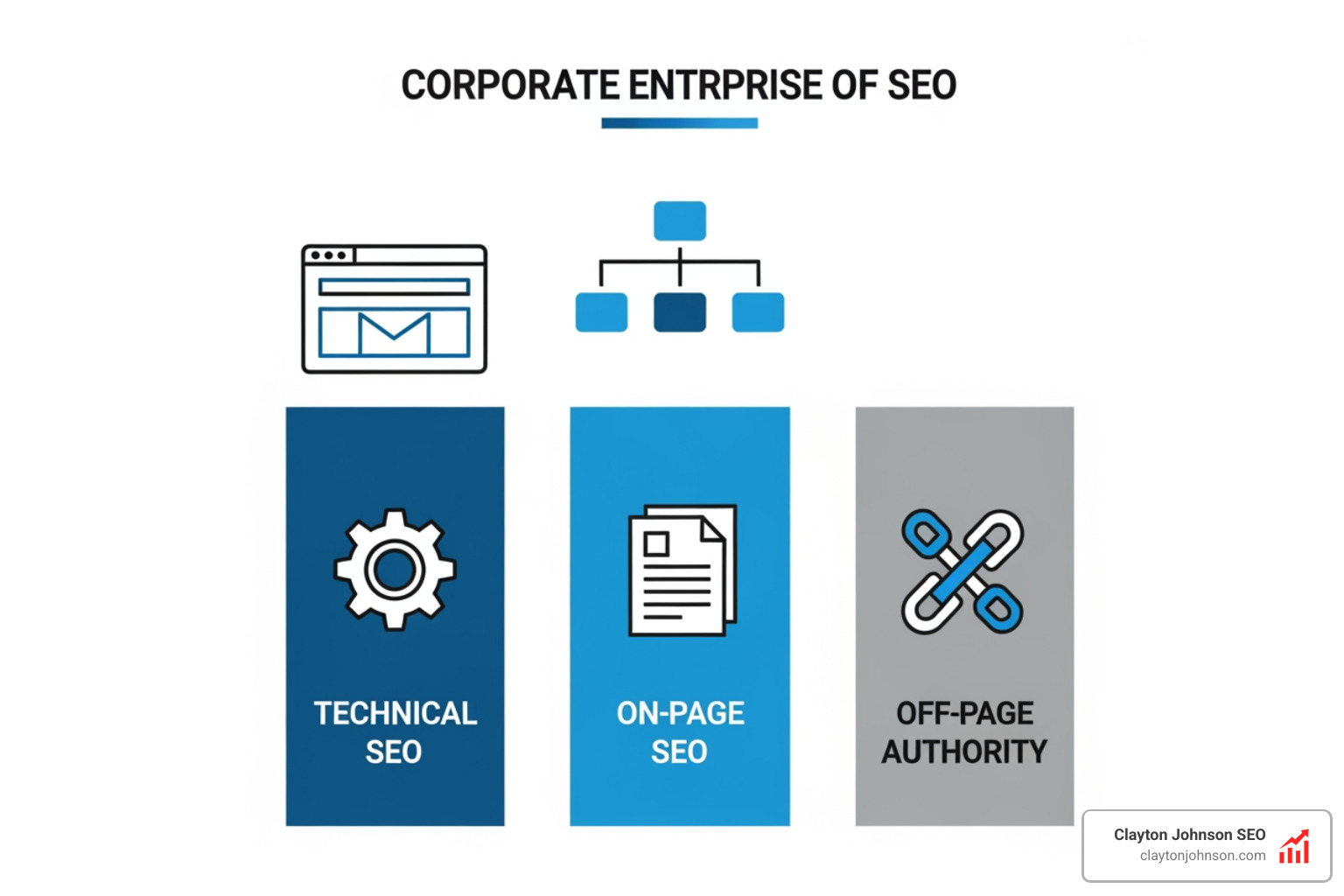
The three primary pillars we focus on are:
- On-Page Optimization: This is everything you do on your website to help search engines understand your content. It includes keyword usage, high-quality writing, and HTML tags.
- Off-Page Authority: These are signals from the rest of the web that tell Google you are a trusted leader. The most significant signal here is the backlink—a “vote of confidence” from another site.
- Technical Infrastructure: This is the “under the hood” work. If your site is slow, broken, or impossible for a bot to read, your content won’t rank, no matter how good it is.
Why does this matter? Because trust is the currency of the internet. A scientific research study on global trust in advertising shows that earned media (like organic search rankings) is consistently more trusted than paid ads. By building these pillars, you aren’t just chasing an algorithm; you’re building a brand people trust. You can explore more about how we implement these via our SEO services.
How Search Engines Discover and Rank Content
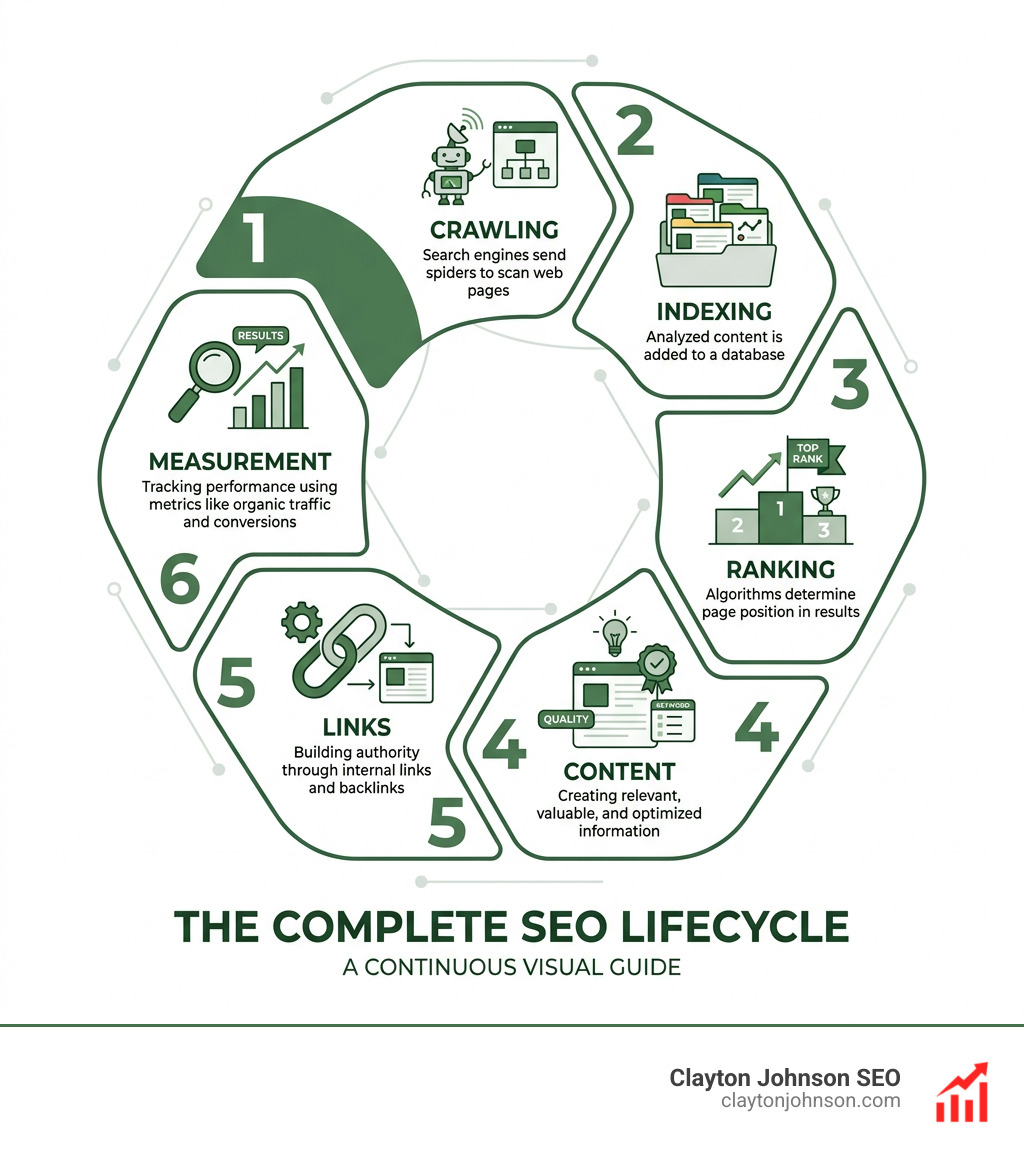
Before you can rank, you have to be found. Search engines like Google use a three-step process to manage the trillions of pages on the web:
- Crawling: Google sends out “spiders” or bots to discover new and updated content. They follow links from one page to another.
- Indexing: Once a page is found, the bot tries to understand what it’s about. It then stores this information in a massive database called the Index.
- Ranking: When someone types a query, Google scours its index to find the most relevant, high-quality answers. It uses hundreds of ranking factors to decide who gets the top spot.
To help Google navigate your site effectively, you need a clean architecture. We use a specific internal linking strategic framework to ensure that link equity flows to your most important pages, making them easier for bots to find and rank. For a deeper dive into the mechanics, check out Google’s guide to how search works.
Keyword Research and Intent: The Complete Guide to Search Engine Optimization Strategy
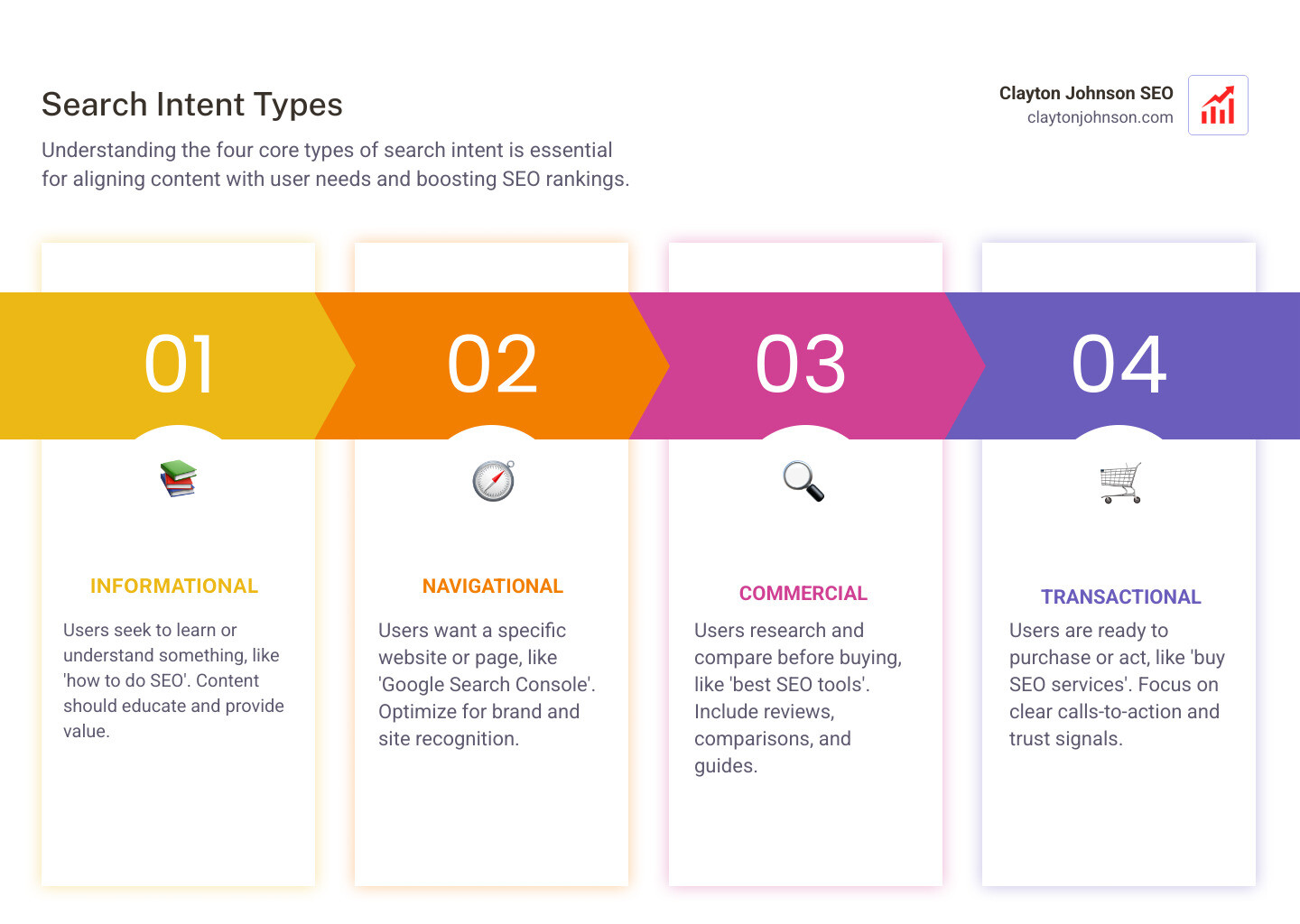
Keywords are the bridge between what people are searching for and the content you provide to fill that need. However, modern SEO has moved beyond just “matching words.” We now focus on Search Intent.
Search intent is the why behind a search. Are they looking to buy (transactional), learn (informational), find a specific site (navigational), or compare products (commercial)? If your content doesn’t match the intent, you won’t rank.
We prioritize finding “untapped” long-tail queries—longer, more specific phrases that have lower competition but much higher conversion rates. For example, “complete guide to search engine optimization” is a great target because it attracts someone looking for a deep, comprehensive resource. You can learn our full process in the ultimate guide to keyword strategy.
Technical, On-Page, and Off-Page Techniques
In any complete guide to search engine optimization, you need a clear distinction between the “what” and the “how.”
| Feature | On-Page SEO | Technical SEO |
|---|---|---|
| Focus | Content & HTML | Backend & Server |
| Goal | Relevancy & User Value | Crawlability & Speed |
| Examples | Title tags, H1s, Alt text | HTTPS, XML Sitemaps, Robots.txt |
| User Impact | Direct (Reading/Viewing) | Indirect (Loading/Security) |
On-Page Essentials:
- Title Tags: Keep them under 60 characters and include your primary keyword.
- Meta Descriptions: Write compelling summaries (150-160 characters) to boost your click-through rate.
- Header Tags: Use H1 for your title and H2/H3 for subheadings to create a logical structure.
Technical Essentials:
- Site Speed: Google uses speed as a ranking factor. Use Google PageSpeed Insights to see where you’re lagging.
- Mobile-First Indexing: Over 60% of searches are on mobile. If your site doesn’t work on a phone, you’re losing more than half your potential traffic.
- Security: 99.4% of first-page results use HTTPS. It’s no longer optional.
For those ready to master the “invisible” side of SEO, we recommend our guide on winning at technical SEO.
Advanced Systems: AI, E-E-A-T, and Long-Term Growth
As we move further into the age of “Answer Engines,” traditional SEO tactics are being joined by more sophisticated systems. Google is no longer just looking for keywords; it’s looking for Authority.
Google uses a framework called E-E-A-T to evaluate the quality of a website:
- Experience: Does the author have first-hand, real-world experience with the topic?
- Expertise: Is the author a recognized expert in this field?
- Authoritativeness: Is the website a “go-to” source for this information?
- Trustworthiness: Is the site secure, transparent, and accurate?
By following Google’s helpful content guidelines, we move away from “SEO content” and toward “helpful content.” We build this through authority-driven content systems that focus on information gain—providing something unique that doesn’t exist elsewhere on the web.
Optimizing for the Generative AI Search Era
The rise of AI search, like Google’s AI Mode and Bing Generative Search, has introduced “Zero-Click Searches.” This is when a user gets their answer directly on the search page without ever clicking a link.
To stay visible, we must optimize for these “AI Overviews.” This involves:
- Structured Data: Using Schema markup to help AI understand the “entities” (people, places, things) on your page.
- Clarity and Conciseness: Providing clear, “definition-style” answers at the top of your articles.
- Topical Authority: Covering a subject so deeply that AI models view you as a primary source.
You can stay ahead of these changes by following the Google AI Search Experience updates and reading our ultimate guide to generative engine optimization.
Demonstrating E-E-A-T and Content Quality
How do you actually “show” E-E-A-T? It’s about the details.
- Author Bios: Don’t just post as “Admin.” Link to a real person with a real background.
- Personal Anecdotes: Use first-person pronouns (“I,” “we”) to show you’ve actually done the work.
- Multimedia: Include original photos, videos, or charts. Research suggests that stock images might negatively impact rankings because they don’t provide “unique value.”
- Citations: Link out to reputable sources to back up your claims.
We also believe in building partnership SEO content ecosystems, where shared authority across multiple trusted sites creates a “rising tide” effect for everyone involved.
Getting Started: Tools and a Complete Guide to Search Engine Optimization Checklist
SEO is a marathon, not a sprint. To help you get started, we’ve compiled the essential toolkit and a “Do Once” checklist.
The Essential SEO Toolkit:
- Google Search Console: The most important free tool to see how Google views your site.
- Google Analytics 4 (GA4): To track user behavior and conversions.
- Ahrefs or Semrush: For deep keyword research and competitor analysis.
- Screaming Frog: For auditing technical errors on your site.
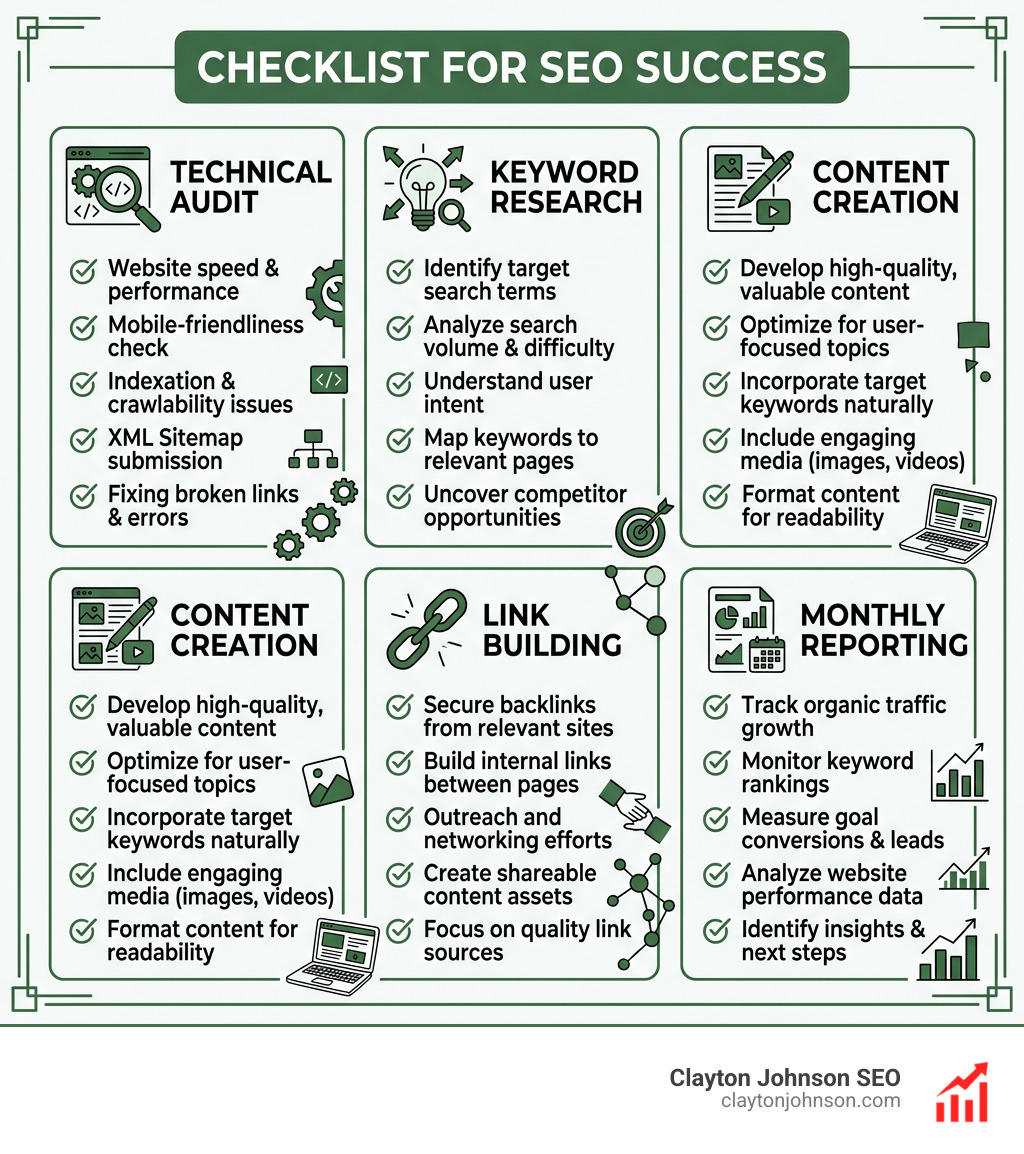
Your Quick-Start Checklist:
- Set up Tracking: Install GA4 and verify your site in Search Console.
- Submit a Sitemap: Tell Google exactly which pages you want them to crawl.
- Claim your Local Identity: Set up a Google Business Profile to appear in local “Map Pack” results.
- Audit your Content: Find “thin” pages that offer no value and either improve or remove them.
- Fix Technical Errors: Resolve 404 errors and broken redirects immediately.
At Clayton Johnson SEO, we don’t just give you a list of tasks; we build the systems that automate your growth. If you’re ready to stop guessing and start ranking, you can download our SEO template to begin your journey.
SEO is never “done.” It is a perpetual process of learning, testing, and adapting. But with the right framework, it becomes the most powerful asset your business owns. To find out more about our philosophy, read why Clayton Johnson is the SEO expert your website deserves.