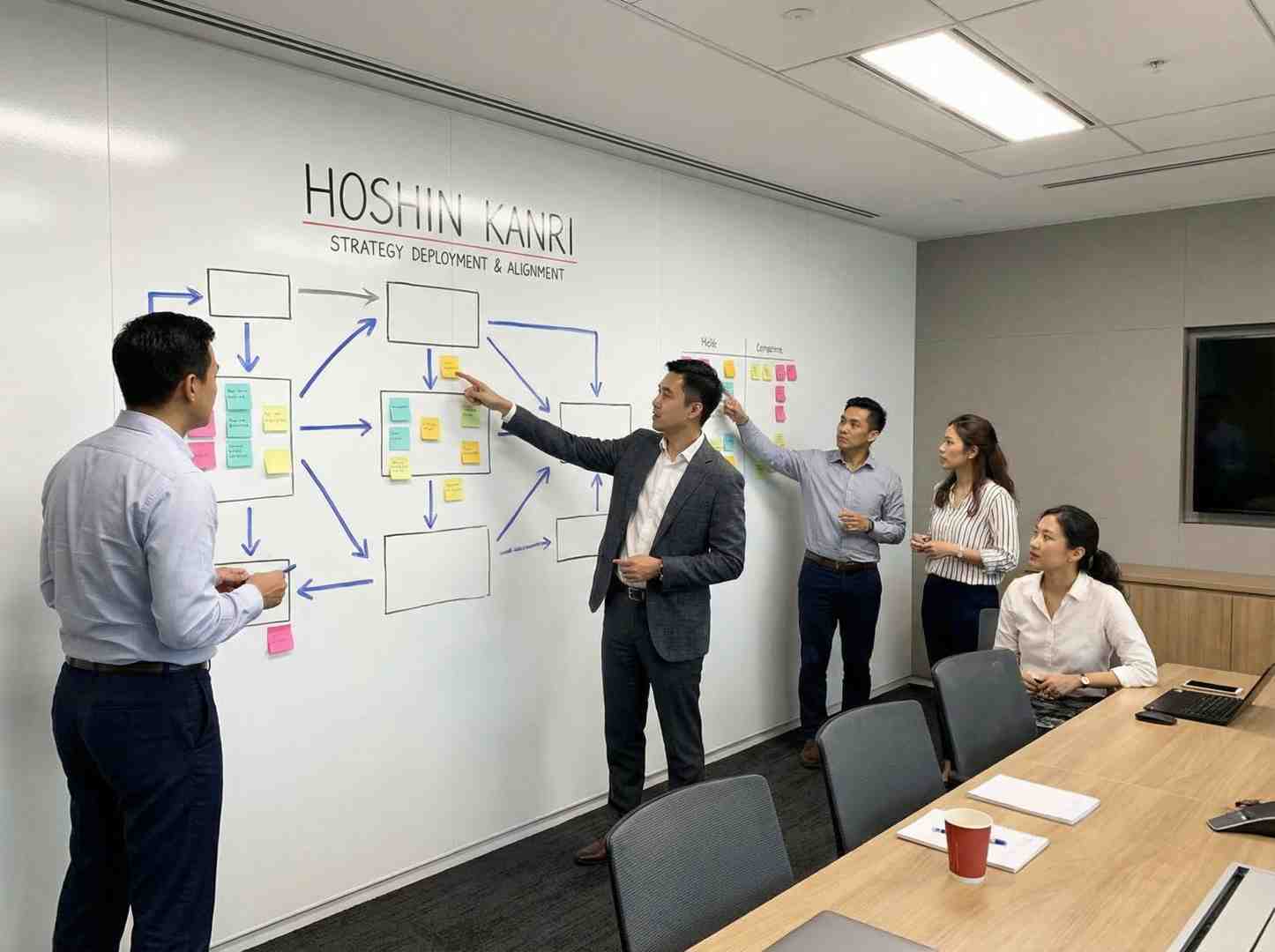
The Hidden Force Behind High-Performing Organizations
Organizational Alignment is the process of ensuring every part of your business — from leadership decisions to daily employee actions — works together toward the same goals.
Here’s a quick breakdown:
| Element | What It Means |
|---|---|
| What it is | Coordinating strategy, culture, people, and processes toward a shared vision |
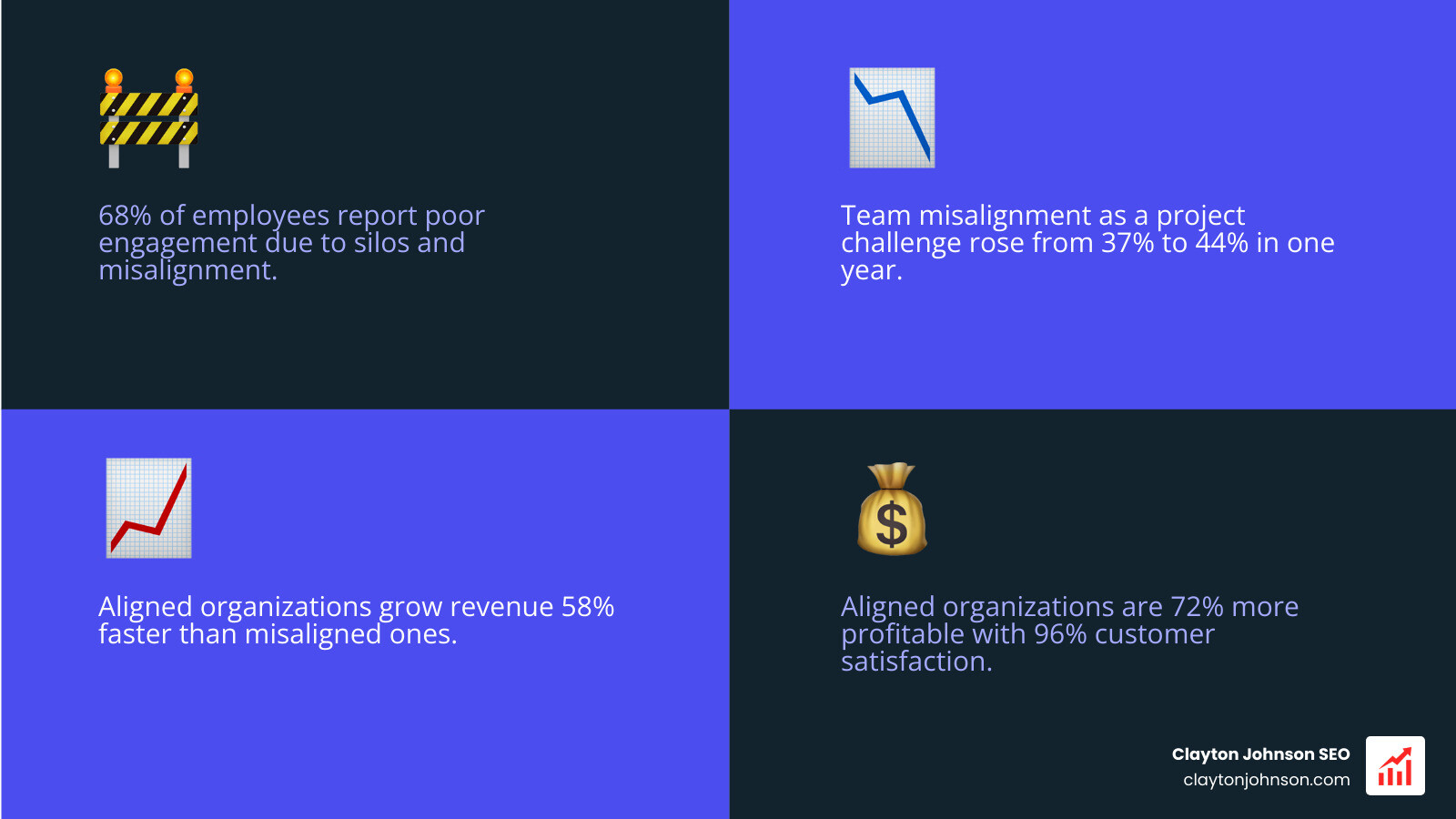
| Why it matters | Aligned orgs grow revenue 58% faster and are 72% more profitable |
| Who it affects | Every level — from the C-suite to individual contributors |
| What breaks it | Silos, poor communication, unclear goals, and culture mismatches |
| How to fix it | Clear goals, cascading communication, cross-functional collaboration, and the right tools |
Most executives know alignment matters. Few actually achieve it.
And the gap is costly. Only 28% of executives and middle managers responsible for executing strategy can even list their company’s strategic priorities. Meanwhile, team misalignment as a project challenge jumped from 37% to 44% in just one year.
That’s not a communication problem. That’s a systems problem.
The best-aligned organizations don’t just have clear mission statements — they have infrastructure that connects vision to execution at every level. Strategy flows down. Feedback flows up. Departments actually talk to each other.
The result? Faster decisions. Better products. Happier customers. And real, measurable growth.
I’m Clayton Johnson, an SEO and growth strategist who has spent years building scalable systems that turn fragmented efforts into cohesive growth engines — the same architecture principles that make Organizational Alignment so critical for founders and marketing leaders operating at scale. In the sections ahead, we’ll break down exactly how alignment works, what breaks it, and how to build it into your organization from the ground up.
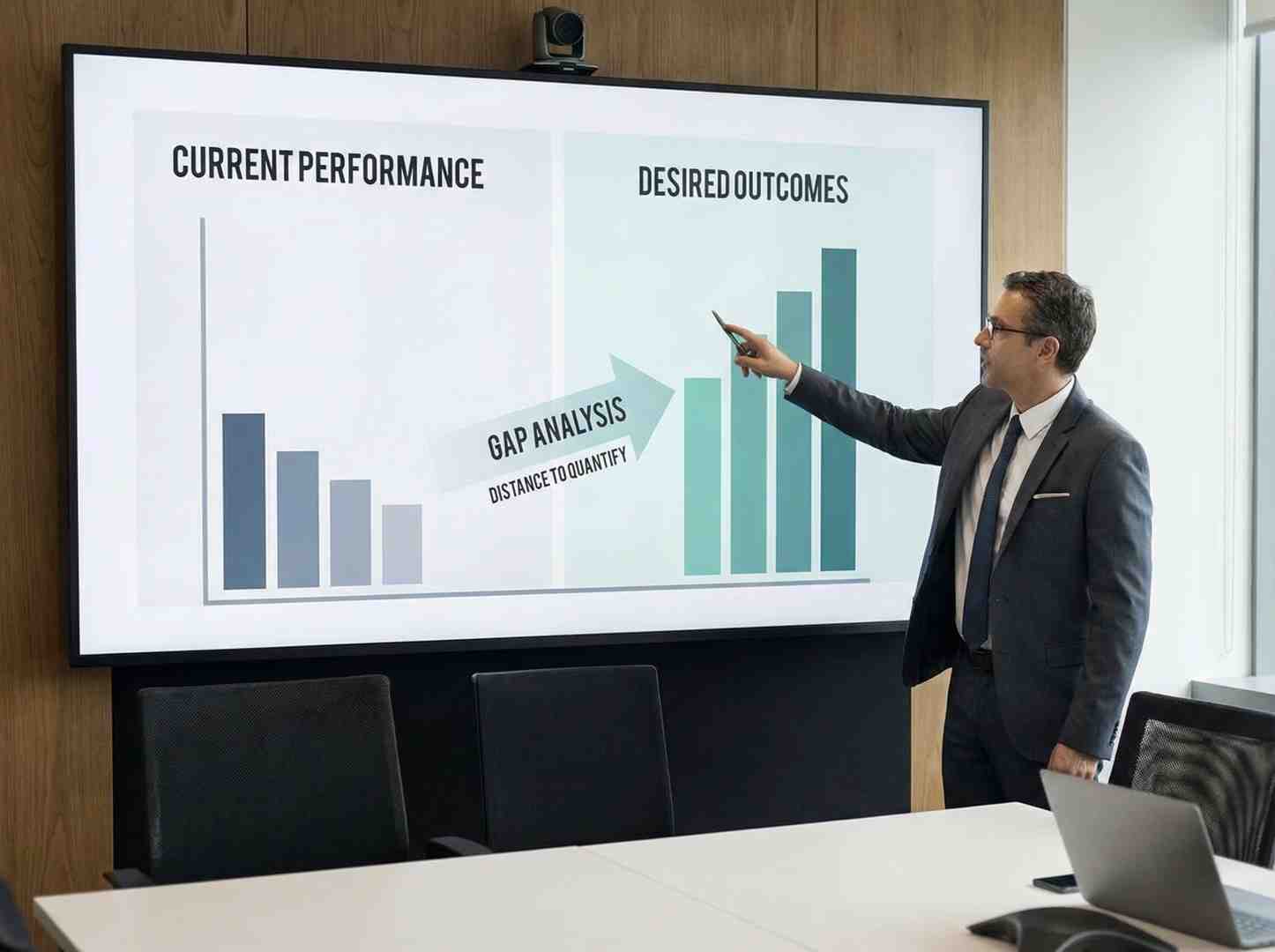
Defining Organizational Alignment: More Than Just Teamwork
When we talk about Organizational alignment, we are describing a process of ensuring all aspects of your organization are aligned with the realization of its strategy. It is the “strategic glue” that bonds a business together.
It functions on two primary levels:
- Operationally: The business’s ability to deliver its “mission” through day-to-day activities.
- Strategically: The management of the business to achieve its long-term “vision.”
Think of it as a bridge. On one side, you have your grand ambitions (the vision). On the other, you have your results (the performance). Alignment is the structure that allows you to cross from one to the other without falling into the “execution gap.”
Vertical vs. Horizontal Organizational Alignment
To achieve true Organizational Alignment, we must look at it through two different lenses: vertical and horizontal.
- Vertical Alignment: This is the traditional “top-down” approach. It ensures that the leadership’s vision cascades down through every layer of management to the individual contributors. When vertical alignment is strong, every employee knows exactly how their specific tasks contribute to the company’s high-level goals.
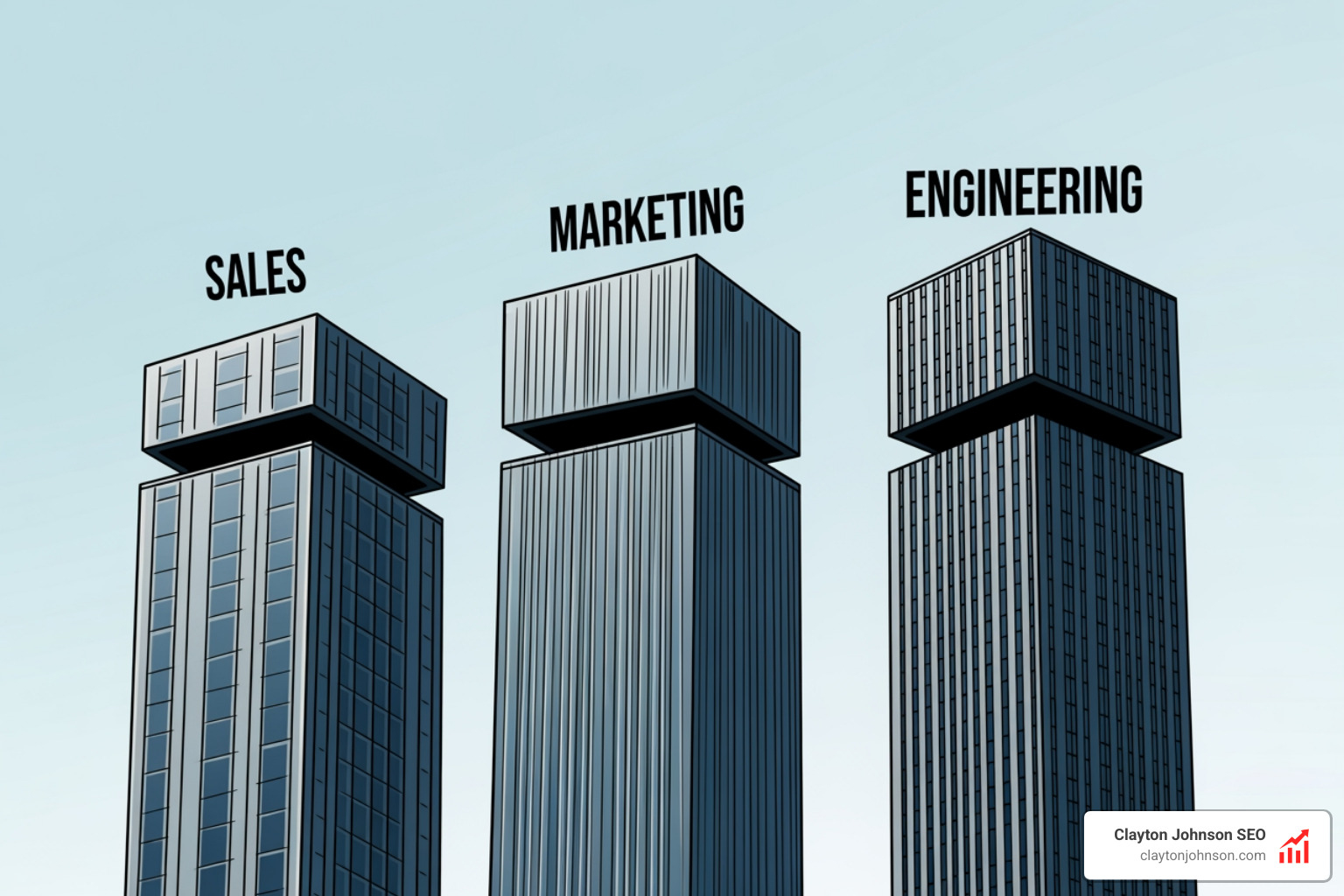
- Horizontal Alignment: This is about cross-functional synergy. It’s ensuring that Marketing isn’t sprinting in one direction while Sales is walking in another. It breaks down the silos that naturally form as companies grow, ensuring that departments rely on and support one another to deliver customer value.
The Tosti and Jackson Model of Organizational Alignment
One of the most robust ways to understand this concept is through the Tosti and Jackson model. This model views organizations as dynamic systems that function best when two distinct “paths” are consistent and interdependent:
- The Strategic Path: This covers the “what”—your mission, vision, goals, and strategic objectives.
- The Cultural Path: This covers the “how”—your values, practices, and behaviors.
In this model, Organizational Alignment requires compatibility between these two paths. You can have the best strategy in the world, but if your company culture (the behaviors you actually reward) doesn’t support that strategy, the system will fail. For example, if your strategy is “innovation” but your culture punishes every small mistake, your employees will never take the risks necessary to innovate.
Why Organizational Alignment Drives Success
Why should you care? Because the numbers don’t lie. Research shows that B2B firms that adopt Organizational Alignment can see 24-27% faster growth in revenue and profit.
When we look at Enterprise Strategy, alignment is the primary differentiator between a plan that sits in a drawer and a plan that changes the market.
Benefits include:
- Revenue Acceleration: Highly aligned organizations increase revenue 58% faster than their unaligned peers.
- Profitability: These same organizations are 72% more profitable.
- Customer Satisfaction: A staggering 96% of high-alignment organizations report satisfied customers, compared to only 30% of low-alignment firms.
- Talent Optimization: When people know their purpose, they work harder. In fact, 7 in 10 employees say they would work harder if they felt their efforts were recognized and aligned with a larger mission.
Roadblocks and Warning Signs of Misalignment
Achieving alignment is difficult because businesses are inherently complex. As we grow, silos naturally form. Information gets trapped in departments, and teams start optimizing for their own success rather than the company’s success.
Common Warning Signs:
- Information Access Issues: According to Project.co, 65% of people struggle to find the information they need to do their jobs. If your team is hunting for data instead of using it, you have an alignment problem.
- The Perception Gap: Gartner research shows that 77% of executives feel “part of something important,” but only 59% of their employees feel the same.
- Unproductive Meetings: If your meetings consist of people arguing about what the goals are rather than how to reach them, you are misaligned.
- Missed Deadlines: When 40% of project managers say nearly all their projects require cross-functional collaboration, a single misaligned department can cause a domino effect of delays.
A Practical Framework for Achieving Alignment
How do we fix it? We move from “accidental” alignment to “intentional” Operational Alignment.
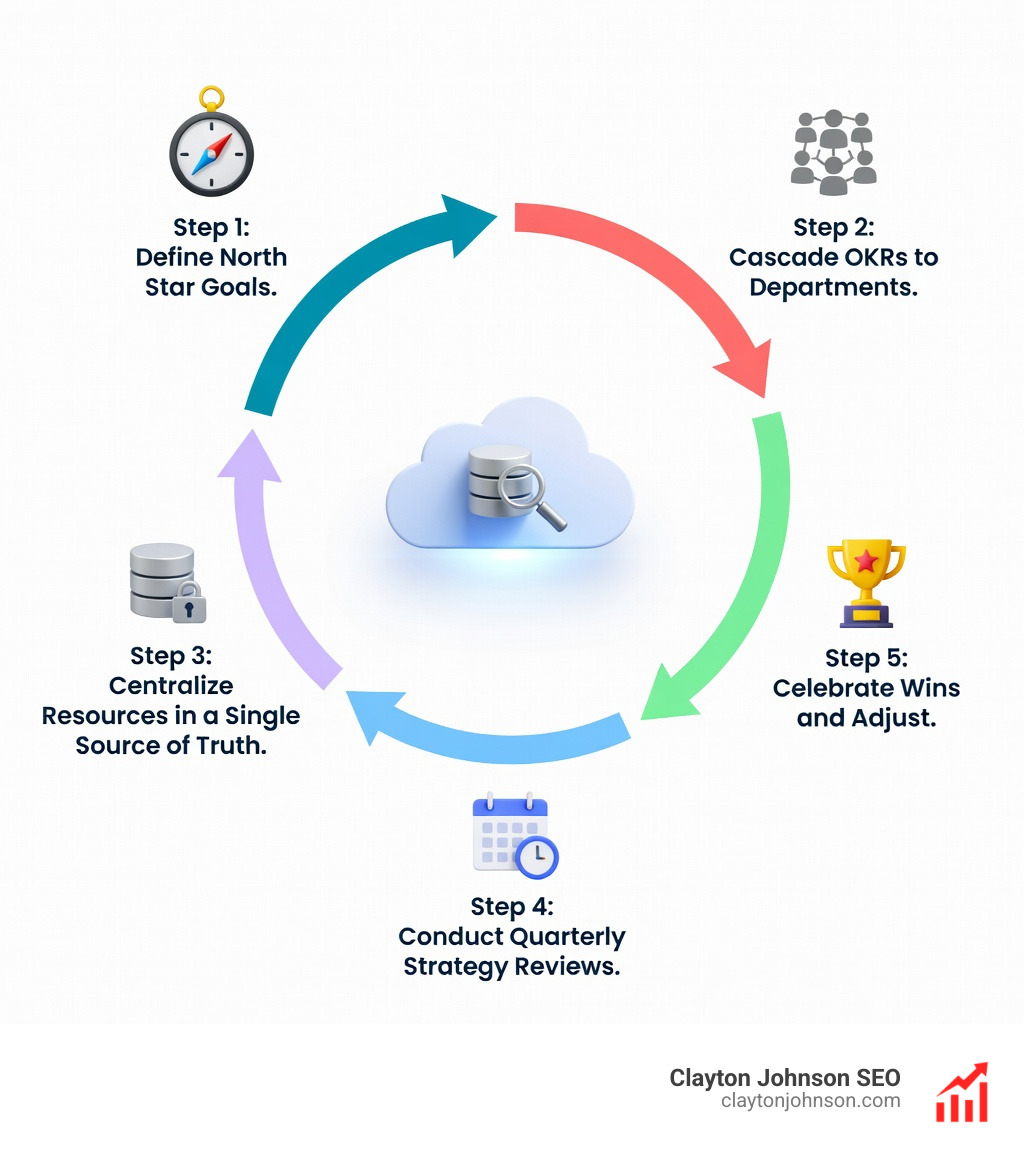
1. Strategic Planning and OKRs
You cannot align toward a goal that hasn’t been defined. We recommend using Objectives and Key Results (OKRs) to create a “North Star.” You must Stop the Silos and Align OKRs by ensuring that every department’s OKRs feed directly into the company’s primary objectives.
2. Quarterly Strategy Reviews
Alignment isn’t a “one and done” event. The McChrystal Group suggests that quarterly strategy reviews offer a rhythmic way to identify sticking points and track progress. It’s a time to ask: “Are we still heading where we said we were going?”
3. Visual Collaboration and Transparency
In a hybrid work world, you need a “single source of truth.” Use visual collaboration tools to map out your Execution Roadmaps & Operational Alignment. When everyone can see the roadmap, there’s no room for “I didn’t know that was a priority.”
4. Shifting to a Matrix Structure
Traditional hierarchies often breed silos. A matrix organization structure encourages employees to respond to multiple managers across different functions. This forces horizontal communication and ensures that expertise is shared across the entire business, not just one department.
Implementing the Rubik’s Cube of Organizational Alignment
Think of your organization like a Rubik’s Cube. To “solve” it, you have to align all six sides. If you only focus on one side (like Sales), you’ll likely mess up the others (like Culture or Systems).
The six sides you must align are:
- Work: The actual tasks and processes.
- Governance & Structure: How decisions are made and who reports to whom.
- Information & Metrics: The data you track and how it’s shared.
- People & Rewards: How you hire, train, and what behaviors you incentivize.
- Continuous Improvement: How you learn from mistakes.
- Leadership & Culture: The values modeled by those at the top.
Measuring Success with Real-World Examples
We can look at companies like Starbucks, which built its empire on Organizational Alignment systems. By aligning operations across 25,000 stores in 62 countries, they ensured a consistent customer experience regardless of geography.
Another great example is the tech startup Betterment. As they scaled to over 100 employees, they realized their performance management wasn’t keeping up. They tested three different performance management systems before finding one that truly aligned individual efforts with their rapid growth targets.
Frequently Asked Questions about Organizational Alignment
How do OKRs support organizational alignment?
OKRs (Objectives and Key Results) provide a framework for transparency. By making all goals public within the company, employees can see how their work connects to the “North Star” objective. It turns abstract strategy into measurable, tactical steps that everyone can follow.
What are the first warning signs of misalignment?
The “canary in the coal mine” is usually a breakdown in communication. If departments are surprised by each other’s projects, or if employees are using different versions of the same data, you are misaligned. High levels of “unproductive meeting time” is another major red flag.
How does company culture impact strategic alignment?
Culture is the “how” of your organization. If your strategy requires speed but your culture requires ten levels of approval for every decision, you are fundamentally misaligned. As the research suggests, over 50% of top executives believe culture is the primary driver of productivity and creativity.
Conclusion: Building Your Growth Architecture
At the end of the day, Organizational Alignment isn’t just a “nice to have” HR initiative. It is the core of your growth architecture.
In our work at Clayton Johnson and through Demandflow.ai, we see this constantly: companies don’t lack tactics; they lack the structured growth infrastructure to execute those tactics effectively. When you align your strategy, your systems, and your people, you create leverage. And leverage leads to compounding growth.
If you’re feeling perplexed by the gap between your ambition and your performance, it’s time to stop looking for new tactics and start looking at your alignment.
Ready to bridge the gap? Achieve Organizational Alignment today and turn your fragmented efforts into a unified growth engine.