The Real Reason Why AI Driven SEO Matters Right Now

Why AI Driven SEO is the Smartest Investment You Can Make Right Now
Why AI driven SEO matters comes down to one simple shift: search engines no longer just rank pages — they generate answers. And if your content isn’t built to be cited inside those answers, you’re invisible where decisions are being made.
Here’s why it matters at a glance:
- Google processes 8.5 billion searches per day — and AI Overviews now appear in a growing share of them
- AI Overviews cut website clicks by 30%+ — meaning ranking alone no longer guarantees traffic
- Pages that directly answer specific queries get 31% higher citation rates in AI-generated results
- 68% of organizations are already shifting strategies to account for AI search
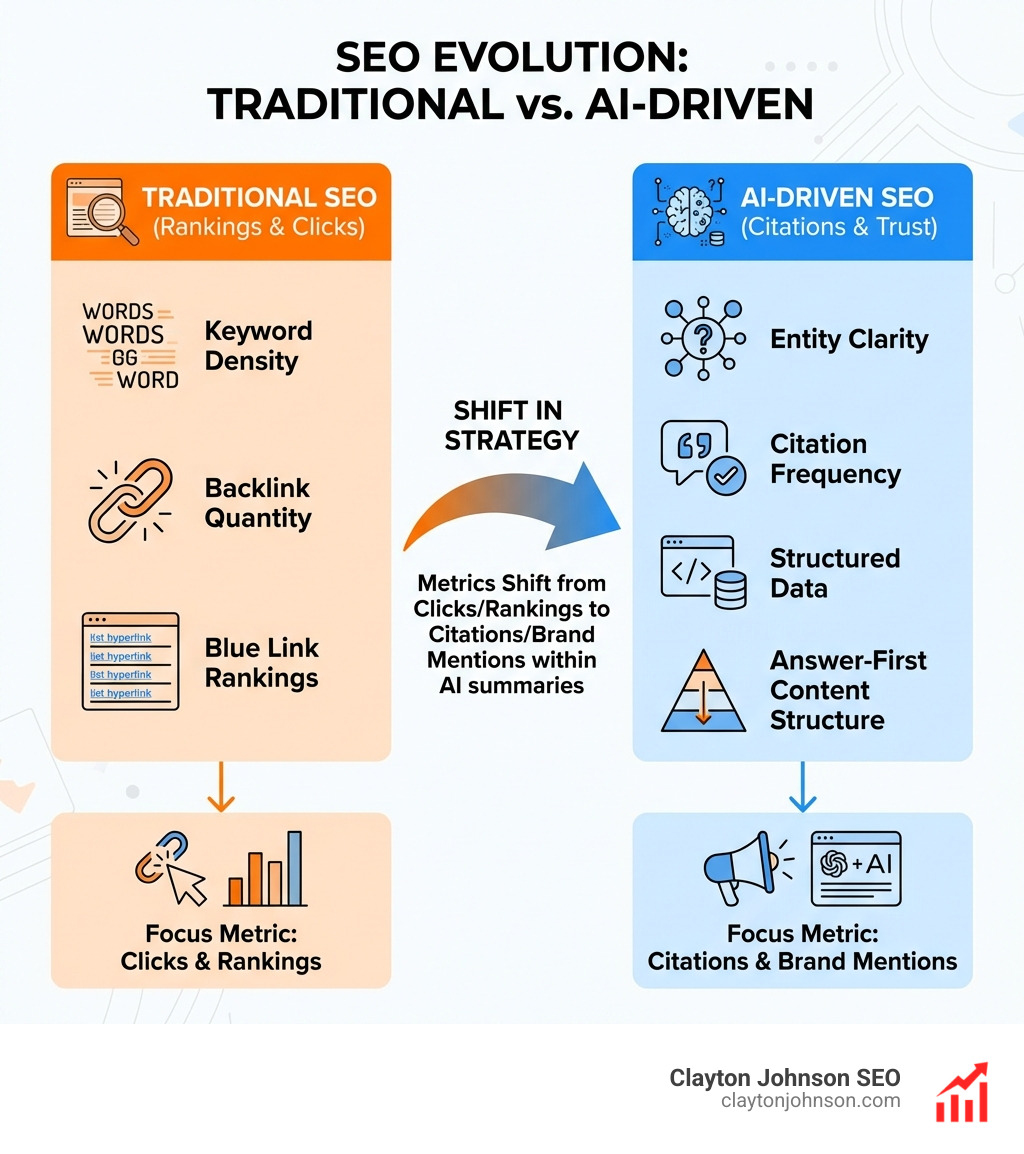
- Traditional SEO gets you ranked. AI-driven SEO gets you cited, recommended, and trusted
Search has fundamentally changed. Tools like Google’s AI Overviews, ChatGPT, and Perplexity don’t return a list of blue links and let users decide. They synthesize information from authoritative sources and deliver a direct answer — with or without your brand in it.
The businesses that understand this shift are building content architectures designed to be the source AI systems pull from. Everyone else is watching their organic traffic compress while wondering what changed.
“AI is not killing SEO — it’s raising the bar for what SEO has to be.”
I’m Clayton Johnson, an SEO strategist who specializes in building scalable content systems and AI-augmented marketing workflows — and understanding why AI driven SEO is now the foundation of durable growth has been central to my work across dozens of business models. If you’re a founder or marketing leader trying to turn fragmented efforts into a compounding demand engine, you’re in the right place.
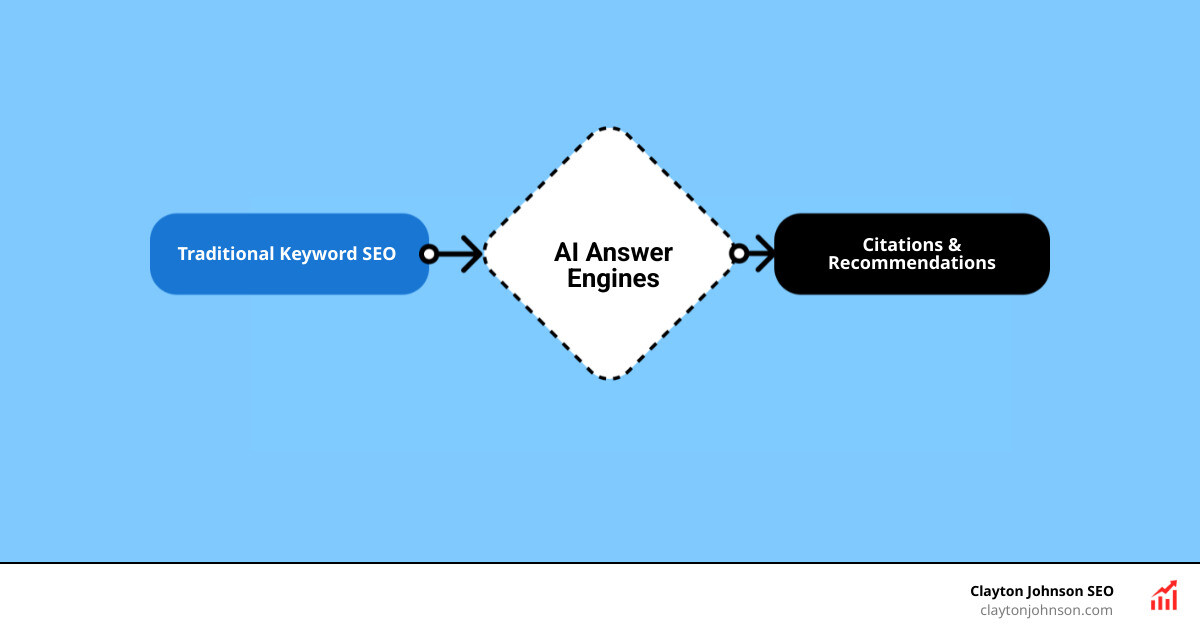
Similar topics to why ai driven seo:
The Strategic Necessity: Why AI Driven SEO is Your Competitive Edge

In the current search landscape, we are witnessing a splintering of how users discover information. While Google still commands over 90% of global search usage, the way it presents information is evolving through Google Search Generative Experience (SGE). Simultaneously, platforms like ChatGPT and Perplexity are capturing “answer-seeking” intent that used to result in a website click.
This has led to the rise of Generative Engine Optimization (GEO), which is the practice of optimizing content specifically to be discovered and cited by these AI-powered tools. In an era of “zero-click search,” where 58.5% of US Google searches end without a user ever leaving the results page, being the cited source within an AI Overview is the only way to maintain brand relevance.
Why AI Driven SEO Redefines Content Relevance
The “why” behind why AI driven SEO is superior lies in its ability to leverage Natural Language Processing (NLP). Traditional SEO often felt like a game of “pin the tail on the donkey,” where we hoped our keywords matched what a user typed. Today, AI systems interpret the meaning behind the query.
By using AI SEO services, we shift from matching strings of text to satisfying intent. AI understands that if a user in Minneapolis asks for “best roofing materials for cold climates,” they aren’t just looking for a list of shingles; they are looking for durability, insulation properties, and local expertise. AI-driven strategies ensure your content provides the semantic depth required to satisfy these complex, contextual needs.
Why AI Driven SEO is the Key to Answer Engine Visibility
Answer Engine Optimization (AEO) is no longer a luxury. When an AI model like Claude or Gemini synthesizes a response, it looks for citable snippets—concise, factual blocks of text that provide high “information gain.”
AI-driven workflows allow us to identify these “extractable” opportunities at scale. By focusing on entity recognition—ensuring the AI knows exactly who your brand is and what specific problem you solve—we increase the probability of referral traffic from “educated clicks.” These are users who have already read an AI summary and click your link because they want to dive deeper into your specific expertise.
Decoding the Machine: How AI Processes Your Content

To win, we must understand how the machine thinks. Modern search is powered by Large Language Models (LLMs) and Retrieval-Augmented Generation (RAG). Systems like RankBrain, BERT, and MUM have moved Google away from simple indexing and toward a deep understanding of human language nuances.
When you publish content, AI systems don’t just “read” it; they synthesize it. They look for relationships between concepts. For example, if you write about “SaaS growth,” the AI expects to see related entities like “churn rate,” “LTV,” and “customer acquisition cost.” If those relationships are missing, the AI may deem your content thin or unauthoritative.
From Keywords to Entities
We are moving from a world of keywords to a world of entities. An entity is a well-defined object or concept—like a brand, a person, or a specific product. AI search engines build Knowledge Graphs that map these entities to specific intents.
By building topic clusters—interconnected groups of content that cover every angle of a subject—we signal to the AI that we are a “topical authority.” This isn’t about repeating a keyword 50 times; it’s about proving we own the category truth through comprehensive, structured information.
The Role of Structured Data

If content is the “meat,” Schema markup is the skeleton that gives it shape. AI systems rely heavily on structured data to parse information quickly. By implementing JSON-LD for FAQPage, Organization, and Article schemas, we provide a roadmap for AI crawlers.
Pages with robust structured data see significantly higher citation rates. For instance, Organization schema appears on up to 34% of cited pages in AI search modes. It tells the AI: “This is who we are, this is what we do, and here are the specific questions we are qualified to answer.”
Building Unshakable Authority in an AI-Mediated World
In an AI-driven world, the authority era in search is defined by E-E-A-T: Experience, Expertise, Authoritativeness, and Trustworthiness. AI models are trained to prioritize “legitimacy” over “optimization.”
We build this authority by moving beyond simple link building and into digital PR and brand building. When your brand is mentioned on Reddit, Quora, LinkedIn, and YouTube, AI systems take note. These off-site signals act as a “legitimacy multiplier,” proving to the AI that you are a trusted entity in the real world, not just a well-optimized URL.
Category Authority and Trust
To dominate, you must own the “canonical explanation” for your niche. This means creating the definitive guide or hub that everyone else—including the AI—references as the source of truth. Distributed authority ensures your brand name is synonymous with your category across the entire web ecosystem.
Human-AI Collaboration for Quality
The “secret sauce” of why AI driven SEO works isn’t just the AI—it’s the human oversight. While AI can generate drafts and identify trends, human experts provide the “icing and sprinkles”: the lived experience, the unique brand voice, and the rigorous fact-checking that prevents AI hallucinations. This collaboration ensures your content is both AI-readable and human-resonant.
Practical Steps to Launch Your AI SEO Strategy
Ready to get started? The first step is technical readiness. You must ensure your site is “discoverable” by the new generation of bots. This involves reviewing your robots.txt file to explicitly allow AI crawlers like GPTBot (OpenAI) and ClaudeBot (Anthropic), unless you have specific security reasons to block them.
If you need help navigating this transition, working with an SEO consultant can help you identify high-impact workflows and technical gaps that might be holding you back from AI inclusion.
Technical Foundations for AI Discovery
AI systems favor sites that are fast, mobile-optimized, and structurally sound. Core Web Vitals—like Largest Contentful Paint (LCP) and Cumulative Layout Shift (CLS)—remain critical. If your site is JavaScript-heavy, you may need to implement dynamic rendering to ensure AI crawlers can see your full content without getting stuck in a loading loop.
Content Optimization for Citations
To get cited in an AI Overview, your content must be “snippable.” This means:
- Question-based optimization: Use H2s and H3s that mirror exactly how people ask questions.
- Standalone answer blocks: Provide a clear 2-3 sentence summary at the top of key sections.
- Bulleted lists and tables: AI loves structured data it can easily extract into a summary.
- Descriptive headings: Tell the machine exactly what each section covers.
Frequently Asked Questions about AI Search
Will SEO exist in the next decade?
Absolutely, but it will look different. Search is a fundamental human behavior. As long as people have questions, businesses will need a strategy to provide answers. SEO will evolve from “ranking for keywords” to “managing brand presence across all discovery platforms.” Human creativity and strategic positioning will remain the ultimate differentiators.
What is the difference between SEO and GEO?
Traditional SEO focuses on earning a high rank in the “blue links” of a search engine results page. GEO (Generative Engine Optimization) focuses on being the source that an AI model summarizes or cites within a generated answer. SEO is about the click; GEO is about the citation and recommendation.
Do keywords still matter in the age of AI?
Yes, but their role has changed. Keywords are now “intent signals.” They help the AI understand the topic you are covering, but the AI also looks at semantic clarity and topic modeling. You can’t just “stuff” keywords anymore; you have to use them as part of a deep, expert-level conversation about a subject.
Conclusion
At the end of the day, why AI driven SEO is your new best friend is simple: it provides the structured growth architecture needed to thrive in a complex digital world. We believe in a model of Clarity → Structure → Leverage → Compounding Growth.
By shifting your mindset from “chasing algorithms” to “building authority,” you create a durable asset that survives every update Google throws your way. At Clayton Johnson SEO, we help founders and marketing leaders build these growth systems using Demandflow.ai—our proprietary framework for taxonomy-driven SEO and AI-augmented workflows.
Don’t just rank. Be the answer. Be the authority. Let’s build your search-everywhere edge together.