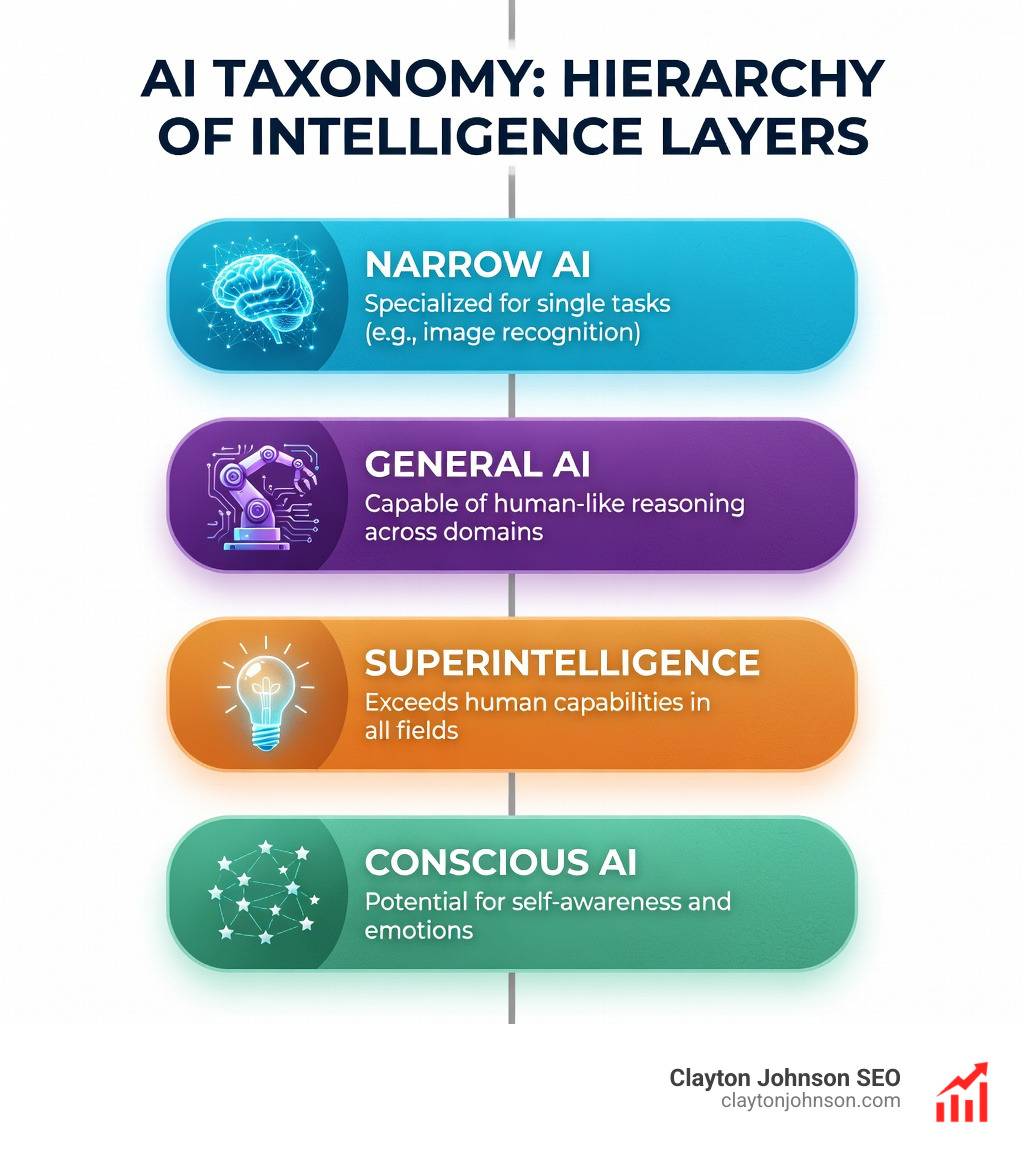
How to use AI for positioning without looking like a robot


Why How AI Competitive Positioning Works — and Why Most Companies Get It Wrong
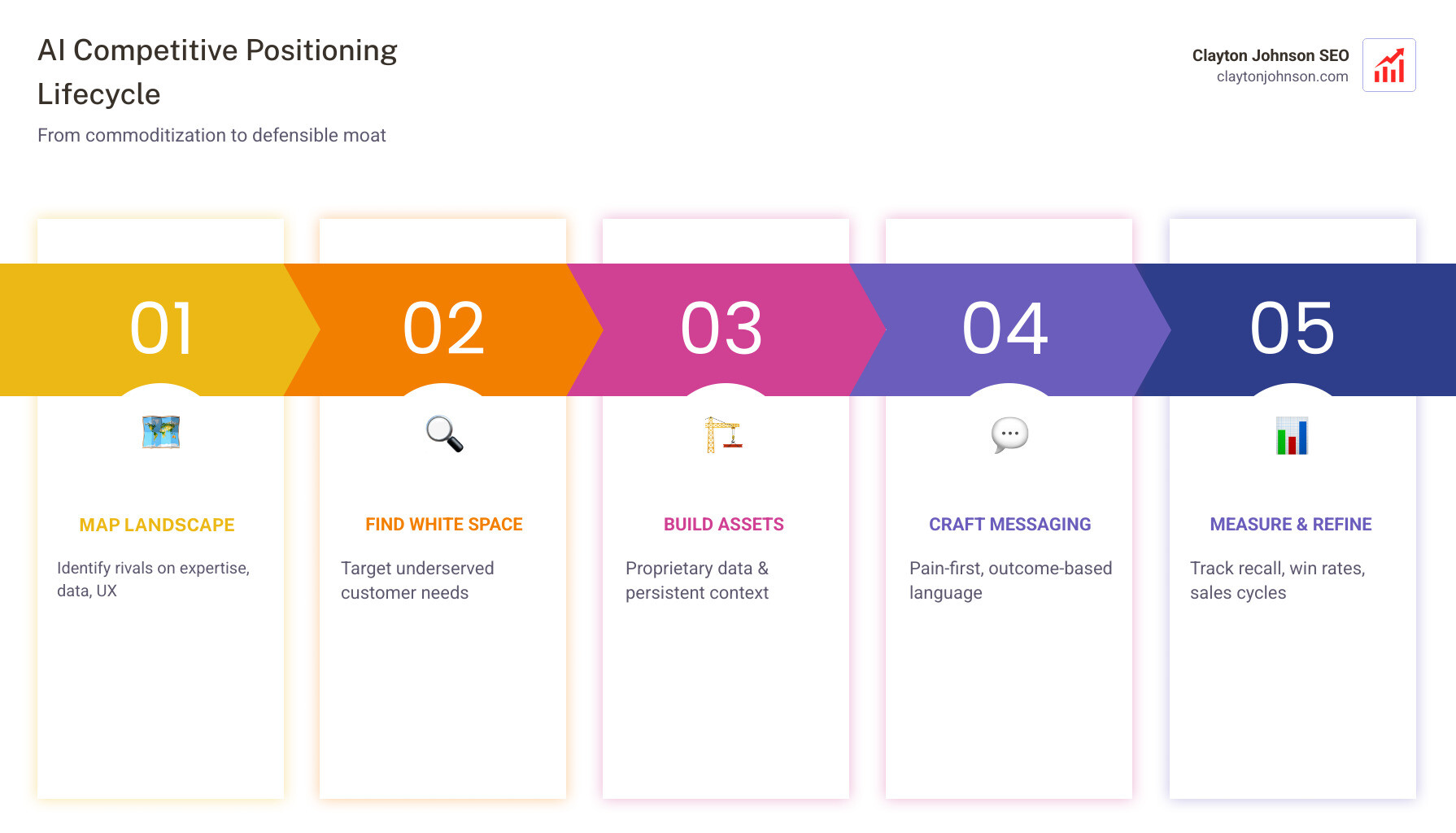
How AI competitive positioning works comes down to one core idea: it’s not about which AI model you use — it’s about how you deploy AI to create an advantage no competitor can easily copy.
Here’s a quick breakdown:
- Map your competitive landscape — Identify where rivals cluster on dimensions like domain expertise, data advantage, and user experience.
- Find positioning white space — Locate underserved quadrants where customer needs go unmet.
- Build proprietary assets — Use unique data, persistent context, or vertical specialization that generalist AI cannot replicate.
- Craft pain-first messaging — Lead with customer problems, not feature lists.
- Measure and refine — Track message recall, win rates, and sales cycle length to validate your position.
Right now, AI capabilities are rapidly commoditizing. Access to a powerful language model is no longer a moat — it’s a baseline. As one strategic analysis puts it, the prevailing enterprise AI approach focused on securing access to the largest foundational models is now obsolete. The real competitive edge has moved up the stack, into the application layer — where proprietary data, domain depth, and persistent context create advantages that are genuinely hard to replicate.
The problem? Most AI companies and AI-powered businesses still position themselves with the same generic language: “We use AI to optimize your workflow and increase efficiency.” That’s not positioning. That’s wallpaper.
If your AI messaging sounds like everyone else’s, it doesn’t matter how good your product is. Undifferentiated positioning is one of the fastest ways to lose deals, compress margins, and become invisible in a crowded market.
I’m Clayton Johnson — an SEO strategist and competitive intelligence practitioner who has used how AI competitive positioning frameworks to help founders and marketing leaders build strategies that actually differentiate. In my work across B2B SaaS and growth-stage companies, I’ve seen how the right positioning system transforms AI from a commodity feature into a durable competitive weapon.
Understanding the Shift: How AI Competitive Positioning Has Evolved
In the early days of the current AI boom, simply having access to a high-performing Large Language Model (LLM) was enough to turn heads. But we have reached an inflection point. The market is shifting from foundational model dominance to application-layer value.
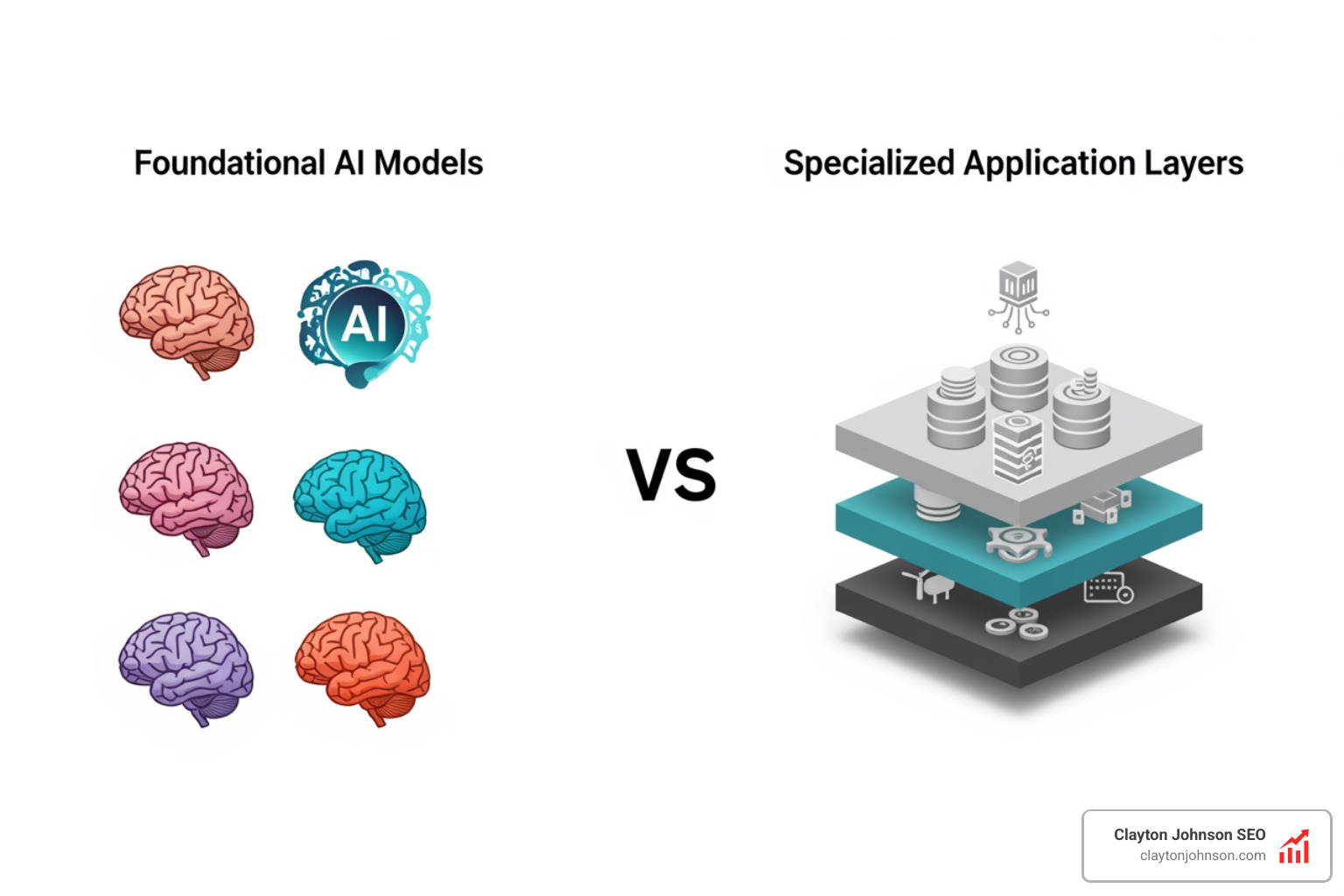
When we look at AI-enabled business models for competitive advantage, we see that some firms successfully harness AI to create unparalleled wealth while others fail. The difference isn’t the “brain” (the model); it’s the “body” (the business model and data ecosystem). Research shows that AI software revenue is projected to surge from $71.5 billion to over $775 billion by the early 2030s. To capture that growth, you need more info about competitive intelligence to move beyond being a “wrapper” for someone else’s technology.
The Death of the API Moat
If your entire value proposition is “We plugged GPT-4 into a dashboard,” you don’t have a moat; you have a rental. Relying solely on third-party APIs makes you a low-margin reseller vulnerable to price hikes or feature updates from the model providers themselves.
The transition of top executives from major AI labs into venture capital confirms a strategic bifurcation. On one side, giants like OpenAI and Google are locked in a capital-intensive race for compute. On the other side, the real winners will be those who build specialized applications. Without a unique layer of value, companies face strategic irrelevance. You can see how the landscape is shifting by studying The AI Competitive Map, which highlights how positioning is becoming more fragmented and specialized.
Moving from Generalist to Specialist
The “Swiss Army Knife” approach to AI is losing its edge. Generalist models are impressive, but they often struggle with high-stakes, realistic tasks. While LLMs achieve success rates of 95% in simple “needle-in-a-haystack” tests, their performance can drop as low as 60% on complex, industry-specific workflows.
This is where vertical specialization wins. Specialized AI accuracy research shows that models fine-tuned for specific domains—like legal contract review or genomic sequencing—can achieve a 25-40% improvement in accuracy over their generalist counterparts. By narrowing your focus, you aren’t limiting your market; you’re deepening your moat.
Building a Defensible Moat: The Three Pillars of AI Differentiation
To stand out, we must move beyond the “robot” look and feel. A defensible moat in the age of AI isn’t built on code alone; it’s built on proprietary data, persistent context, and economic leverage.

Understanding how to think about competitive pressure means recognizing that if a competitor can replicate your output with a better prompt, you don’t have a sustainable position.
Mastering Persistent Context in How AI Competitive Positioning
The ultimate differentiator is what we call “Mastering Persistent Context.” A general AI model starts every conversation with a blank slate. A positioned AI company builds a “context graph”—a dynamic, living model of a business’s specific entities, relationships, and history.
When AI has persistent context, it doesn’t just generate text; it provides unreplicable intelligence tailored to a specific user. This solves the “context rot” problem where LLM success rates in realistic tasks plummet because the model loses focus or lacks the specific background data to be useful.
Economic Leverage through Cost-Efficient Inference
Positioning isn’t just about what you do; it’s about how efficiently you do it. Using a “sledgehammer to crack a nut”—like using a massive, expensive model for a simple data entry task—is a recipe for margin collapse.
Strategic leaders are now adopting tiered AI portfolios. By using smaller, specialized models for routine tasks and reserving flagship models for complex reasoning, companies can see tiered AI workload savings of 50-70%. This economic leverage allows you to outprice competitors while maintaining higher profitability.
The AI Competitive Positioning Matrix: Identifying Your White Space
How do you know where you fit? We use a structured framework to map the market. By plotting Technical Capability against User Experience, we can see exactly where the “white space” is.
| Dimension | Standard / Generalist | Specialized / Proprietary |
|---|---|---|
| Technical Capability | Off-the-shelf APIs | Custom-tuned models |
| User Experience | Complex / Prompt-heavy | Seamless / Outcome-oriented |
| Domain Expertise | Horizontal (All industries) | Vertical (Specific niche) |
| Data Advantage | Publicly available data | Proprietary / First-party data |
Using the Matrix for How AI Competitive Positioning
When you use this matrix, you’re looking for underserved quadrants. Most AI startups crowd the “Generalist/Technical” corner. The “Specialized/High UX” corner is often wide open.
Visualizing your edge with a strategy canvas helps you see if you are merely mirroring a leader or carving a new path. If you find your brand is stuck in a crowded quadrant, it’s time to consult a market positioning models guide to pivot toward a more defensible space.
Avoiding the Generic Messaging Trap
The biggest mistake we see is “mirroring.” A competitor changes their headline to “AI-Powered Insights,” so you do too. This leads to a sea of sameness. Most AI companies sound identical because they rely on internal brainstorming rather than customer pain points.
To break out, you must master the art of being different and better. Don’t tell them your AI is “fast”; show them how it solves a specific, agonizing problem that their current manual process creates.
From Generic to Genius: Crafting Pain-First Messaging
If you want to avoid looking like a robot, stop talking about your features and start talking about your customer’s pain.
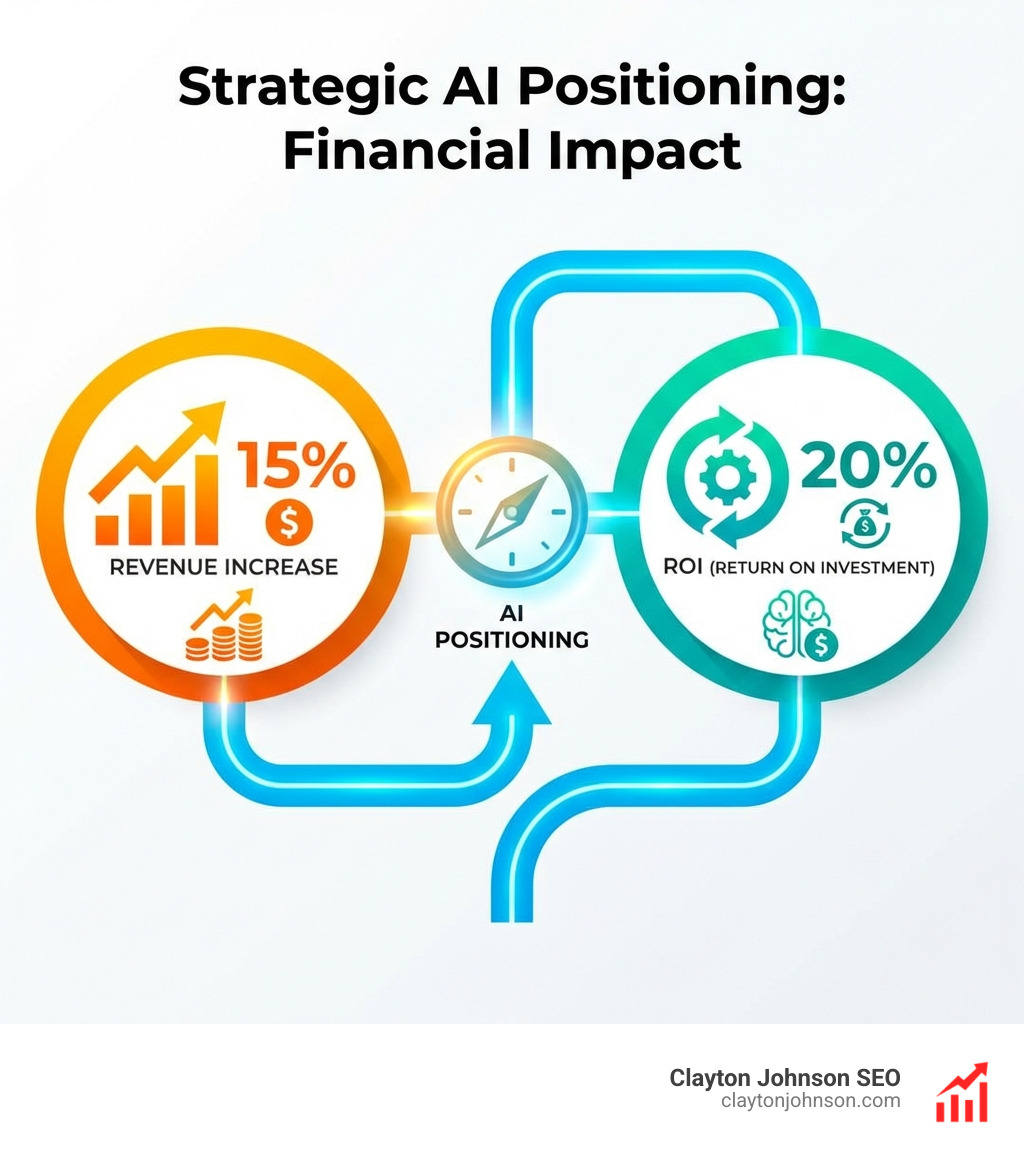
Research shows that AI-powered recommendations can increase revenue by up to 15%. But to get that revenue, you have to sell the outcome. Check out these how to increase revenue with AI trends to see how the best sales teams are pivoting toward value-based conversations.
Developing a Unique Value Proposition
Your Unique Value Proposition (UVP) should follow a clear formula: “We help [Target Audience] achieve [Specific Outcome] through [Unique AI Approach] without [Common Pain Point].”
The AI-powered predictive analytics benefits are clear: better decisions and faster responses to market shifts. Your messaging should highlight these specific business wins, not the technical specs of your neural network.
Leveraging AI for Competitive Intelligence and Research
AI isn’t just the product; it’s the tool you use to refine your positioning. By using Natural Language Processing (NLP) and pattern recognition, you can scan thousands of competitor reviews, patent filings, and job postings to uncover their hidden strategies.
The efficiency gains are massive. Evidence synthesis time reduction research suggests that AI can decrease research time by over 50%, leading to a labor reduction of over 75% compared to manual analysis. This allows you to stay two steps ahead of the market at a fraction of the cost.
Navigating Risks, Ethics, and Implementation Challenges
Pursuing an AI-driven competitive advantage isn’t without its hurdles. From technical hallucinations to ethical dilemmas, leaders must navigate a complex landscape.
One major concern is the AI impact on employment data, which suggests significant shifts in roles like software development and database administration. Positioning your company as an “AI-augmented” workforce rather than an “AI-replaced” one is a key part of modern brand ethics.
Overcoming Technical and Human Barriers
Hallucinations remain a significant risk, with most LLMs maintaining a 10-15% error rate on complex tasks. To mitigate this, we recommend “critic agents”—AI models designed specifically to check the work of other models.
Furthermore, you need the right talent. We are seeing the rise of “Context Architects”—professionals who blend data engineering with business strategy to ensure the AI remains grounded in reality. Using AI-powered data visualization tools can help bridge the gap between complex AI outputs and actionable human insights.
Ethical Considerations in AI-Driven Advantage
How you acquire your data matters. Using natural language processing in CI to scrape private data can cross into the territory of corporate espionage.
Ethical positioning means being transparent about your data sourcing and ensuring your models are free from Western bias, which often underrepresents global competitors. In cities like Minneapolis, Minnesota, where the tech scene is growing, maintaining high ethical standards is essential for long-term brand authority.
Frequently Asked Questions about AI Positioning
What is the biggest mistake AI companies make in their positioning?
The biggest mistake is “feature-first” messaging. Companies spend too much time explaining how their AI works (the tech) and not enough time explaining why it matters to the customer (the value). This results in a generic “robot” brand that fails to connect with human buyers.
How can proprietary data create a sustainable competitive moat?
Proprietary data is information that your competitors cannot buy or scrape. For example, a healthcare AI company with 50 million anonymized patient records has a moat that a general LLM cannot cross. When your AI is trained on unique, first-party data, its insights become exclusive to your business.
Can small businesses use AI to compete with industry giants?
Absolutely. Small businesses often have the advantage of agility. While giants are locked into massive, multi-year infrastructure projects, small firms can use specialized, low-cost AI tools to provide hyper-personalized customer service or niche market research that large corporations are too slow to execute.
Conclusion: Building for Compounding Growth
Mastering how AI competitive positioning works is the difference between being a temporary trend and a permanent market leader. The goal is to move from “using AI” to “owning a category” through structured strategy.
At Clayton Johnson SEO and through our platform Demandflow.ai, we believe that most companies don’t lack tactics — they lack structured growth architecture. By combining actionable strategic frameworks with AI-augmented workflows, you can turn your technology into a compounding asset.
Clarity leads to structure. Structure leads to leverage. Leverage leads to compounding growth. Don’t just build another AI tool — build a defensible market position that stands the test of time.
Start building your SEO content marketing infrastructure today and stop guessing where you fit in the AI-driven future.