Why Every Growth-Focused Brand Needs an AI SEO Strategy Framework
An ai seo strategy framework is a structured system for earning visibility across both traditional search rankings and AI-generated answers — combining content architecture, authority signals, technical optimization, and measurement into one cohesive growth engine.
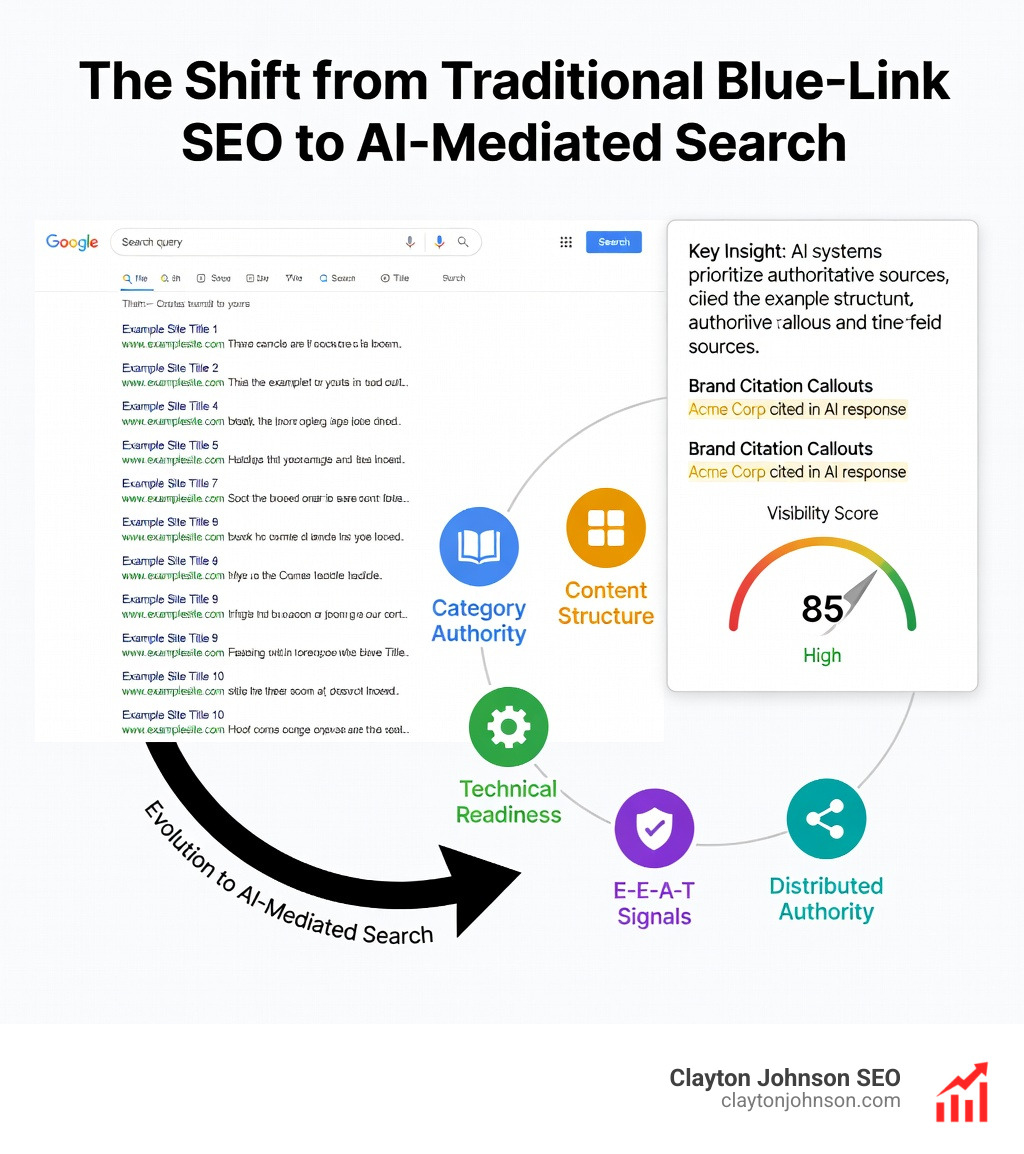
Here’s what a strong AI SEO strategy framework covers:
- Category Authority — Own your niche by building deep topical expertise AI systems recognize
- Content Structure — Format content so AI tools can extract, cite, and surface it
- Technical Readiness — Schema, crawl access, and Core Web Vitals optimized for both Google and LLMs
- E-E-A-T Signals — Verifiable trust signals that AI models use to validate sources
- Distributed Authority — Presence across reviews, communities, PR, and third-party platforms
- Measurement — Track AI citations, brand mentions, and share of voice — not just rankings
Search has fundamentally changed. 65% of Google searches now end without a click. When an AI-generated summary appears in results, users click traditional links only about 8% of the time.
That means ranking #1 no longer guarantees traffic. Visibility now requires being the source AI trusts — not just the page Google ranks.
The brands winning in this environment aren’t just doing more SEO. They’re operating with a structured framework that connects content, authority, and technical infrastructure into a system built for both organic rankings and AI-generated answers.
This guide breaks down exactly how to build that system — from foundational pillars to phased implementation to measurement.
I’m Clayton Johnson, an SEO strategist and growth operator who specializes in building ai seo strategy frameworks that turn fragmented marketing efforts into scalable, compounding authority systems. I’ve applied these frameworks across dozens of business models, aligning technical SEO, content architecture, and AI-augmented workflows to drive measurable pipeline results.
Similar topics to ai seo strategy framework:
- AI SEO performance optimizer
- AI content SEO strategy
- AI powered keyword research
The Evolution of Authority in an AI-Mediated Search World
In the early days of SEO, authority was a relatively crude concept. Ranking well often came down to how effectively you could game PageRank. If you bought enough links and repeated the right keywords, visibility followed. It was mechanical, transactional, and remarkably easy to manipulate.
As search evolved, Google began experimenting with entity-based understanding. Author photos appeared in search results, knowledge panels surfaced, and brands were treated less like URLs and more like connected entities. Today, we have moved beyond “synthetic authority” (authority built solely through technical tricks) to a world where AI models look for genuine legitimacy across the entire web.
In an AI-mediated world, authority is no longer just about who links to you. It is about who mentions you and how those mentions are contextualized. Large Language Models (LLMs) synthesize information from across the web—Reddit, Quora, LinkedIn, and YouTube—to decide which brands are trustworthy enough to cite in an AI Overview.
Shifting from Keywords to Entities
Traditional SEO focused on keywords; modern AI SEO focuses on entities. An entity is a well-defined object or concept—like a brand, a person, or a specific product.
When we build an ai seo strategy framework, we prioritize Semantic SEO. This means creating content that covers a topic with such depth and clarity that AI systems can easily map the relationships between your brand and the “truth” of that category. LLM training cycles rely on these relationships to provide accurate answers. If your brand is consistently mentioned alongside high-value topics in your niche, you become an authoritative entity in the eyes of the AI.
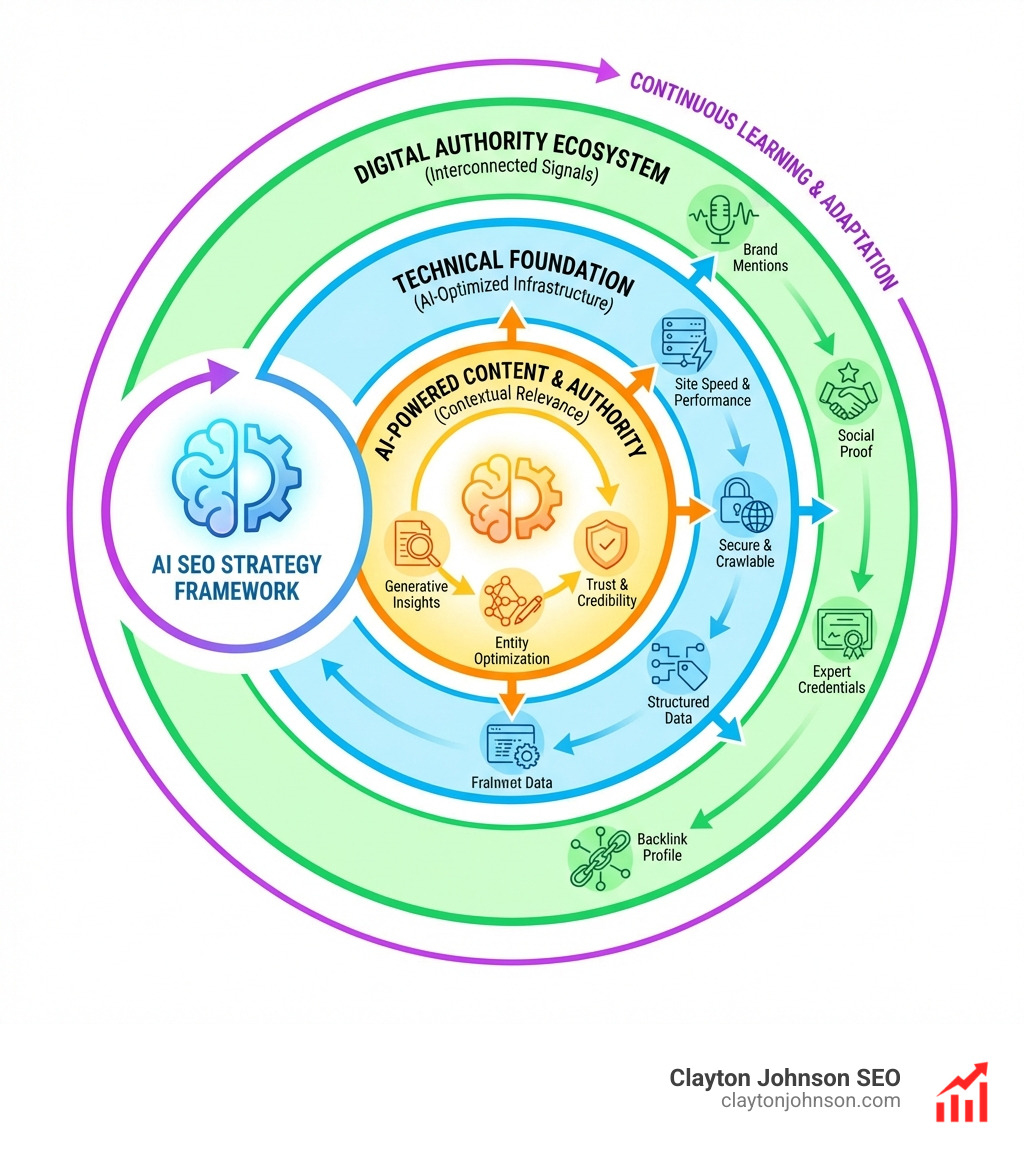
AI Search is not a static list of links; it is a conversational engine that requires contextual relevance. We must move away from siloed pages and toward interconnected content architectures that prove topical mastery.
Core Pillars of an Effective AI SEO Strategy Framework
To succeed today, we utilize a three-pillar approach to authority. This ensures your brand is not only visible but also cited as a trusted source.
- Category Authority: Owning the “truth” of your niche. This is about being the definitive voice on specific topics so that when an AI needs a factual answer, it looks to you.
- Canonical Authority: Creating the definitive explanations. These are your hubs, guides, and FAQs that serve as the raw material for AI models to summarize.
- Distributed Authority: Proving legitimacy beyond your website. This involves being cited on the most heavily cited sources in AI search responses like Reddit, G2, and industry news sites.
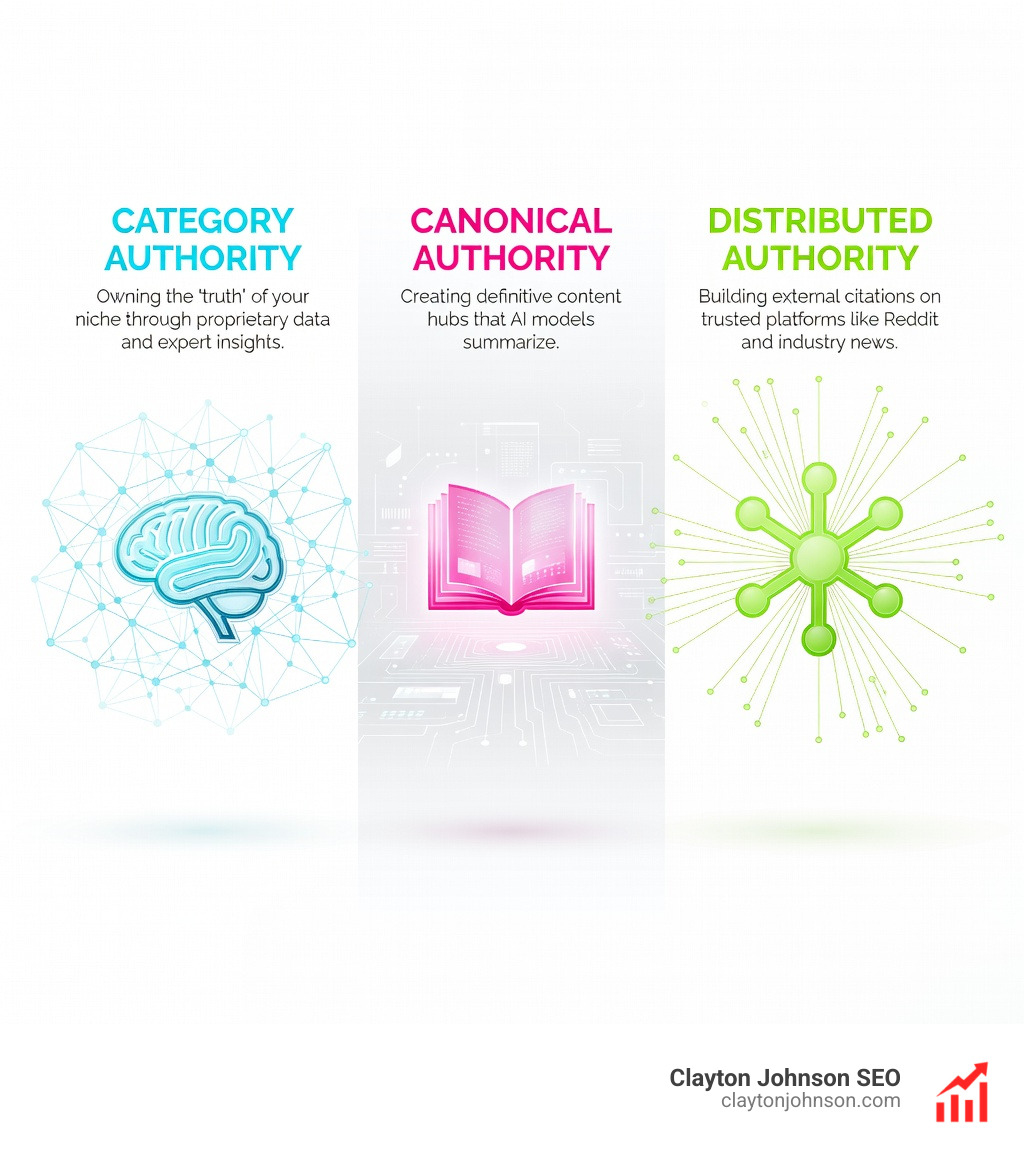
Establishing Category Authority within the AI SEO Strategy Framework
Category authority is about niche dominance. It’s the difference between having traffic and having influence. To build this, we focus on:
- Proprietary Data: Publishing original research that others (and AI) want to cite.
- Expert Interviews: Mining internal knowledge from your engineers or product leads to create unique insights that AI can’t find elsewhere.
- Information Gain: Adding new, valuable information to the web rather than just echoing what already exists.
Working with an SEO Consultant helps you identify these unique content gaps. We don’t just target keywords; we build topic clusters that establish you as the “Category King.”
Optimizing for Answer Engines using an AI SEO Strategy Framework
Answer Engine Optimization (AEO) and Generative engine optimization (GEO) are the tactical executions of your framework.
AI models process information through “chunking.” They retrieve small, semantically meaningful segments of text to build an answer. To be the source they choose, your content must be structured for easy extraction.
AI-Friendly Content Structures include:
- Answer-First Paragraphs: Placing a direct, 2-3 sentence answer immediately following an H2 or H3 heading.
- Bulleted Lists: Making data points and steps easy for a crawler to parse.
- HTML Tables: Providing structured comparisons that AI models love to cite.
- TL;DR Summaries: Using “mini-answers” at the top of long-form guides.
| Feature | Traditional SEO | AI SEO Strategy Framework |
|---|---|---|
| Primary Goal | Rank in top 10 blue links | Be the cited source in AI answers |
| Main Metric | Keywords & Backlinks | Mentions, Citations & Sentiment |
| Content Focus | Keyword density & length | Direct answers & topical depth |
| User Journey | Click -> Read -> Convert | Answer -> Trust -> Search Brand |
| Platform | Google Search | ChatGPT, Perplexity, Gemini, SGE |
Implementing the Phased Roadmap for AI Search Visibility
Building a robust ai seo strategy framework doesn’t happen overnight. We follow a phased implementation roadmap to ensure long-term, compounding growth.
Phase 1: Technical Foundations and Crawler Access
Before you can be cited, you must be seen. Technical SEO is the bedrock of AI readiness. We focus on:
- IndexNow: Implementing instant indexing protocols so AI crawlers see your updates immediately.
- Semantic HTML: Using clean code that clearly defines headers, lists, and tables.
- Structured data: Applying Schema markup (Organization, Person, FAQ, and Product) to help AI systems identify your brand as an entity.
- Core Web Vitals: Ensuring a fast, mobile-friendly experience, as behavioral signals like dwell time influence how AI perceives your content’s helpfulness.
Phase 2: Building E-E-A-T and Genuine Authority
Google and other AI engines learn about E-E-A-T (Experience, Expertise, Authoritativeness, and Trustworthiness) through verifiable signals.
We help brands move toward User-first E-E-A-T by:
- Author Bios: Connecting content to real experts with verifiable credentials.
- First-hand Experience: Including original visuals, case studies, and “boots on the ground” insights.
- Third-party Corroboration: Securing mentions on “Citation Core” sites like Wikipedia, industry databases, and high-authority news outlets.
- Digital PR: Building a footprint of brand mentions across the web that LLMs use to validate your legitimacy.
Top Tools and Technologies for AI-Powered SEO
To execute an ai seo strategy framework at scale, we integrate a specialized tech stack. These tools allow us to move faster and with more precision than manual methods.
- Content Optimization: Tools like Surfer SEO or Yarnit help us align content with semantic clusters and AI visibility requirements.
- Technical Audits: SEMrush AI and Moz help us maintain site health and forecast keyword shifts before they impact traffic.
- Research: We use AI-powered platforms to identify “intent gaps”—questions users are asking that no one has answered definitively yet.
Automating Workflows with AI Agents
The future of SEO lies in AI agents—autonomous “teammates” that handle repetitive tasks. We use agents for:
- Real-time Monitoring: Detecting when a competitor is cited in an AI Overview and suggesting content updates to win back that citation.
- Predictive Analytics: Identifying which topics are likely to trend based on LLM training data.
- Automated Audits: Running weekly technical checks and automatically generating tickets for developers.
This allows our human experts to focus on high-level strategy and creative judgment, while the “agent layer” handles the heavy lifting of execution.
Measuring Success: Beyond Traditional Clicks and Rankings
In the age of AI, traditional metrics like “rankings” only tell half the story. We need to measure how often your brand is the answer.
We track:
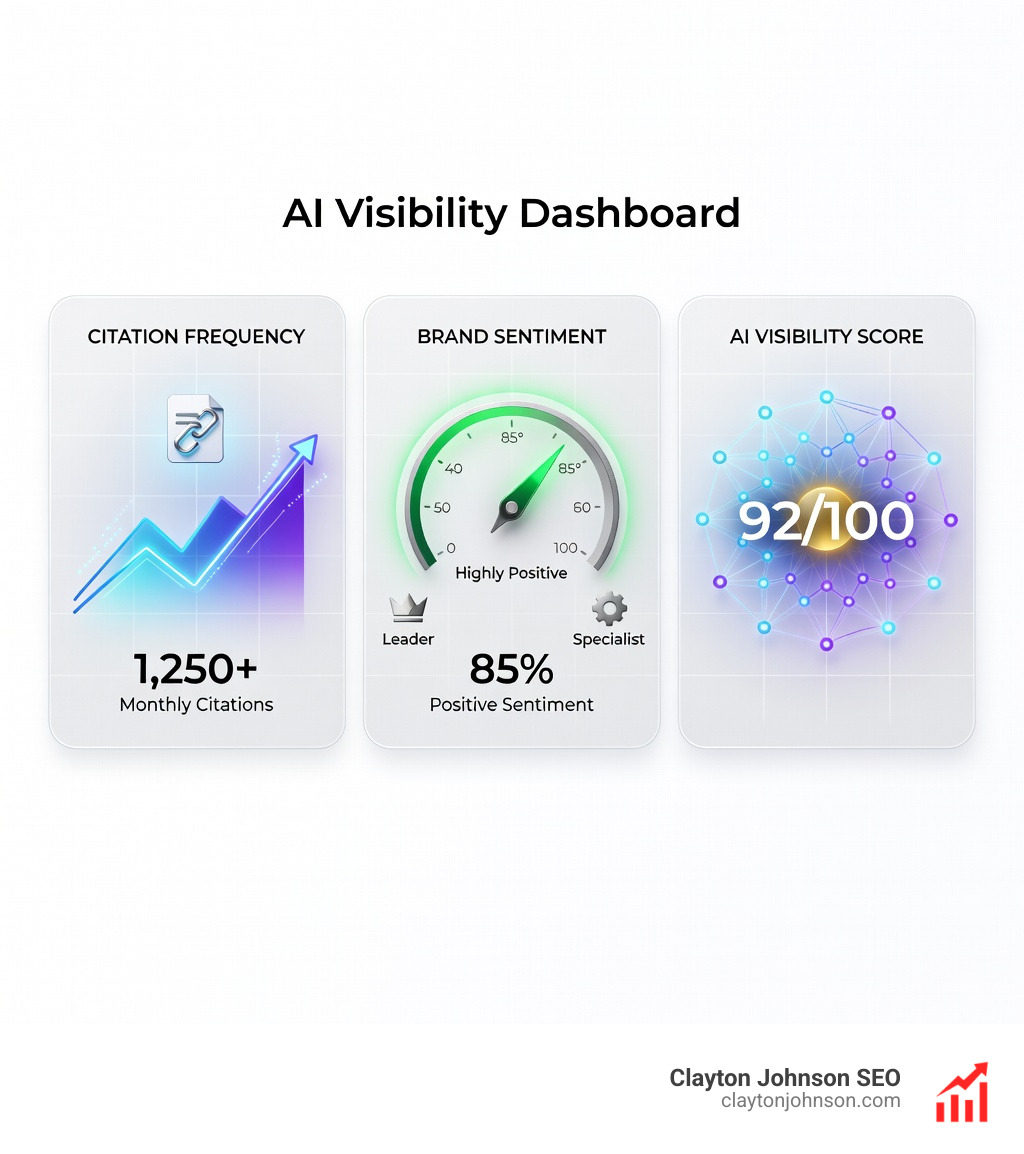
- AI Visibility Percentage: How often your brand appears in LLM responses for your target prompts.
- Share of Voice: Your brand’s presence in AI Overviews compared to competitors.
- Sentiment Analysis: Whether AI models characterize your brand as a “leader,” a “budget option,” or a “specialist.”
- Citation Frequency: How many times your site is listed as a source in generative search.
Analyzing ROI and Conversion Impact
LLM optimization isn’t just about vanity metrics. Google itself reports that click-throughs from AI summaries are often higher quality. Users who have already had their question answered by an AI summary and still click through to your site are highly pre-qualified.
We’ve seen cases where LLM-referred traffic converts at 16% compared to just 0.8% for traditional organic traffic. This is because the AI has already done the “selling” for you by citing you as the expert.
Clayton Johnson SEO Scalable Authority Retainer Framework
To implement these strategies, we offer structured retainer tiers designed to build compounding authority. Each tier focuses on a single domain to ensure maximum impact.
Foundation Authority — $1,997 / month
- 1 DR45+ PR link per month
- 2 Done-for-You articles per month
- Strategic Focus: Foundational authority + initial AI eligibility signals.
- Outcome: Baseline ranking growth and structured topical expansion.
Growth Authority — $2,997 / month
- 2 DR45+ PR links per month
- 4 Done-for-You articles per month
- Strategic Focus: Increased link velocity + expanded cluster depth.
- Outcome: Ranking momentum and improved AI visibility footprint.
Competitive Authority — $3,997 / month
- 3 DR45+ PR links per month
- 6 Done-for-You articles per month
- Strategic Focus: Stronger backlink concentration + deeper topic authority.
- Outcome: Multi-cluster ranking expansion and AI Overview positioning.
Expansion Authority — $4,997 / month
- 5 DR45+ PR links per month
- 10 Done-for-You articles per month
- Strategic Focus: Balanced authority scaling + ecosystem development.
- Outcome: Broader keyword penetration and higher AI inclusion probability.
Scale Authority — $6,997 / month
- 7 DR45+ PR links per month
- 14 Done-for-You articles per month
- Strategic Focus: Accelerated authority density + multi-topic cluster growth.
- Outcome: Faster SERP capture and expanded generative search visibility.
Market Leader Authority — $9,997 / month
- 10 DR45+ PR links per month
- 20 Done-for-You articles per month
- Strategic Focus: High-consistency authority acquisition + scalable content infrastructure.
- Outcome: Competitive displacement, AI citation authority, and durable market dominance.
Frequently Asked Questions about AI SEO Strategy
How does AI SEO differ for Ecommerce vs. B2B SaaS?
Ecommerce brands should focus on product schema, “best of” list inclusions, and technical specs that AI can compare. B2B SaaS brands need to focus on category definitions, proprietary frameworks, and deep educational hubs that solve complex problem-solution queries.
What is the difference between GEO and AEO?
AEO (Answer Engine Optimization) is the broad discipline of optimizing for any platform that provides direct answers (like Alexa or Siri). GEO (Generative Engine Optimization) specifically targets LLM-based systems like ChatGPT or Google AI Overviews by focusing on extractable content “chunks.”
Does traditional SEO still matter in an AI-first world?
Absolutely. Research shows that 97% of AI Overviews cite at least one source from the top 20 organic results. Traditional SEO—backlinks, technical health, and keyword alignment—is the prerequisite for AI visibility. You can’t be cited if you aren’t indexed and trusted by the underlying search engines.
Conclusion
The digital landscape has shifted from a “bun fight for visibility” to a “judgment of authority.” If your brand isn’t being cited in the answers users are receiving, you are effectively invisible.
Most companies don’t lack tactics; they lack structured growth architecture. At Demandflow, we provide that architecture through taxonomy-driven SEO systems and AI-augmented workflows. We believe that clarity leads to structure, which creates the leverage needed for compounding growth.
Whether you are based in Minneapolis, Minnesota, or operating on a national scale, your success depends on moving beyond legacy tactics. It’s time to Build a Robust AI SEO Strategy Framework that positions your brand as the definitive answer in your category.