Who is Larry Kim? The Architect of Modern PPC
Before we dive into the tactical “how-to,” we need to understand the “who.” Larry Kim is widely recognized as one of the most influential figures in digital marketing. He founded WordStream, which grew into the world’s leading PPC management software company, managing billions in ad spend for tens of thousands of customers. Later, he founded MobileMonkey (now Customers.ai), focusing on the next frontier: AI-powered sales automation and chatbots.
Voted “Marketer of the Year” by Search Engine Land and a frequent guest lecturer at Harvard Business School, Kim’s reputation is built on data. He doesn’t just guess what works; he audits billions of dollars in real-world performance metrics to find the “unicorns”—those rare, high-performing campaigns that defy industry averages.
One of his most famous achievements was a viral campaign comparing Facebook vs. Google ad ROI. Timed perfectly to coincide with the eve of Facebook becoming a publicly traded stock, Kim released a data-heavy report that inserted his brand into a global conversation. While everyone was talking about Facebook’s stock price, Kim was talking about ad performance. The result? Millions of links back to his site from over 85 countries and coverage in ABC News, Forbes, and Business Insider.
This philosophy of finding the top 1% of performers—the “Unicorns”—and ruthlessly eliminating the bottom 99%—the “Donkeys”—is the cornerstone of his methodology. When most marketers settle for average click-through rates and mediocre conversion, Kim’s approach demands a radical shift in how we allocate budget and creative energy. By focusing on these outliers, you can achieve exponential growth rather than incremental gains.
The Inverted Unicorn and Other Larry Kim Ad Strategies
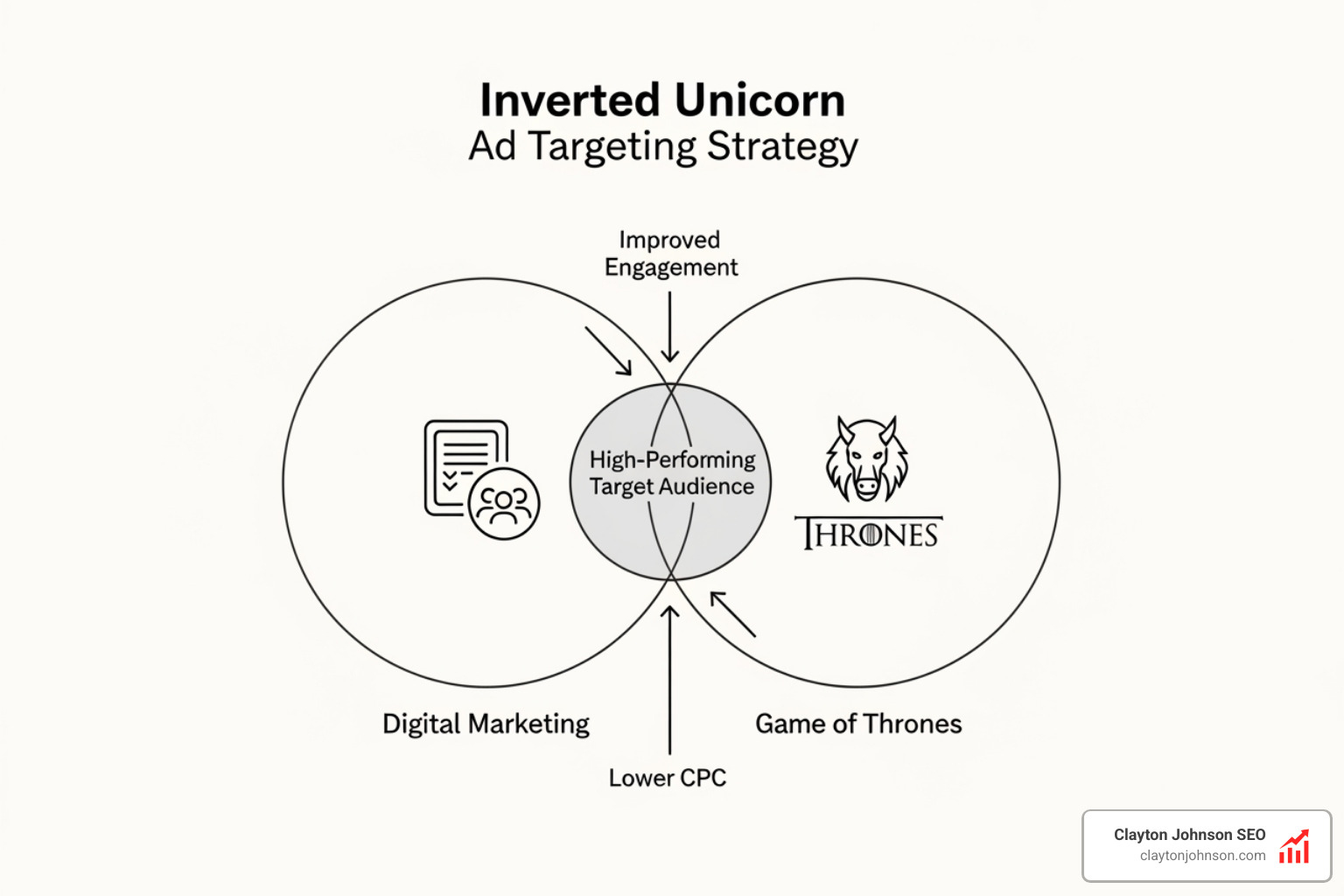
The “Inverted Unicorn” is perhaps the most famous of all Larry Kim ad strategies. To understand it, we first have to look at how most people target ads. Usually, if you sell email marketing software, you target people interested in “digital marketing.” This is what Kim calls “Donkey targeting.” It’s logical, but it’s also what every one of your competitors is doing, leading to high competition and high costs.
The Inverted Unicorn trick flips this on its head.
How the Inverted Unicorn Works
Instead of targeting one broad interest, you target the intersection of two completely unrelated interests. For example, Kim once ran ads for his marketing software by targeting people interested in “Digital Marketing” AND “Game of Thrones.”
By using Game of Thrones-themed imagery and copy to sell a marketing tool, the ad achieved massive engagement because it was unexpected and highly relevant to that specific niche. High engagement leads to a higher Quality Score, which in turn drives down your Cost Per Click (CPC).
When your ad resonates so deeply with a specific sub-culture, the algorithms reward you. Platforms like Facebook and Google prioritize content that users interact with, meaning your “Unicorn” ad gets more impressions for less money. We’ve seen that when you stop wasting money on Facebook ads without a strategy and start using these layered interest “hacks,” your ads become significantly more memorable and cost-effective.
Competitive Interception: Hijacking Your Rival’s Traffic
Why build an audience from scratch when your competitors have already done the hard work for you? Larry Kim is a proponent of “sneaky” competitive advertising tactics that place your brand directly in front of your rival’s customers.
Disrupting Competitors with Larry Kim Ad Strategies
One of the most effective ways to do this is through YouTube TrueView ads. You can target specific keywords related to your competitor’s brand or even their specific videos. Imagine a user searching for a competitor’s product demo and seeing your “Why We’re Better” video ad before the competitor’s video even starts.
This isn’t just about being present; it’s about being present at the exact moment of high intent. By positioning your solution as the superior alternative right when a prospect is researching a rival, you shorten the sales cycle significantly. Other high-leverage competitive tactics include:
- Twitter Follower Targeting: Using tools like BirdSong Analytics to download a list of a competitor’s Twitter followers and uploading them as a “Tailored Audience” for your own ads.
- Trademark Targeting: Bidding on competitor brand names in search and Gmail to capture users who are already deep in the consideration phase.
This level of precision is essential for mastering the art of pay-per-click advertising campaigns in crowded markets.
Using Gmail Ads to Outsmart Competition
Gmail Ads (now part of Discovery/Demand Gen campaigns) offer a unique “organic” feel. They appear at the top of the Promotions tab, looking just like a regular email.
Kim’s secret for Gmail Ads involves three steps:
- The Unicorn Subject Line: Don’t guess which subject line will work. Look at your past email marketing data and find the subject lines with the highest open rates (the top 5%). Reuse those for your ads.
- Emoji Power: Using topically relevant emojis can boost open rates by up to 30%.
- Keyword Proxy: Since you can’t always use traditional remarketing in Gmail, target your competitor’s brand terms as keywords. Your ad will appear when users receive emails from those competitors.
For businesses looking to scale, exploring paid advertising services that utilize these Gmail-specific hacks can yield a massive ROI for a fraction of the cost of traditional search ads.
The 10% Rule: Achieving Unicorn Conversion Rates
In Larry Kim ad strategies, a 2% conversion rate is a “donkey” result. While most marketers spend their time A/B testing button colors, Kim argues that incremental tweaks will never turn a donkey into a unicorn.
Optimizing the Funnel via Larry Kim Ad Strategies
To reach the top 10% of advertisers—who see conversion rates of 9.6% or higher—you need two things: Offer Differentiation and Brand Affinity.
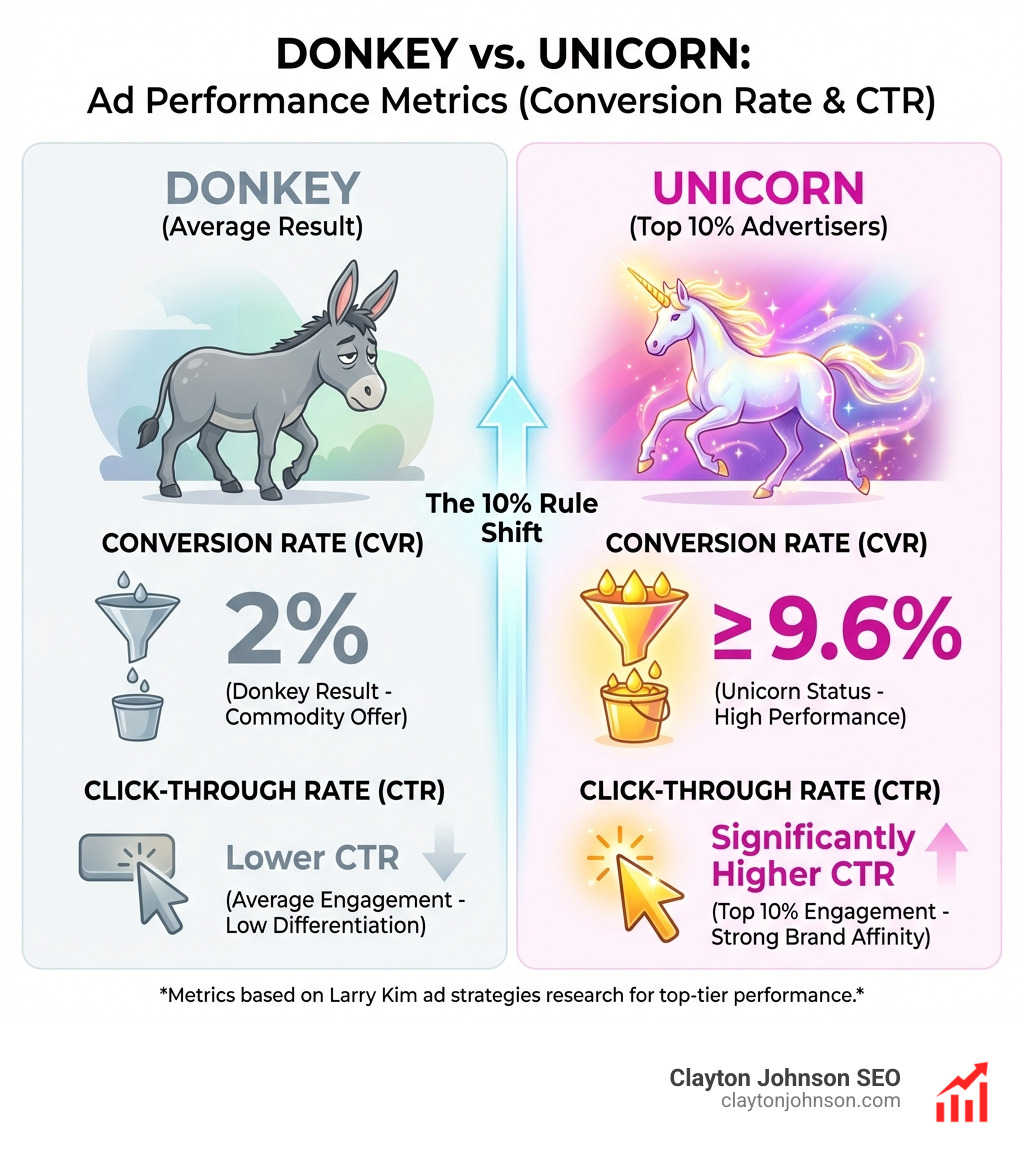
If your offer is the same as everyone else’s (e.g., “Free Consultation”), you are a commodity. Unicorns offer something radically different or more valuable. Think about offering a proprietary tool, a comprehensive audit, or an exclusive data report that provides immediate utility. Furthermore, Kim’s research shows that prior visitors who already know your brand are 200–300% more likely to convert. This is why we prioritize remarketing; it accounts for 70% of conversions while usually representing only 10% of the ad spend.
Leveraging First-Party Data for SEO and Ads
With the deprecation of third-party cookies, the “golden era” of easy tracking is shifting. Kim advises that the next decade of winners will be those who stockpile first-party data.
By integrating your CRM data directly with ad platforms via server-side APIs, you can bypass cookie restrictions. This allows for “Identity Resolution,” where you know exactly who your prospects are across different devices.
We recommend following a step-by-step guide to paid advertising strategy that prioritizes building your own database rather than relying solely on platform-owned data. This ensures that your SEO and paid efforts work in tandem to build a resilient marketing ecosystem.
Future-Proofing: AI Personalization and Messenger Hacks
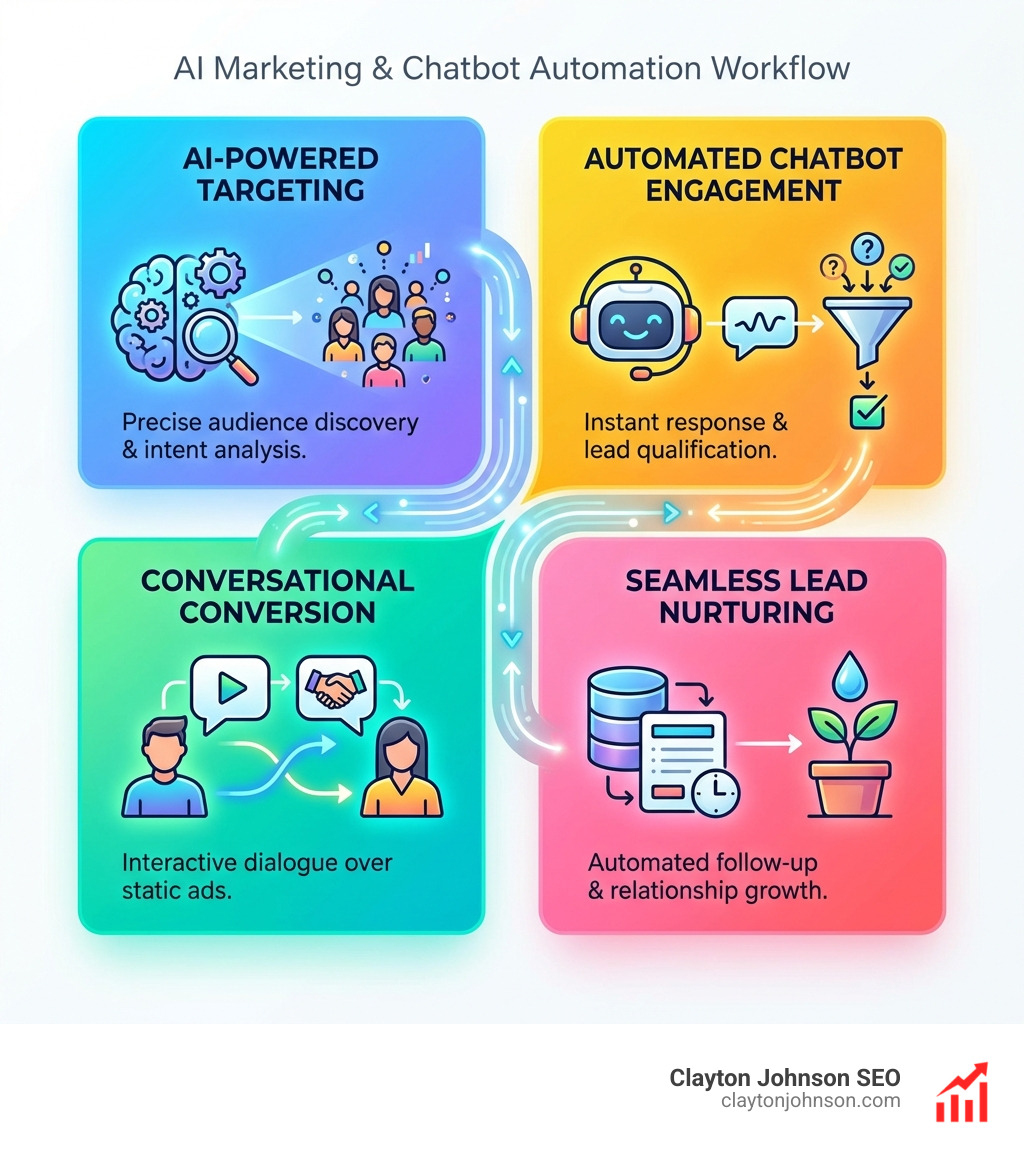
The future of Larry Kim ad strategies lies in automation and conversation. Kim has long championed Facebook Messenger ads because they capture contact information instantly—no landing page required.
The Power of Conversational Ads
- Messenger Ads: These have 10x higher open rates than email and a CPA that is often 90% cheaper than conventional Facebook ads.
- Post Autoresponders: Automatically send a Messenger message to anyone who comments on your Facebook post, turning passive engagement into a lead.
- Generative AI: Using AI to create personalized video or voice messages for every single recipient in a campaign.
By integrating AI into these conversational flows, you can provide instant answers to complex customer questions, effectively moving them through the funnel while you sleep. Instead of sending everyone to a static form, these strategies use chatbots to qualify leads in real-time. If you want to scale effectively, you must stop guessing and start clicking with paid search advertising that leverages these automated conversational funnels.
Frequently Asked Questions about Larry Kim Ad Strategies
What is the Inverted Unicorn ad targeting trick?
It is a strategy where you target two completely unrelated interests (like “SEO” and “Star Wars”) to create a highly specific, high-engagement ad. This results in a higher Quality Score and much lower ad costs compared to broad, competitive targeting.
How does brand affinity impact conversion rates?
Brand affinity is the “secret sauce” of high conversion. People are biased toward brands they recognize. Research shows that visitors who have interacted with your brand before are 2-3 times more likely to convert than total strangers, making remarketing the most profitable part of any ad budget.
Why should businesses prioritize first-party data?
As privacy regulations tighten and browsers block third-party cookies, platforms lose their ability to track users. By collecting your own data (emails, phone numbers, CRM interactions), you can upload these lists directly to ad platforms to maintain precise targeting and attribution.
Conclusion: Building Your Growth Architecture
Mastering Larry Kim ad strategies isn’t about finding a single “magic button.” It’s about moving away from “Donkey” marketing—the average, the uninspired, and the expensive—and building a system that identifies and scales “Unicorns.”
At Clayton Johnson SEO, we believe that most companies don’t lack tactics; they lack structured growth architecture. Whether it’s through taxonomy-driven SEO or competitive positioning models, the goal is to create a compounding engine where every ad dollar spent builds long-term brand authority. By implementing these frameworks, you move from reactive marketing to a proactive growth operating system.
Larry Kim showed us that with the right framework, you can out-market competitors with ten times your budget. By focusing on high-affinity audiences, differentiated offers, and first-party data, you aren’t just running ads—you’re building a legacy. This is the essence of Demandflow: clarity, structure, and leverage.
If you’re ready to learn from the best, check out our deep dive into the greatest marketers of all time to see how these strategies fit into a broader growth operating system.