Why Most SEO Audits Never Get Implemented (And How to Fix That)
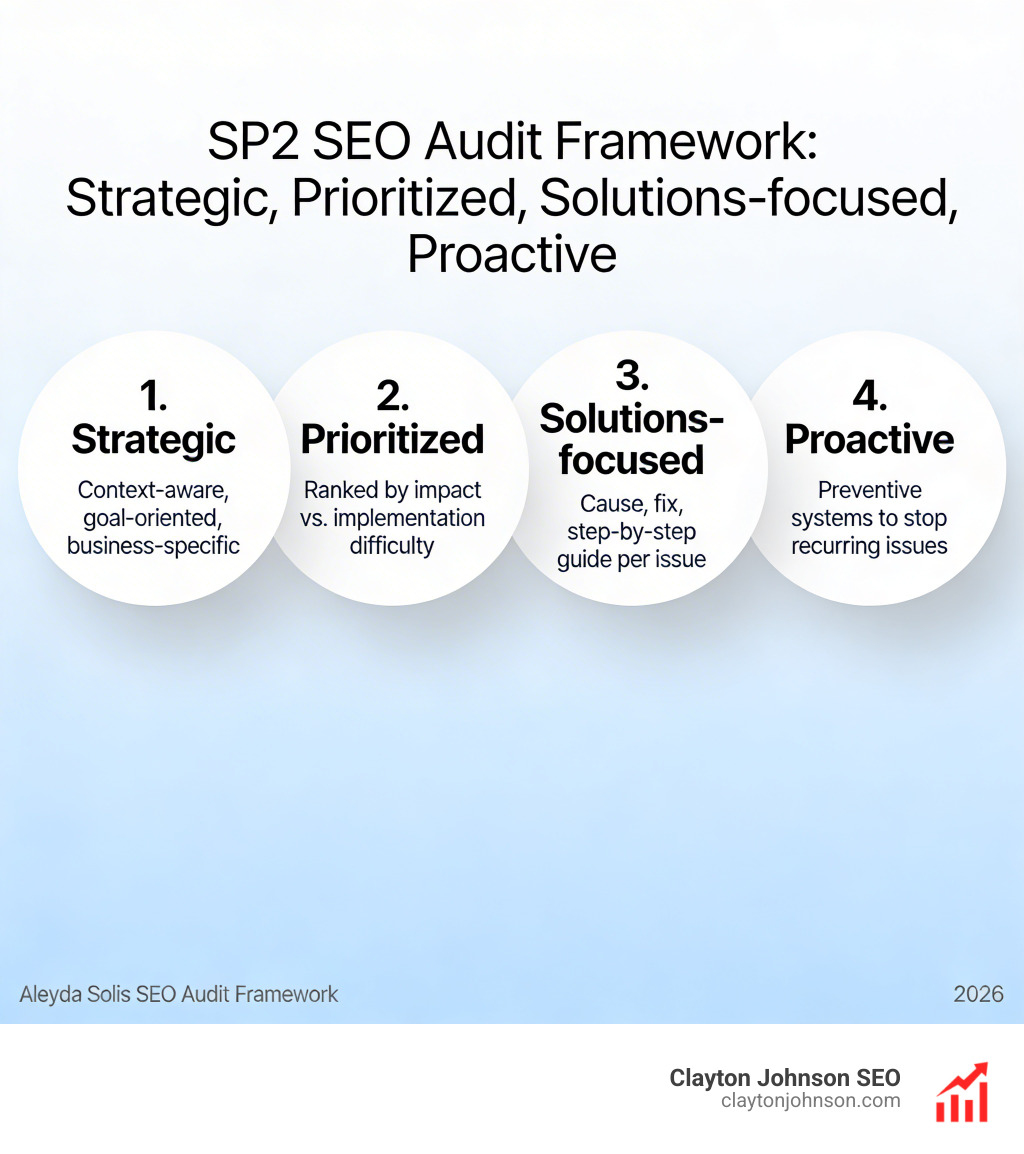
The Aleyda Solis SEO audit approach solves one of the most common problems in SEO: audits that sit in a document and never get executed. Here is a quick summary of the SP2 framework:
- Strategic – Context-aware, goal-oriented, and business-specific
- Prioritized – Ranked by impact vs. implementation difficulty
- Solutions-focused – Every issue includes a cause, fix, and step-by-step guide
- Proactive – Preventive systems to stop issues from recurring
A poll of 534 SEO professionals found that the top five causes of SEO process failure all traced back to execution challenges — not a lack of tactics or checklists. The problem is not identifying issues. It is getting them fixed.
Most SEO audits fail for a simple reason: they are long, generic, and disconnected from business goals. A 40-page document full of technical findings does not drive action. It drives overwhelm.
The SP2 framework was developed specifically to close the gap between audit findings and real implementation. This approach reframes the audit not as a deliverable, but as a driver of business growth.
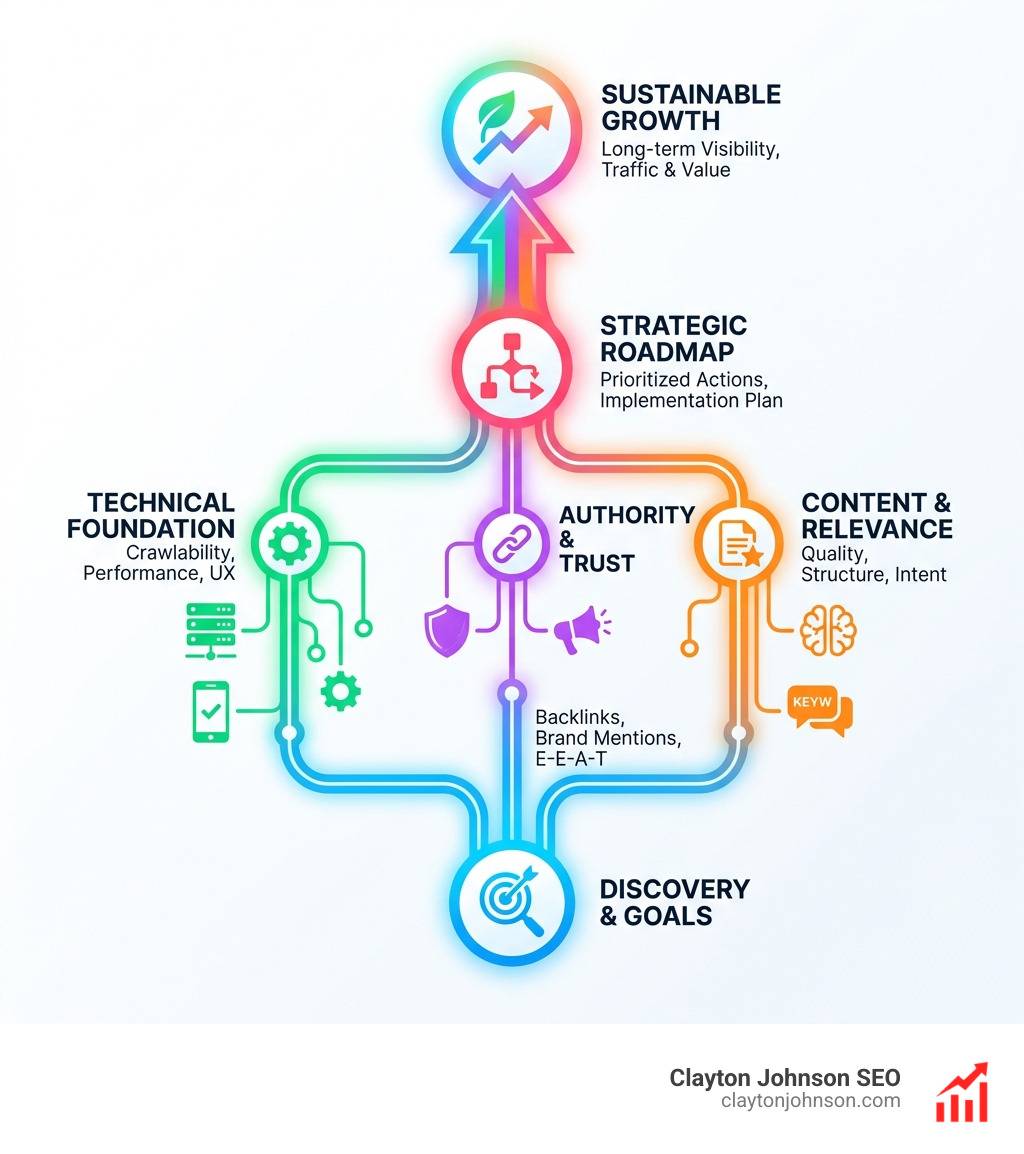
I’m Clayton Johnson, an SEO strategist who builds scalable search systems and structured growth frameworks — the same principles behind an Aleyda Solis SEO audit inform how I architect execution-ready strategies for founders and marketing leaders. In the sections below, I’ll break down exactly how to apply her methodology to get your recommendations off the page and into production.
Why Traditional SEO Audits Fail to Drive Results
We have all been there. We spend weeks running crawlers, checking status codes, and building a massive spreadsheet with 200+ points of validation. We hand it over to the client or the development team, feeling proud of our thoroughness. Then, months later, we check the site and realize that exactly zero of those recommendations have been implemented.
According to research shared by Aleyda Solis, only 20% of SEOs see more than 90% of their recommendations implemented. This “execution gap” is the graveyard of SEO success. When Aleyda polled 534 SEOs to identify why processes fail, the results were eye-opening. The top five causes were all related to execution challenges rather than a lack of SEO knowledge.
For reference, here is Aleyda’s deck on the topic: What Makes Your SEO Fail (and How to Fix It).
The Implementation Bottleneck
Traditional audits often fail because they ignore the reality of a company’s internal environment. Common blockers include:
- Legacy Systems: Technical debt that makes “simple” changes like updating a robots.txt or changing a URL structure incredibly complex.
- Organizational Bureaucracy: Long chains of command where SEO recommendations get lost in the shuffle between marketing, product, and engineering.
- Lack of Buy-In: Decision-makers who view SEO as a “nice-to-have” technical chore rather than a primary revenue driver.
- Generic Checklists: Handing a developer a list of 242 issues without explaining why they matter or how to fix them specifically on their platform.
In her research on why SEO fails, Aleyda emphasizes that we are not paid to spot issues; we are paid to achieve goals. If our audit doesn’t facilitate implementation, it hasn’t provided value. To bridge this gap, we need to move beyond visible errors and learn how to use AI audits to spot the invisible patterns that actually move the needle.
To make audits easier to implement across teams, it also helps to align on shared terminology and concepts. Google provides a useful baseline definition of key SEO concepts in its Search Essentials documentation.
The SP2 Framework for an Actionable Aleyda Solis SEO Audit
To combat audit fatigue and implementation paralysis, Aleyda introduced the SP2 framework. This isn’t just a different checklist; it’s a fundamental shift in how we approach the entire auditing process.
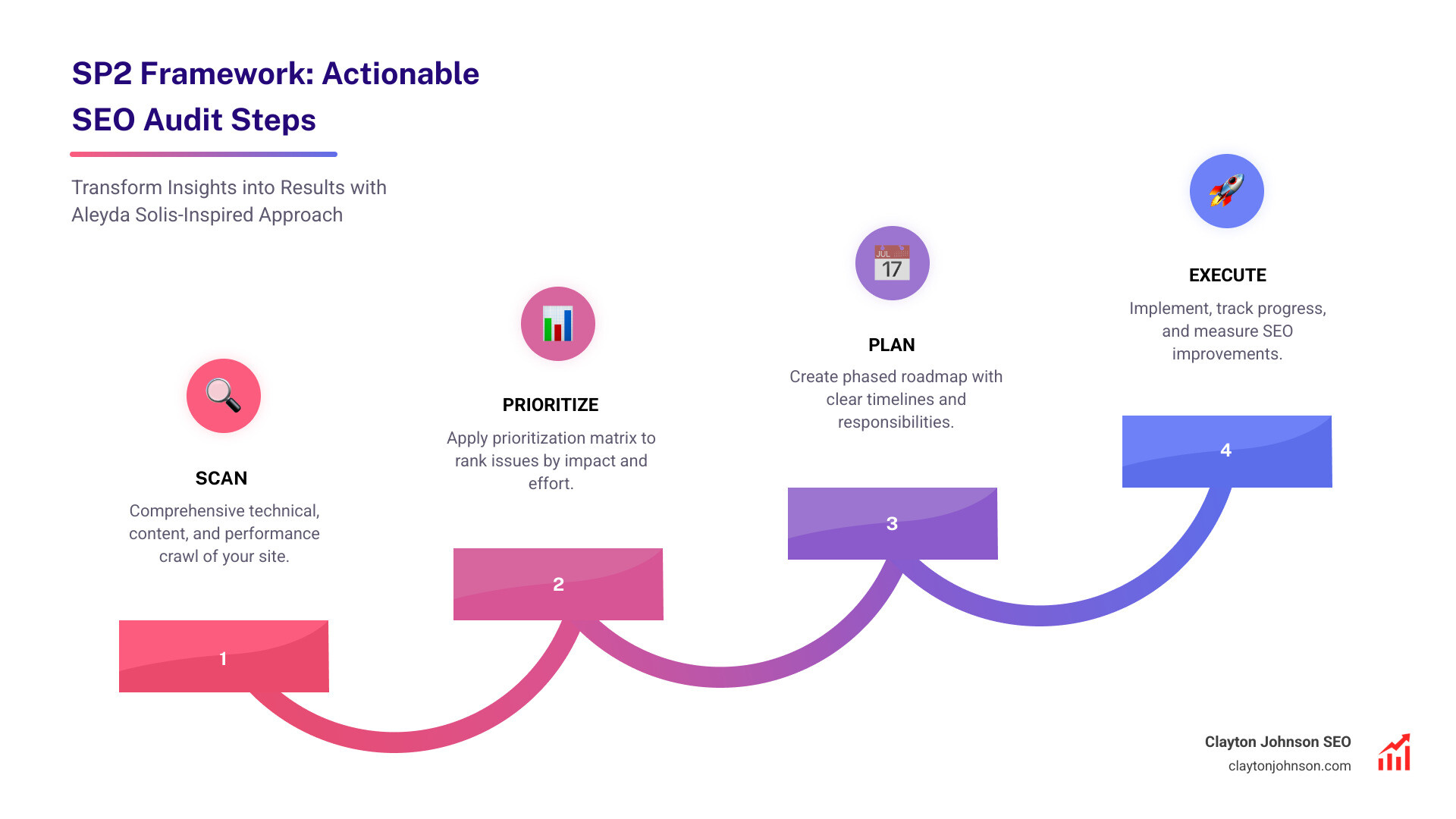
The SP2 framework stands for:
- Strategic: The audit must be context-aware and goal-oriented. It shouldn’t just list every error; it should focus on the errors that prevent the business from reaching its specific objectives.
- Prioritized: Recommendations must be ranked. We use a matrix that balances SEO impact against implementation difficulty to ensure the team works on the right things first.
- Solutions-focused: We don’t just point at a problem and walk away. Every recommendation must include the “why,” the “how,” and a clear path to resolution.
- Proactive: We build systems to ensure that once an issue is fixed, it stays fixed. This involves education and automated monitoring.
By following this structure, we can diagnose your site health with AI SEO growth diagnostics and turn a static report into a living roadmap for growth.
Making Your Aleyda Solis SEO Audit Context-Aware
One size does not fit all in SEO. A national news site has completely different technical requirements and restrictions than a local B2B startup or a massive international marketplace.
A context-aware Aleyda Solis SEO audit starts by asking:
- What is the business model? Are we driving lead gen, ad impressions, or e-commerce sales?
- What are the technical restrictions? Are we working with a modern JS framework, a legacy CMS, or a proprietary platform?
- What is the SEO maturity of the team? Do they have in-house developers who understand SEO, or do we need to provide step-by-step training?
Standardized audits are often ignored because they suggest “impossible” fixes for the specific platform in use. By understanding how to audit SEO with AI, we can tailor our findings to the specific technical constraints of the site.
Goal-Oriented Diagnostics in an Aleyda Solis SEO Audit
The quickest way to get a CEO’s attention is to show them how a technical issue is costing them money. Instead of saying “Your canonical tags are messy,” we should say “Duplicate content issues are causing keyword cannibalization, which is splitting our authority and costing us an estimated 15% in potential organic revenue.”
Aleyda suggests several ways to show business impact:
- Competitor Gaps: Show the queries and traffic competitors are winning that you are currently missing due to technical blockers.
- Forecasting: Use data to show potential outcomes. If we fix X, we expect Y growth in traffic and Z growth in conversions.
- Paid Search Comparison: Use AdWords CPC data to show how much it would cost to “buy” the traffic that we are currently losing. This highlights the cost-effectiveness of SEO.
Using AI-driven SEO audits allows us to process these vast datasets quickly, making our business cases much more compelling.
Mastering the SEO Recommendations Prioritization Matrix
The heart of the Aleyda Solis SEO audit is the prioritization matrix. We cannot expect a development team to tackle 100 tasks at once. We must give them a “Radical Top 10” action plan.
Aleyda recommends a three-stage prioritization process:
- Ideal Prioritization: This is based purely on SEO impact. If we had unlimited resources, what would we fix first?
- Expected Prioritization: We adjust the “Ideal” list by factoring in implementation difficulty (low, medium, high).
- Validated Prioritization: We meet with the stakeholders and developers to get their feedback. They might tell us that a “High Impact/High Effort” task is actually impossible this quarter, leading us to shift focus to “Quick Wins.”
The Prioritization Matrix
| Priority Level | Impact (0-10) | Effort (0-10) | Action |
|---|---|---|---|
| Quick Wins | High (8-10) | Low (1-3) | Execute Now |
| Big Projects | High (8-10) | High (7-10) | Plan & Assess |
| Fill-ins | Low (1-3) | Low (1-3) | Do if time permits |
| Time Wasters | Low (1-3) | High (7-10) | Ignore/Don’t Do |
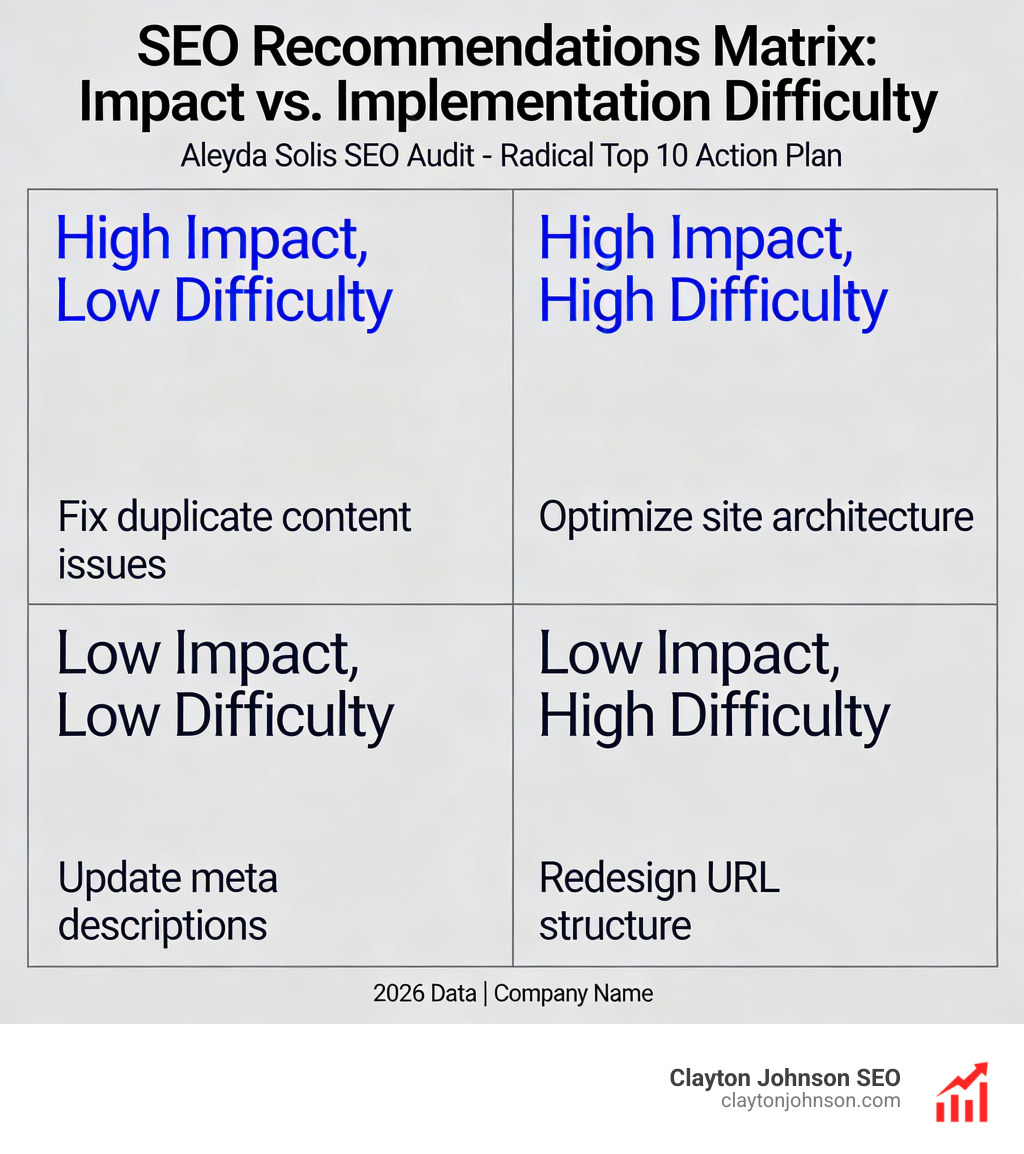
By using this matrix, we ensure that we aren’t overwhelming the team with “Time Wasters.” We focus on the “Quick Wins” first to build momentum and show immediate value. This is a critical step in setting up your SEO audit automation process to ensure consistent progress.
From Recommendations to Execution: Solutions and Prevention
A great audit report shouldn’t just be a list of problems; it should be a manual for solutions. Aleyda advocates for “solutions-focused” reporting. This means every identified issue must be accompanied by:
- The Cause: Why is this happening? (e.g., “The CMS automatically generates a new URL every time a product category is updated.”)
- The Findings: Proof of the issue with screenshots and specific examples of affected URLs.
- The Action: A step-by-step fix. Don’t just say “Fix the redirects.” Provide the specific logic for the 301 redirects.
- The Resource: Who is needed? (Technical team, Content team, or PR?)
When we provide this level of detail, we make it easy for the developers to say “yes.” We aren’t giving them a puzzle to solve; we are giving them a ticket to implement. This is the core of how to implement automated SEO audits like a pro.
Establishing an SEO Quality Assurance Framework
The final piece of the Aleyda Solis SEO audit is prevention. We want to stop the “SEO horror stories” where a site launch wipes out years of rankings. Aleyda suggests a Quality Assurance (QA) framework built on three pillars:
- Education: Training the tech and content teams so they understand the SEO implications of their work. If a developer knows why a certain JS framework might hurt crawlability, they are less likely to implement it poorly.
- Validation: Setting up checklists and automated checks within the development workflow. This includes pre-release and post-release validations.
- Monitoring: Using real-time tools like ContentKing or LittleWarden to alert us the moment a critical SEO configuration changes.
By setting up your SEO audit automation process with these preventive measures, we move from “fixing bugs” to “building growth.”
Frequently Asked Questions about Aleyda Solis SEO Audits
What is the SP2 SEO audit framework?
The SP2 framework is a methodology created by Aleyda Solis to ensure SEO audits lead to actual implementation. It stands for Strategic, Prioritized, Solutions-focused, and Proactive. It shifts the focus from exhaustive technical checklists to actionable business growth plans.
How does Aleyda Solis recommend prioritizing SEO tasks?
Aleyda recommends a matrix that balances SEO impact against implementation difficulty. She suggests starting with “Ideal Prioritization” (impact only), then moving to “Expected Prioritization” (adding difficulty), and finally “Validated Prioritization” (getting stakeholder and developer feedback to ensure the plan is realistic).
What free resources are available for an Aleyda Solis SEO audit?
There are several free resources available for those conducting an SEO audit using this framework. These include Google Sheets templates for SEO recommendation prioritization, a “Minimum Viable SEO Validation Checklist,” and diagnostic questions for pages that aren’t ranking. Many practitioners also utilize various third-party checklists to ensure comprehensive coverage.
Your Next Technical SEO Audit, Upgraded
At Clayton Johnson SEO, we believe that an audit is only as good as its execution. We don’t just hand over a document and wish you luck. We help you build the structured growth architecture necessary to turn technical findings into compounding traffic.
By following the Aleyda Solis SEO audit principles, we move away from the “it depends” culture of SEO and toward a model of reliability and transparency. We use taxonomy-driven SEO systems and AI-augmented marketing workflows to ensure that your technical foundation is not just “fixed,” but optimized for long-term dominance.
If you are tired of SEO audits that go nowhere and are ready for a structured growth architecture that actually drives results, let’s talk. We help founders and marketing leaders build the systems that turn search intent into measurable revenue.