Why Developing and Communicating a Positioning Strategy Is the Foundation of Business Growth
Developing and communicating a positioning strategy is the process of defining exactly where your brand stands in the market — and making sure every customer touchpoint reflects that clearly and consistently.
Here’s a quick overview of how it works:
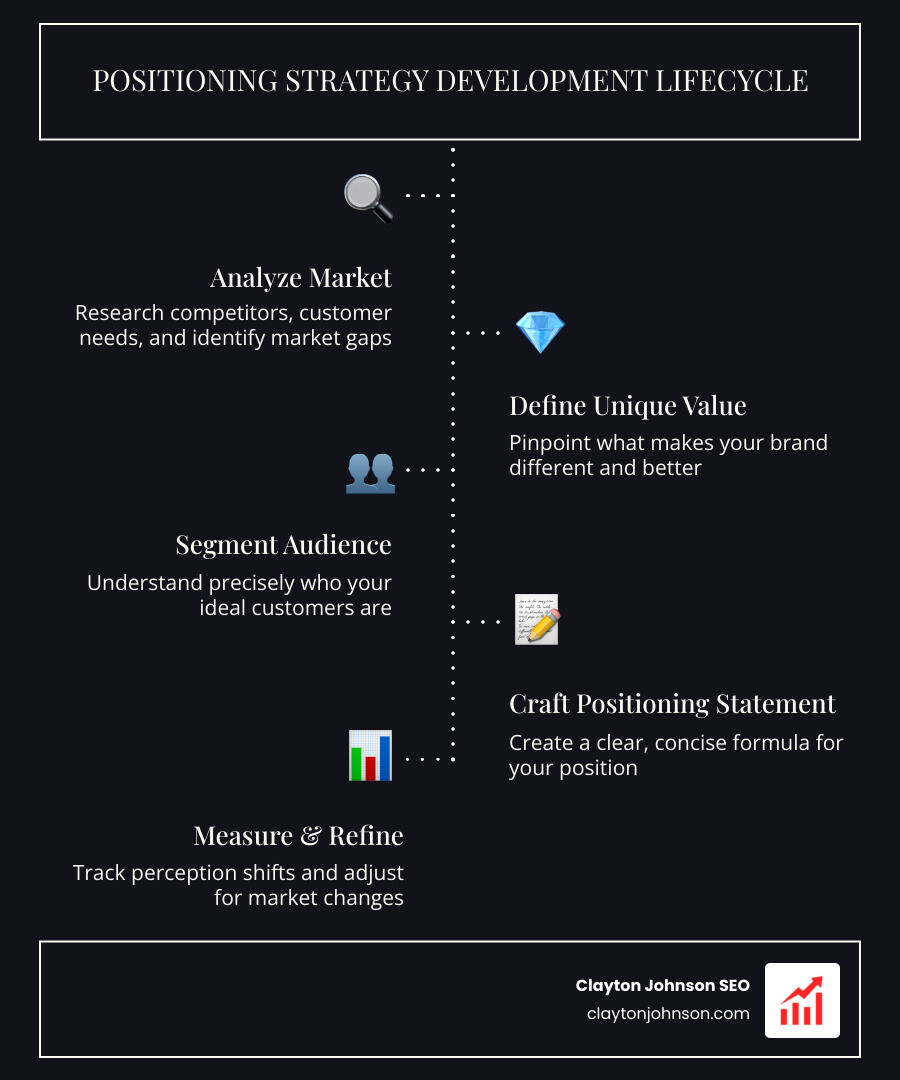
- Analyze your market — Research competitors, customer needs, and gaps in the market
- Define your unique value — Identify what makes you genuinely different and better
- Segment your audience — Know precisely who you’re talking to
- Write a positioning statement — Capture your position in a clear, concise formula
- Build your messaging architecture — Translate positioning into consistent language across all channels
- Measure and refine — Track perception, adjust based on feedback and market shifts
Most businesses struggle not because their product is weak — but because their market position is unclear.
Think about it this way: if a prospect can’t immediately understand why your brand is the right choice for them, they’ll default to whoever is clear. That’s usually a competitor.
As Al Ries and Jack Trout wrote in Positioning: The Battle for Your Mind, positioning isn’t about creating something new. It’s about manipulating what already exists in the prospect’s mind — connecting your brand to perceptions that are already there.
That insight is just as relevant today. In fact, it’s more relevant. Markets are noisier than ever, and an undifferentiated brand gets buried.
The good news? A well-developed and clearly communicated positioning strategy gives you a real, lasting competitive edge — one that shapes how customers perceive you, what they’re willing to pay, and whether they come back.
This guide walks you through every step, from market analysis to real-world examples to measuring what’s working.
The Strategic Framework for Developing and Communicating a Positioning Strategy
To win in a crowded market, you can’t just “be better.” You have to be different in a way that matters to your customers. This requires a structured approach to developing and communicating a positioning strategy. We start by looking outward at the market landscape before we look inward at our own strengths.
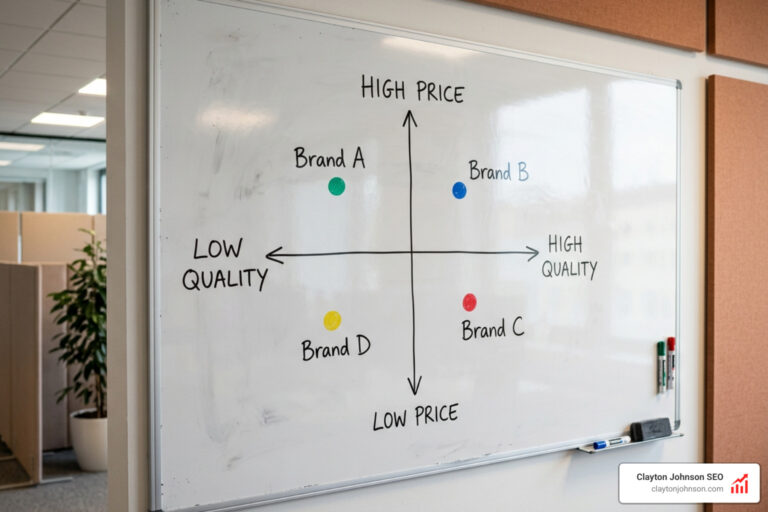
A solid framework involves analyzing market dynamics, spotting competitor gaps, and understanding the target audience through a SWOT analysis. One of the most effective tools we use is perceptual mapping. By plotting your brand and your competitors on a graph based on two key attributes (like “Price” and “Innovation”), you can visually identify “white space”—areas of the market that are currently underserved.
According to SurveyMonkey’s guide on market positioning, the goal is to present your brand’s unique value so clearly that you set yourself apart instantly. You aren’t just guessing; you are using competitive intelligence to stop the trial-and-error approach.
Analyzing Market Dynamics for Developing and Communicating a Positioning Strategy
Before you can claim a spot in the customer’s mind, you need to understand the “mental real estate” available. This begins with deep customer research. We don’t just look at demographics; we look at psychographics and behaviors. Why do they buy? What keeps them up at night?
Quantitative analysis is also vital. This includes market sizing and cluster analysis to find distinct customer segments. Interestingly, academic research on brand communications suggests that brand positioning has evolved significantly over the decades—from being purely product-centric in the 1950s to being value-and-stakeholder-focused today.
To navigate these complexities, we often rely on proven market positioning models that help categorize how a brand should behave based on its maturity and the competitive environment.
Identifying Competitive Gaps and Substitutes
One of the biggest mistakes businesses make is only looking at direct competitors. If you sell CRM software, your competitor isn’t just another software company; it might be an Excel spreadsheet or a physical notebook. These are “substitutes,” and they are often your biggest rivals for the prospect’s budget.
In his seminal work, Positioning: The Battle for Your Mind, Al Ries explains that the mind has limited space. To get in, you sometimes have to “de-position” the competition.
We often recommend a strategy called category narrowing. Instead of trying to be the “best marketing agency,” you might become the “best SEO agency for wealth management firms.” By narrowing your focus, you become the big fish in a smaller pond, making it much easier to master the art of being different and better.
Crafting the Message: Types of Strategies and Value Propositions
Once you know where you want to stand, you have to decide how you’ll stand there. There are several common types of positioning strategies:
- Product Positioning: Focusing on specific features or technical superiority.
- Price-based Strategy: Positioning as either the “value leader” (low cost) or the “premium choice” (high cost, high status).
- Benefit Positioning: Highlighting the specific problem you solve (e.g., “Whiter teeth in 7 days”).
- Emotional Appeal: Connecting with how the customer wants to feel (e.g., empowered, safe, or adventurous).
- Symbolic Positioning: Focusing on self-image and social standing.
Comparison: Functional vs. Emotional Positioning
| Feature | Functional Positioning | Emotional Positioning |
|---|---|---|
| Primary Focus | Tangible features and problems | Feelings and self-actualization |
| Customer Goal | Efficiency, utility, or cost-savings | Belonging, status, or joy |
| Example Claim | “Lasts 24 hours on one charge.” | “Feel unstoppable every single day.” |
| Best For | B2B, utilities, or technical products | Lifestyle brands, luxury, and B2C |
When developing and communicating a positioning strategy, your value proposition is the bridge between your internal strategy and the external world. As Harvard Business School experts suggest, a perfect statement must be true, differentiated, and relevant. To avoid a generic “we do everything” approach, check out April Dunford’s methods for standing out.
The Role of Value Propositions in Developing and Communicating a Positioning Strategy
A Value Proposition is more than a slogan. It is a promise of value to be delivered. We use the CRCD framework to ensure every value proposition hits the mark:
- Clarity: Is it easy to understand?
- Relevance: Does it solve a real customer pain point?
- Credibility: Can you actually prove your claims?
- Differentiation: Is it distinct from what everyone else is saying?
Take Colgate, for example. They don’t just say “we sell toothpaste.” They position specific products around clear benefits like “Total” protection or whitening, using clinical proof to establish credibility.
Real-World Examples of Successful Positioning
Looking at the giants can provide a roadmap for our own strategies:
- Nike: They don’t just sell shoes; they sell motivation. By positioning around the athlete’s journey (“Just Do It”), they moved from a utility product to an emotional necessity.
- Apple: Their positioning isn’t about gigabytes or processor speeds; it’s about “Thinking Different.” They position themselves as the intersection of technology and the liberal arts.
- Red Bull: They created their own category. They aren’t just a soda; they are “Energy” and “Adventure,” backed by sponsorships of extreme sports.
- Patagonia: Their positioning is rooted in values. By telling customers “Don’t Buy This Jacket” (to encourage sustainability), they built a fiercely loyal base that shares their ethical stance.

Even these giants are looking at how AI positioning models can help refine their messaging for digital-first audiences.
Executing the Vision: Communication, Consistency, and Trends
A strategy that lives only in a PDF is useless. Execution is where the “communicating” part of developing and communicating a positioning strategy happens. This involves creating a messaging architecture—a hierarchy of points that ensures your sales team, your social media manager, and your CEO are all telling the same story.
Strategic communication means aligning every channel. Whether someone sees a LinkedIn ad or talks to a customer support rep, the “vibe” and the core value should feel the same. This Medium guide on strategic messaging emphasizes that messaging is an extension of your company’s “Why.” When you get this right, you can make your competitors cry because you’ve occupied the most desirable spot in the market.
The Role of Consistency in Developing and Communicating a Positioning Strategy
Consistency isn’t just a “nice to have”—it’s a revenue driver. Research shows that consistency across all marketing touchpoints can increase revenue by up to 23%.
Why? Because consistency builds trust. If your brand is “luxury” on Instagram but “budget” on your website, the customer gets confused. A confused mind always says “no.”
Consistency ensures that your developing and communicating a positioning strategy efforts actually stick in the customer’s long-term memory. It turns a one-time buyer into a loyal advocate.
Adapting to AI, Sustainability, and Digital Tools
The world doesn’t stand still, and neither should your positioning. Three major trends are currently reshaping how we think about market placement:
- Generative AI: We can now use AI to analyze thousands of customer reviews in seconds to find the exact language customers use. However, the trick is using AI without looking like a robot—maintaining that human, emotional connection.
- Sustainability: Ethical positioning is no longer a niche. Customers are increasingly choosing brands based on their environmental and social impact.
- Personalization: Digital tools allow us to “hyper-segment.” We can communicate one positioning angle to a CEO and a slightly different one to a middle manager, as long as the core brand remains consistent.
Frequently Asked Questions about Positioning Strategy
What is the difference between positioning and branding?
Think of branding as the “who”—your personality, logo, and colors. Positioning is the “where”—it’s the specific space you occupy in the market relative to your competitors. Branding is the identity; positioning is the competitive strategy.
How do you measure the effectiveness of a positioning strategy?
We look at several key metrics:
- Brand Awareness and Recall: Do people know who you are and what you stand for?
- Win/Loss Analysis: Why are you winning or losing deals against specific competitors?
- Perception Scores: Use surveys to see if customers describe you using the words you want them to use.
- Revenue and Pricing Power: Strong positioning usually allows you to charge a premium (15-30% higher) without losing customers.
When should a company consider repositioning its brand?
Repositioning is necessary when:
- Sales are stagnating despite a good product.
- A new, aggressive competitor has entered the market.
- Your target audience’s needs have fundamentally shifted (e.g., the move toward remote work).
- Your current positioning has become a “commodity” and you are stuck in a price war.
Conclusion
Developing and communicating a positioning strategy is not a one-and-done task; it’s a continuous cycle of listening, adapting, and speaking. By integrating these strategic pillars—from deep market analysis to consistent omnichannel communication—you move your brand from being “just another option” to being the only logical choice for your target audience.
At Clayton Johnson SEO, we understand that for specialized sectors like wealth management, generic strategies don’t cut it. You need a “North Star” that guides your digital presence and ensures your expertise is recognized by the right people.
Ready to stop blending in and start leading? Explore our SEO services to see how we can help you claim your rightful mental real estate in the digital world.