Why Most Growth Playbooks Never Get Used
Actionable growth playbooks for senior marketers are structured systems that connect strategy, data, and execution to drive compounding revenue — not just a list of tactics to check off.
Here’s a quick-reference breakdown of what separates playbooks that work from ones that collect dust:
| What Works | What Doesn’t |
|---|---|
| Strategy tied to business outcomes (revenue, CLV, NRR) | A to-do list of disconnected tactics |
| CRM as a revenue engine with lifecycle automation | CRM as a passive contact database |
| Incrementality testing to prove true ROI | Vanity metrics like impressions and MQLs |
| AI-augmented SEO targeting intent clusters | Chasing isolated keywords |
| 90-day execution plans with clear RACI ownership | Annual plans with no weekly cadence |
| CLV:CAC ratio guiding budget decisions | Spend decisions made on gut feel |
The hard truth? Fewer than half of mid-market companies have documented a marketing strategy that actually connects to business outcomes. Most have a to-do list masquerading as a plan.
That gap — between having a playbook and running one — is exactly where growth stalls.
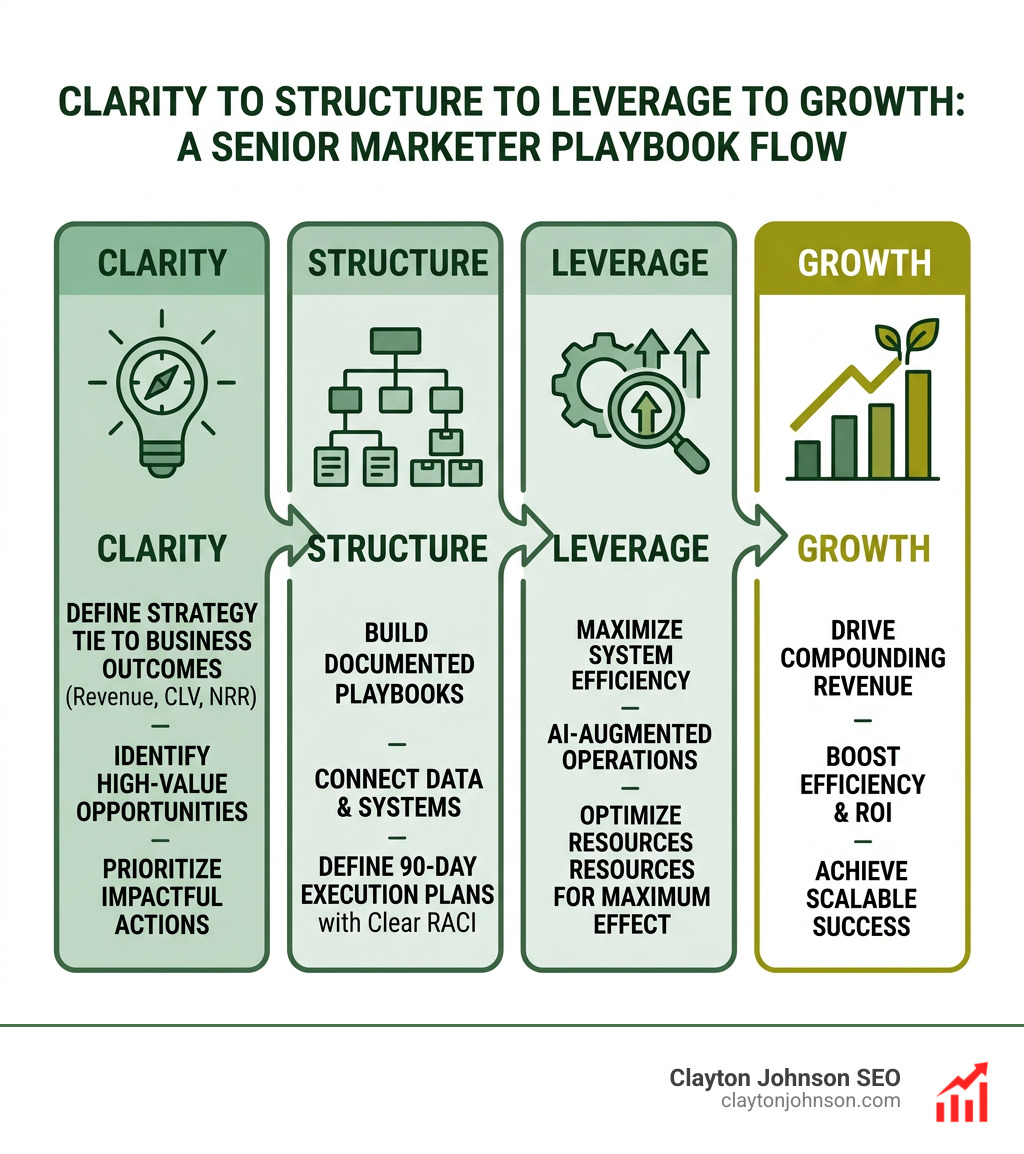
The problem isn’t a lack of ideas. Senior marketers have plenty of those. The problem is clarity, structure, and leverage: knowing which levers to pull, in what order, and how to measure whether they’re actually working.
I’m Clayton Johnson, an SEO strategist and demand generation expert with nearly two decades of experience building scalable growth systems — and I’ve put together this guide specifically around actionable growth playbooks for senior marketers who are ready to move from fragmented tactics to compounding revenue engines.
6 Actionable Growth Playbooks for Senior Marketers to Drive Compounding Revenue
When we talk about “marketing excellence,” we aren’t just using a buzzword to fill up a slide deck. Academic research has shown that companies pursuing true marketing excellence—focusing on ecosystems, end-users, and agility—saw a simulated investment of $100 grow to $1,313 over an 18-year period. Compare that to the $744 generated by businesses stuck in conventional marketing orientations, and the choice becomes clear.
To achieve those kinds of results, we have to stop viewing marketing as a cost center and start treating it as a growth system. This requires moving beyond the traditional 4Ps (Product, Price, Place, Promotion) and embracing a model that prioritizes organic growth through durable systems.
According to scientific research on marketing excellence, the shift involves three core priorities:
- Ecosystem Priority: Building networks that extend beyond your industry.
- End-User Priority: Focusing on the person actually using the product, not just the person signing the check.
- Marketing Agility: Creating fast, iterative cycles of experimentation.
The CRM Growth Model and Loop Marketing System in Actionable Growth Playbooks for Senior Marketers
If your CRM is just a digital Rolodex, you’re sitting on a goldmine without a shovel. In our experience, CRM is the most underused strategic asset in the building. To turn it into a compounding revenue engine, we focus on the Customer Lifetime Value (CLV). If you don’t know your CLV, you don’t know how much you can afford to spend on acquisition.
The CRM growth model relies on six specific levers:
- Acquisition Data & Attribution: Knowing exactly where your best customers come from.
- Lead Qualification & Scoring: Using AI to separate the “just looking” from the “ready to buy.”
- Lifecycle Automation: Engaging customers at every stage without needing a human to click “send.”
- Account Management & Retention: Protecting the revenue you already have.
- Revenue Intelligence: Using data to forecast where your next million is coming from.
- Customer Insights: Turning feedback into product improvements.
To operationalize this, we use the Loop Marketing System. This is a four-stage cycle:
- Express: Nail your brand story and voice.
- Tailor: Use CRM data to personalize the experience.
- Amplify: Scale what works through paid and organic channels.
- Evolve: Use AI as a data co-pilot to optimize the entire loop based on real-time performance.
As noted in scientific research on the impact of Chief Growth Officers, having cross-functional teams dedicated to these growth levers significantly outperforms traditional siloed departments. For more on how to structure these efforts, check out our guide to strategic frameworks.
The SMART Framework for High-Stakes Prospect Journeys
In high-stakes industries like senior living, the journey from “search” to “move-in” is long, emotional, and complex. You can’t just run a few Facebook ads and hope for the best. You need a conversion optimization strategy that maps to the nine distinct stages of the prospect journey.
We apply the SMART framework to ensure every stage is covered:
- Strategy: Aligning marketing goals with occupancy targets.
- Marketing Automation: Guiding Boomers through the funnel with well-timed content.
- Analytics: Tracking the “messy middle” where decisions are actually made.
- Resources: Ensuring the sales team has the collateral they need to close.
- Technology: Using a stack that talks to itself, from the website to the CRM.
This approach is detailed in the book SMART(er) Marketing for Senior Living Communities, which emphasizes that today’s Boomer prospects are savvy. They don’t want a sales pitch; they want an authentic, personalized experience that respects their intelligence.
SaaS Expansion Plays and the White-Glove Retention Model
In the SaaS world, acquisition is only half the battle. With the rise of AI-powered competitors, retention and expansion are where the real profit lives. We focus heavily on Net Revenue Retention (NRR). If your NRR is below 100%, you’re essentially trying to fill a bucket with a hole in the bottom.
One of the most effective plays we’ve seen is the White-Glove Program. In a case study involving enterprise customers, a cohort of 30 “Tier 1” customers saw a 76% year-over-year usage increase, generating over $500 million in additional revenue. This wasn’t achieved through generic emails; it was done through dedicated support, executive alignment, and personalized roadmaps.
Other top SaaS plays include:
- Category Creation: Don’t just compete on features; define a new category (like HubSpot did with “Inbound Marketing”).
- Executive Branding: Activating 2-3 leaders to share original research and insights on social media.
- Strategic Partnerships: Building a value-added reseller (VAR) program to expand your reach.
Before you scale, we recommend running a B2B demand gen audit checklist to ensure your foundations are solid.
AI-Augmented SEO and Generative Engine Optimization (GEO)
The SEO landscape is shifting under our feet. Gartner research projects that traditional search engine volume will decline by 25% as users move toward AI-powered alternatives like ChatGPT, Claude, and Gemini.
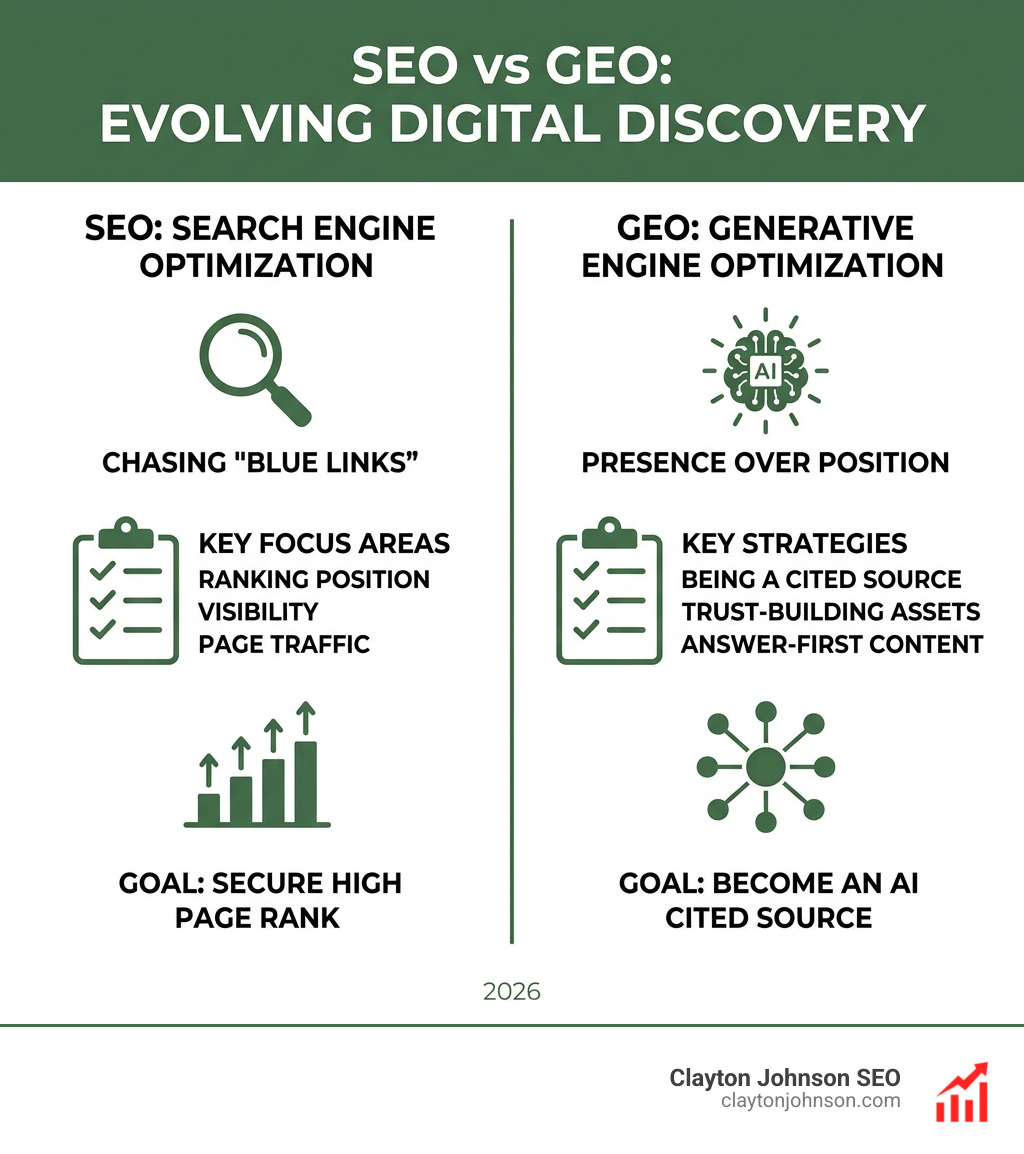
This doesn’t mean SEO is dead; it means it’s evolving into Generative Engine Optimization (GEO). Instead of chasing “blue links,” we are now optimizing for “presence over position.” We want our brands to be the cited sources in AI answers.
To succeed here, we focus on:
- Trust-Building Assets: Original research, proprietary data, and expert POVs that AI can’t easily replicate.
- Content Architecture: Using a hub-and-spoke model to build topical authority.
- Answer-First Content: Structuring articles to provide direct answers that AI engines can easily scrape and credit.
For a step-by-step approach to this transition, we recommend reading our ultimate guide to AI-driven SEO strategy and systems.
Measuring Incrementality in Actionable Growth Playbooks for Senior Marketers
In a privacy-first world, traditional attribution models (like last-click) are increasingly flawed. They often over-credit branded search and under-credit top-of-funnel brand awareness. To fix this, senior marketers must shift toward incrementality testing.
Incrementality asks: “Would this sale have happened without this ad?”
By running controlled experiments—where one group sees the ads and a control group does not—we can measure the true lift. This is how you build trust with a CFO. Instead of showing them “influenced pipeline” (which they usually don’t believe), you show them the causal link between spend and revenue.
Key metrics to track in your incrementality playbook include:
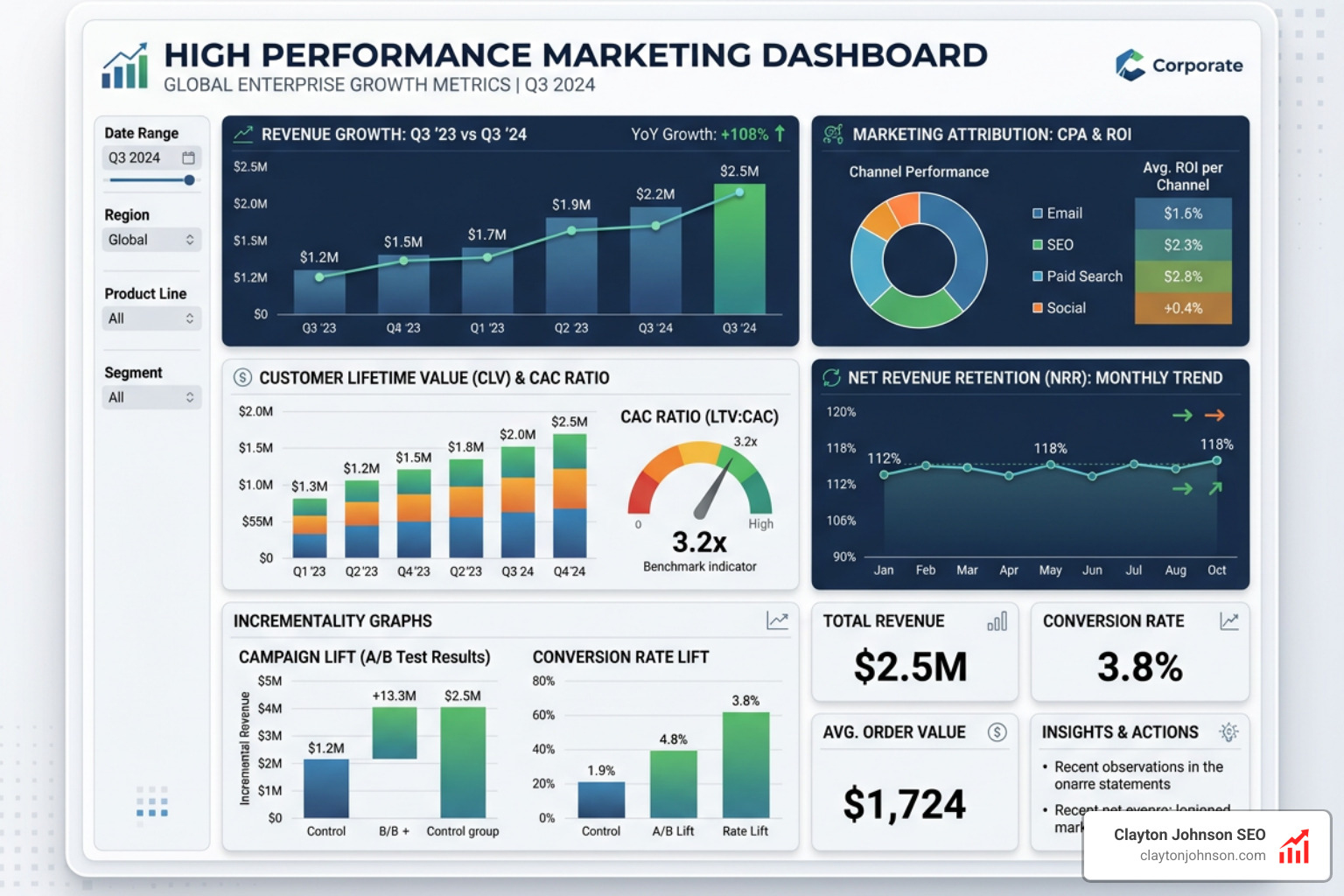
- CLV:CAC Ratio: A ratio of 3:1 is healthy; 10:1 means it’s time to pour gasoline on the fire.
- CAC Payback Period: How many months does it take to break even on a new customer? (Target < 12 months).
- NRR: The ultimate measure of product-market fit and long-term viability.
The 90-Day Transformation Plan for Marketing Excellence
Most marketing plans fail because they are too long and lack accountability. We prefer a 90-day transformation plan that breaks the process into three 30-day sprints.
- Days 1-30: Foundation & Data: Audit your CRM, clean up your data, and draft a Metrics Charter. This document defines exactly what a “lead” is and who owns each KPI. Use a RACI matrix (Responsible, Accountable, Consulted, Informed) to ensure there is only one “Accountable” person for every task.
- Days 31-60: Automation & Alignment: Implement your Service Level Agreements (SLAs) between sales and marketing. If a lead isn’t followed up on in 5 minutes, who gets the alert? This is also when you launch an ABM Pilot targeting your top 50 accounts.
- Days 61-90: Optimization & Scale: Review the data from your pilot, run incrementality tests, and present a “Revenue Impact Report” to the board.
This structured approach is backed by scientific research on marketing agility and ecosystems, which suggests that companies with clear strategic planning processes significantly outperform their peers. For more on building these systems, see the executive guide to compounding growth architecture.
Conclusion: Moving from Tactics to Durable Systems
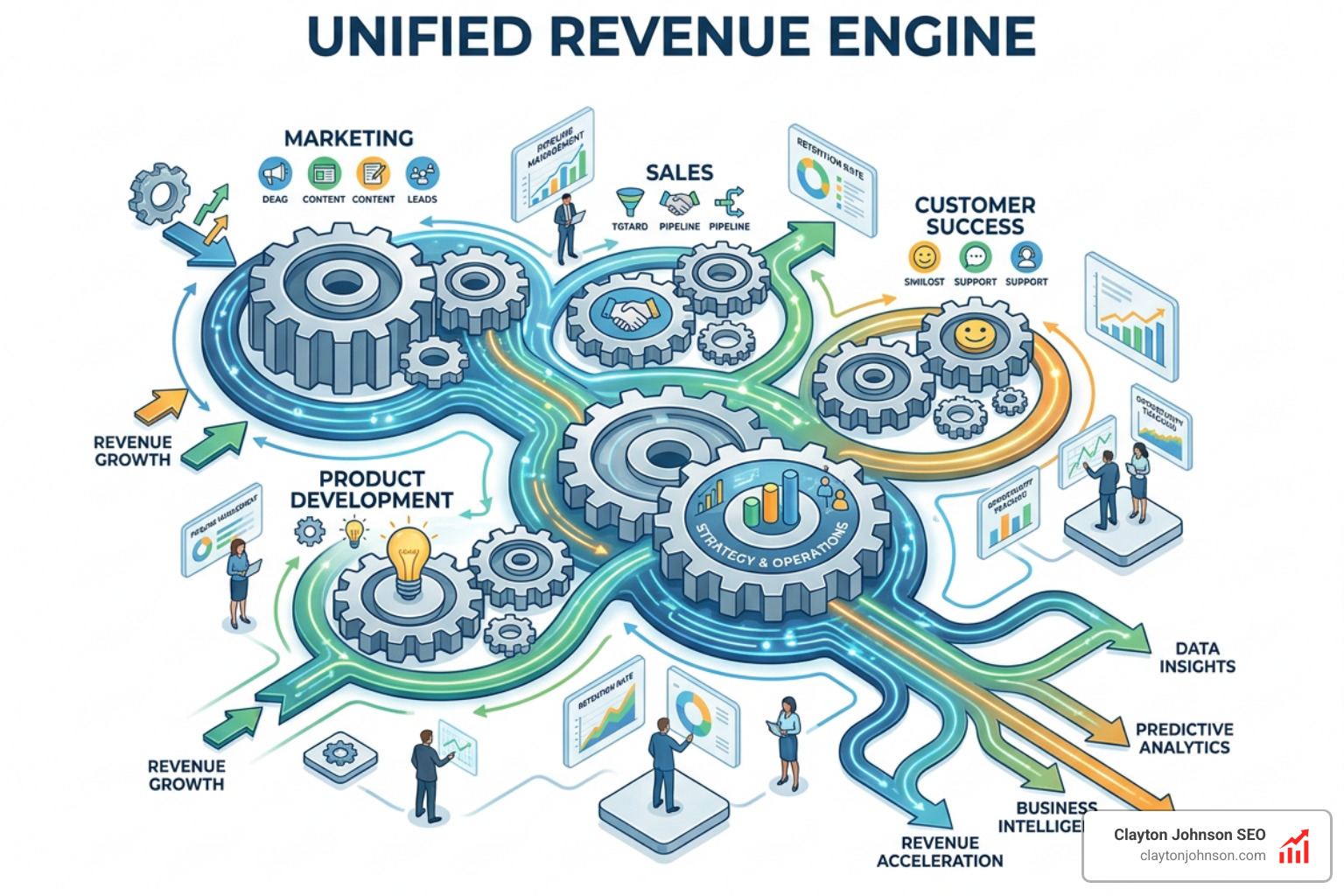
At the end of the day, actionable growth playbooks for senior marketers aren’t about finding a “silver bullet” tactic. They are about building durable systems that compound over time.
Whether it’s turning your CRM into a revenue engine, optimizing for the new world of AI search, or proving your worth to the CFO through incrementality, the goal is the same: Clarity → Structure → Leverage → Compounding Growth.
Stop chasing the latest shiny object and start building the architecture that will sustain your brand for years to come. If you’re ready to move from a to-do list to a revenue-generating system, we’re here to help you build it.
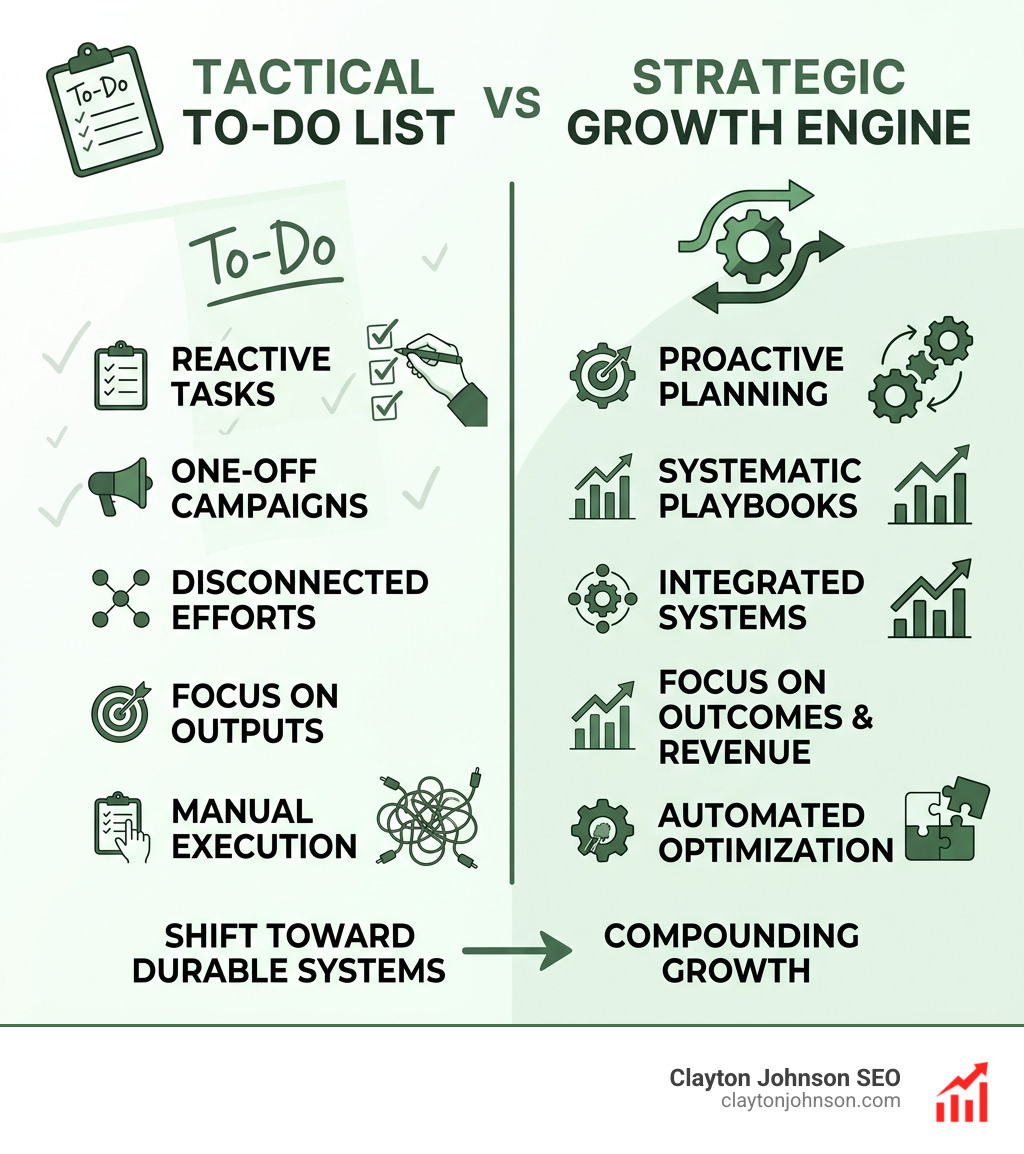
Ready to stop reacting and start growing? Explore AI-driven growth systems or see how we can help you turn your fragmented efforts into a coherent engine at Clayton Johnson SEO.