Why Strategy Frameworks Are the Difference Between Growth and Guesswork
Strategy frameworks are structured tools that help businesses analyze their situation, set clear goals, and execute plans that actually work.
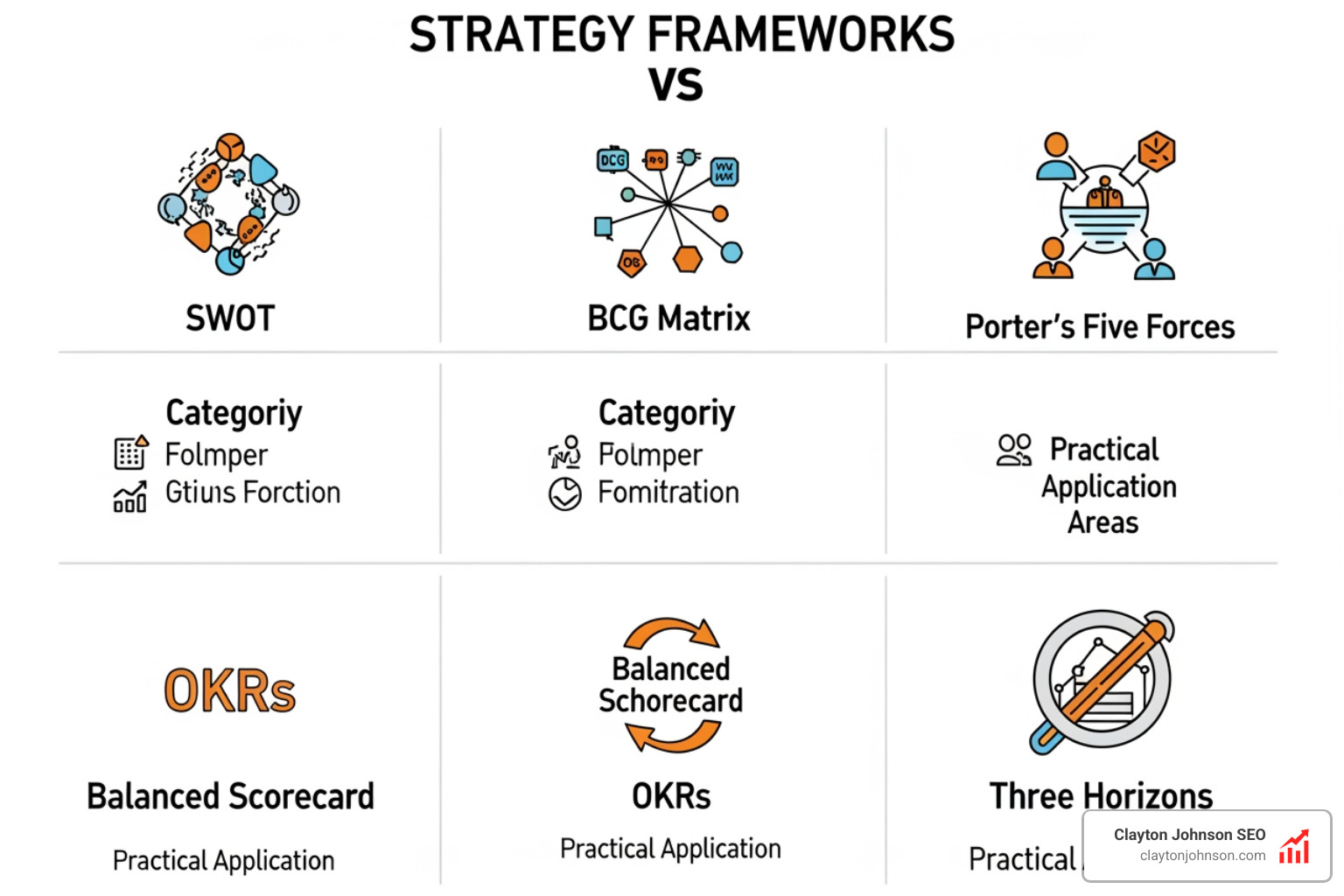
Here are the most widely used strategy frameworks and what each one does best:
| Framework | Best Used For |
|---|---|
| SWOT Analysis | Understanding internal strengths/weaknesses and external opportunities/threats |
| PESTLE Analysis | Scanning the broader political, economic, social, and tech environment |
| Porter’s Five Forces | Assessing how competitive and attractive an industry is |
| Balanced Scorecard | Tracking performance across financial, customer, process, and growth dimensions |
| OKRs | Setting ambitious goals and measuring progress with key results |
| BCG Matrix | Deciding where to invest, grow, or cut across a product portfolio |
| VRIO Framework | Identifying internal resources that create lasting competitive advantage |
| Ansoff Matrix | Mapping options for growth across markets and products |
| 3 Horizons Model | Balancing short-term wins with long-term innovation |
Most businesses skip the strategy part and jump straight to tactics. They run ads, post content, and chase leads — without a clear picture of where they stand or where they’re going.
That’s where strategy frameworks come in. They replace guesswork with structure.
Research backs this up: organizations that document their strategic plans grow 30% faster than those that don’t. And companies that use strategic planning tools consistently see a 33% boost in overall performance.
I’m Clayton Johnson, an SEO strategist and demand generation expert who has spent nearly two decades building data-driven growth systems — and strategy frameworks sit at the core of every scalable plan I build. Below, I’ll break down the frameworks that matter most and show you exactly how to apply them.
Essential Strategy Frameworks for Analysis and Execution
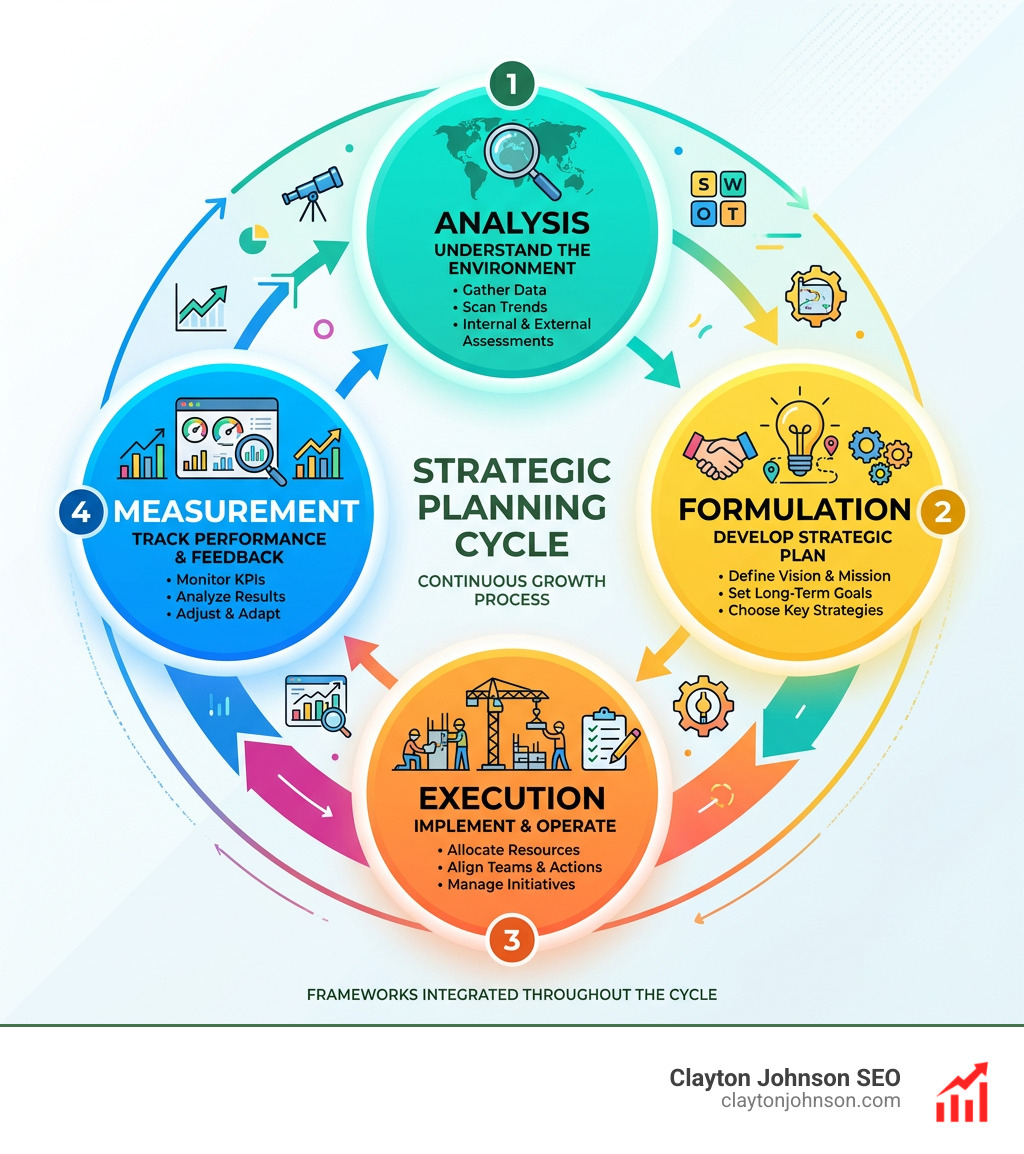
When we talk about strategy frameworks, we aren’t just talking about a single “to-do” list. True strategic planning is a multi-layered process that involves three distinct areas: analysis (formulation), description (mapping), and execution (tracking). Think of it like building an airport: you need the high-level blueprint (the model), the specific flow charts for passenger traffic (the framework), and the actual construction equipment (the tools).
One of the biggest reasons businesses fail to scale is that they confuse these layers. They might have a great SWOT analysis (analysis) but no way to measure if their daily tasks are moving the needle (execution). To truly succeed, you need to understand the decomposition method—the way a framework breaks down a complex business environment into manageable parts.
Following a structured approach allows you to turn vague “strategic intent” into testable hypotheses. Studies show that organizations that grow 30% faster are those that take the time to document these plans. Furthermore, using these methods can lead to a 33% boost in overall performance over a three-year period.
Environmental Analysis with SWOT and PESTLE
Before you can decide where to go, you have to know where you are. This is where environmental analysis comes in. We use two primary lenses: internal and external.
SWOT Analysis is the “old faithful” of the business world. It looks at:
- Strengths: Internal advantages (e.g., a proprietary AI workflow).
- Weaknesses: Internal limitations (e.g., outdated legacy software).
- Opportunities: External chances for growth (e.g., a new market niche).
- Threats: External risks (e.g., new low-cost competitors).
However, many people stop at the list. To make it actionable, we use the TOWS Matrix. TOWS reverses the order, starting with external threats and opportunities to avoid internal bias. It forces you to ask: “How can we use our Strengths to exploit this Opportunity?” (SO Strategy) or “How can we minimize this Weakness to avoid that Threat?” (WT Strategy).
While SWOT looks at your immediate bubble, a PEST analysis (or PESTLE) zooms out to the macro-environment. It examines Political, Economic, Social, Technological, Legal, and Environmental factors. For instance, a change in data privacy laws (Legal) or a surge in remote work culture (Social) can completely shift your strategy before you’ve even launched a product.
Competitive Strategy: Porter’s Five Forces and VRIO
Once you understand the environment, you need to understand the competition. Porter’s five forces is the gold standard for assessing industry attractiveness. It looks at:
- Competitive Rivalry: How many competitors do you have?
- Supplier Power: Can your suppliers easily drive up prices?
- Buyer Power: Can your customers easily switch to a cheaper rival?
- Threat of Substitution: Can a different product solve the same problem?
- Threat of New Entrants: How easy is it for someone else to start a business like yours?
But knowing the market isn’t enough; you need a sustainable advantage. This is where the VRIO Framework shines. VRIO is an internal audit tool that asks four questions about your resources:
- Valuable: Does this resource help you exploit an opportunity or neutralize a threat?
- Rare: Is it something only you (or very few) possess?
- Inimitable: Is it difficult or expensive for others to copy?
- Organized: Is your company actually set up to capture the value of this resource?
Take a look at the Nike case study: their brand and innovative patents are Valuable, Rare, and Inimitable. Because they are perfectly Organized to exploit these, they maintain a sustained competitive advantage. If you have a resource that is valuable and rare but easy to copy, you only have a temporary advantage.
Execution and Performance: OKRs and the Balanced Scorecard Strategy Frameworks
You’ve analyzed the market and identified your strengths. Now, how do you actually get the work done? This is where execution strategy frameworks like OKRs and the Balanced Scorecard come into play.
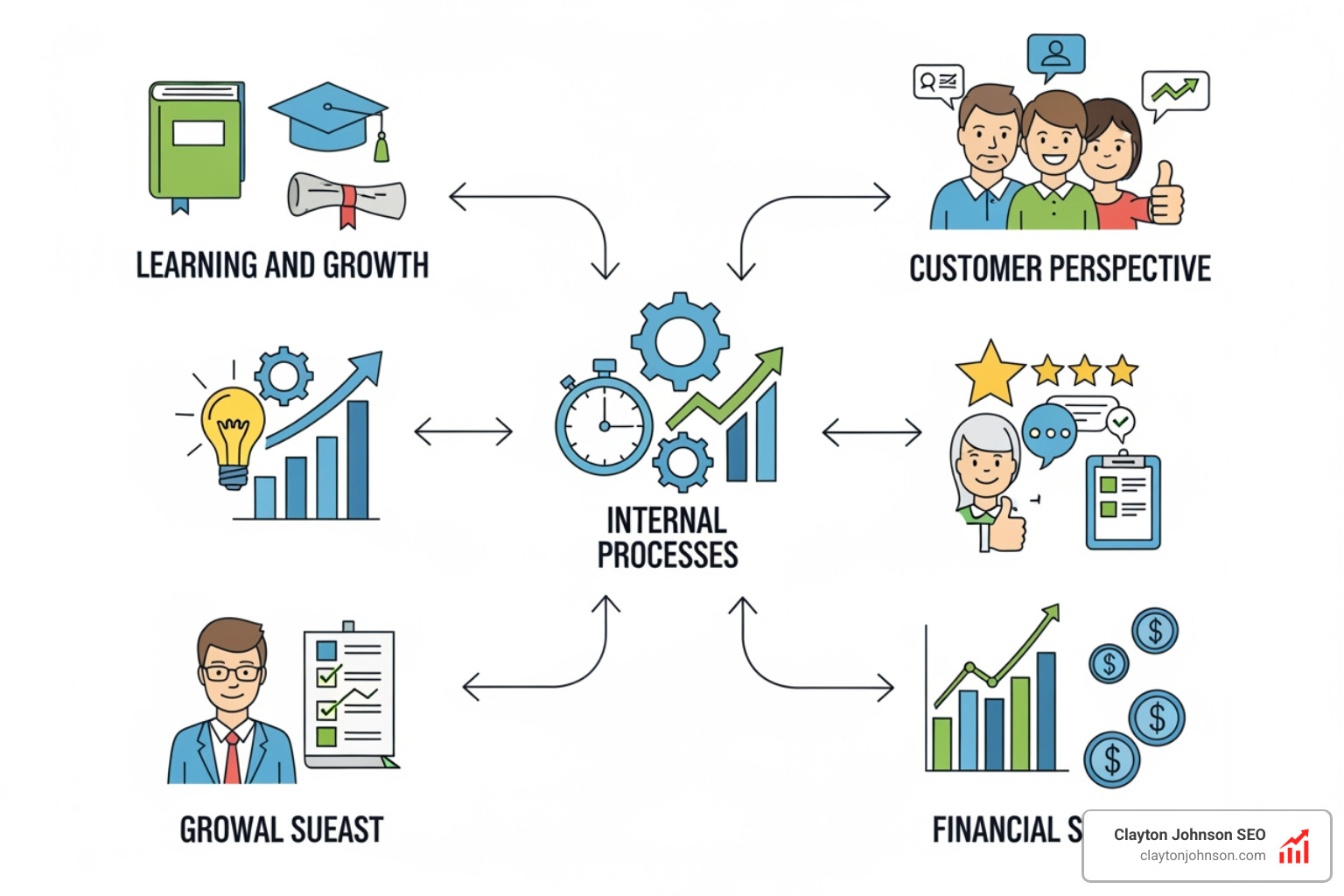
A balanced scorecard (BSC) is a comprehensive way to track performance. Instead of just looking at profit (a lagging indicator), it looks at four perspectives:
- Financial: How do we look to shareholders?
- Customer: How do customers see us?
- Internal Processes: What must we excel at?
- Learning and Growth: How can we continue to improve and create value?
We often supplement the BSC with a strategy map, which is a visual diagram showing the cause-and-effect links between these perspectives. For example, if we train our staff better (Learning), our processes will improve (Internal), which makes customers happier (Customer), leading to more sales (Financial).
For fast-moving teams, Objectives and Key Results (OKRs) are the way to go. The rule of thumb here is to shoot for a 70% key result success rate. If you’re hitting 100% every time, your goals aren’t ambitious enough! Look at Zoom’s revenue growth during the pandemic—they used clear strategic objectives to scale their infrastructure and capture a massive surge in market share.
Implementing and Scaling Your Strategic Planning Process
Starting a business is easy. Sustaining one is the hard part. To scale, you need to stop thinking about strategy as a once-a-year meeting and start thinking of it as an “Always-On” system.
We often use the airport blueprint analogy to explain this. A strategic model is like the high-level drawing of the airport—it shows where the roads connect to the terminal. A strategic framework is the detail within that plan—like the specific layout of the security gates to maximize passenger flow. Finally, planning tools are the software and systems you use to manage the project daily.
The Strategic Planning Steps
To build an actionable strategy, we follow a repeatable process:
- Identify Vision: Where do you want to be in 5 years?
- Assess Environment: Use SWOT and PESTLE to see the current landscape.
- Outline Goals: Set 3-5 high-level objectives.
- Assign Responsibility: Who owns which part of the plan?
- Measure Outcomes: Use KPIs and OKRs to track progress.
For more info about strategic frameworks, you can explore our full library of models tailored to different business sizes.
Portfolio Management and Future-Oriented Strategy Frameworks
If you are running a business with multiple products or services, you need a way to allocate resources. You can’t give everything 100% of your budget.
The BCG Matrix (created by the Boston Consulting Group) helps you categorize your products:
- Stars: High growth, high market share. Invest heavily!
- Cash Cows: Low growth, high market share. Milk these for cash to fund other areas.
- Question Marks: High growth, low market share. Decide if they are worth the investment.
- Dogs: Low growth, low market share. Divest or minimize support.
In its prime, over half of the Fortune 500 used the BCG Matrix. A classic example of failing to use this logic is the Microsoft Zune. Microsoft realized the MP3 player market was declining (it was becoming a “Dog” due to smartphones) and wisely decided to retreat and focus on their “Stars” like cloud computing.
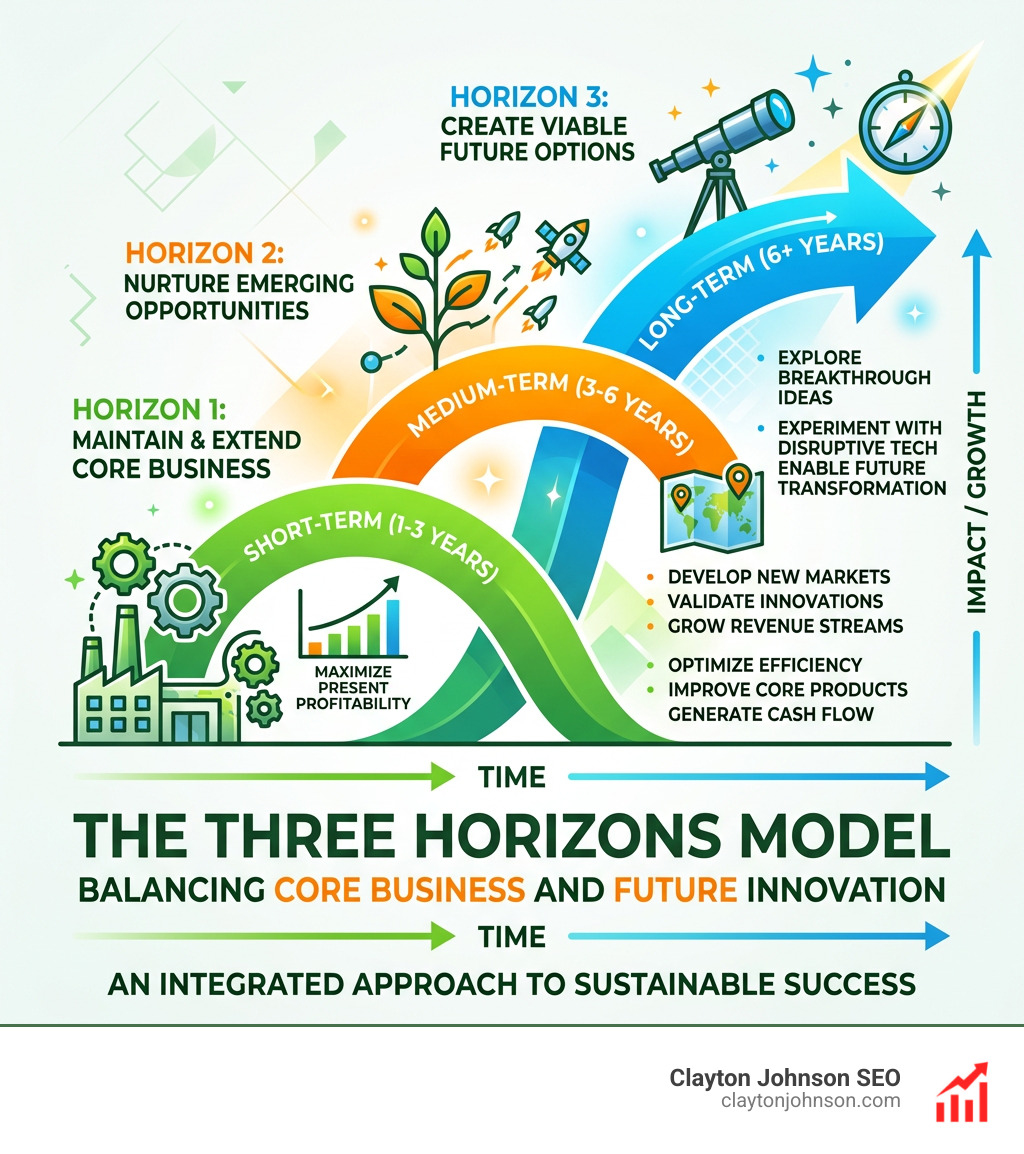
For long-term innovation, we look at the Three Horizons model:
- Horizon 1: Maintain and extend your core business (short-term).
- Horizon 2: Nurture emerging opportunities (medium-term).
- Horizon 3: Create viable options for the future (long-term transformation).
Choosing and Customizing Frameworks for Business Success
There is no “one size fits all” when it comes to strategy frameworks. A startup might thrive on a Lean Canvas and OKRs, while a massive enterprise might need the rigor of COBIT or TOGAF for their IT governance.
Hybrid approaches are often the most successful. You might use Porter’s Five Forces for your initial market analysis, the Balanced Scorecard for your quarterly reporting, and Jira or Airtable for your daily task management. The key is to ensure your tools complement your frameworks. For example, using Mural for a visual SWOT session can get stakeholder buy-in much faster than a boring spreadsheet.
One of the biggest implementation challenges is executive buy-in. If the leadership team doesn’t “live” the framework, the rest of the organization won’t either. Strategy is a muscle—you have to exercise it every day.
At Clayton Johnson SEO, we specialize in building these durable systems. Whether it’s more info about strategy systems or integrating more info about AI tools into your marketing workflow, our goal is to move you from fragmented effort to compounding growth.
Common Challenges and How to Overcome Them
- Analysis Paralysis: Don’t try to use 15 frameworks at once. Pick 2 or 3 that answer your most pressing questions.
- Static Planning: A strategy shouldn’t sit in a PDF on a shelf. It needs to be a living document that changes as the market does.
- Lack of Specificity: Avoid generic strengths like “good customer service.” Use data, like “NPS score of 85,” to make your analysis defensible.
Summary: Turning Ambition Into Reality
Strategy frameworks are not just academic exercises—they are the operating systems of successful businesses. By using tools like SWOT, VRIO, and OKRs, you stop guessing and start making decisions based on structure and data.
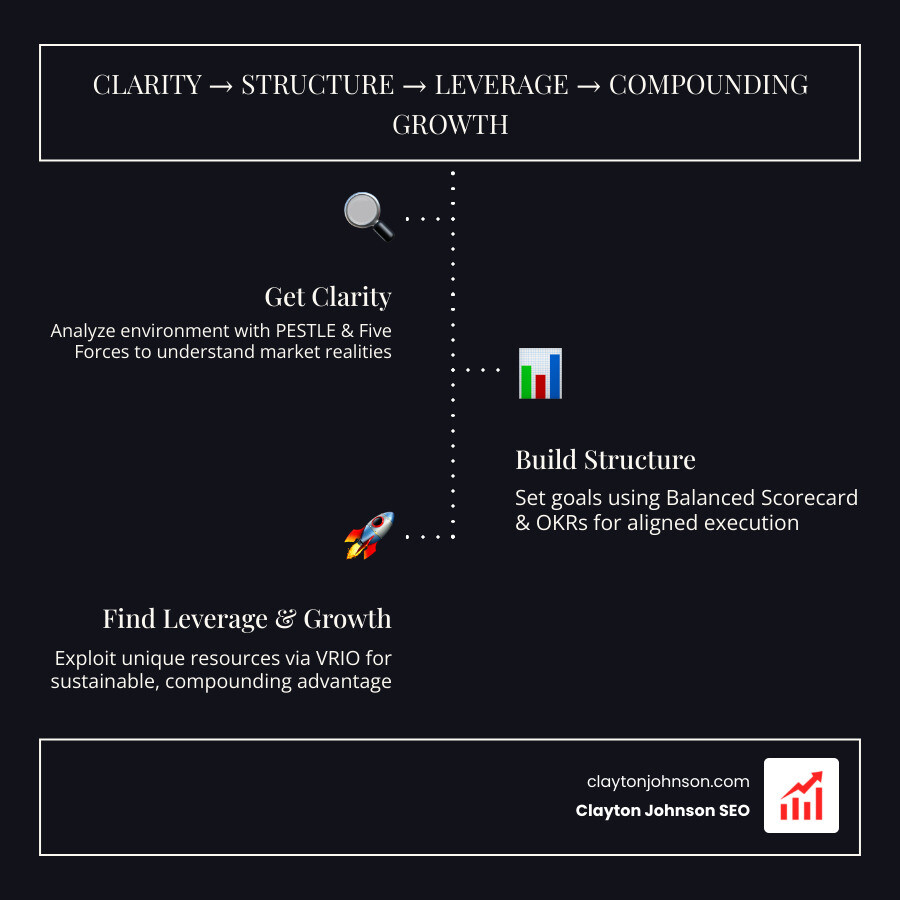
Remember the core philosophy: Clarity → Structure → Leverage → Compounding Growth.
- Get Clarity on your environment (PESTLE, Five Forces).
- Build Structure into your goals (Balanced Scorecard, OKRs).
- Find Leverage in your unique resources (VRIO, Core Competencies).
- Watch your business achieve Compounding Growth.
If you’re ready to stop the guesswork and start building a scalable traffic and growth engine, we’re here to help. Whether you need a structured SEO audit or a full-scale strategic roadmap, let’s turn your ambitions into a measurable reality.