A – Z Guide to Email Marketing & Automation

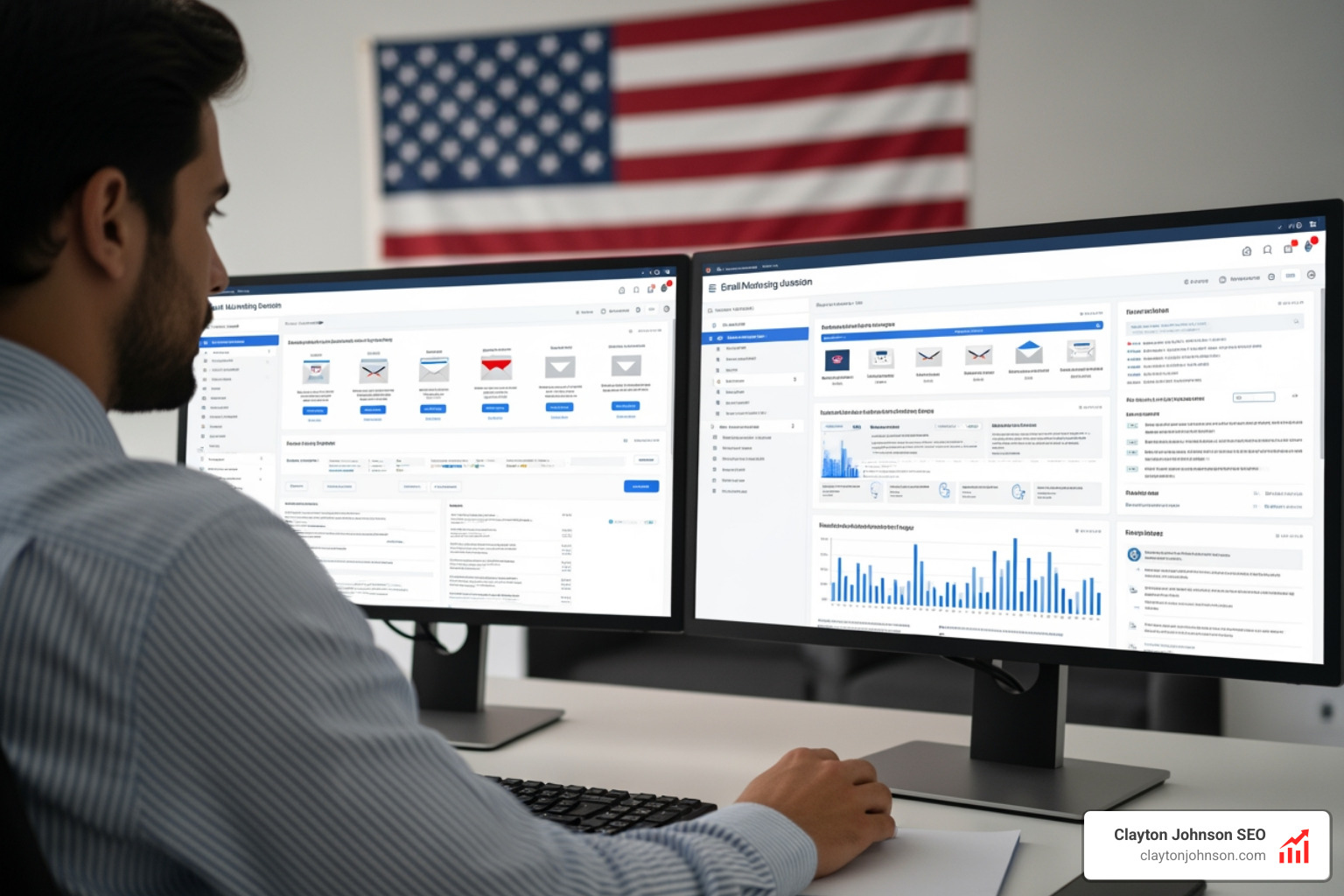
Why Email Marketing & Automation Is the Growth Engine You Can’t Ignore
Email Marketing & Automation is the process of using software to automatically send targeted, personalized emails based on subscriber behavior, triggers, and predefined rules — without manual effort every time.
Here’s a quick snapshot of what it covers:
| Topic | What You’ll Learn |
|---|---|
| What it is | Trigger-based emails sent automatically based on user actions |
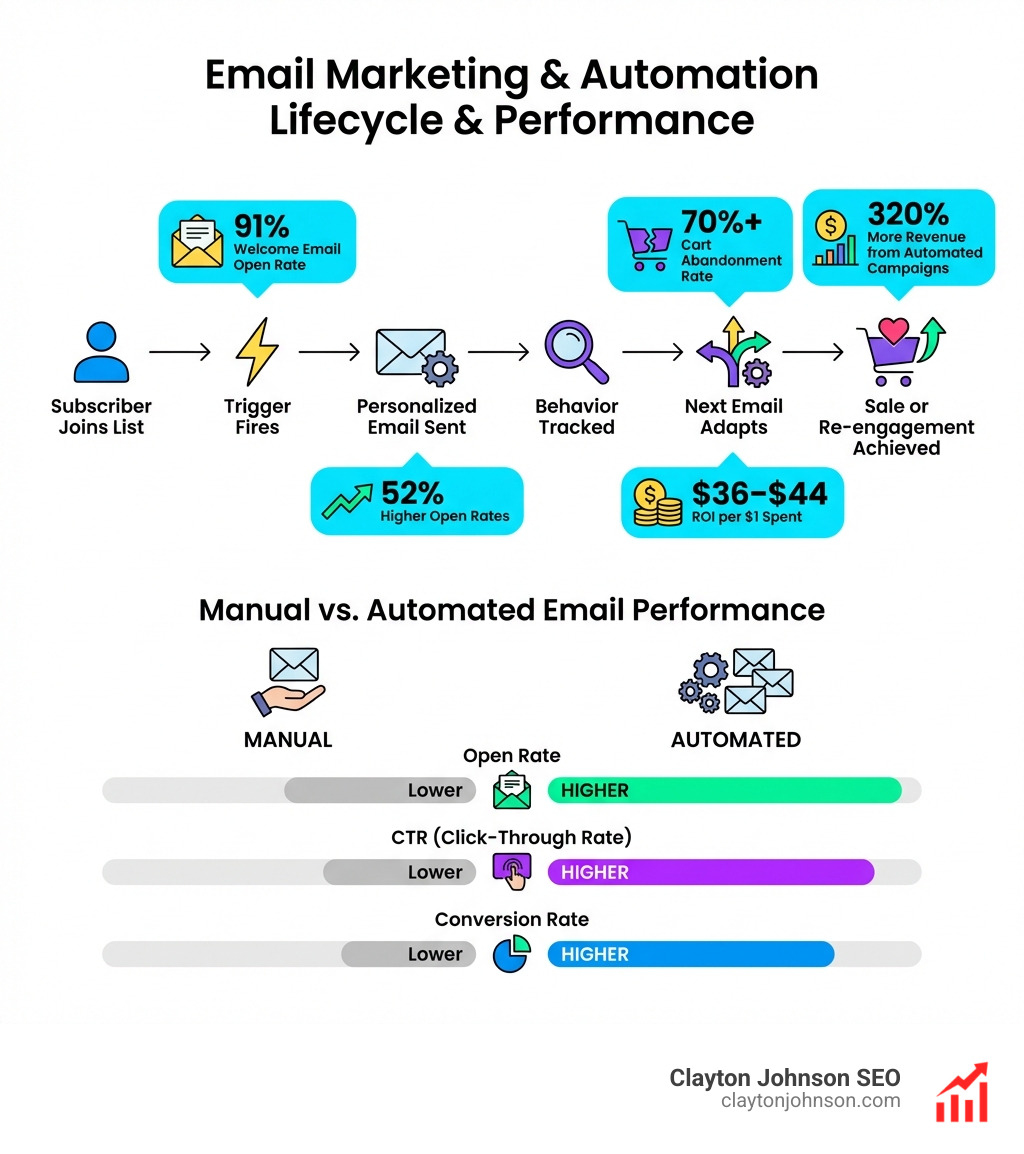
| Key benefit | Automated emails drive 52% higher open rates and 320% more revenue |
| Best use cases | Welcome series, abandoned cart, drip campaigns, re-engagement |
| Top tools | ActiveCampaign, Mailchimp, Omnisend, Klaviyo, Brevo, MailerLite |
| ROI | Email delivers $36–$44 for every $1 spent |
| Who it’s for | eCommerce, SMBs, B2B teams, creators, and founders |
Email is not a legacy channel. With 4.5 billion users worldwide and 99% of people checking their inbox daily, it remains the highest-ROI channel in digital marketing.
The problem most founders and marketing leaders face isn’t email itself. It’s doing it manually — tagging subscribers by hand, scheduling blasts one at a time, guessing what to send and when.
Automation fixes that. It turns your email list into a system — one that nurtures leads, recovers lost revenue, and builds relationships while you focus on growth.
Whether you’re just getting started or trying to scale a fragmented email strategy into a real revenue engine, this guide covers everything you need to know.
I’m Clayton Johnson — an SEO strategist and growth operator who builds scalable marketing systems where Email Marketing & Automation plays a central role in compounding demand and measurable business growth. This guide distills what actually works, built from real-world frameworks across dozens of business models.
Similar topics to Email Marketing & Automation:
Understanding Email Marketing & Automation
At its core, the shift from traditional email marketing to Email Marketing & Automation is a shift from “broadcasting” to “conversing.” Traditional email marketing often involves sending a one-off blast to your entire list, hoping something sticks. Automation, however, relies on trigger-based logic and behavioral data.
When a user interacts with your website—perhaps they download an eBook or view a specific product page three times—the system notices. That behavior acts as a trigger. Instead of you manually noticing and sending a follow-up, the software does it for you, delivering the right message at exactly the right moment.
The results of this precision are staggering. Research shows that automated emails deliver 52% higher open rates, 332% higher click-through rates, and a massive 2,361% higher conversion rate compared to manual sends. This is because automation allows for lead nurturing that feels personal and timely.
By using customer journey mapping, we can visualize every touchpoint a prospect has with our brand. Automation ensures that no one falls through the cracks, whether they are a first-time visitor or a loyal customer. If you’re looking to integrate these systems into your broader growth strategy, you can find more info about email marketing services that focus on building this kind of structured architecture.
Core Benefits and ROI of Automation
Why do we obsess over automation? Because it transforms marketing from a cost center into a high-efficiency revenue engine. Businesses using automation software generate twice as many leads as those stuck in manual mode.
The financial argument is even more compelling. Data indicates that email delivers between $36–$44 for every $1 spent. When you add automation to the mix, those campaigns generate 320% more revenue than manual blasts.
Automation provides four primary pillars of value:
- Efficiency: It saves your team hours of manual work, from tagging subscribers to managing list hygiene.
- Scalability: You can communicate with 10,000 customers as easily as you do with ten.
- Retention: It’s much more cost-effective to sell to an existing customer than to acquire a new one. Automation keeps you top-of-mind without you having to remember to “check in.”
- Relevance: Sending fewer, but more targeted messages, leads to better engagement and fewer unsubscribes.
Manual vs. Automated Performance Comparison
| Metric | Manual Email Blasts | Automated Workflows |
|---|---|---|
| Open Rate | ~17% – 21% | 30% – 50%+ |
| Conversion Rate | Baseline | 2,361% Higher |
| Revenue Generation | Linear | 320% More per Email |
| Lead Generation | Standard | 2x More Leads |
Top Tools and Features for Scalability
Choosing the right Email Marketing & Automation software is about finding a tool that fits your current needs while providing a runway for future growth. You aren’t just looking for an email editor; you’re looking for an “automation-first” mindset.
Key features to look for include:
- AI Orchestration: Modern tools use AI to optimize send times, predict churn, and even suggest content.
- CRM Sync: Your email tool should “talk” to your CRM (like Salesforce or HubSpot) to ensure sales and marketing are aligned.
- API & Webhooks: These allow your email platform to trigger actions in other apps (e.g., sending a Slack notification when a high-value lead clicks a link).
- Predictive Analytics: Understanding which leads are most likely to convert allows you to prioritize your efforts.
Advanced Segmentation in Email Marketing & Automation
The “secret sauce” of automation is segmentation. We move away from one giant list toward dynamic lists and tagging. If a subscriber clicks on a link about “SEO strategy,” they get a tag. That tag then places them into a specific segment that receives content tailored to that interest.
90% of consumers find personalized content appealing. By using data enrichment, we can pull in external data to further refine our messaging. This ensures that every email feels like a 1-to-1 conversation rather than a mass-produced advertisement.
Best Email Marketing & Automation Tools for eCommerce and SMBs
Different businesses have different needs. Here is how the top players stack up:
- ActiveCampaign: The powerhouse for advanced drip automations and CRM integration. It offers over 500 pre-built automation recipes.
- Mailchimp: Great for SMBs looking for an all-in-one marketing platform that is easy to use.
- Omnisend & Klaviyo: The gold standards for eCommerce. They offer deep integrations with Shopify and BigCommerce, including pre-built segments for “high-potential buyers.”
- Brevo (formerly Sendinblue): Excellent for budget-conscious businesses, offering unlimited contacts on their free plan.
- Kit (formerly ConvertKit): Designed specifically for creators and bloggers, focusing on flexible tagging and simple landing pages.
- Loops: A newer, SaaS-friendly tool that offers unlimited automations even on its free tier.
- MailerLite: Known for its clean interface and interactive content blocks, making it perfect for small to mid-sized businesses.
High-Impact Workflows and Best Practices
To see real results, you need to implement specific workflows that target different stages of the funnel.
1. The Welcome Series
When someone joins your list, they are at their peak interest. Welcome messages get 4 times more reads and 5 times more clicks than standard marketing emails. They can generate up to 320% more income per email. Use this series to introduce your brand, set expectations, and deliver immediate value.
2. Abandoned Cart Recovery
This is the single most important workflow for eCommerce. Over 70% of online shopping carts are abandoned. A well-timed series of 2-3 emails can recover a significant portion of this lost revenue. Often, people just need a gentle nudge or a small incentive to complete the purchase.
3. Drip Campaigns
These are a series of emails sent over time to educate and nurture a lead. They “drip” useful content, gradually building trust until the prospect is ready to buy.
4. Re-engagement Campaigns
If a subscriber hasn’t opened an email in 90 days, don’t just keep emailing them—that hurts your deliverability. Trigger a re-engagement campaign with a “We miss you” offer. If they still don’t engage, it’s time to clean them from your list.
Compliance and Best Practices
When setting up your Email Marketing & Automation, you must adhere to legal standards. This isn’t just about being a good “internet citizen”—it’s about protecting your sender reputation.
- CAN-SPAM ACT (USA): Requires clear sender ID and an easy opt-out mechanism.
- GDPR (EU): Demands explicit consent and transparency in how personal data is used.
- CASL (Canada): Similar to GDPR, it requires express consent for commercial electronic messages.
Frequently Asked Questions about Email Automation
What is the difference between an autoresponder and automation?
An autoresponder is a simple, linear sequence (e.g., “Send Email A on Day 1, Email B on Day 3”). Automation is a complex web of “if/then” logic based on behavior. If a user clicks a link, they might skip Email B and go straight to a specialized “Sales” sequence. Automation is adaptive; autoresponders are static.
How do I prevent my automated emails from going to spam?
First, practice good email hygiene by regularly cleaning inactive subscribers. Second, avoid “spammy” subject lines (all caps, excessive exclamation points, or words like “FREE” in all caps). Third, ensure you have a reputable ESP and have set up your SPF, DKIM, and DMARC records. Finally, always provide a clear, one-click unsubscribe link.
Is email marketing automation expensive for small businesses?
Not anymore. While enterprise tools like Salesforce Marketing Cloud can be pricey, platforms like Brevo and MailerLite offer robust automation features for free or very low monthly costs. Most tools scale their pricing based on the number of contacts, so you only pay more as your business grows.
Conclusion
Most companies don’t lack tactics; they lack structured growth architecture. Email Marketing & Automation is a critical component of that architecture. It is the system that takes the traffic generated by your SEO and content efforts and converts it into compounding revenue.
At Demandflow, we believe in a philosophy of Clarity → Structure → Leverage. By automating your email, you create leverage. You allow your marketing to work for you 24/7, delivering personalized experiences at scale.
If you’re ready to move beyond random acts of marketing and build a measurable growth model, we can help. Whether it’s through our framework library or a systems implementation, our goal is to help founders and marketing leaders achieve durable market dominance.
Work with me to audit your current systems and build a growth engine that actually compounds.