AI for Business Growth: Because Robots Don’t Take Sick Days


Why AI Is Now the Core Engine of Business Growth
AI for business growth is no longer a future-state conversation — it’s the competitive divide happening right now, between companies pulling ahead and those falling behind.
Here’s the short answer if you need it fast:
How AI drives business growth:
- Operational efficiency — Automates repetitive tasks, reduces errors, cuts costs
- Data-driven decisions — Analyzes vast datasets in real time to surface actionable insights
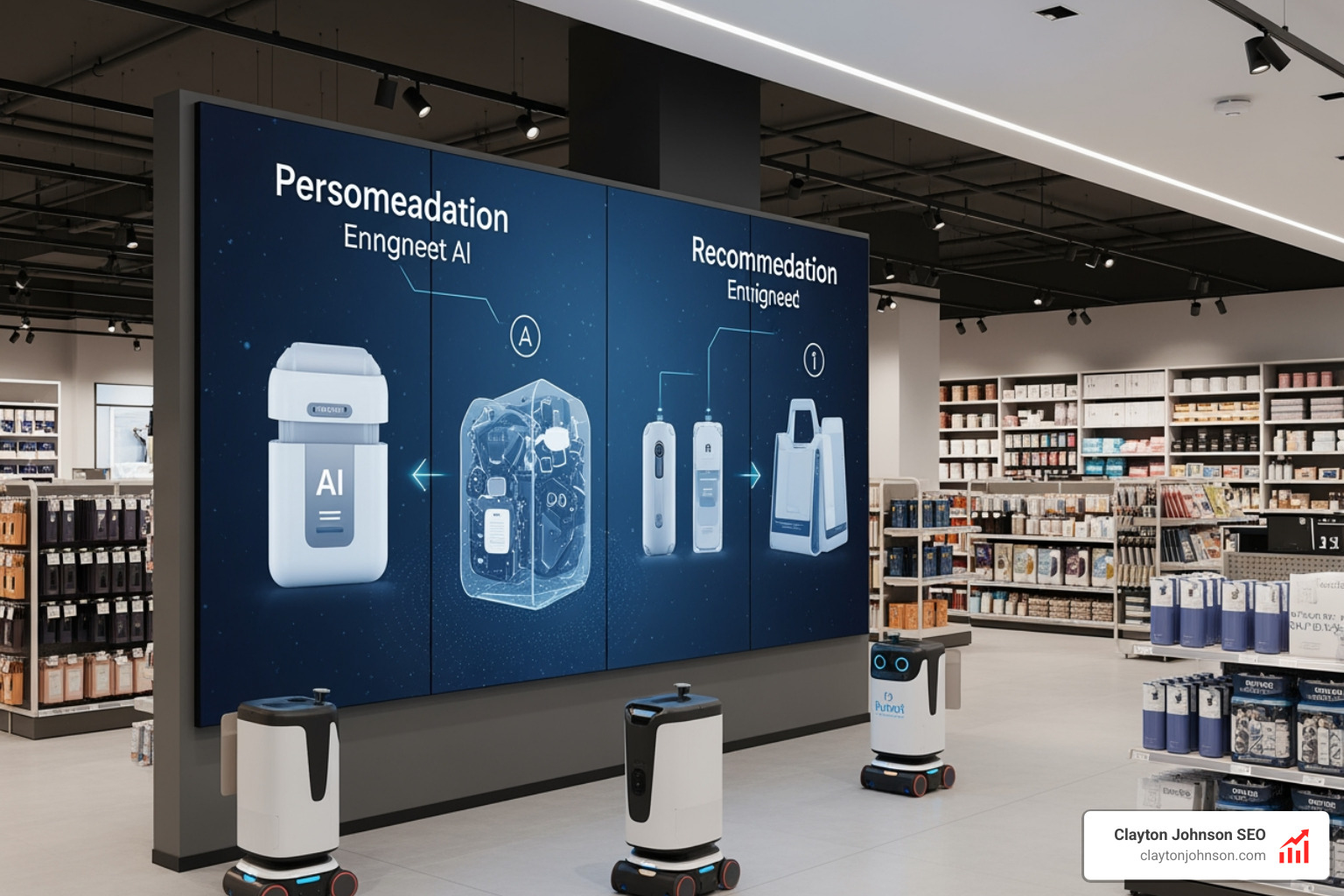
- Customer engagement — Personalizes experiences at scale with chatbots, recommendations, and dynamic content
- Revenue expansion — Unlocks new business models, products, and markets through generative and agentic AI
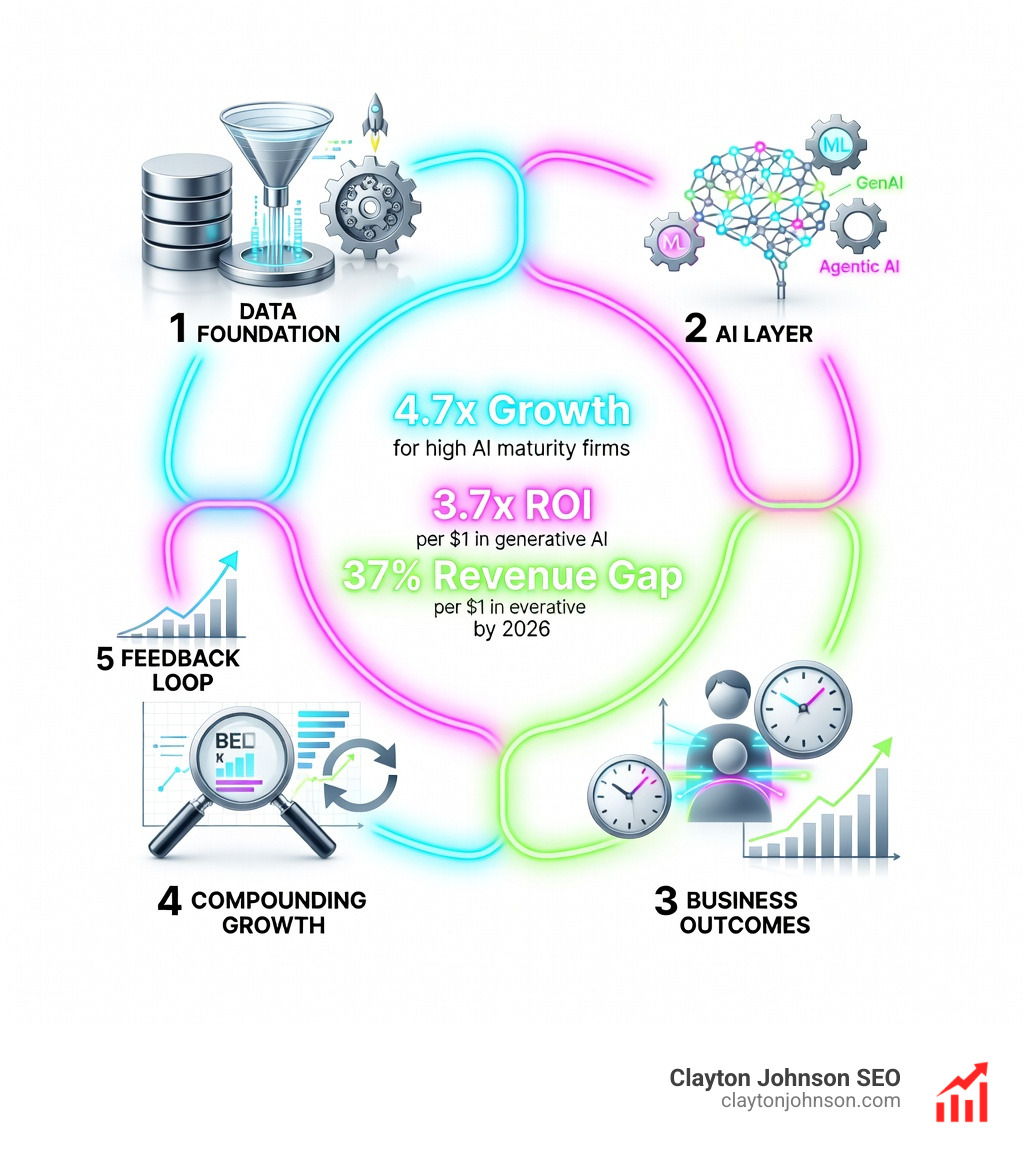
- Competitive advantage — Companies with high AI maturity grow 4.7x faster than low-maturity peers
The numbers make the case bluntly. Companies pursuing AI-fueled reinvention already outperform peers by 15% in top-line growth — a gap expected to more than double to 37%. And for every $1 invested in generative AI, businesses are seeing a 3.7x return.
Yet only 22% of companies currently qualify as what researchers call “Frontier Firms” — the organizations actually capturing those returns. The other 78% are experimenting without a system.
That gap isn’t a technology problem. It’s a strategy and execution problem.
“The question is no longer if or why they should implement AI, but how.” — Microsoft AI Use Cases Report
Most businesses already use AI in some form — inside their CRM, their ad platforms, their email tools. But using AI tactically is very different from building AI into your growth architecture.
This guide is built for founders and marketing leaders who want the latter.
I’m Clayton Johnson — an SEO strategist and growth operator focused on AI-augmented marketing systems and scalable growth frameworks. My work at the intersection of AI for business growth, technical SEO, and structured content strategy helps founder-operators turn fragmented efforts into compounding demand engines. Let’s build the system, not just the tactic.
Defining AI for Business Growth: Beyond the Hype
To harness AI for business growth, we first need to strip away the science-fiction terminology and look at what the technology actually does for a P&L statement. At its core, Artificial Intelligence is the development of computer systems capable of performing tasks that usually require human intelligence—like spotting patterns, understanding language, and making complex decisions.
AI vs. BI: Knowing the Difference
Many leaders confuse AI with Business Intelligence (BI). While they are cousins, they play very different roles in your growth stack. BI is descriptive; it tells you what happened in the past using dashboards and reports. AI is predictive and prescriptive; it tells you what is likely to happen next and what you should do about it.

| Feature | Business Intelligence (BI) | Artificial Intelligence (AI) |
|---|---|---|
| Perspective | Backward-looking (Historical data) | Forward-looking (Predictive/Proactive) |
| Output | Reports, Dashboards, KPIs | Predictions, Automations, Content |
| Goal | Informing human decisions | Augmenting or automating decisions |
| Function | “What happened last quarter?” | “What will happen next quarter?” |
When these two work together, they create a unified analytics ecosystem. Imagine a BI dashboard showing a dip in retention, while an AI model simultaneously predicts which specific customers are at risk and triggers a personalized win-back email. This synergy is a cornerstone of Artificial Intelligence and Business Strategy.
By moving beyond simple reporting, we can use growth auditing in the age of artificial intelligence to identify exactly where machine learning and Natural Language Processing (NLP) can remove friction from your customer journey.
The Three Horizons of AI-Driven Expansion
Growth doesn’t happen all at once. According to research from Accenture and other leading firms, successful companies view AI for business growth across three distinct horizons. This framework prevents us from getting distracted by “shiny object syndrome” and ensures we’re building a strong AI growth strategy that delivers both immediate wins and long-term value.
Horizon 1: Amplifying the Core
This is about making your current business better, faster, and cheaper. We use AI to drive hyper-personalization in marketing and optimize operational workflows. For example, a retail brand might use AI to suggest products based on past behavior, driving a “virtuous feedback loop” where more data leads to better recommendations and higher revenue.
Horizon 2: Expanding to Adjacencies
Here, we use AI to identify and enter neighboring markets. Generative AI can perform rapid market assessments, analyzing thousands of competitor data points in seconds to find gaps your brand can fill. This allows for faster “time-to-market” for new offerings—sometimes reducing product development cycles by up to two-thirds.
Horizon 3: Creating New Revenue Models
The most mature firms use AI to become “entrepreneurial.” This involves creating entirely new business models, such as “AI-as-a-Service” or using generative design to create custom products (like 3D-printed razor handles tailored to a user’s grip). These AI-enabled business growth strategies shift the company from defensive cost-cutting to offensive revenue generation.
Real-World Use Cases and Industry Impact
The theoretical potential of AI for business growth is massive, but the practical applications are where the ROI lives. Across industries, we are seeing AI move from a “nice-to-have” tool to a fundamental part of the enterprise AI strategy.
- Manufacturing: Predictive maintenance uses real-time sensor data to forecast equipment failures before they happen, drastically reducing downtime.
- Finance: Banks use AI for automated loan approvals, processing four times more applications than human teams while maintaining strict risk modeling.
- Retail: Companies like Coca-Cola have used AI-powered vending machines to increase revenue by 6% through personalized flavor suggestions and optimized restocking schedules.
- Healthcare: AI is being used to improve cancer screenings by evaluating the quality of mammogram images in real-time, ensuring doctors have the best possible data for diagnosis.
Leveraging Generative AI for Business Growth
Generative AI (GenAI) is the “content engine” of the modern business. Beyond writing emails, GenAI is transforming how we handle knowledge work.
- Content Monetization: Creating high-quality, SEO-optimized educational hubs at scale.
- Synthetic Data: Generating massive datasets to train other models without compromising user privacy.
- Rapid Prototyping: Using AI to generate code, design mockups, and product profiles in hours instead of weeks.
We’ve found that GenAI is most effective when integrated into a scalable marketing framework, allowing for a “human-in-the-loop” approach that maintains brand authority while maximizing output.
Scaling Operations with Agentic AI for Business Growth
The next frontier is “Agentic AI”—autonomous agents that don’t just generate text, but actually execute multi-step workflows. Unlike a simple chatbot, an AI agent can plan a project, coordinate with other software via APIs, and handle complex tasks like managing a financial portfolio or resolving 50% of customer support calls end-to-end.
To succeed here, you need best-in-class AI infrastructure that allows these agents to access company data securely. This isn’t about replacing humans; it’s about delegating the “drudge work” so your team can focus on high-level strategy.
Building a Structured Roadmap for AI Transformation
You can’t just “buy” AI and expect growth. You need a roadmap. Many businesses get stuck in the “proof of concept” phase because they lack a structured approach to scaling.
- Assess Business Needs: Don’t start with the tool; start with the pain point. Is your bottleneck customer support? Lead generation? Supply chain latency?
- Audit Your Data: AI is only as good as the data it’s fed. Create data flow diagrams to ensure information isn’t trapped in silos.
- Identify Technology Gaps: Do your current systems have built-in AI modules? (Many out-of-the-box tools do!) Check those first before investing in custom builds.
- Prioritize Use Cases: Score potential AI projects based on business impact vs. complexity. Start with the “low-hanging fruit” to build momentum.
- Adopt Responsibly: Establish a responsible AI framework early. This includes governance around data privacy, ethics, and transparency.
A strategic framework for scaling AI ensures that every dollar spent on technology is directly tied to a growth metric.

Measuring ROI and Success in AI Initiatives
How do we know if AI for business growth is actually working? We look at the “Frontier Firms” — the top 22% of companies achieving 3x higher returns than their peers.
- Revenue Growth: High-maturity companies have seen 4.7x higher year-over-year growth.
- Total Return to Shareholders: Companies with differentiated AI strategies have delivered 3x higher returns over a five-year period.
- Productivity Gains: The average worker saves 40-60 minutes per day using AI, while technical roles (like data engineering) save up to 80 minutes.
- Efficiency: GenAI ROI is currently averaging 3.7x for every $1 invested.
We measure success by looking at how AI impacts product-market fit and long-term brand growth. If AI isn’t helping you acquire customers faster or keep them longer, it’s just an expensive toy.
Frequently Asked Questions about AI Integration
How can small businesses start with AI on a budget?
You don’t need a million-dollar budget to start. Most modern CRMs and email platforms (like HubSpot or Mailchimp) have built-in AI features for predictive lead scoring and content generation. Start by turning these on. Use low-code platforms to automate simple tasks, and focus on incremental automation rather than a total overhaul.
What are the biggest challenges in combining AI and BI?
The “big three” are data silos, data quality, and governance. If your sales data doesn’t talk to your marketing data, your AI will give you flawed predictions. Clean, unified data is the prerequisite for any successful AI initiative. Furthermore, “interpretability” is key—your team needs to understand why the AI made a certain recommendation to trust it.
How do businesses measure the success of AI-driven marketing?
Focus on the metrics that matter: conversion rates, customer lifetime value (CLV), and engagement depth. AI should allow you to run more experiments, personalize more touchpoints, and ultimately lower your customer acquisition cost (CAC) through better targeting and attribution modeling.
Conclusion
The era of “guessing” at growth is over. AI for business growth provides the structured architecture necessary to turn data into a compounding asset. But remember: AI is the engine, not the driver.
To win, you need a digital core that combines clean data, scalable cloud infrastructure, and a culture of continuous learning. Most companies don’t lack tactics—they lack the structured growth systems required to make those tactics work together.
At Clayton Johnson, we specialize in building this infrastructure. Whether you need a taxonomy-driven SEO system or a full AI-augmented marketing workflow, we help you move from fragmented efforts to a scalable reality.
The robots might not take sick days, but they still need a map. Let’s build yours.