AI Positioning Model 101

What Is an AI Positioning Model (And Why It Changes Everything)
An AI positioning model is a system that uses artificial intelligence to analyze competitive data, customer signals, and market trends — then generates clear, evidence-based positioning strategies for your product or brand.
Here’s a quick breakdown:
| Element | What It Means |
|---|---|
| What it is | An AI-powered framework for finding your unique market position |
| What it does | Analyzes competitors, customers, and trends at scale |
| Why it matters | Turns positioning from guesswork into a data-driven advantage |
| Who it’s for | Product marketers, founders, and GTM teams in competitive markets |
| Key output | Clear differentiation, messaging, and whitespace opportunities |
Most product messaging fails. Not because the product is bad. Because it’s built on shaky assumptions and outdated data.
Think about it: your CEO calls it a “platform,” sales calls it “Salesforce but easier,” and engineering calls it “the thing we built that does the stuff.” Same product. Completely different stories. That kind of internal chaos costs you deals every single day.
Traditional positioning relies on small-sample interviews, gut instinct, and manual research that takes 12–16 hours to produce a single competitive analysis. By the time you finish, the market has already moved.
AI changes the equation entirely.
With the right AI positioning model, that same analysis takes 30 minutes — a 96% reduction in time. More importantly, it surfaces signals humans simply can’t process at scale: social sentiment, review patterns, search intent shifts, and competitive whitespace hiding in plain sight.
The AI software market is projected to grow from $71.5 billion to over $775 billion, and yet most companies still sound identical. Generic phrases like “fast,” “easy-to-use,” and “AI-powered” fill every homepage. That’s not positioning — that’s noise.
This guide breaks down exactly how an AI positioning model works, how to build one, and how to use it to own a clear, defensible space in your market.
The Mechanics of a Modern AI Positioning Model
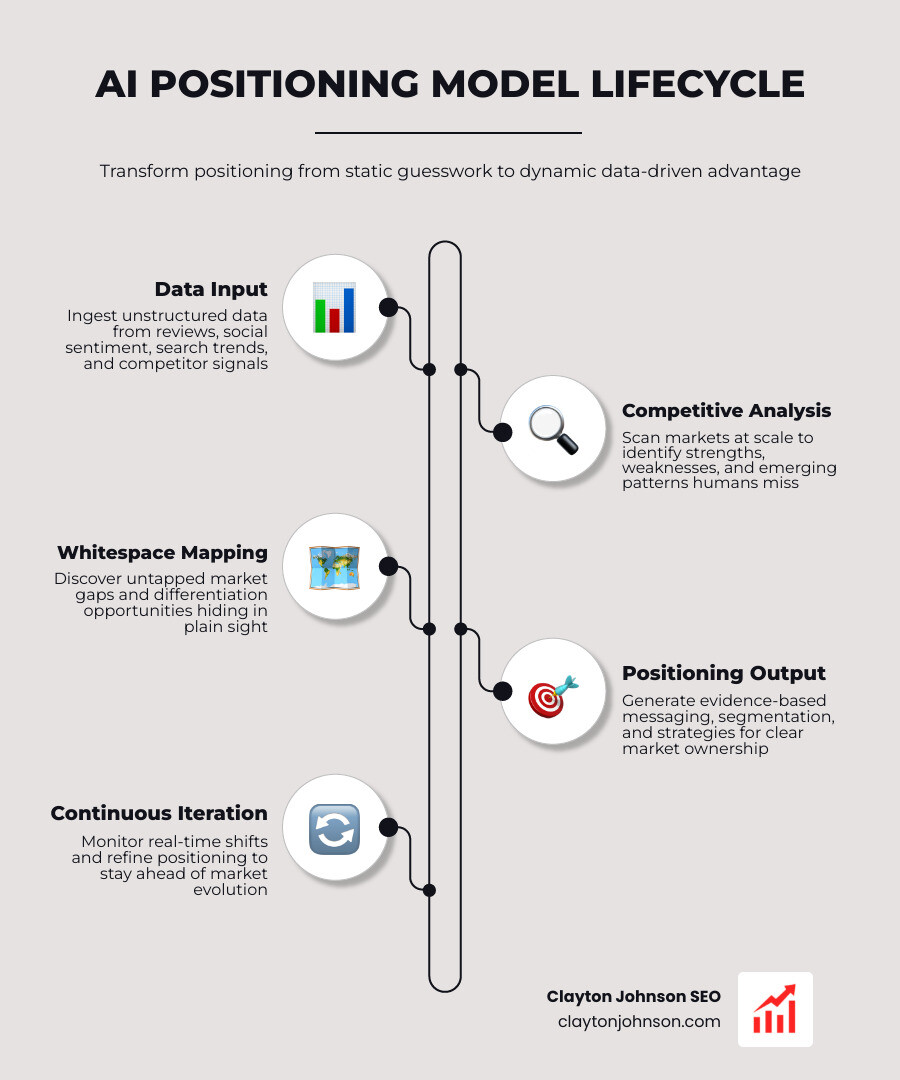
To understand how an positioning model functions, we have to look at it as a high-speed engine for market intelligence. In the past, positioning was a “one-and-done” workshop exercise. You gathered in a conference room, looked at three competitors, and picked a tagline.
Today, an AI-driven approach treats positioning as a living system. It continuously ingests unstructured data—like G2 reviews, Reddit threads, and competitor pricing updates—to find where your brand truly stands. This isn’t just about “better” data; it’s about dynamic segmentation. Instead of grouping customers by static job titles, AI clusters them by actual pain points and behavior patterns.
This real-time analysis allows us to spot a “competitive gap” before the competition even realizes they’ve left the door open. For a deeper look at how this fits into your broader GTM plan, check out our complete guide to market positioning strategy.
Why Traditional Frameworks Fail in AI Markets
The SaaS world is moving at a speed that traditional frameworks can’t handle. Most companies are still using internal brainstorming as their primary source of truth. They sit in a vacuum, speculating on what might resonate with prospects instead of collecting genuine feedback.
Traditional methods fail for three main reasons:
- Static Data: By the time a manual competitive report is finished, a new LLM update or a competitor feature launch has made it obsolete.
- Manual Bias: We tend to see what we want to see. AI doesn’t have an ego; it looks at the raw data of what customers are actually saying.
- Feature-First Messaging: Technical founders often fall into the trap of explaining how the AI works (RAG, neural nets, etc.) rather than why it matters to the buyer.
As the market for AI in SaaS explodes, the cost of being “indistinguishable” becomes a business killer. To avoid these traps, many teams are turning to structured approaches like April Dunford’s positioning framework, which we can now accelerate using AI.
Core Components of an AI Positioning Model
A functional ai positioning model consists of several layers that work together to turn raw market signals into a narrative.
| Feature | Manual Positioning | AI-Enhanced Positioning |
|---|---|---|
| Research Time | 12–16 Hours | 30 Minutes |
| Data Sources | Anecdotal / Small Sample | Millions of data points (Social, Reviews, SEO) |
| Update Frequency | Annual / Quarterly | Real-time / On-demand |
| Output | Static Document | Interactive Matrix & Narrative Guardrails |
The core components include:
- Data Aggregation: Using AI scrapers to pull every mention of your competitors from across the web.
- Sentiment Analysis: Understanding not just what people are saying, but the emotional weight behind their frustrations.
- Whitespace Mapping: Identifying the “underserved quadrants” where competitors are silent, but customers are shouting for help.
Visualizing these signals is key to stakeholder alignment. You can learn more about how to visualize these gaps in our guide to competitive positioning maps demystified.
Differentiation Strategies for AI Companies
When everyone is building on the same foundation models (like GPT-4), how do you actually stand out? The answer isn’t just “more AI.” It’s about how you apply it.
We see four primary levers for differentiation:
- Proprietary Data: Companies with unique, high-quality datasets—like a healthcare AI with millions of anonymized patient records—can establish sustainable competitive advantages that others simply can’t replicate.
- Domain Expertise: Horizontal AI is a “red ocean” of brutal competition. Domain-specialized offerings that solve specific problems for compliance officers or retail managers find much more receptive audiences.
- UX Innovation: Sometimes the most “advanced” AI loses to the one that is exceptionally accessible.
- Business Model Innovation: Creating powerful separation by changing how you charge—like performance-based pricing—rather than just what you do.
Whether you are in a “structured industry” (like banking, where compliance is king) or an “agile industry” (like creative tech, where speed is king), your positioning must reflect your environment. For more on making your competitors sweat, see our article on how to position your brand so competitors cry.
Implementing and Measuring Your AI Strategy
Building an ai positioning model isn’t just a technical task; it’s an organizational shift. According to McKinsey’s State of AI research, “high performers” are 3x more likely to use AI for transformative change and are much more likely to have redesigned their workflows to accommodate these tools.

The most successful teams use a “human-AI pairing” model. You aren’t replacing the Product Marketing Manager (PMM); you’re giving them a superpower. The AI acts as the “Automator” for data gathering and the “Augmentor” for generating hypotheses, while the human remains the “Strategist” who makes the final call.
If you’re ready to build these systems into your own growth engine, you can contact us for growth systems or explore our positioning strategy development guide.
A 4-Step AI Positioning Model Framework
We recommend a structured 4-step process to get your positioning model off the ground:
- Data Aggregation: Use tools like Gumloop or BrowserAI to scrape competitor websites, G2 reviews, and social threads. Don’t just look at direct competitors; look at “status quo” alternatives like spreadsheets.
- AI Analysis: Feed this data into an LLM with specific prompts to identify “distinct attributes.” Ask the AI: “What are the recurring complaints about Competitor X that our product solves?”
- Positioning Hypothesis: Map these attributes to value themes. AI can help you run “so what?” chains to turn a feature (like “automated scheduling”) into a business outcome (like “30% reduction in no-shows”).
- Validation & Iteration: Test your new messaging. Use AI-powered A/B testing or sentiment tracking to see if the market actually reacts.
This framework is designed to be lean. You can find more templates in our ultimate guide to market positioning models.
Influencing Brand Perception in LLMs and AI Search
A new frontier in positioning is how AI itself characterizes your brand. When a user asks Perplexity or ChatGPT, “What’s the best AI tool for sales teams?”—where do you land?
This is brand positioning in AI. These platforms act as automated filters. If they characterize you as “best for small teams” when you’re trying to move up-market to enterprise, you have a positioning problem that no amount of traditional SEO can fix.
To influence this, you must:
- Create Structured Content: Use clear, quotable value propositions on high-authority pages.
- Secure Third-Party Signals: AI models weigh G2 reviews, Gartner reports, and press mentions heavily.
- Own Your Data Story: Emphasize your proprietary data sets so LLMs recognize your unique authority.
Understanding what an AI positioning model is in this context means realizing that your “audience” isn’t just humans anymore—it’s the algorithms that recommend you to humans.
Measuring Success and Avoiding Pitfalls
How do you know if your ai positioning model is working? You have to move beyond vanity metrics and look at strategic lift.
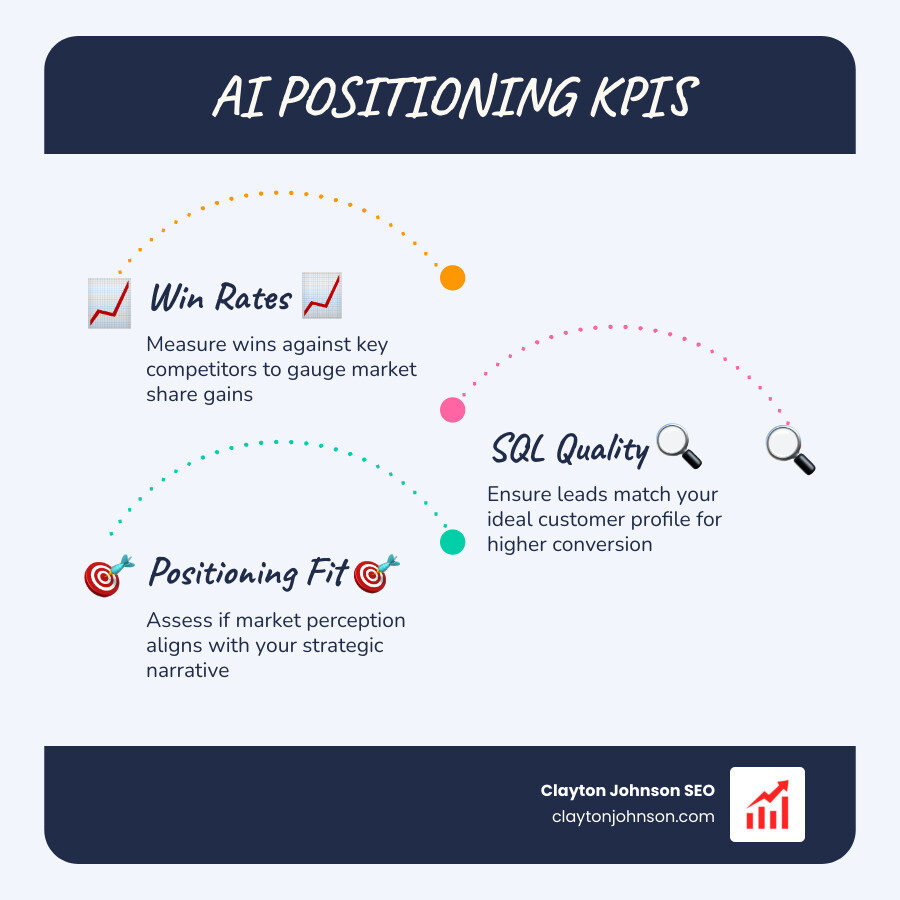
Key Metrics to Track:
- Win Rates: Are you winning more often against specific competitors?
- SQL Quality: Is the “sales-qualified lead” actually the “best-fit customer” you defined?
- Positioning Fit Score: A qualitative measure of how closely your market perception matches your intended narrative.
- Strategy Refinement Velocity: How quickly can you update your messaging when a market shift occurs?
Common Pitfalls to Avoid:
- Over-Automation: Don’t let the AI write your entire strategy. Human judgment is still required to ensure brand safety and emotional resonance.
- Data Biases: If your input data is biased (e.g., only looking at your happiest customers), your positioning will be skewed.
- The “Robot” Look: Avoid sounding like every other AI company. Use AI to find the data, but use human creativity to craft the story. For tips on this, read how to use AI for positioning without looking like a robot.
At Clayton Johnson SEO, we focus on building these durable systems. Whether you need to scale your financial services traffic or redesign your entire content architecture, the goal is always the same: Clarity → Structure → Leverage → Compounding Growth.
Positioning is no longer a static statement on a slide deck; it is a competitive weapon.