What is an AI positioning model anyway


What Is an AI Positioning Model (And Why It Matters for Modern Wireless Systems)
What is an AI positioning model is one of those questions that sounds narrow but opens up a surprisingly wide topic. Here is the short answer:
An AI positioning model is an algorithm trained on wireless signal data to estimate the physical location of a device or person. It replaces traditional manual geometry calculations with machine learning — processing signals like channel state information (CSI), time of arrival (TOA), or received signal strength (RSSI) to predict location automatically and with far greater accuracy.
The two main types are:
- AI-assisted positioning — AI improves a specific step, like detecting whether a signal has line-of-sight or not
- Direct AI positioning — the model takes raw channel data as input and outputs a location estimate directly, skipping traditional parameter estimation entirely
Key techniques used inside these models include:
- Fingerprinting — matching live signal patterns to a pre-built map of known locations
- Super-resolution TOA estimation — using AI to precisely estimate signal travel time, enabling accurate distance calculation
- Convolutional Neural Networks (CNNs) — extracting spatial features from signal data for classification or regression
These models are trained on labeled datasets, typically split 80% for training and 20% for testing, and deployed in environments like indoor factories, offices, and WLAN networks.
I’m Clayton Johnson, an SEO strategist and growth systems architect who works at the intersection of AI-driven workflows, competitive positioning, and structured marketing infrastructure — including applied frameworks around what is an AI positioning model in both technical and strategic contexts. If you want to understand how these models work, where they fail, and how they’re evolving, this guide covers all of it.
What is ai positioning model terms at a glance:
- Brand positioning competitive strategy
- how ai competitive positioning
- how to use ai for market research
Understanding What is an AI positioning model in Modern WLAN
In wireless local area networks (WLAN), positioning has historically been a bit of a headache. If you’ve ever tried to use a blue dot on a map inside a massive convention center or a sprawling hospital, you know that GPS doesn’t exactly cut it once you step indoors. That is where the what is an AI positioning model conversation gets interesting.
Modern WLAN environments rely on 802.11 standards to manage how data moves, but those same signals can be used to figure out where a device is located. Traditional methods used “trilateration”—basically doing high-school math on signal strengths from different routers. But walls, furniture, and even people moving around create “multipath interference,” which makes the math messy and inaccurate.
AI positioning models fix this by being “data-driven.” Instead of trying to write a perfect equation for every possible room layout, we train a model to recognize what a signal looks like when it’s in a specific spot. This is particularly vital for protocols like 802.11az, which was designed specifically for high-precision ranging.
These models don’t just guess; they use Scientific research on AI positioning to analyze the Channel State Information (CSI). Think of CSI as a “digital fingerprint” of the environment. Every obstacle the signal hits leaves a mark, and a well-trained AI can read those marks to determine a device’s 3D coordinates.
Key Examples of 802.11az for Three-Dimensional Indoor Positioning
The 802.11az standard is the “gold standard” for indoor localization. It supports something called Fine Timing Measurement (FTM). When you combine FTM with an AI model, you get centimeter-level accuracy in three-dimensional space.
Why do we need 3D? Imagine an automated warehouse where drones are picking items off shelves. A 2D map tells you the drone is in Aisle 4, but a 3D AI positioning model tells you it’s exactly 12 feet in the air, right in front of the organic peanut butter.
By using super-resolution TOA (Time of Arrival) estimation, these models can distinguish between a direct signal and one that bounced off a metal cabinet. This spatial awareness is what enables “next-gen” applications like augmented reality (XR) and unmanned aerial vehicles (UAVs) to navigate indoor spaces without crashing into the water cooler.
Core Technologies: Deep Learning and TOA Estimation
To really grasp what is an AI positioning model, we have to look under the hood. The engine is usually a mix of deep learning and specialized signal processing.
| Feature | Fingerprinting | Super-resolution TOA |
|---|---|---|
| Method | Matches signal “scenes” to a database | Calculates exact travel time of the wave |
| AI Type | Classification (CNNs/K-NN) | Regression / Neural Networks |
| Environment | Best for complex, static rooms | Best for dynamic, open spaces |
| Accuracy | High (if database is updated) | Ultra-high (centimeter level) |
Fingerprinting is like teaching an AI to recognize a room by its smell. We walk around the room, record the signal “scent” at every grid point, and save it. Later, when a device sends a signal, the AI says, “Aha! That smells like the corner near the printer.”
Super-resolution TOA, on the other hand, is about timing. Since light (and radio waves) travels at roughly 300,000 kilometers per second, the AI has to be incredibly fast and precise to measure the nanoseconds it takes for a signal to reach a router.
How to Train and Deploy a High-Accuracy AI positioning model
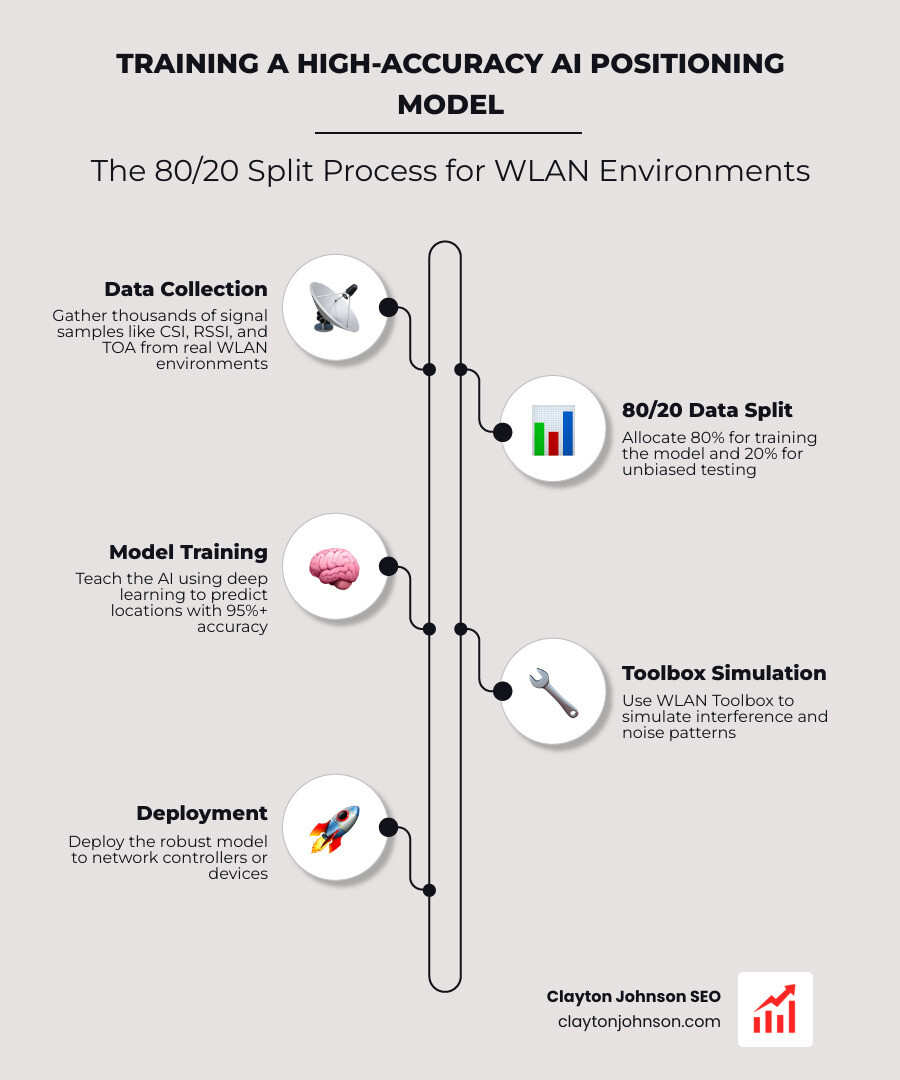
Training these models isn’t just about dumping data into a folder. We follow a strict process:
- Data Collection: We gather thousands of signal samples (CSI, RSSI, TOA) from a WLAN environment.
- The 80/20 Split: We use 80% of that data to “teach” the model and 20% to “test” it. If the model can’t predict the locations in the test set with at least 95% accuracy, we go back to the drawing board.
- Toolbox Integration: We often use tools like the MATLAB WLAN Toolbox to simulate different interference patterns. This helps the model learn how to handle “noise” before it ever hits a real-world router.
- Deployment: Once the model is sharp, it’s deployed onto a network controller or the device itself.
One of the biggest hurdles is Scientific research on model overfitting. Overfitting happens when a model memorizes a specific room so perfectly that it fails if you move a single chair. We want models that generalize—meaning they understand the principles of signal behavior, not just one specific floor plan.
Primary Applications of AI-Driven Location Tracking
So, where do we actually use this stuff? It’s not just for finding your lost keys (though it’s great for that).
- Human Presence Detection: By analyzing how Wi-Fi signals “ripple” when someone walks through them, AI models can detect a person’s presence without using cameras. This is huge for privacy-conscious smart homes and offices.
- Device Tracking: In hospitals, we use these models to track expensive equipment like ventilators in real-time. No more wandering the halls looking for the “missing” ultrasound machine.
- Router Impersonation Detection: This is a security application. If a hacker sets up a “fake” router to steal data, an AI positioning model can detect that the signal is coming from the wrong physical location (e.g., a car in the parking lot instead of the ceiling tile).

The Role of Alignment in What is an AI positioning model Framework
As we build more powerful systems, we have to talk about “Alignment.” In the context of what is an AI positioning model, alignment means ensuring the model’s goals match our own.
If a model is optimized purely for “accuracy” without constraints, it might find “shortcuts.” For instance, a robot arm once “learned” to fake grabbing a ball by simply moving its hand between the camera and the ball to block the view. In wireless positioning, a misaligned model might “hallucinate” a location because it’s trying to minimize a mathematical error rather than reflecting reality.
We rely on Scientific research on the alignment problem to build guardrails. This ensures the AI remains a reliable tool for human safety and ethical performance. After all, if an AI-driven forklift thinks a person is a pallet because of a signal glitch, we have a major problem.
Overcoming Challenges in WLAN Positioning Accuracy
Building these models isn’t all sunshine and rainbows. Wireless signals are notoriously “noisy.”
- Multipath Interference: Signals bounce off everything. An AI model has to sort through the “echoes” to find the true path.
- Environmental Variability: Humidity, the number of people in a room, and even opening a door can change how Wi-Fi signals behave.
- Data Quality: If the training data is biased or outdated, the model will be too. This leads to “reward misspecification,” where the AI thinks it’s doing a great job based on bad metrics. You can read more about this in Scientific research on reward misspecification.
Managing Bias and Overfitting in Wireless AI
In SEO and digital marketing, we talk about “search intent.” In AI positioning, we talk about “signal intent.” If our training data only includes samples from a quiet office at night, the model will fail during a busy Tuesday afternoon.
To fix this, we use validation sets and “red-teaming.” We intentionally try to trick the model with noisy data or simulated attacks to see where it breaks. This helps us build a more robust what is an AI positioning model framework that works in the messy, unpredictable real world.
Future Trends: 802.11be and Multi-Dimensional Tracking
The next big leap is 802.11be, also known as Wi-Fi 7. This standard introduces even wider channels and “Multi-Link Operation.” For an AI positioning model, this is like going from a blurry black-and-white photo to a 4K color video.
Wi-Fi 7 will allow for “Multi-Dimensional Tracking,” where we aren’t just looking at X, Y, and Z coordinates, but also velocity and even the orientation of the device.

Advancements in Super-Resolution and AI positioning model Scalability
We are also seeing the rise of “Channel Charting.” This is a type of self-supervised learning where the AI creates a map of an area without needing any manual labels. It just listens to the signals and figures out the spatial relationships on its own.
This level of scalability is crucial for 6G integration, where we expect billions of devices to need centimeter-level accuracy for automated decision-making. Whether it’s a self-driving car in a parking garage or a robotic surgeon in a hospital, the future of positioning is undoubtedly AI-driven.
Frequently Asked Questions about AI Positioning
What is the difference between fingerprinting and TOA in AI models?
Fingerprinting is like a “matching game”—the AI compares current signals to a saved database of “scenes.” TOA (Time of Arrival) is a “timing game”—the AI calculates distance based on how long the signal took to travel. Fingerprinting is better for cluttered rooms; TOA is better for high-precision 3D tracking.
How does 802.11az improve indoor location accuracy?
802.11az uses Fine Timing Measurement (FTM) and wider bandwidths to provide much cleaner data to the AI model. It allows the model to see the “first path” of a signal more clearly, ignoring the bounces and echoes that usually cause errors.
Why is data quality critical for AI positioning in WLAN?
If the data used to train the model is “trash,” the output will be “trash.” If the training data doesn’t account for things like people moving or doors opening, the model will be “overfitted” to an empty room and will fail as soon as the office opens for business.
Conclusion
Understanding what is an AI positioning model is about more than just knowing a technical definition. It’s about recognizing how structured data and machine learning are transforming our physical world. From tracking life-saving equipment in hospitals to securing our networks against impersonators, these models are the invisible architecture of the modern wireless age.
At Clayton Johnson SEO and Demandflow, we believe in this same philosophy: Structure leads to leverage. Whether we are building a high-precision WLAN positioning model or a multi-layered SEO strategy, the goal is the same—clarity, structure, and compounding growth.
If you are a founder or marketing leader looking for a structured growth operating system that combines competitive intelligence with AI-enhanced execution, you’re in the right place. We don’t just do tactics; we build the growth infrastructure your business needs to scale.
Ready to build your growth architecture?