Audit Your Audience Like a Pro with This Template


Why an SEO Audience Audit Template Is the Missing Piece in Your SEO Strategy
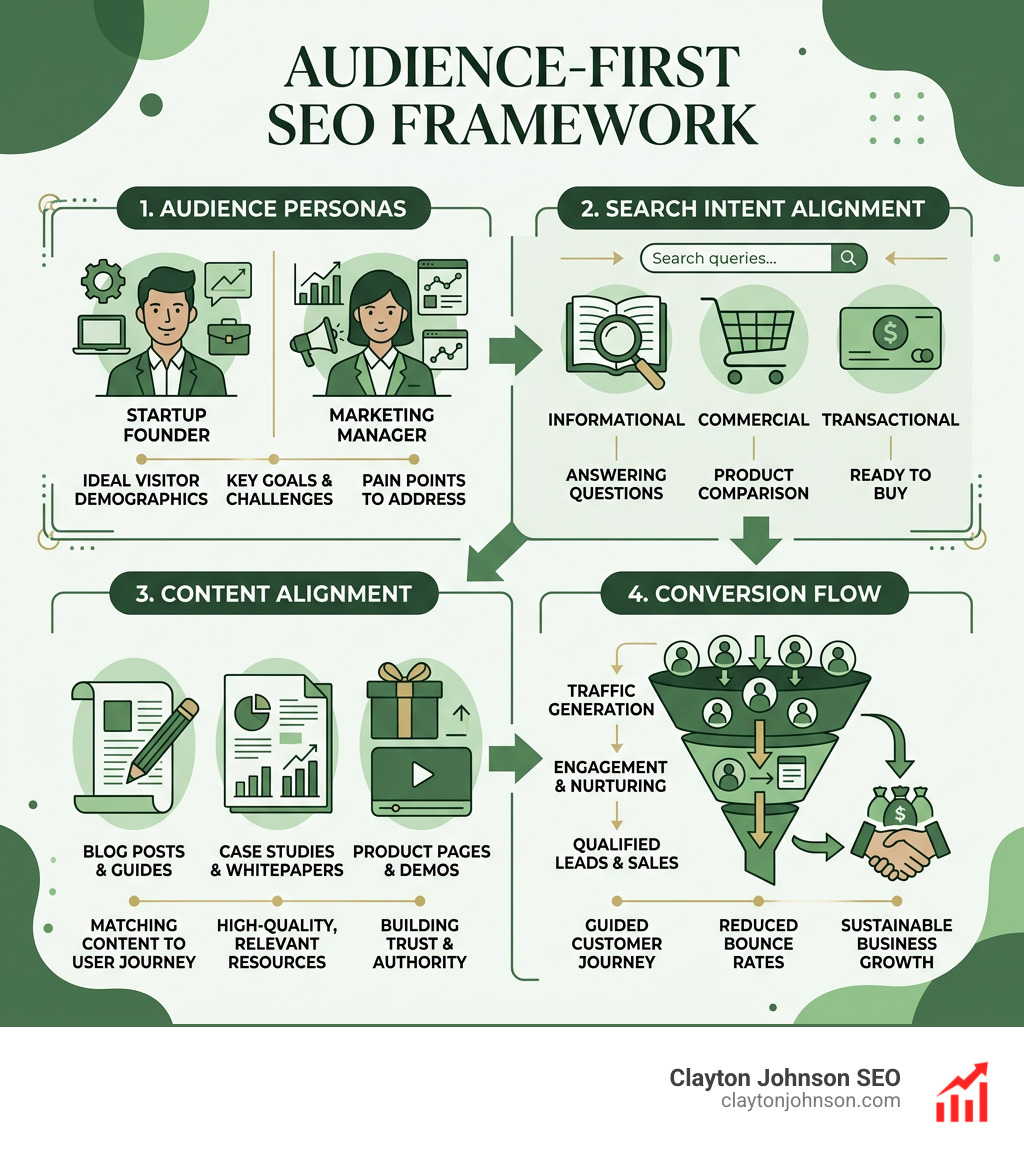
An SEO audience audit template is a structured framework that helps you analyze whether your website is attracting the right people — not just any traffic, but the visitors most likely to become customers.
Here’s what an SEO audience audit template covers at a glance:
| Component | What It Examines |
|---|---|
| Audience personas | Who your ideal visitors are by demographics, goals, and pain points |
| Search intent alignment | Whether your content matches what your audience is actually searching for |
| Traffic quality | Are visitors engaging, converting, or bouncing immediately? |
| Content-audience fit | Where content mismatches are costing you qualified leads |
| Competitor audience overlap | Who else is capturing your ideal customers in search |
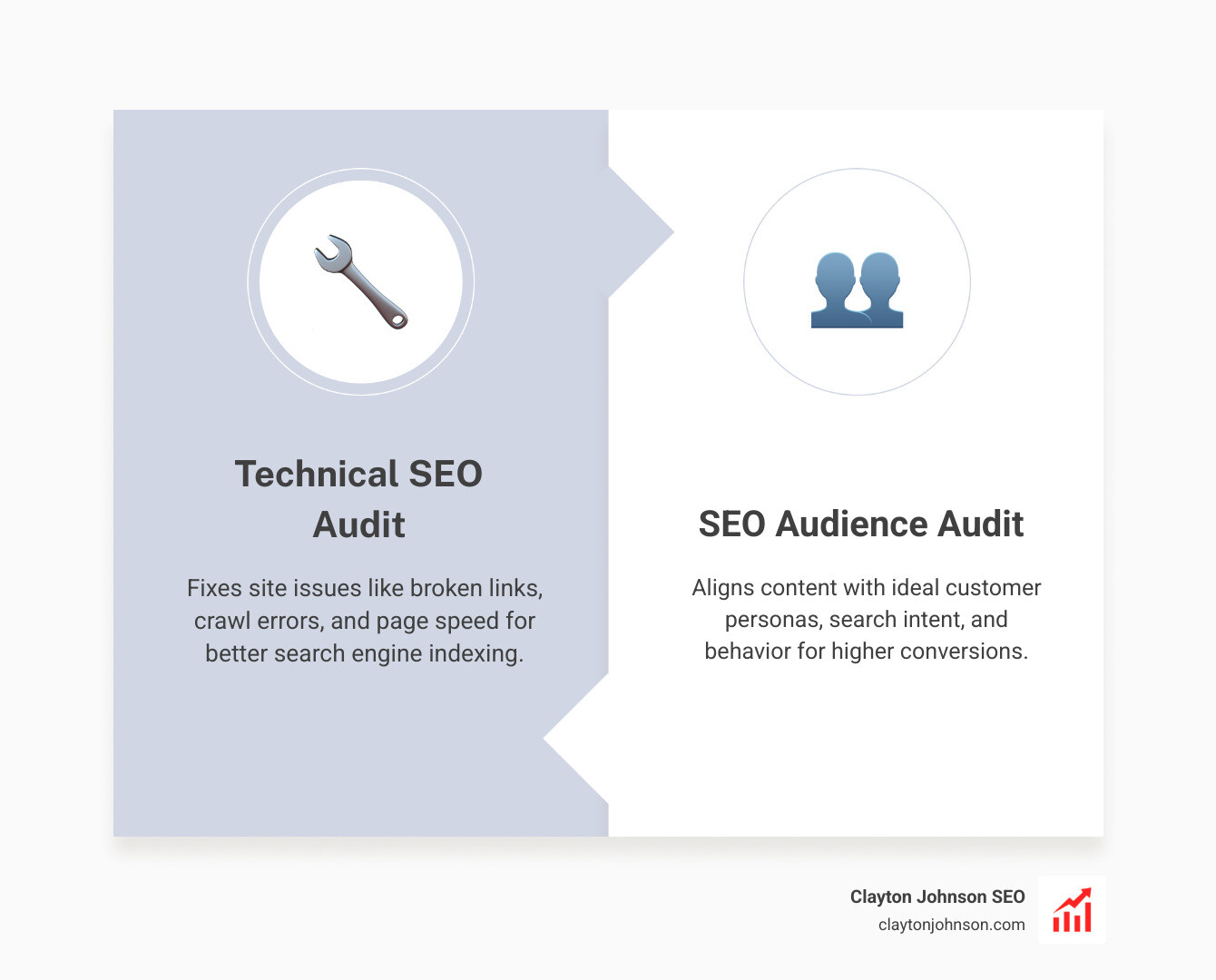
Most SEO audits focus on technical issues — broken links, crawl errors, page speed. Those matter. But they miss a bigger question: even if search engines can read your site perfectly, is your content reaching the right people?
Driving traffic is one thing. Driving the right traffic is another entirely.
That gap between visitors and ideal customers is exactly what an audience-focused audit is designed to close. When your content speaks directly to the people most likely to buy, every other SEO effort compounds faster.
I’m Clayton Johnson, an SEO strategist with nearly two decades of experience building scalable search frameworks for ambitious businesses — and the SEO audience audit template has become one of the most powerful tools in my client growth process. If you want to attract high-quality leads instead of just clicks, this guide will show you exactly how.
Core Components of an SEO Audience Audit Template
When we talk about an SEO audience audit template, we aren’t just looking at a checklist. We are looking at a “treasure map” that leads us to the people who actually want what we are selling. While a technical audit looks at the “plumbing” of your site, an audience audit looks at the “people.”
The core components of a truly effective template include:
- Target Personas: Detailed profiles of your ideal customers.
- Search Behavior Analysis: How these people use Google to find answers.
- Demographic Data: The age, location, and language of your visitors.
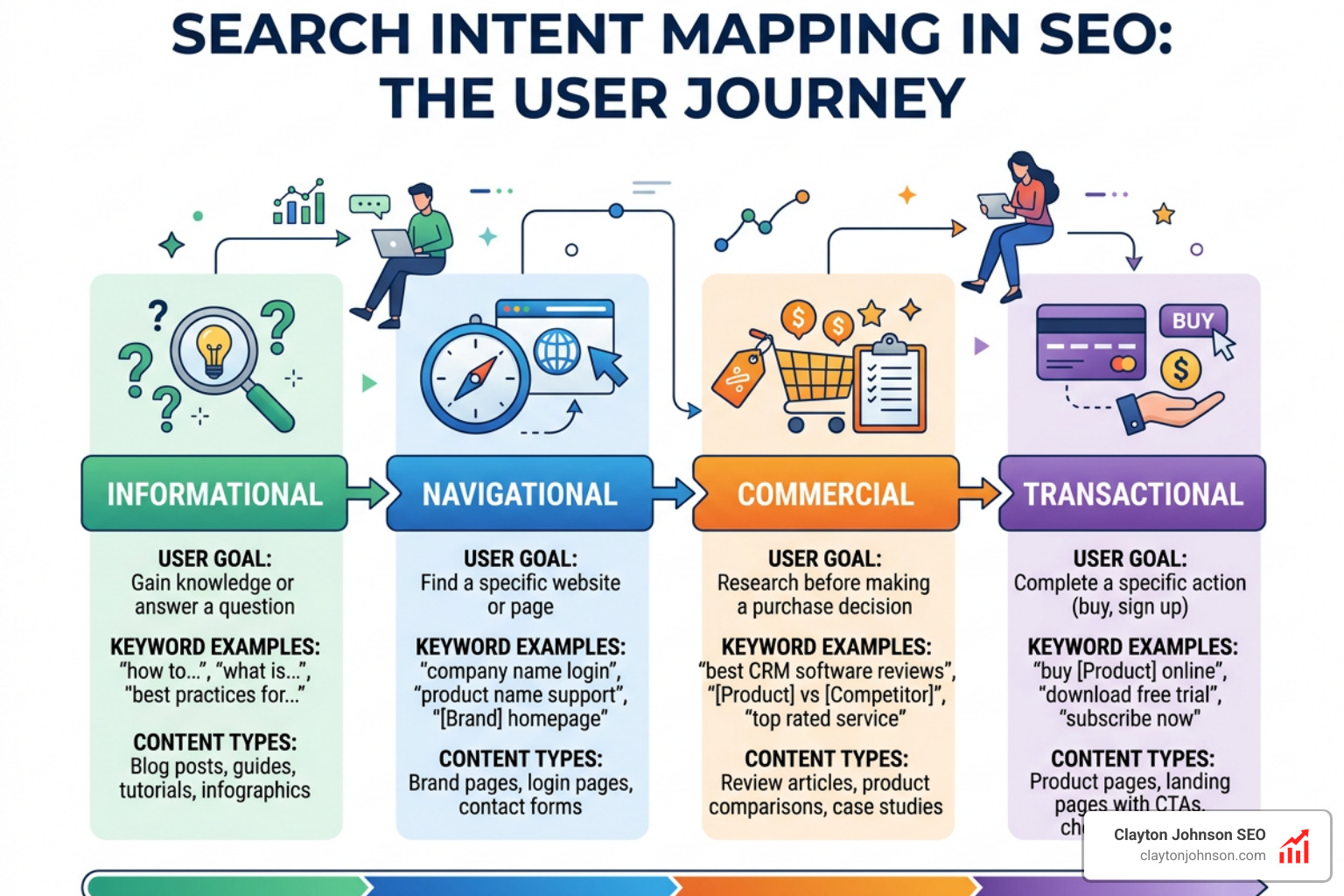
- Intent Mapping: Why they are searching (to learn, to buy, or to find a specific brand).
- Content Mismatch Identification: Spotting pages that attract the wrong crowd.
Statistics show that 53% of all website traffic comes from organic search. However, if that traffic is landing on pages that don’t solve their problems, they will bounce faster than a rubber ball on a trampoline. This is why understanding Google Analytics data through an audience lens is so critical.
Technical SEO vs. Audience Audits: The Key Differences
| Feature | Technical SEO Audit | SEO Audience Audit |
|---|---|---|
| Primary Goal | Search engine crawlability | User relevance and conversion |
| Main Tools | Screaming Frog, Search Console | GA4, Social Insights, AI Analysis |
| Metric Focus | Indexing, Status Codes, Speed | Engagement Rate, Intent, Personas |
| Outcome | Fixed “plumbing” and errors | High-quality, qualified leads |
Identifying Personas within an SEO Audience Audit Template
Identifying your target audience personas is the first real step in our audit framework. We need to move beyond “everyone who needs our service” and get specific. Are we talking to a busy B2B manager looking for efficiency, or a B2C customer looking for a quick emotional win?
In a B2B context, the customer journey is often longer and more complex. We need to audit our content to see if it supports multiple stakeholders. Our B2B SEO audit framework for growing pipelines dives deep into this, but for a general audience audit, we focus on psychographics: their pain points, their goals, and the “why” behind their search.
If you are new to this, starting with SEO 101 can help you understand the basics of how search engines categorize these users, but the SEO audience audit template is where we get into the advanced detective work.
Integrating Data Sources into Your SEO Audience Audit Template
We don’t guess who our audience is; we let the data tell us. A modern SEO audience audit template integrates several high-powered data sources:
- Google Analytics 4 (GA4): This is our primary source for demographics (age, location, interests). We look for mismatches—for example, if our ideal customer is 45+, but our traffic is mostly 18-24, we have a targeting issue.
- Google Search Console (GSC): This tells us the exact queries people use to find us. If they are finding us for “free tips” when we only sell “premium services,” there is an intent gap.
- AI Analysis: We use AI to spot patterns in thousands of rows of data. AI can cluster keywords by intent much faster than a human can. We’ve explored this extensively in our guide on AI-driven SEO audits.
By combining these sources, we create a “coherent growth engine.” Instead of chasing random keywords, we use a keyword strategy that aligns with our actual buyers.
Analyzing Search Intent and Competitor Overlap
Search intent is the “heartbeat” of SEO. If someone searches for “how to fix a sink,” they have informational intent. If they search for “plumber near me,” they have transactional intent.
Your SEO audience audit template must categorize your top-performing pages by intent. Common audience-related SEO issues include:
- Content Mismatch: Providing a sales page when the user wanted a guide.
- Poor Intent Targeting: Ranking for broad terms that bring “looky-loos” instead of buyers.
We also look at competitor audience overlap. Who else is ranking for your ideal keywords? By analyzing their content, we can see what they understand about the audience that we might be missing. Learning how to audit SEO with AI allows us to scrape competitor data and find these “audience gaps” in minutes.
Executing and Presenting Your Audience Audit Findings
Once the audit is complete, the real work begins: implementation. An audit that sits in a folder is useless. We need an actionable SEO roadmap.
When we present findings to stakeholders, we focus on the “Impact vs. Effort” matrix. We prioritize “quick wins”—like adding internal links to high-performing pages or refreshing outdated content—to show immediate ROI.
Using Project Management for Audit Workflows
To keep our team accountable, we often use project management tools like Asana, Trello, or Monday.com. These tools allow us to:
- Assign specific owners to technical fixes.
- Set deadlines for content refreshes.
- Track the status of “Critical” vs. “Low Priority” items.
If you are ready to start, you can grab an SEO template download to see how we structure these projects. For those worried about their site’s current state, diagnosing site health with AI SEO growth diagnostics is a great way to find the biggest hurdles quickly.
Step-by-Step Process for Audience Optimization
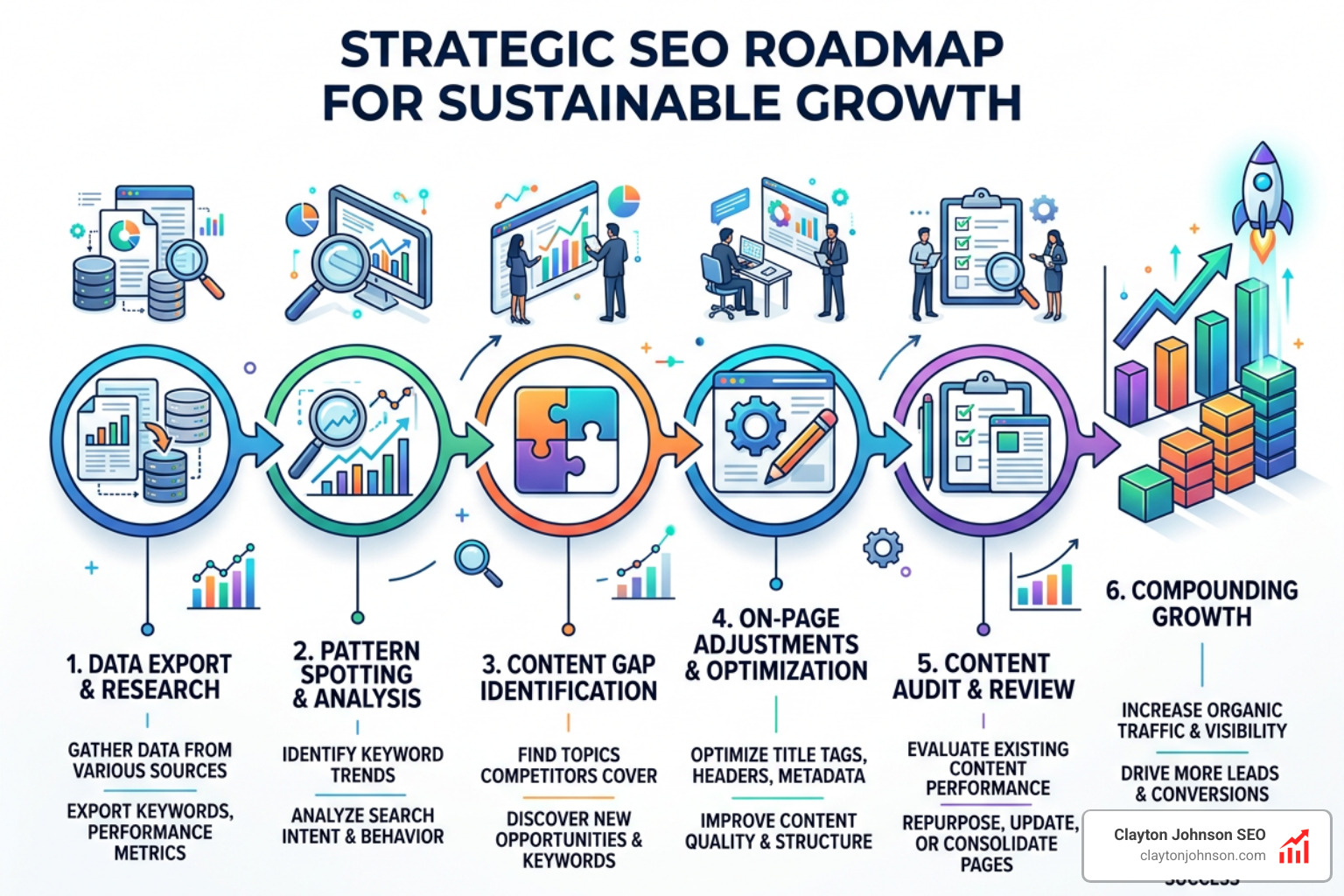
Follow this simple workflow to get the most out of your SEO audience audit template:
- Data Export: Pull your query data from Search Console and your demographic data from GA4.
- Pattern Spotting: Use AI or manual review to find which keywords bring the highest engagement.
- Identify Content Gaps: Find questions your audience is asking that you haven’t answered yet.
- On-Page SEO Adjustment: Update your titles, meta descriptions, and headings to match the intent you discovered.
- Audit Your Content: Use a structured approach to audit your content and prune or refresh low-value pages.
Measuring Engagement and Post-Audit Success
How do we know if the audience audit worked? We look at engagement metrics.
- Bounce Rates: If this drops, it means our content is more relevant to the visitors.
- Dwell Time: The longer they stay, the more they trust us.
- Conversion Tracking: This is the ultimate metric. Are more people signing up or buying?
Technical performance still matters for engagement. A delay of just one second in page load time can reduce conversions by up to 20%. We always check our speed via PageSpeed Insights as part of our final validation.
Scaling Growth with Clayton Johnson SEO Systems
At Clayton Johnson SEO, we believe in building durable systems, not just chasing temporary tactics. Our philosophy is simple: Clarity → Structure → Leverage → Compounding Growth.
We help founders and operators turn fragmented marketing efforts into coherent growth engines. By focusing on search intent modeling and taxonomy-driven content ecosystems, we ensure your SEO isn’t just a “task” but a scalable traffic system.
Whether you need professional SEO services or a structured strategy framework to run your own team, we provide the tools and the expertise to make it happen.
Frequently Asked Questions
What is an SEO audience audit template and why is it essential?
It is a framework used to evaluate how well your website attracts and serves your ideal customer. It is essential because ranking for the “wrong” keywords leads to high traffic with zero sales.
How does an SEO audience audit differ from a technical audit?
A technical audit fixes site errors (like broken links and slow speed). An audience audit fixes “relevance” errors (like content that doesn’t match what users want to find).
Who benefits most from using an SEO audience audit template?
Marketers, agency teams, and e-commerce managers benefit most. It helps them stop wasting budget on content that doesn’t convert and focuses their energy on high-intent users.
How often should an SEO audience audit be conducted?
We recommend a deep dive every quarter. However, you should monitor your “Branded Keywords” and “Top Landing Pages” monthly to ensure no sudden drops in traffic quality.
What actionable recommendations typically come from this template?
Typical actions include:
- Rewriting titles to better match search intent.
- Creating “Content Clusters” around specific audience pain points.
- De-indexing low-value pages that attract unqualified traffic.
- Improving internal linking to guide users through their buyer journey.
How can AI enhance modern SEO audience audits?
AI can analyze massive datasets to find “hidden” audience segments, predict search intent for thousands of keywords at once, and even suggest content outlines that specifically target those personas.
What are common audience-related SEO issues?
The most common is “Content Mismatch”—where a site ranks for a high-volume keyword but provides information that doesn’t help the person who searched for it. Another is “Intent Mismatch,” where you target a “Buy” keyword with a “How-To” guide.
How can the template be customized for B2B vs. Local business?
For B2B, the template focuses on decision-maker personas and longer educational funnels. For Local SEO, the template emphasizes NAP consistency (Name, Address, Phone) and location-specific intent (e.g., “near me” searches).
Final Thoughts on Audience Auditing
Auditing your audience is the difference between being a “noise maker” and a “solution provider.” When 70% of marketers say producing engaging content is their biggest challenge, the SEO audience audit template gives you the clarity to stop guessing.
By focusing on the intersection of technical depth, search intent, and AI-enhanced workflows, you can build a website that doesn’t just rank—it grows your business.
Ready to build your growth engine? Let’s get to work.