Beat the Competition with AI Analysis

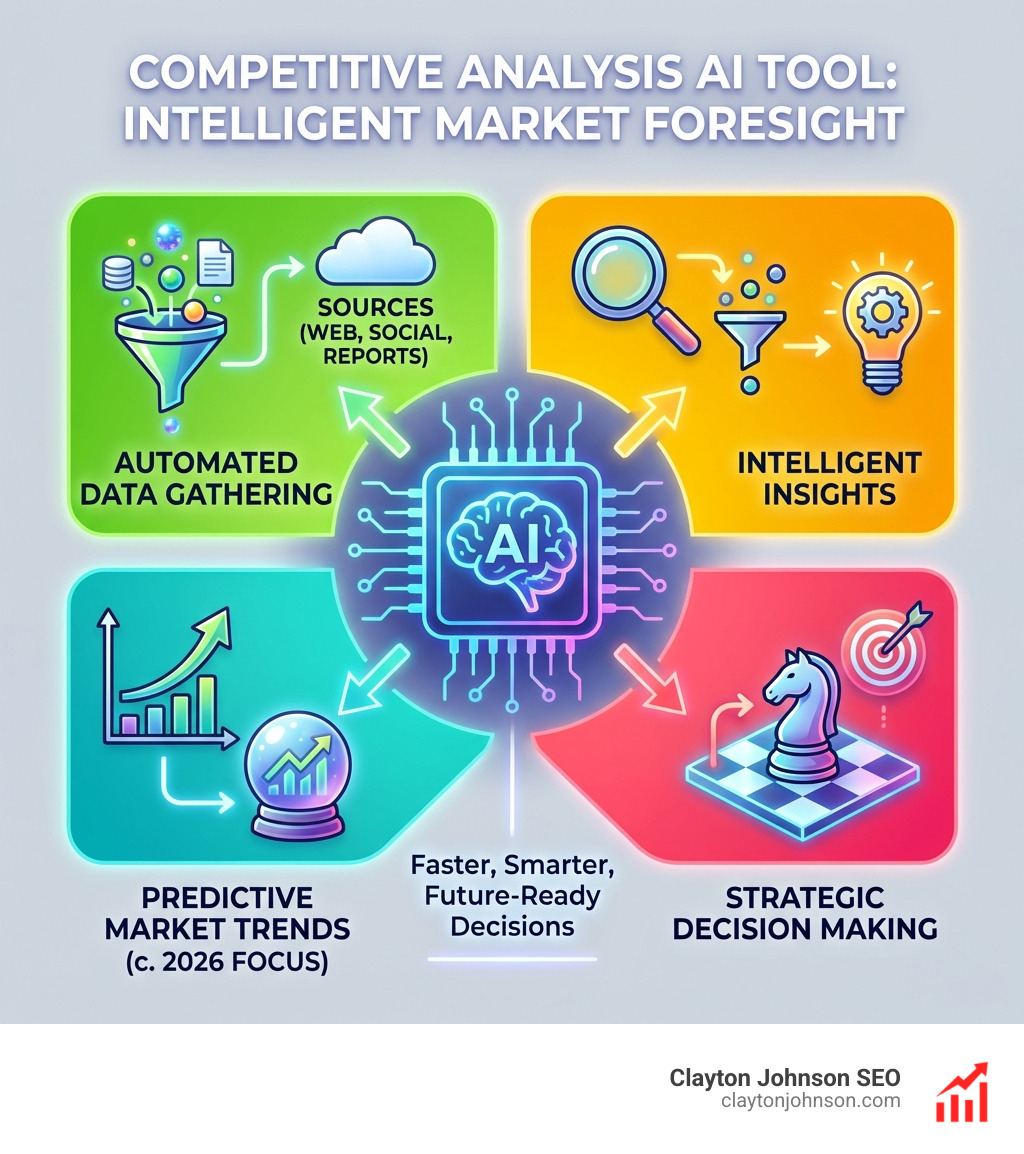
Why Knowing Your Competitors’ Every Move Is a Strategic Superpower
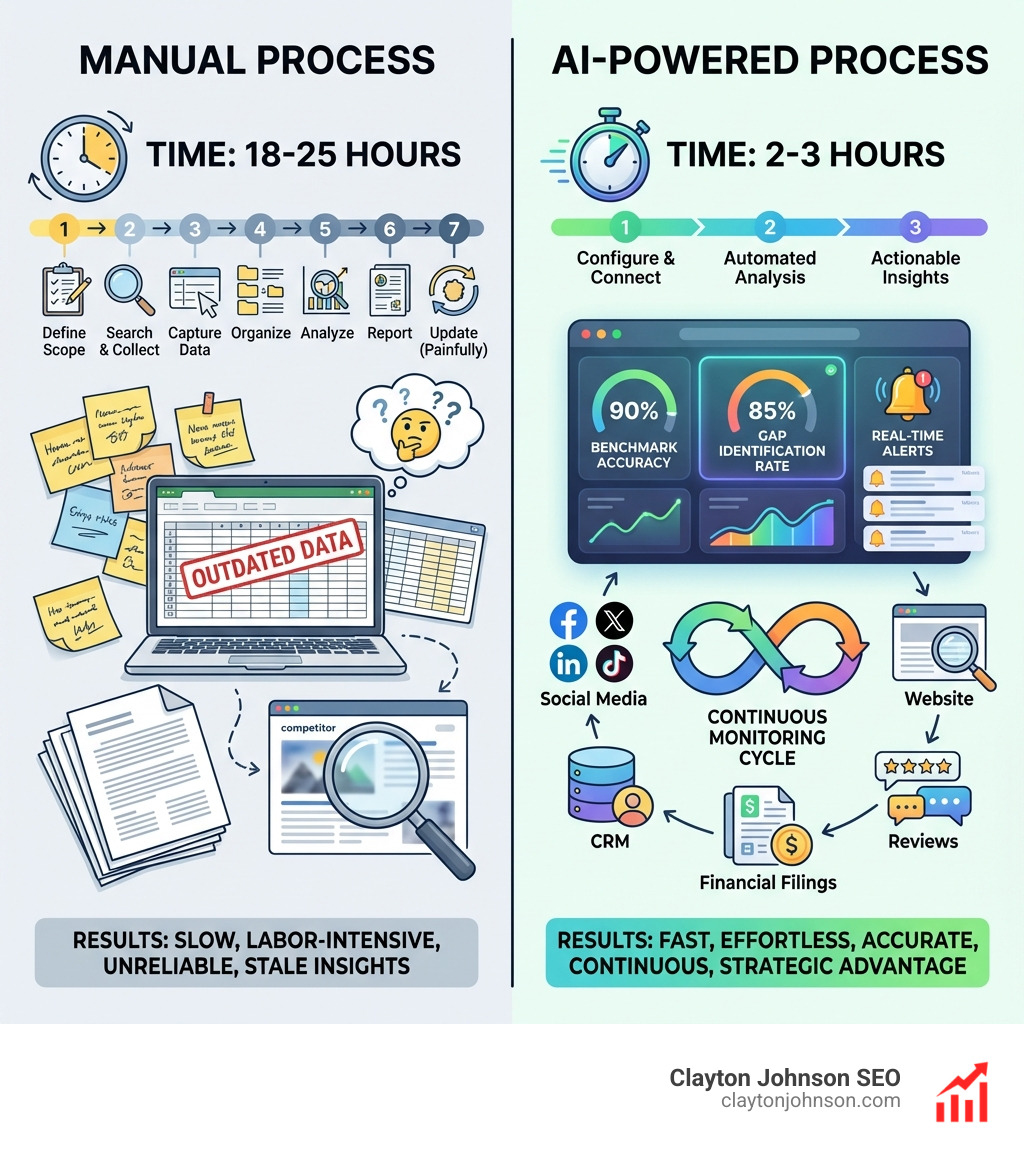
A competitive analysis AI tool can replace weeks of manual research with a 2–3 hour automated pipeline — delivering insights on pricing, messaging, features, and market positioning across your entire competitor set.
Here’s what the best AI competitive analysis tools do:
| Capability | What You Get |
|---|---|
| Automated data collection | Competitor websites, reviews, social media, filings |
| Real-time monitoring | Alerts when competitors change pricing or messaging |
| Gap identification | ~85% gap identification rate vs. manual methods |
| SWOT generation | Structured strengths, weaknesses, opportunities, threats |
| Continuous updates | Re-analysis every 2–4 weeks without manual effort |
Staying ahead of your competitors used to mean weeks of painful manual research — spreadsheets, screenshots, and gut instinct. And by the time you finished, half the data was already outdated.
That’s not strategy. That’s archaeology.
The stakes are real. One hour of competitive analysis can save days or weeks of misdirected product development. Yet most founders and marketing leaders still skip it — or do it once a quarter at best — because the manual process simply doesn’t scale.
AI changes that equation entirely. Instead of drowning in tabs, you can now process hundreds of competitor data points in minutes, spot hidden patterns, and get real-time alerts when a rival makes a move.
I’m Clayton Johnson — SEO strategist and growth operator. I’ve built AI-augmented competitive intelligence workflows for founders and marketing leaders across dozens of business models, and I use every major competitive analysis AI tool covered in this guide inside my own systems. In the sections ahead, I’ll walk you through exactly how to use AI to turn competitive pressure into strategic leverage.
Quick competitive analysis ai tool definitions:
- AI Powered SEO Strategy
- AI SEO Performance Tracker
- Intelligent Automation Tools
Why Every Modern Strategy Needs a Competitive Analysis AI Tool
In the past, competitive intelligence was a luxury for enterprise companies with massive budgets. Today, a competitive analysis AI tool levels the playing field for startups and mid-market companies. The efficiency gains are staggering: teams can replace an 18–25 hour manual process with a 2–3 hour automated pipeline.
Beyond just speed, the quality of intelligence improves. AI-driven models regularly achieve ~90% benchmark accuracy and 95% completeness. When you stop guessing and start using verified data, your strategic architecture becomes “audit-ready.” You move from reactive “firefighting” to proactive market leadership by understanding how to think about competitive pressure through a data-driven lens.
How AI Competitive Analysis Differs from Traditional Research
Traditional research is static. You build a PowerPoint deck, present it, and it immediately begins to gather digital dust. AI-driven analysis is a “living” ecosystem.
A recent McKinsey survey on the state of AI adoption found that 50% of respondents have adopted AI in at least one business function. In competitive intelligence, this shift manifests in three ways:
- Real-time updates: Instead of quarterly check-ins, AI monitors competitor sites daily.
- Pattern recognition: AI identifies shifts in messaging or pricing that a human might miss across 50+ pages.
- Unbiased insights: AI provides a fresh, unemotional perspective, preventing the “blind spots” we often have for our own brands.
Primary Benefits of a Competitive Analysis AI Tool
The most immediate benefit is time. Tools like Competely typically save 30 to 60 work hours per month for a typical business. But the true value lies in opportunity mapping.
AI tools achieve an 85% gap identification rate. This means you can finally stop letting your rivals win by identifying the high-intent keywords and product features they have neglected. This scalability allows you to monitor 10 or 20 competitors with the same effort previously required for two.
A 5-Step Framework for AI-Powered Competitive Intelligence

To get the most out of any competitive analysis AI tool, you need a structured process. At Demandflow, we believe clarity precedes leverage. You shouldn’t just “plug in a tool” and hope for the best; you need to integrate it into your strategic frameworks.
Here is the workflow we recommend to turn raw data into a compounding growth asset:
| Step | Manual Workflow (Old Way) | AI-Augmented Workflow (New Way) |
|---|---|---|
| Data Collection | Manual browsing & copy-pasting | Automated web crawling & API hooks |
| Analysis | Subjective “gut feeling” | Pattern recognition & sentiment scoring |
| Reporting | Static PDF/Slide deck | Live dashboards & automated alerts |
| Updates | Happens once a year (maybe) | Continuous monitoring every 2 weeks |
Step 1: Define Intelligence Goals and Scope
Before you open a single tab, define what you are trying to solve. Are you identifying pricing gaps? Predicting a product launch? Or performing a broad market analysis to find your unique positioning?
We recommend selecting 3–5 direct competitors and 2 “aspirational” leaders. Map these against your revenue goals to ensure the intelligence you gather is actually actionable.
Step 2: Gather Multi-Channel Data with a Competitive Analysis AI Tool
Once your scope is set, let the AI do the heavy lifting. Start with a sitemap analysis to understand the scope of their content. A pro tip: give your reports to an AI whenever you see an export button. Whether it’s a Semrush keyword report or a Google Analytics export, ask the AI to find the anomalies.
Leverage platforms like Crayon or Brandwatch for social listening and digital footprint tracking. This allows you to see not just what they say on their website, but how the market responds to them in real-time.
Step 3: Analyze and Score Competitor Performance
Data is useless without context. Use AI to perform a “blind” SWOT analysis. AI models like ChatGPT or Claude can ingest competitor homepages and summarize their core value proposition in seconds.
To go deeper, learn how to score your brand using AI-powered benchmarking. You can analyze customer sentiment from ReviewTrackers or G2 to find out exactly where your competitors are failing their customers. If a rival has a 2-star rating for “customer support,” that is your immediate entry point for a conquest campaign.
Step 4: Visualize Insights for Strategic Planning
Raw AI analysis often comes in the form of massive spreadsheets. To make this useful for your team, you must visualize it. We use a strategy canvas to map our features against the competition.
Tools like Miro offer AI-powered templates for Porter’s Five Forces and Strategic Group Mapping. This turns “data points” into “decision points,” allowing stakeholders to see the “white space” in the market at a glance.
Step 5: Continuous Monitoring and Real-Time Updates
Static reports age quickly. The final step is setting up “agentic workflows”—AI agents that live in the background and monitor for changes.
By using AI competitive insights that refresh every 2–4 weeks, you ensure your sales battlecards are always current. When a competitor changes their pricing page in Minneapolis, your team should know about it within 24 hours, not three months later.
Leveraging AI for SEO, Content, and Messaging Dominance

SEO is no longer just about keywords; it’s about “AI visibility.” If your brand isn’t appearing in Google AI Overviews or being cited by ChatGPT, you are becoming invisible. A competitive analysis AI tool is essential for maintaining your search footprint.
Analyzing Competitor Messaging and Persona Alignment
Does your messaging actually land with your Ideal Client Profile (ICP)? You can use an AI persona prompt to “roleplay” as your customer and browse your competitor’s site.
We recommend using screen capture tools like Snagit to give the AI a full-page view of homepages. This is one of three ways to give AI a page, and it’s the most effective because the AI can “see” visual trust seals and layout hierarchy. Once you have the data, use this guide for homepages to ensure your positioning themes outperform the competition.
Uncovering Content Gaps and SEO Opportunities
The most common mistake in content marketing is “copycatting.” If you only write what your competitors write, you’ll never build authority. Use AI to analyze competitor sitemap.xml files to identify:
- Topic Clusters: What areas are they trying to own?
- Content Gaps: What questions are customers asking that they haven’t answered?
- Authority Signals: Which external domains are citing them in AI-generated answers?
By identifying “Missing Prompts”—queries where competitors appear in AI answers but you don’t—you can create a targeted content blueprint to steal that visibility.
Frequently Asked Questions about AI Competitive Analysis
How accurate is AI-driven competitive analysis?
With normalized inputs and source verification, AI-driven benchmarks typically reach ~90% accuracy. However, “hallucinations” are possible. We always recommend a human-in-the-loop approach where a strategist verifies the AI’s “first draft” before making major budget shifts.
What are the common pitfalls of using AI for research?
The biggest risk is tool over-reliance and data privacy. Never upload non-public, sensitive company data to a public AI model. Additionally, AI can sometimes miss subtle contextual nuances—like a competitor’s pivot that hasn’t been fully reflected on their website yet.
How often should I refresh my competitor data?
For high-volatility segments like paid search or pricing, weekly refreshes are ideal. For broader strategic planning and messaging audits, a monthly or quarterly cadence is sufficient. Most competitive analysis AI tool platforms allow you to automate these refreshes so you get a “brief” in your inbox without lifting a finger.
Conclusion
Competitive intelligence is no longer a “one-and-done” project; it is a compounding strategic asset. By leveraging a competitive analysis AI tool, you move from a position of uncertainty to one of structured leverage.
At Clayton Johnson SEO and Demandflow, we help businesses build this “growth infrastructure.” We don’t just provide tactics; we provide the systems—from taxonomy-driven SEO to AI tools for growth—that allow you to outpace your rivals.
Ready to turn your competitor’s data into your growth roadmap?
Search visibility today requires more than just ranking; it requires authority across the entire AI and organic ecosystem.
Why SEO Still Matters — Especially in the Age of AI
Search has changed. Google now delivers AI-generated answers, AI Overviews, and conversational search results directly in the SERPs. If your business isn’t visible in:
- Traditional organic rankings
- Google AI Overviews
- Generative AI search experiences (ChatGPT, Gemini, Perplexity)
You are invisible where decisions are being made. Modern SEO helps you build trust, authority, and brand legitimacy while generating compounding inbound demand.
Clayton Johnson SEO Scalable Authority Retainer Framework
Each retainer applies to a single domain and focuses on building the structured growth architecture you need to win.
- Foundation Authority — $1,997 / month
- 1 DR45+ PR link per month, 2 Done-for-You articles.
- Focus: Baseline ranking and initial AI eligibility.
- Growth Authority — $2,997 / month
- 2 DR45+ PR links per month, 4 Done-for-You articles.
- Focus: Increased link velocity and expanded cluster depth.
- Competitive Authority — $3,997 / month
- 3 DR45+ PR links per month, 6 Done-for-You articles.
- Focus: Multi-cluster ranking expansion and AI Overview positioning.
- Market Leader Authority — $9,997 / month
- 10 DR45+ PR links per month, 20 Done-for-You articles.
- Focus: Competitive displacement and durable market dominance.
Clarity → Structure → Leverage → Compounding Growth.
Let’s build your structured growth architecture today. Whether you are based in Minneapolis or scaling nationally, the AI-first competitive landscape is forming right now. Don’t let your rivals own the future.