Wealth Manager SEO


Why SEO Is the Highest-ROI Growth Channel for Wealth Managers
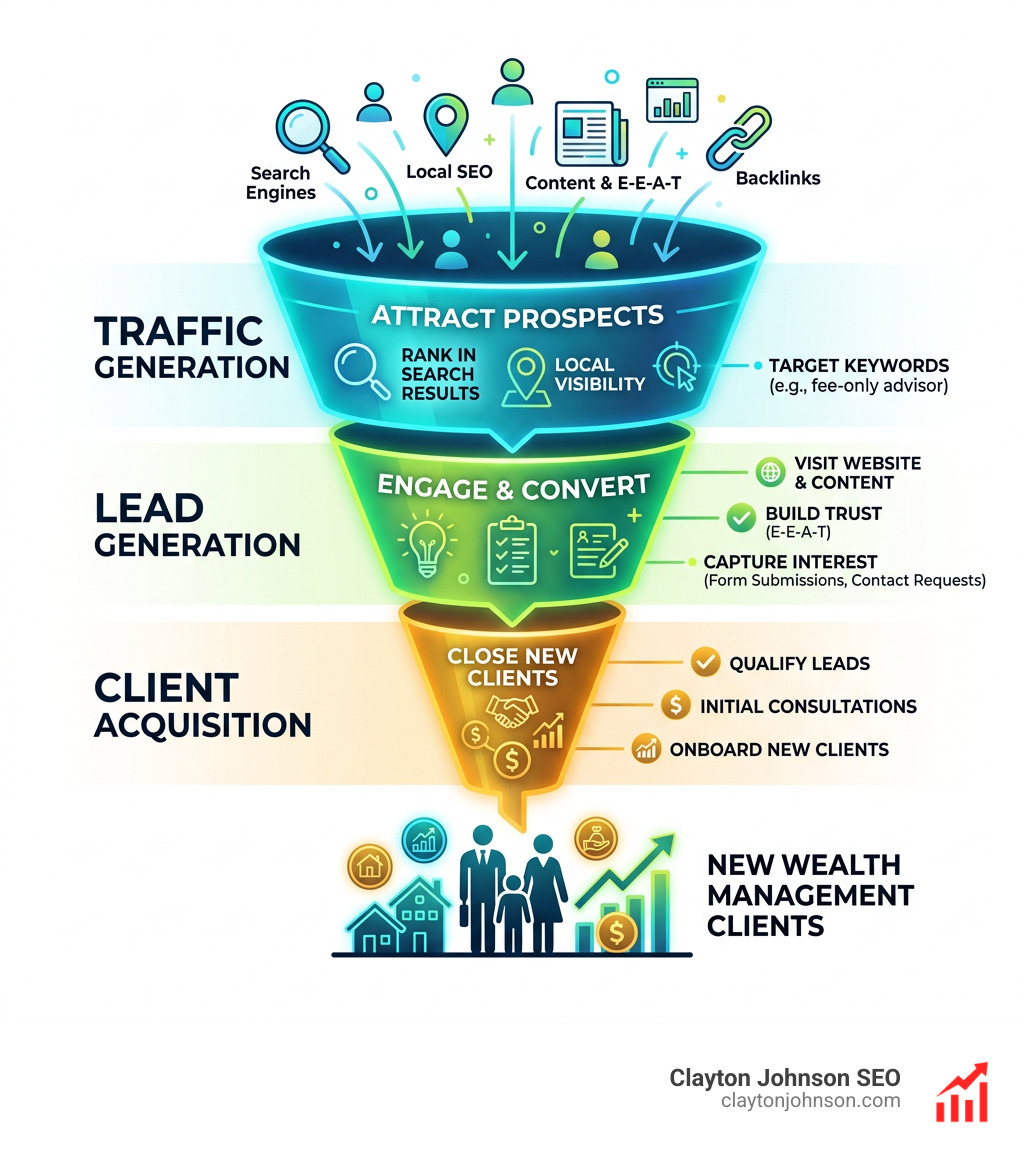
SEO for wealth managers is the practice of optimizing your firm’s online presence so high-net-worth prospects find you when they search for financial guidance — before they ever call a competitor.
Here’s what that looks like in practice:
| SEO Element | What It Does for Wealth Managers |
|---|---|
| Local SEO | Puts your firm in front of prospects searching “financial advisor near me” |
| Keyword Strategy | Targets high-intent searches like “fee-only advisor in [city]” |
| Content & E-E-A-T | Builds trust and authority with Google and prospective clients |
| Technical SEO | Ensures your site loads fast, ranks well, and converts visitors |
| Backlinks | Signals credibility through authoritative third-party citations |
| AI Search Optimization | Positions your firm inside AI-generated answer summaries |
The opportunity is significant — and largely untapped. Only 22% of financial advisors currently use SEO as part of their marketing strategy, despite it having the lowest client acquisition cost of any marketing channel. Meanwhile, the keyword “financial advisor” attracts over 130,000 monthly searches. Most of that traffic flows to whoever shows up on page one. Only 7% of searchers ever go to page two.
SEO works differently than paid ads. When you stop paying for ads, the traffic stops. With SEO, the content and authority you build compounds over time — generating qualified leads months and years after the initial investment. One wealth management firm generated over $2.8M in annual recurring revenue from a $300,000 SEO investment over five and a half years. That’s not a campaign. That’s infrastructure.
The challenge for wealth managers is that the competitive landscape online is steep. Broad keywords like “wealth management” are dominated by national aggregators. The firms that win are the ones that get specific — targeting niche client types, local geographies, and high-intent long-tail queries that convert.
I’m Clayton Johnson, an SEO strategist and growth architect who specializes in building scalable, system-level search strategies — including SEO for wealth managers who want to grow beyond referrals and into a durable demand engine. This guide gives you the full framework, from local SEO to AI-driven search, structured for practical execution.
The Core Pillars of SEO for Wealth Managers
To understand how to rank, we first need to understand how search engines “think.” Google uses automated programs called crawlers to browse the web, index pages, and determine which ones provide the most value to users. For wealth managers, this isn’t just about keywords; it’s about proving you are a legitimate, trustworthy fiduciary.
Effective SEO for wealth managers rests on four distinct pillars:
- On-Page SEO: Optimizing the visible elements of your website, such as your headlines, body text, and images.
- Off-Page SEO: Building your firm’s reputation through external signals like backlinks and social media mentions.
- Technical SEO: The “under the hood” work that ensures search engines can find, read, and index your site without errors.
- Content SEO: Creating high-quality, educational material that answers the specific questions your ideal clients are asking.
Following Google’s guidelines is the best way to ensure long-term success. Google’s goal is to provide the best possible answer to a user’s query. If your website is the most helpful, clear, and authoritative source, you will naturally climb the rankings.
Local SEO for Wealth Managers: Dominating Your Geographic Niche
Most high-net-worth individuals (HNWIs) still prefer working with someone they can meet in person. This makes local SEO the “low-hanging fruit” of SEO for wealth managers. If you are a firm in Minneapolis, you don’t need to outrank Fidelity nationally; you just need to own the search results in the Twin Cities.
The cornerstone of local search is your Google Business Profile. This is the listing that appears in the “Map Pack” at the top of search results. To optimize it:
- Claim and Verify: Ensure you have full control over your listing.
- NAP Consistency: Your Name, Address, and Phone number (NAP) must be identical across your website, social media, and directories like Bing Places for Business.
- Encourage Reviews: Positive, compliant reviews are a major ranking signal.
- Post Updates: Share market commentary or firm news directly to your profile.
For firms with multiple offices, creating regional landing pages is essential. If you offer minneapolis-seo or financial planning in specific suburbs, dedicated pages with local landmarks and community-specific tax info can help you capture hyper-local traffic.
High-Intent Keyword Strategies for Wealth Management Firms
Keywords are the bridge between what people are searching for and the content you provide. However, many advisors make the mistake of chasing “vanity keywords” with high volume but low intent.
At Clayton Johnson SEO, we utilize The Ultimate Guide to Keyword Strategy to help firms identify “long-tail keywords.” While “financial advisor” (165,000 searches/month) is highly competitive, a phrase like “wealth management for tech executives in Minneapolis” has lower volume but much higher intent. These searchers are ready to talk.
To find these gems, start with free tools like the Google Keyword Planner to see what people are actually typing. For deeper insights into what your competitors are ranking for, Moz Keyword Explorer provides difficulty scores that tell you how hard it will be to reach page one.
Content Strategy and E-E-A-T for Financial Advisors
In the eyes of Google, wealth management falls under the “Your Money or Your Life” (YMYL) category. Because your advice can significantly impact a person’s financial well-being, Google holds your content to much higher standards, known as E-E-A-T: Experience, Expertise, Authoritativeness, and Trustworthiness.
Our services/seo-content-marketing/ focus on building topical authority. This means instead of writing random blog posts, you create “content clusters.” You might have a pillar page on “Retirement Planning” that links to specific articles on 401(k) rollovers, Social Security timing, and Roth conversions.
To satisfy Google’s YMYL standards, your content should:
- Feature Credentials: Highlight CFP® or CFA designations prominently.
- Cite Sources: Link to official sites like the IRS or FINRA.
- Be Compliant: Ensure all content passes through your compliance team to meet SEC marketing rules regarding testimonials and disclosures.
Technical SEO for Wealth Managers: Speed and Security
You can have the best content in the world, but if your site takes ten seconds to load, nobody will read it. In fact, research shows that conversion rates decrease by 0.3% for every additional second it takes for a page to load.
Key technical factors include:
- Core Web Vitals: Google’s metrics for measuring user experience, including loading speed and visual stability. You can check yours using PageSpeed Insights.
- Mobile Optimization: Over half of all searches happen on mobile. Your site must be responsive and easy to navigate on a smartphone.
- Security (HTTPS): For financial firms, a secure site is non-negotiable. Google will actively warn users away from sites without an SSL certificate.
- Site Architecture: A logical hierarchy makes it easier for both users and crawlers to find information.
Once your site is updated, make sure to submit a sitemap to Google. This acts as a map for search engines, ensuring they index every important page on your site. For a deeper dive into these basics, visit our seo-101/ guide.

Backlinks and Off-Page Authority Building
If on-page SEO is what you say about yourself, off-page SEO is what the rest of the world says about you. The most important factor here is backlinks — links from other websites to yours. Think of a backlink as a “digital referral.”
Not all links are created equal. A link from the NAPFA directory or a major financial publication carries much more weight than a link from a local hobbyist blog. Our services/seo-services/ often include digital PR strategies to help wealth managers earn these high-authority mentions.
Ways to build authority include:
- Guest Posting: Writing educational articles for industry sites.
- Local Sponsorships: Getting listed on the websites of local charities or Chambers of Commerce.
- Expert Commentary: Responding to media requests from journalists looking for financial experts.
Measuring ROI and AI-Driven Search Trends
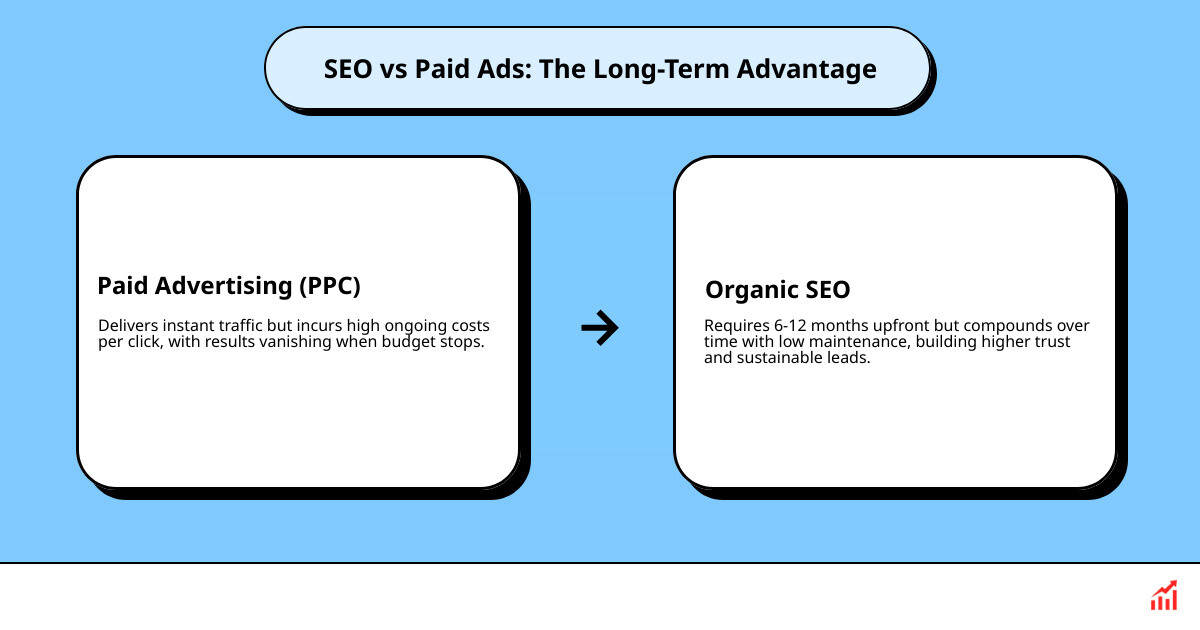
One of the most common questions we hear is: “How does SEO compare to paid advertising?” While paid ads (PPC) provide immediate traffic, SEO offers a significantly lower Client Acquisition Cost (CAC) over time.
| Feature | Paid Advertising (PPC) | SEO for Wealth Managers |
|---|---|---|
| Speed | Instant | 6–12 months |
| Cost | High (Cost-per-click) | Upfront investment, low maintenance |
| Sustainability | Stops when budget ends | Compounds over time |
| Trust | Lower (it’s an ad) | Higher (organic authority) |
As we look toward the future, AI is changing the search landscape. With ChatGPT reaching 800 million weekly users, and Google introducing AI Overviews, wealth managers must optimize for “answer engine” visibility. This means using structured data (schema markup) and answering questions directly and concisely within your content.
To track your success, we use services/analytics-data/ to monitor organic sessions, keyword rankings, and — most importantly — lead conversions. SEO isn’t just about traffic; it’s about how many qualified prospects are booking calls through your site.
Conclusion: Building Your Growth Infrastructure
SEO is not a one-time project; it is a long-term investment in your firm’s growth infrastructure. In an industry built on trust and long-term relationships, appearing at the top of search results is the ultimate digital endorsement.
At Clayton Johnson SEO, we believe that most companies don’t lack marketing tactics — they lack a structured growth architecture. Through Demandflow.ai, we provide the frameworks and AI-augmented workflows necessary to turn your website into a lead-generating machine.
Whether you are a solo advisor in Minneapolis or a multi-state RIA, the steps remain the same: optimize for your local community, answer your clients’ most pressing questions with authority, and ensure your technical foundation is rock solid.
Ready to move beyond word-of-mouth and build a predictable engine for attracting high-net-worth clients? Explore our services/seo-services/ and let’s start building your firm’s digital legacy.