Why Agency Email Service Retainers Are the Growth Engine You’re Ignoring
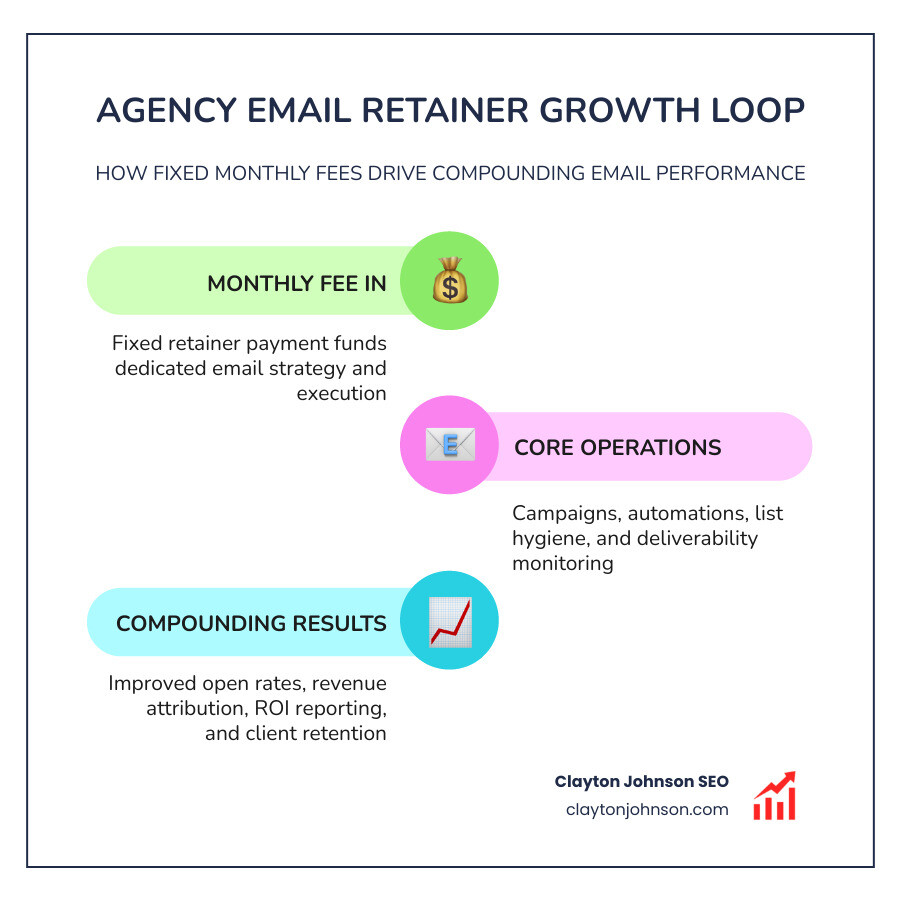
Agency email service retainers are recurring monthly agreements where a client pays a fixed fee for ongoing email marketing strategy, execution, and optimization — instead of paying per project or per hour.
Here’s a quick breakdown of what that means in practice:
| Model | How It Works | Best For |
|---|---|---|
| Retainer | Fixed monthly fee for ongoing services | Agencies wanting predictable revenue |
| Project-based | One-time fee per campaign or deliverable | Clients with occasional needs |
| Hourly | Pay per hour of work completed | Simple, low-volume work |
The fast answer: A retainer locks in a defined scope of email services — campaigns, automations, list management, reporting — for a predictable monthly price. It beats project work because it creates stable cash flow, deeper client relationships, and compounding email performance over time.
Most agencies live in a feast-or-famine cycle. 🎢 One month you’re drowning in projects. The next, you’re chasing new clients to cover payroll.
Email marketing is one of the few channels that genuinely rewards continuity. Automations compound. Lists improve. Deliverability strengthens. Strategy gets sharper. None of that happens in a one-off campaign.
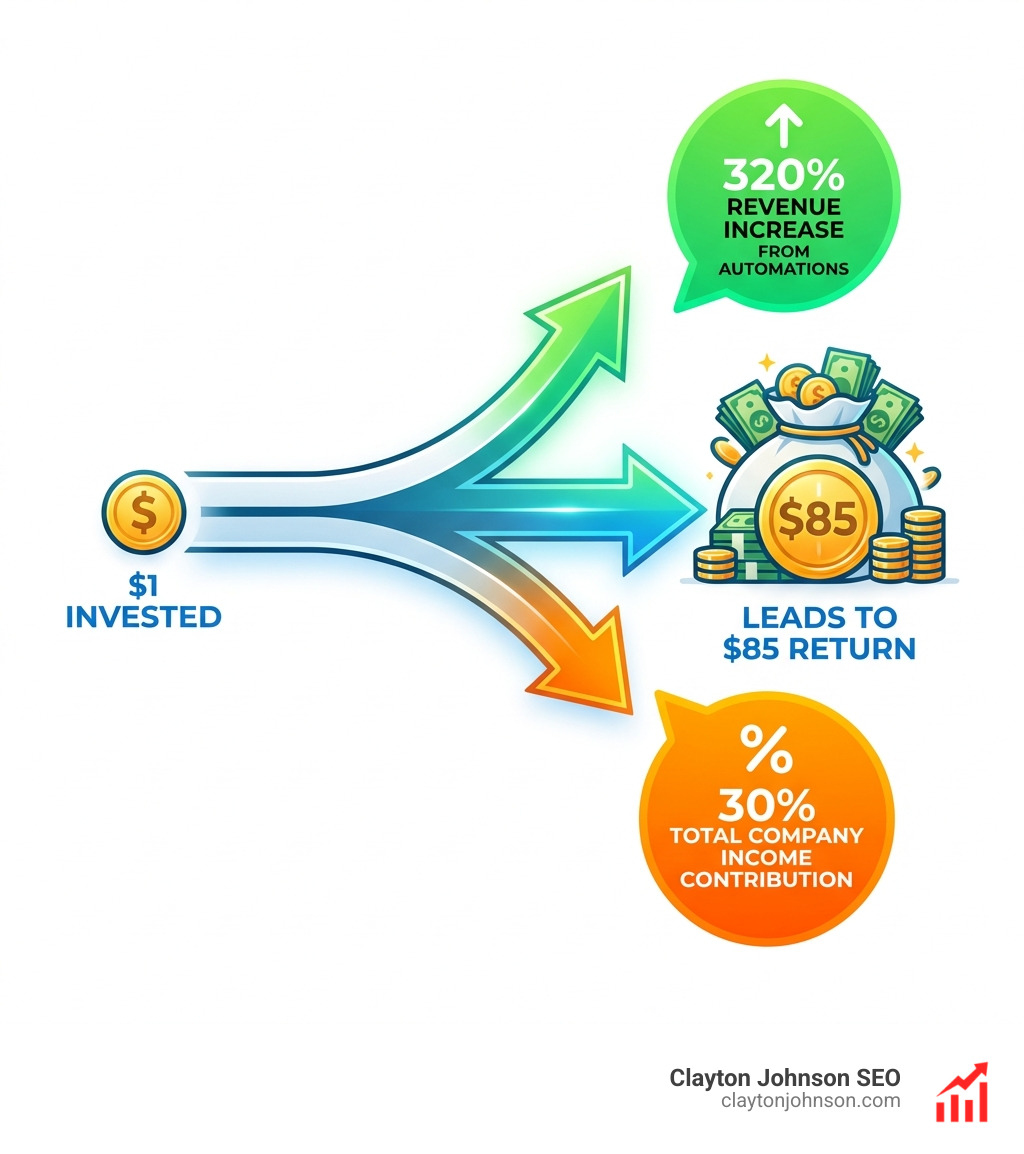
And the numbers back this up. Email marketing generates an average ROI of 85:1 — for every $1 invested, businesses can see $85 in return. It contributes roughly 30% of a company’s total revenue. Yet most agencies still sell it as a one-and-done project.
“Most agencies sell hours. The smarter move is to deliver outcomes.”
That gap — between how most agencies price email work and how it actually creates value — is exactly where retainers win.
I’m Clayton Johnson, an SEO strategist and growth architect who has built scalable marketing systems across 50+ business models, including structuring agency retainer frameworks that convert fragmented email efforts into compounding revenue engines. My work with agency email service retainers sits at the intersection of strategic positioning, repeatable delivery systems, and measurable business outcomes.
Defining Retainers vs. Project-Based Pricing
To build a sustainable agency in Minneapolis or anywhere else, you have to understand the fundamental shift from “selling tasks” to “providing a service.” Agency Retainer Pricing: Escape the Feast-or-Famine Cycle is about moving away from the exhaustion of constant pitching.
When you sell a project, like a single welcome sequence, you are a vendor. When you sell agency email service retainers, you become a strategic partner. You aren’t just writing copy; you are managing a revenue channel.
| Feature | Project-Based | Hourly Billing | Retainer Model |
|---|---|---|---|
| Revenue Predictability | Low (One-off) | Variable | High (Monthly) |
| Client Relationship | Transactional | Tactical | Strategic |
| Scope | Rigidly defined | Open-ended | Evolving/Continuous |
| Agency Focus | Completing tasks | Tracking minutes | Delivering outcomes |
For the client, the benefits of email marketing services on a retainer basis include predictable budgeting and dedicated expert access. They don’t have to worry if you have “capacity” this month; they’ve already bought it. For the agency, it smooths out cash flow—research shows that having over 60% of revenue from retainers drastically reduces the stress of the agency grind.
The 5 Most Profitable Agency Email Service Retainers Models
Not all retainers are created equal. Choosing the right model depends on your agency’s maturity and your clients’ needs.
- Fixed-Fee Model: The most common approach (used by over 56% of agencies). The client pays $X per month for a set list of deliverables (e.g., 4 newsletters and 2 automation audits).
- Points-Based System: Tasks are assigned “points” based on value or effort. This allows for flexibility—one month the client might want more conversion optimization work, and the next they might focus on a big holiday sale.
- Value-Based Pricing: You charge based on the estimated revenue you’ll generate. If your email strategy is poised to add $100k in monthly recurring revenue, a $10k retainer is an easy “yes” for the client.
- Hybrid Models: A combination of a lower base retainer plus a performance-based incentive (like a percentage of “email-attributed revenue”).
- Hourly Credits: The client buys 20 hours a month. While simple, we generally recommend moving away from this because it commoditizes your time rather than your expertise.
Productizing Your Agency Email Service Retainers with Three Tiers
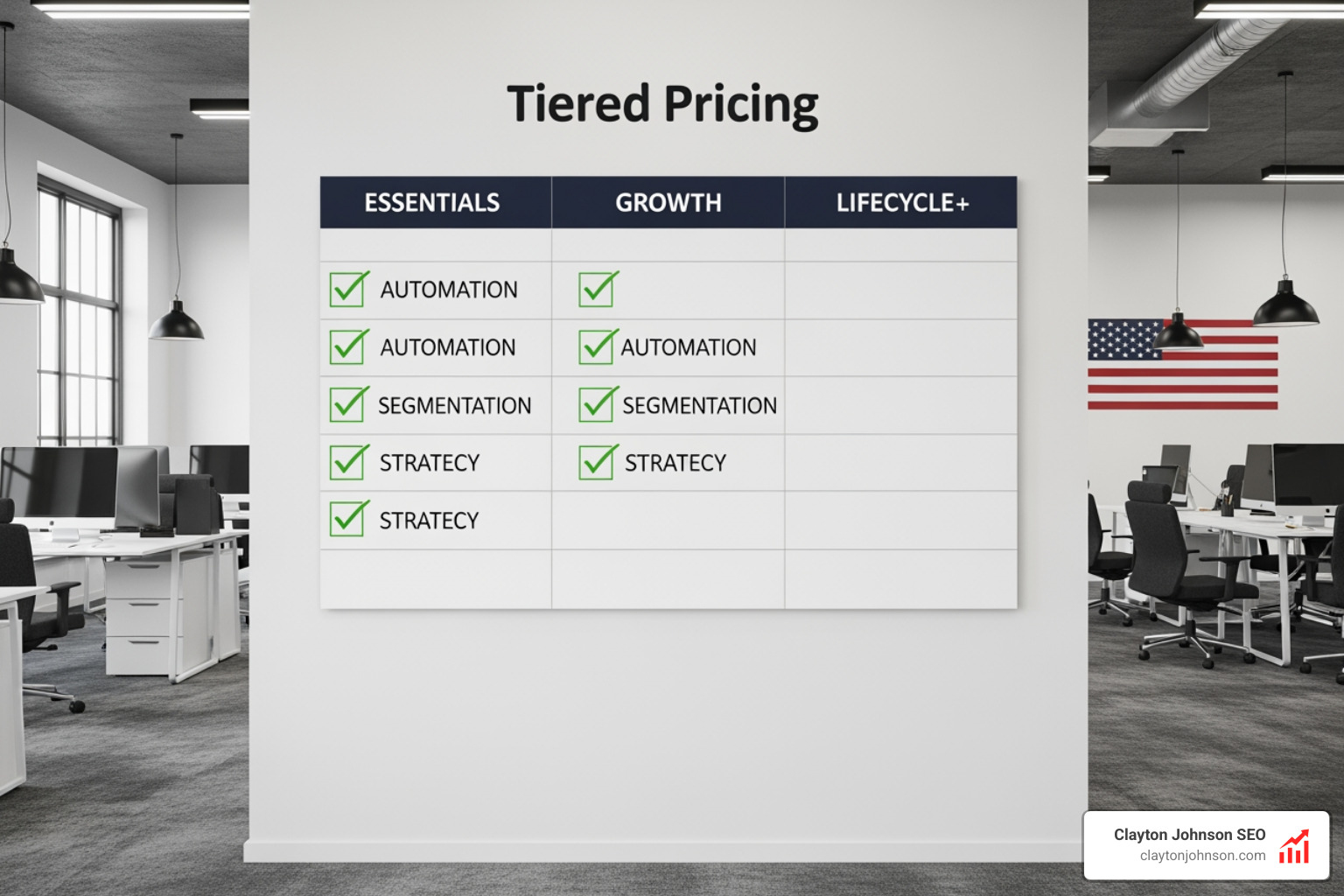
To scale, you need to stop custom-quoting every lead. Instead, “productize” your services into a Good-Better-Best strategy. This creates “repeatable recipes” that your team can execute efficiently while maintaining high margins.
- The Essentials (Good): Focuses on the basics. Monthly newsletter, list hygiene, and basic reporting. Perfect for small businesses with small lists.
- The Growth Flagship (Better): Our “anchor” package. Includes weekly campaigns, A/B testing, and advanced SEO content marketing integration.
- The Lifecycle+ (Best): The premium tier. Unlimited campaigns, complex behavioral automations, and deep-dive analytics and data integration.
Core Services and Infrastructure for Retainer Success
Success in agency email service retainers isn’t just about pretty templates; it’s about technical infrastructure. If your emails don’t land in the inbox, your retainer won’t last three months.
- Technical Setup: You must configure SPF, DKIM, and DMARC records for every client. These are the “digital passports” that prove to Gmail and Outlook that you aren’t a spammer.
- List Hygiene: Regular cleaning is non-negotiable. If a client’s bounce rate is over 2%, their sender reputation is at risk.
- Automation Flows: This is where the real money is made. Automated emails generate 320% more revenue than standard broadcasts. Every retainer should include the “Big Three”: Welcome Series, Abandoned Cart, and Post-Purchase Nurture.
- Audience Segmentation: 65% of marketers see better open rates with segmented lists. Your retainer should involve moving away from “blast” emails toward targeted behavior-based messaging.
Proving ROI in Your Agency Email Service Retainers
Clients don’t cancel retainers that make them money. You must prove your value every single month.
We use Google Postmaster Tools to monitor domain health and ensure we’re staying out of the “Promotions” or “Spam” tabs. But the real “wow” factor comes from revenue attribution.
When you show a client that their abandoned cart emails have a 39.07% open rate and recovered $5,000 in sales last month, the retainer pays for itself. Use visual dashboards to bridge the “data literacy” gap—most clients don’t understand “CTR,” but they definitely understand “Dollars Earned.”
Managing Scope Creep and Client Expectations
The biggest killer of agency profit is “scope creep”—those “quick questions” and “one-off favors” that eat your margins.
To prevent this, you need a structured onboarding workflow. Define exactly what is in-scope and what requires a “Change Order.”
- Set Boundaries: Establish clear communication cadences. Are you available on Slack 24/7, or do you have a weekly check-in?
- Use a Client Portal: Centralize everything. If a client can see the status of their campaigns in a dashboard, they are less likely to email you for updates.
- Time Tracking: Even if you don’t bill hourly, you must track your team’s time internally. If a $2,000 retainer is taking 40 hours of work, you aren’t running a business; you’re running a charity.
Frequently Asked Questions about Email Retainers
How much should an email marketing retainer cost?
Pricing varies based on list size, email volume, and your specific expertise. Standard email marketing packages often follow these benchmarks:
- Low-End ($1,000 – $2,500/mo): Basic management for small lists, 2-4 emails per month.
- Mid-Range ($2,500 – $5,000/mo): Comprehensive strategy, weekly campaigns, and basic automation management.
- High-End ($7,500 – $15,000+/mo): Enterprise-level support, daily sends, complex segmentation, and full lifecycle management.
When should an agency avoid offering a retainer?
Don’t rush into a long-term contract with a “bully” client or someone who doesn’t understand the value of marketing. If a prospect has a total annual budget of less than $12,000, they likely aren’t ready for a full-service retainer. We often recommend a 3-month trial period for new clients to ensure the “fit” is right before committing to a 12-month agreement.
Is it better to pitch retainers as a freelancer or an agency?
It depends on the client size. Smaller businesses often prefer the lower cost and personal touch of a freelancer. Larger corporations in Minneapolis often have risk policies that require them to work with established agencies for stability and insurance purposes. If you’re a solo operator, you can still pitch agency email service retainers by positioning yourself as a “specialist boutique” rather than a “generalist freelancer.”
Conclusion
At the end of the day, agency email service retainers are about leverage. They give you the financial stability to stop “hustling” and start building.
But a retainer is only as good as the strategy behind it. Most companies don’t lack the tactics to send an email; they lack the structured growth architecture to make those emails convert at a high level. That is why we built Demandflow.ai. It’s a growth operating system designed to help founders and marketing leaders move past the “lead gen treadmill” and into a world of compounding, predictable growth.
If you’re ready to escape the lead gen treadmill and build a real engine for your business, it starts with structure.