Goodbye Clicks and Hello Answers

The Search Revolution Nobody Warned You About
Zero Click Search is what happens when Google answers a user’s question directly on the search results page — no click required.
Here’s a quick breakdown:
| Term | What It Means |
|---|---|
| Zero Click Search | A search that ends on the SERP — no website visit occurs |
| Featured Snippet | A boxed answer pulled from a webpage, shown at the top of results |
| AI Overview | Google’s AI-generated summary synthesizing multiple sources |
| Knowledge Panel | A sidebar card showing facts about a person, place, or brand |
| People Also Ask | Expandable Q&A boxes triggered by related questions |
These aren’t edge cases. They’re the new normal.
In 2024, 58.5% of U.S. searches ended without a single click to any website. On mobile, that number climbs even higher. And with Google’s AI Overviews now appearing in over 13% of queries — up from 6.5% just two months earlier — the trend is accelerating fast.
For founders and marketing leaders, this creates a real problem. Traffic that used to flow to your site is now staying inside Google. Rankings still exist. Impressions are up. But clicks — and the pipeline that depends on them — are quietly eroding.
This isn’t a temporary glitch. It’s a structural shift in how search works.
“A zero-click search is when someone Googles a question and receives the answer right away, without needing to click or visit any other websites — including yours.”
The question isn’t whether this is happening. It’s what you do about it.
I’m Clayton Johnson — an SEO strategist focused on building scalable visibility systems that perform in exactly this kind of environment. My work in Zero Click Search optimization spans structured data architecture, AI answer engine positioning, and intent-based content systems that drive measurable business outcomes, not just traffic volume.
Let’s break down what’s really going on — and how to turn it into a strategic advantage.
The Anatomy of a Zero Click Search
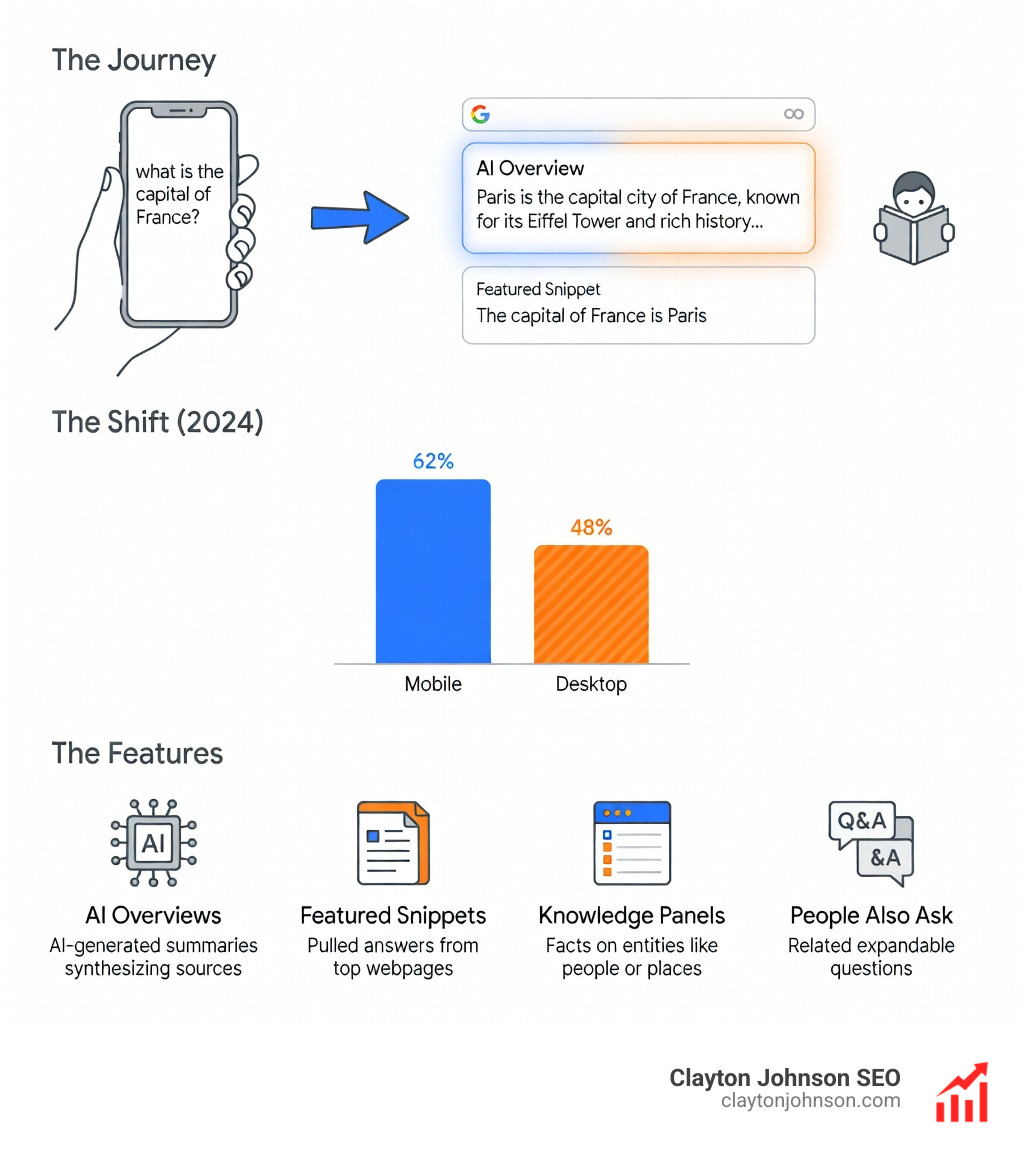
To survive this shift, we first need to understand the mechanics. A Zero-Click search definition is simple: it occurs when a Search Engine Results Page (SERP) displays the answer to a user’s query at the top of the page, satisfying their intent without requiring a click to an external website.
Think about the last time you searched for “what time is it in London” or “how many kilometers in a mile.” You didn’t click a link. You got your answer and moved on. This behavior is called “information foraging,” where users take the path of least resistance to find data.
The “culprits” behind this trend are specific SERP features designed for instant answers:
- Featured Snippets: Often called “Position Zero,” these pull a specific paragraph or list from a site to answer “how-to” or “what is” questions.
- Knowledge Panels: These sidebar boxes use the Knowledge Graph to show facts about entities like celebrities, historical figures, or brands.
- People Also Ask (PAA): These boxes appear in 78% of search results, keeping users engaged with a recursive loop of related questions.
- Direct Answer Boxes: Simple tools like calculators, weather widgets, and unit converters.
Mobile search dominance has accelerated this. Nearly 60% of Google searches on mobile now end without a click because users on small screens want immediate utility, not a multi-tab browsing experience.
How AI Overviews Redefine Zero Click Search
If featured snippets were the spark, Generative AI is the wildfire. Previously known as Search Generative Experience (SGE), AI Overviews synthesize information from multiple sources into a single, cohesive paragraph.
This changes the game because AI Overviews now appear in approximately 30% of informational queries. Unlike a snippet that quotes one site, the AI summarizes the “consensus.” This is the core of The truth about AI SEO: we are moving from a “library of links” to an “answer engine.” While citations exist, they are often hidden behind “read more” toggles, further decoupling visibility from traffic.
The Impact of Local Packs and Knowledge Graphs
For local businesses in Minneapolis, the Zero Click Search isn’t always a threat—it can be a bridge. When someone searches for “SEO agency Minneapolis,” the Local Pack (the map with three business listings) provides a phone number, address, and reviews immediately.
While this might technically be a “zero-click” for your website, it drives high-value actions like phone calls or driving directions. Brand credibility is built right there on the SERP. If your Google Business Profile is optimized, you’re winning the customer before they ever see your homepage.

Why Clicks are Vanishing: The Evolution of Search
The shift toward a clickless web didn’t happen overnight. It is the result of a decades-long evolution from a simple index to a sophisticated AI assistant.
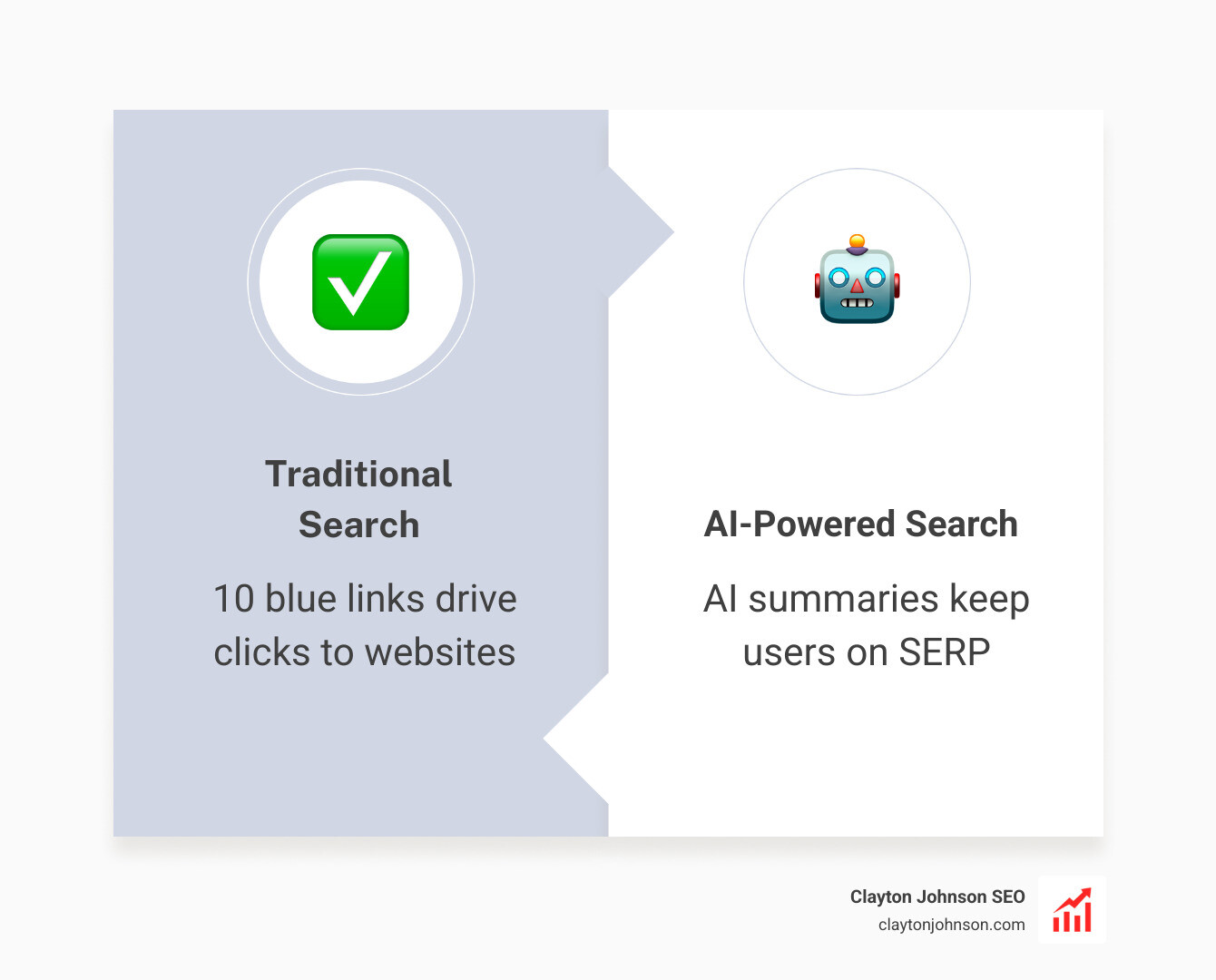
| Feature | Traditional Search | AI-Powered Search |
|---|---|---|
| Primary Goal | Direct users to the best third-party website | Answer the query directly on the SERP |
| Result Type | 10 Blue Links | AI Summaries, Snippets, Interactive Tools |
| User Journey | Search → Click → Read → Convert | Search → Read Answer → (Optional) Dig Deeper |
| Data Source | Crawled web pages | Knowledge Graph + LLM Synthesis |
This evolution began in 2007 with Universal Search, which integrated images and news into the main results. Then came the Knowledge Graph in 2012, allowing Google to understand “entities” (people, places, things) rather than just strings of keywords. Microsoft Bing followed suit with its own knowledge graph, Satori.
Today, we see the culmination of this with Generative Search. The goal is no longer to be a middleman; it is to be the destination.
Understanding Google Zero and the Publisher Crisis
There is a growing concern in the industry known as “Google Zero.” Coined by Nilay Patel of The Verge, it refers to a hypothetical point where Google provides zero referral traffic to the open web.
For online news publishers and informational blogs, this is an “extinction-level event.” When Google translates English content for international users or summarizes a breaking news story using AI, the original publisher often loses the ad revenue associated with that visit. This has led to “newsletter pivots” and a focus on direct audience relationships—moving users from search engines to owned platforms like email or private communities.
How AI Overviews Redefine Zero Click Search (Continued)
The rise of AI search means we must master Winning the AI search era. Traditional keyword research focused on volume; AI-era research focuses on intent resolution.
If a query is “how to improve page load speed,” Google recognizes the informational intent and provides a 300-word AI summary. To stay relevant, our content must be the “source of truth” that the AI cites. We aren’t just ranking for humans anymore; we are optimizing for the Large Language Models (LLMs) that feed the overviews.
Strategic Optimization for an Answer-First World
If the search engine is becoming an “answer engine,” our strategy must shift to Answer Engine Optimization (AEO). This doesn’t replace SEO; it augments it.
When 96.55% of content gets zero traffic from Google, we have to be in the 3.45% that actually matters. This requires a shift in how we write. We use the Inverted Pyramid style:
- The Answer: Provide a clear, direct answer in the first 40-60 words.
- The Context: Provide supporting details and data.
- The Deep Dive: Provide the “why” and “how” for users who do click through for more info.
Our Clayton Johnson SEO strategy focuses on building Topical Authority and E-E-A-T (Experience, Expertise, Authoritativeness, and Trustworthiness). AI models prefer citing brands that show deep, first-party data and lived experience over generic “top 10” lists.
Leveraging Schema for Zero Click Search Visibility
Structured data is the “code equivalent of a red flashing sign” for Google. It tells the search engine exactly what your content is about. To dominate Zero Click Search features, you need:
- FAQPage schema: This helps your Q&A content appear in People Also Ask boxes.
- HowTo markup: Essential for step-by-step guides to appear in rich snippets and AI summaries.
- LocalBusiness schema: Critical for Minneapolis businesses to show up accurately in Map Packs.
By implementing these, you aren’t just hoping to be seen; you are providing the structured growth architecture that search engines crave.
Building Brand Authority and AI Visibility
Visibility in the AI era is about Entity Building. We want search engines to associate your brand with specific topics. This is why Featured Snippets optimization is so vital. Even if a user doesn’t click, they see your brand name as the source of the answer.
This builds brand familiarity and credibility. Over time, this leads to “navigational searches”—where users search for your brand specifically because they’ve seen you provide the best answers repeatedly on the SERP.

Measuring Success Beyond the Click
If traffic is plateauing or declining, how do we prove our marketing is working? We have to stop using “vanity metrics” like raw sessions and start measuring Algorithmic Influence.
Success in a Zero Click Search world looks like this:
- Impressions: Are people seeing our brand on the SERP?
- SERP Feature Share: How many snippets, PAA boxes, and AI citations do we own?
- Brand Mention Sentiment: How is the AI describing our brand to users?
We need to Stop guessing and start measuring our AI visibility. Traditional CTR benchmarking is still useful, but it’s only half the story.
New Metrics for the Zero Click Search Era
Marketers must look at SEO research trends that separate “clicked” searches from “non-clicked” searches.
- Intent Signaling: High search volume for a keyword with high zero-clicks indicates high consumer interest. Even if you don’t get the click, being the answer builds massive brand equity.
- Conversion Attribution: We’ve seen cases where AI search referrals convert at 10%—much higher than traditional organic search—because the AI has already “pre-sold” the user on your solution before they even land on your site.
Tools for Tracking AI and SERP Performance
To track this, we look beyond just Google Search Console (GSC), which is often limited to 16 months of data and doesn’t always show AI Mode performance clearly. We use:
- Ahrefs/Semrush: For tracking “Position Zero” and PAA box ownership.
- Brand Radar: To monitor how often your brand is cited in AI Overviews.
- Manual Audits: Regularly searching your core “money keywords” to see what the AI is actually saying.
Frequently Asked Questions about Zero-Click Results
What is the difference between SEO and AEO?
Traditional SEO is about ranking high to get clicks. Answer Engine Optimization (AEO) is about being the source that the AI uses to generate its answer. SEO focuses on keywords and backlinks; AEO focuses on structured data, clear definitions, and entity authority. One gets you the visit; the other gets you the citation.
Does zero-click search kill organic traffic?
It doesn’t “kill” it, but it certainly “filters” it. Purely informational “factoid” traffic (like “what is the capital of France”) is gone. However, high-intent, complex queries still drive clicks. Users will still click through for deep guides, white papers, and case studies that an AI summary can’t fully replicate.
How do I track my brand’s presence in AI Overviews?
While GSC is starting to track “AI Mode” clicks, the best way is through third-party visibility scores and manual citation monitoring. Look for your brand name in the “Sources” or “Links” section of the AI Overview. If you are being cited but not clicked, your “Impression” count will rise while your “CTR” falls—this is the classic signature of a Zero Click Search win.
Conclusion
The search landscape has shifted from “finding links” to “getting answers.” While the decline in traditional website traffic can be jarring, it represents a massive opportunity for brands that can adapt.
At Clayton Johnson SEO, we believe that Zero Click Search isn’t an obstacle—it’s a new channel for brand authority. By building structured growth architecture through Demandflow.ai, we help founders and marketing leaders move beyond simple tactics and into a system of compounding growth.
Whether you are optimizing for the local Minneapolis market or a global SaaS audience, the goal remains the same: Own the answer.
Ready to build your Zero-Click Search Strategy? Let’s move from just “ranking” to becoming the definitive authority in your space.