How to Win the RIA Digital Marketing Game with SEO


Why RIA SEO Best Practices Determine Who Gets Found (and Who Doesn’t)
RIA SEO best practices are the strategies registered investment advisors use to rank higher in search results, attract qualified prospects, and grow their client base through organic traffic.
Here’s a quick overview of what works:
- Target long-tail keywords – Focus on specific phrases like “fiduciary financial advisor for retirees in Denver” instead of broad terms like “financial advisor”
- Optimize for local search – Claim your Google Business Profile and keep your name, address, and phone number consistent everywhere
- Create helpful content – Write educational blog posts and pages that answer the questions your ideal clients are actually searching for
- Build quality backlinks – Earn links from reputable sites through guest posts, industry directories, and shareable content
- Fix technical fundamentals – Make sure your site loads fast, works on mobile, and is easy for search engines to crawl
- Track what matters – Use tools like Google Search Console and SEMRush to monitor rankings, traffic, and conversions
Here’s the hard truth: 62% of advisors say their website is ineffective at generating leads. At the same time, only 7% of searchers ever click past the first page of results.
That means if you’re not ranking on page one, you’re essentially invisible.
For RIAs, this is a serious problem. Most prospective clients start their search for a financial advisor online. They type in a question, scan the first few results, and make a judgment call – often before they ever contact anyone.
The firms that show up consistently are the ones that win the clients.
The good news? Most RIAs are barely doing any SEO at all. Only around 30% have any kind of active strategy in place. That’s a real opportunity for advisors willing to put in the work.
This guide walks you through exactly how to do it – without wasting time on tactics that don’t move the needle.
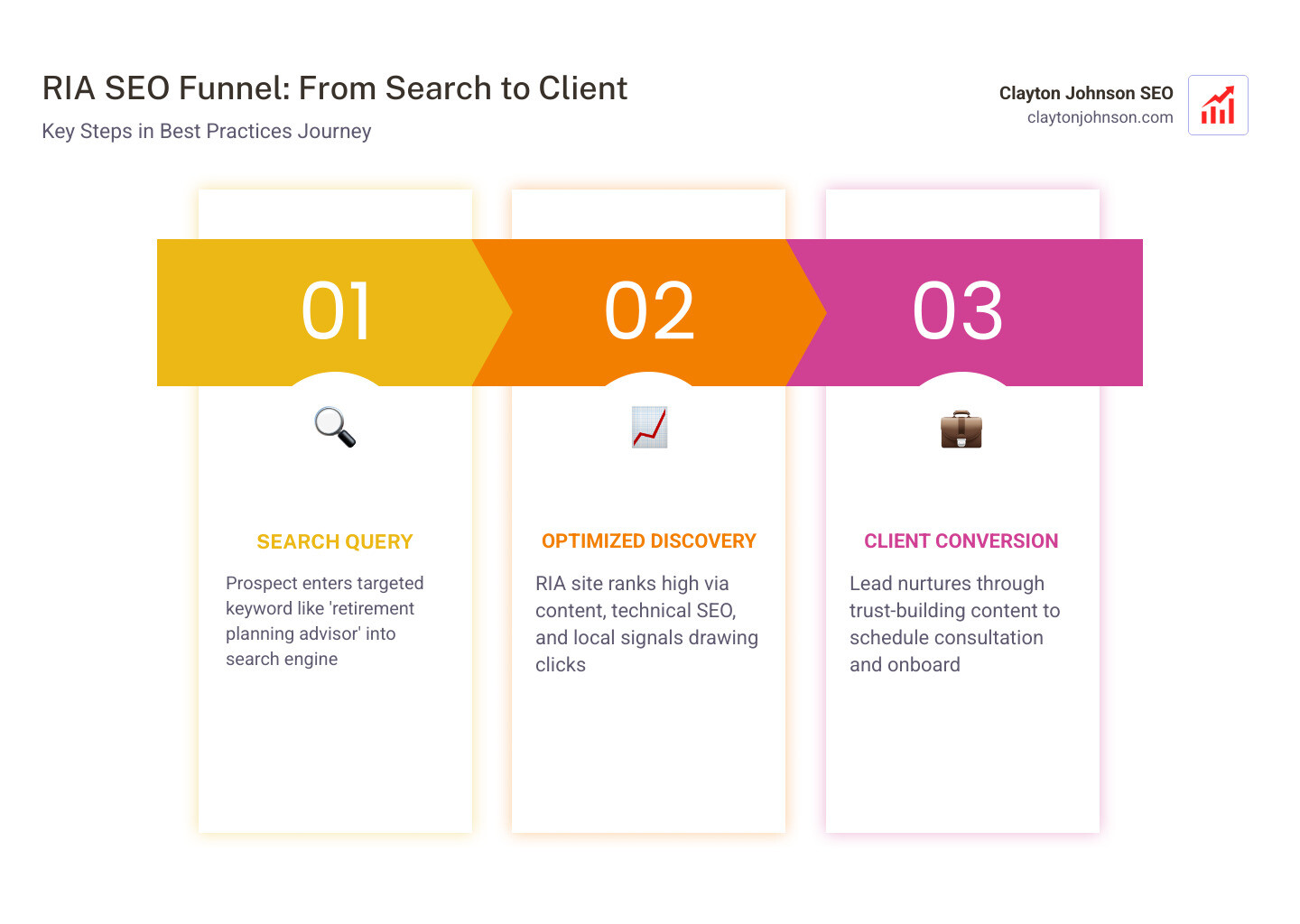
Core Components of RIA SEO Best Practices
When we talk about SEO for Registered Investment Advisors, we aren’t just talking about “keywords.” We are talking about building a digital ecosystem that Google trusts. Think of your website as your digital storefront. If the door is jammed (slow loading) or the signs are in a language no one speaks (jargon), people will walk away.
Effective RIA SEO best practices break down into four primary pillars: technical SEO, content strategy, local search, and off-page authority.
Technical SEO: The Foundation
Technical SEO is the “under-the-hood” work. If your site isn’t crawlable, even the best content in the world won’t rank. We need to ensure that search engine “bots” can easily navigate your site map and index your pages.
- Mobile Optimization: More than half of all web traffic now happens on mobile devices. If your site has tiny text or annoying pop-ups on a smartphone, Google will penalize you.
- Site Speed: People are impatient. If your site takes more than three seconds to load, your “bounce rate” will skyrocket. Use PageSpeed Insights to see where you stand.
- Security: As an RIA, trust is your currency. An “HTTPS” certificate isn’t just a security feature; it’s a ranking signal.
For a deeper dive into these fundamentals, check out our Beginner’s guide to mastering core SEO.
Keyword Strategy: Broad vs. Niche
Many RIAs make the mistake of trying to rank for “Financial Advisor.” That is a losing battle against giants like Fidelity or Schwab. Instead, we focus on intent.
| Keyword Type | Example | Competition | Conversion Rate |
|---|---|---|---|
| Short-Tail | Financial Advisor | Extremely High | Low |
| Long-Tail | Fee-only RIA for tech founders in Austin | Low | High |
| Problem-Based | How to minimize taxes on RSUs | Medium | Very High |
By targeting specific “long-tail” phrases, we attract people who are looking for exactly what we offer.
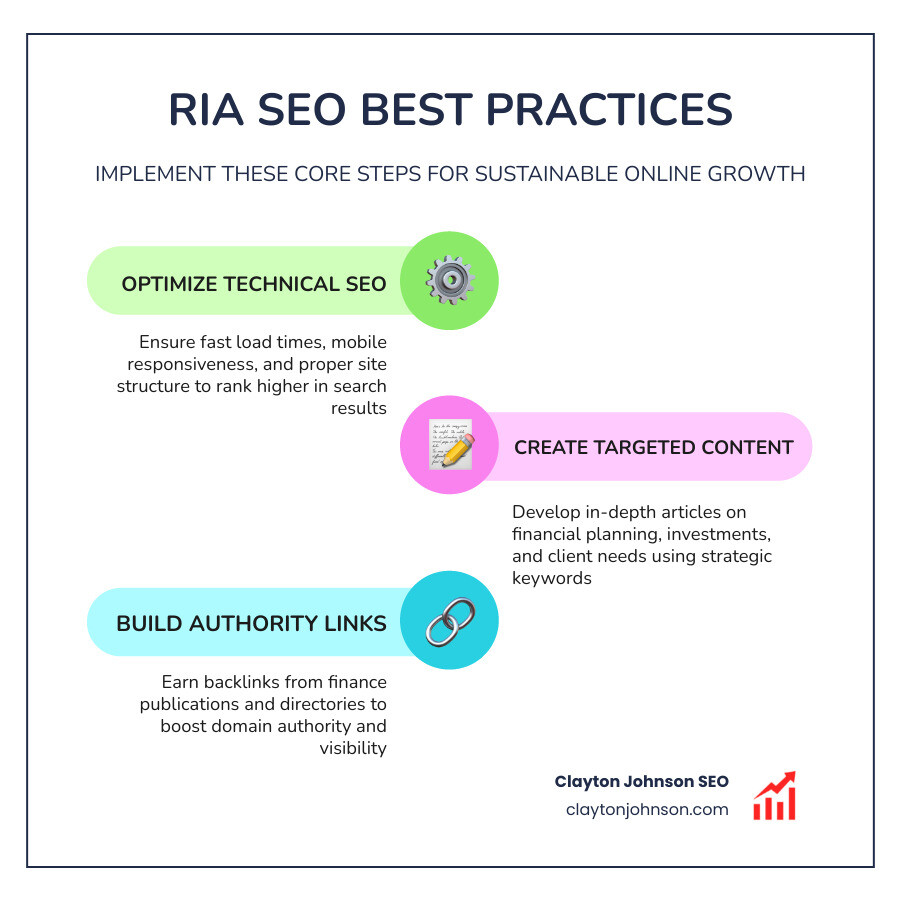
Mastering Local Search and RIA SEO Best Practices
For most RIAs, the bread and butter of the business is local. Even if you can work with anyone nationwide, appearing in the “Map Pack” (the three local businesses Google shows at the top of a search) is a game-changer.
- Google Business Profile: This is your most important local asset. You must Create a free business profile on Google and keep it updated. Post photos of your office, share your holiday hours, and respond to every single review.
- NAP Consistency: NAP stands for Name, Address, and Phone number. If your site says “Suite 200” but your Bing Places for Business listing says “Ste 200,” it confuses search engines. Keep it identical everywhere.
- Local Citations: Get listed in local directories, Chamber of Commerce sites, and industry-specific listings. These “citations” act as votes of confidence for your location.
- Client Reviews: While we must always be mindful of compliance, Google loves reviews. High-quality, authentic reviews tell Google that you are a legitimate, active business in your community.
Building Authority Through Content and Backlinks
In financial services, Google applies a standard called E-E-A-T: Experience, Expertise, Authoritativeness, and Trustworthiness. Because you deal with “Your Money or Your Life” (YMYL) topics, the bar is higher for you than it is for a lifestyle blogger.
Fiduciary Positioning as a Content Strategy As an RIA, your fiduciary status is a massive SEO advantage. You can write transparently about fees, conflicts of interest, and specialized planning in a way that big-box brokers often can’t. This builds trust with both the user and the algorithm.
The Power of Backlinks A backlink is a link from another website to yours. Think of it as a digital recommendation. According to research on search engine ranking factors, the #1 result in Google has an average of 3.8x more backlinks than positions #2-#10.
How do we get them?
- Guest Posting: Write for industry publications or local news outlets.
- Podcast Appearances: Most podcasts include a link to the guest’s website in the show notes.
- Niche Authority: When you publish original research or unique insights, other sites will naturally link to you as a source.
If you are just starting out, our Beginner’s guide to wealth manager SEO offers a roadmap for building this initial authority.
Optimizing for AI Overviews and Mobile Search
Search is changing. With the rise of AI Overviews, Google often provides a summary answer at the very top of the page. To show up here, we need to change how we write.
- Content Chunking: Instead of long, rambling paragraphs, use short sentences. Break up your text with H2 and H3 headers.
- Direct Answers: If your heading is “What is a Fiduciary?”, the very next sentence should be a clear, 1-3 sentence definition. Google loves to “pull” these definitions into AI snippets.
- Technical Readiness: Ensure you Submit a sitemap to Google so the AI can find your newest content immediately.

Implementing a Sustainable Growth Framework
SEO is not a one-time project; it’s a system. We’ve seen many firms dive into SEO, spend a fortune on a “one-month cleanup,” and then wonder why their traffic disappears three months later. To win, we need to build a system that compounds over time.
Identifying High-Conversion Long-Tail Keywords
The secret to RIA SEO best practices isn’t finding the keywords with the most traffic—it’s finding the ones with the right traffic. We want “commercial intent.”
Use tools like Google Keyword Planner or Moz Keyword Explorer to find phrases where people are actively looking for help.
Examples of High-Intent RIA Keywords:
- “Tax-efficient withdrawal strategies for retirees”
- “Estate planning for blended families in San Francisco”
- “How to manage a windfall from an inheritance”
- “Best 401k rollover options for former Fortune 500 employees”
These aren’t just searches; they are “pain points.” When we solve a pain point with a blog post, we aren’t just getting a visitor—we are building a relationship. For more on this, see our SEO strategies for wealth managers demystified.
Measuring Success and Avoiding Common RIA SEO Best Practices Mistakes
If we don’t measure it, we can’t manage it. We recommend every RIA set up a dashboard using Google Search Console, SEMRush, or Ahrefs.
Key Metrics to Track:
- Organic Traffic: Are more people finding you through search?
- Keyword Rankings: Are you moving from page 3 to page 1 for your target terms?
- Click-Through Rate (CTR): Are people actually clicking your link when they see it?
- Conversions: This is the only metric that truly pays the bills. How many “Contact Us” forms or “Schedule a Call” clicks did you get from organic search?
Common Mistakes to Avoid:
- Using Too Much Jargon: If your website sounds like a compliance manual, prospects will leave. Use “simple, clear, and warm” language.
- Ignoring Local SEO: Don’t forget your neighbors while trying to reach the world.
- Copying Content: Google hates “duplicate content.” Your insights must be your own.
- Expecting Instant Results: SEO is a marathon. You might see small wins in 3 months, but significant growth usually takes 12 months of consistent effort.
For a broader look at building your firm, read our Guide to growing your wealth management client base.

Scaling Your Practice with Clayton Johnson SEO
At Clayton Johnson SEO, we don’t believe in chasing “vanity metrics” like total impressions. We believe in building scalable traffic systems. We look at your firm as a growth engine that needs a structured content architecture and a clear strategy framework to thrive.
Our approach combines technical SEO depth with AI-augmented workflows. We don’t just write blogs; we build taxonomy-driven content ecosystems that establish you as the ultimate authority in your niche.
Whether you are a solo advisor or a large firm, we help you turn “fragmented marketing” into a coherent system that drives measurable outcomes. Our philosophy is simple: Clarity → Structure → Leverage → Compounding Growth.
If you’re ready to stop guessing and start growing, Contact us for a strategy session. We specialize in Financial services growth systems that move the needle.
Final Thoughts: Setting Boundaries and Moving Forward
SEO can be a “rabbit hole.” It is easy to spend 50 hours a week obsessing over minor technical details. For a small firm, we recommend setting a boundary: perhaps 5-10 hours a month or a capped budget for the first year.
Don’t put all your eggs in one basket. Diversify your marketing. SEO is a powerful tool, but it works best when paired with email marketing, social media, and traditional networking.
The most important thing? Start today. The “compounding” nature of SEO means that the sooner you plant the seeds—by optimizing your Google Business Profile or writing that first niche blog post—the sooner you will reap the rewards of a consistent, organic lead flow.
Now, take an hour, look at your website through the eyes of a prospect, and ask: “Can they find me, and do they trust what they see?” If the answer is no, it’s time to get to work.