Industrial AI Forecasting: Predicting the Future of Manufacturing

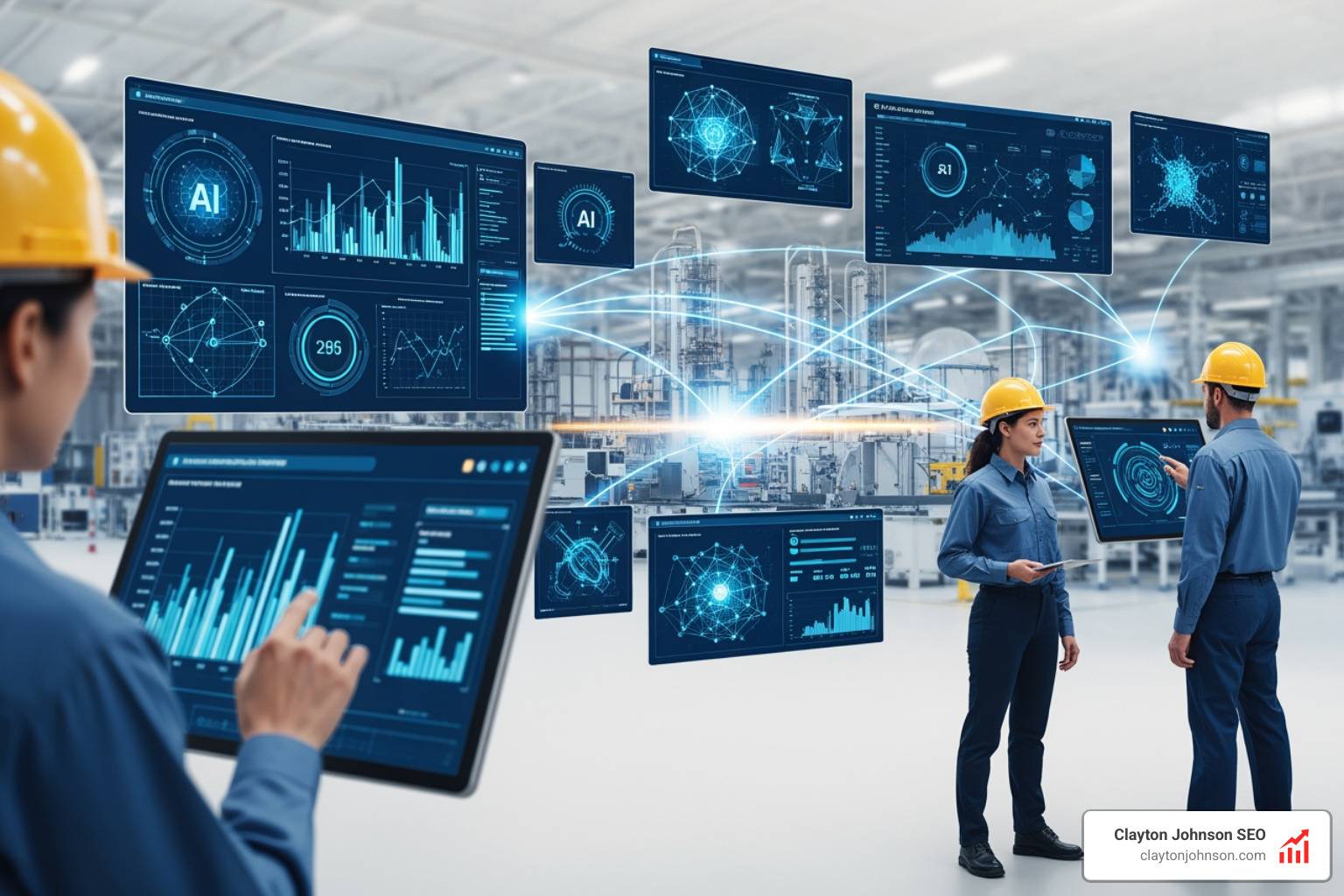
Why Industrial AI Forecasting Tools Are Reshaping Manufacturing
Industrial AI forecasting tools are software platforms that use machine learning to predict future product demand — far more accurately than traditional spreadsheet-based methods.
Here are the top industrial AI forecasting tools used in scalable manufacturing operations:
- C3 AI Demand Forecasting – Enterprise-grade, hierarchical reconciliation, up to 30% accuracy improvement
- SymphonyAI Industrial (IRIS Foundry) – Predictive asset intelligence, digital twins, multi-industry support
- Infor CloudSuite Demand Forecasting – Cloud-native, planner-friendly, ERP-integrated
- Logility – Supply chain-focused, promotion-aware, strong for food & beverage
- RELEX Solutions – Real-time external signal integration, retail and manufacturing
- GMDH Streamline – Mid-market friendly, probabilistic forecasting, strong ERP connectors
Most manufacturers still rely on static historical data and manual planning cycles. The problem? Markets don’t wait. Supply disruptions, demand spikes, and shifting consumer behavior can make yesterday’s forecast worthless by tomorrow.
AI changes that equation entirely. Instead of looking backward, AI forecasting models look in every direction at once — pulling in real-time signals like weather patterns, commodity prices, and market sentiment alongside your internal order history. The result is a living forecast that adapts as conditions change, not one that ages on a spreadsheet.
The business case is no longer theoretical. A global components manufacturer cut forecast error (WAPE) by 22% in just 90 days after integrating AI forecasting with their MRP system. A multinational food company unlocked up to $70M in value within six weeks of deploying AI-powered demand planning.
The gap between companies operationalizing AI forecasting and those still running pilots is widening fast. According to ARC Advisory Group research, only 12.9% of industrial companies have reached Pacesetter status — using AI forecasting as a true competitive advantage — while over 31% remain stuck in low-impact experimentation.
I’m Clayton Johnson, an SEO and growth strategist who has spent years building data-driven systems at the intersection of AI, content architecture, and operational strategy — including deep work with industrial AI forecasting tools and the infrastructure decisions that make them succeed or stall. In the sections below, I’ll break down exactly how these tools work, which platforms lead the market, and how to move from pilot to production without getting stuck.
Explore more about industrial ai forecasting tools:
Understanding Industrial AI Demand Forecasting vs. Traditional Methods
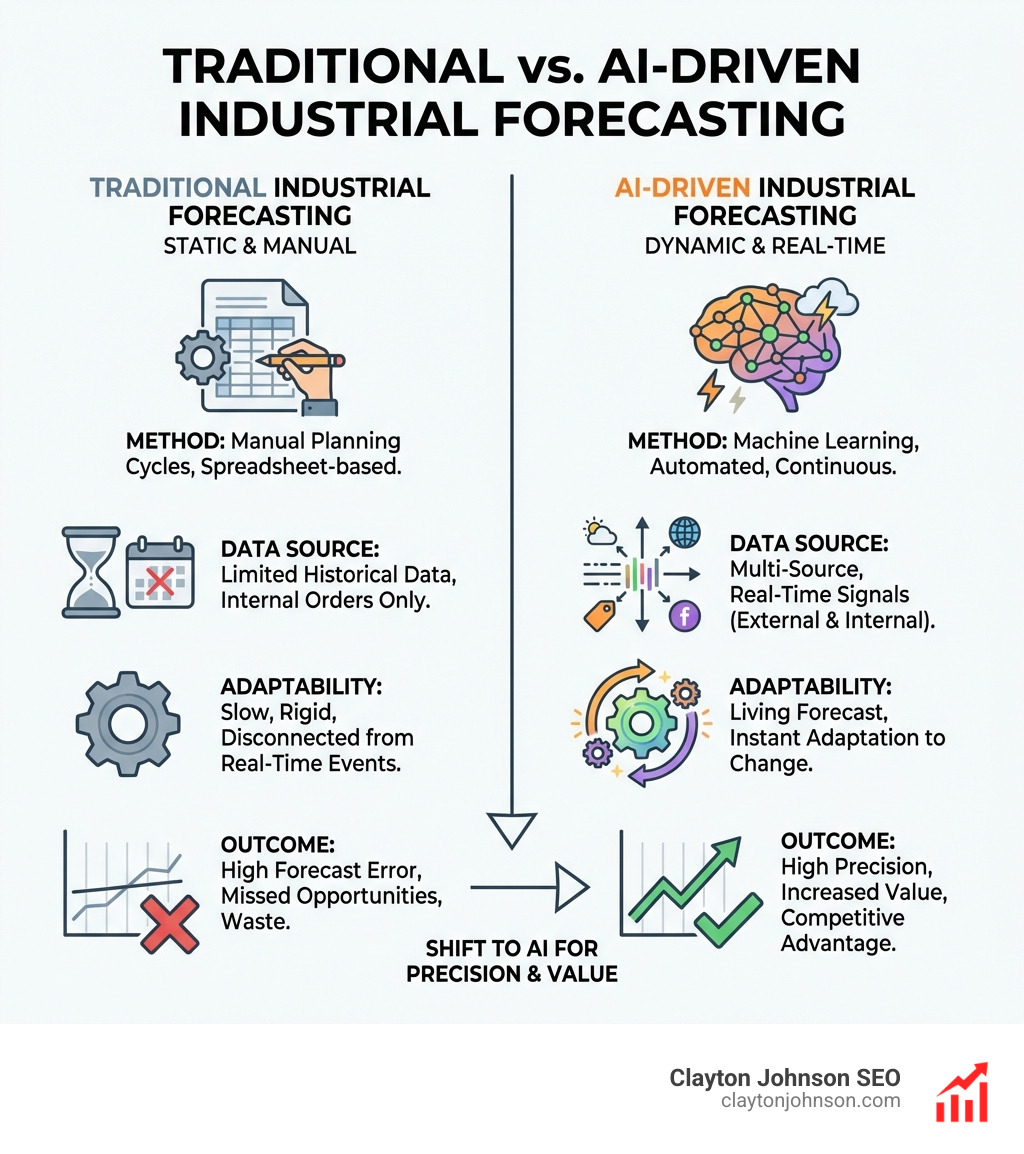
To understand why industrial AI forecasting tools are a “must-have” rather than a “nice-to-have,” we first need to look at what they are replacing. Traditional forecasting usually involves a planner staring at a spreadsheet, looking at what sold last month, and adding a percentage for growth. This is “static” forecasting. It assumes the future will look exactly like the past.
AI-driven forecasting is “dynamic.” It uses predictive analytics and advanced pattern recognition to find hidden correlations in your data that a human could never spot. While traditional methods struggle with harnessing the power of AI in distribution operations, modern AI tools thrive on complexity.
| Feature | Traditional Statistical Models | Dynamic AI Forecasting Models |
|---|---|---|
| Data Source | Primarily historical sales | Historical + Real-time + External signals |
| Adaptability | Reactive (monthly/quarterly updates) | Proactive (real-time adjustments) |
| Variables | 1-2 variables (time and volume) | Hundreds of variables simultaneously |
| Accuracy | High error rates in volatile markets | Up to 30% improvement in accuracy |
| Handling Bias | Manual adjustments prone to human bias | Algorithmic, objective data processing |
The Shift from Historical to Real-Time Data
The biggest differentiator is the data “diet.” Traditional models eat history; AI models eat reality. In an industrial environment, your demand isn’t just affected by your sales team’s performance. It’s affected by exogenous drivers—factors outside your four walls.
Leading industrial AI forecasting tools integrate:
- Weather Patterns: Essential for food and beverage or energy sectors where temperature shifts drive consumption.
- Market Sentiment: Social media and news trends that signal a shift in consumer preference before the first order is even placed.
- Commodity Prices: Fluctuations in raw material costs that might cause your B2B customers to delay or accelerate their purchasing.
- Economic Shifts: Natural disasters or geopolitical disruptions that AI can model to suggest alternative logistics routes.
Overcoming the Limitations of Spreadsheet Planning
We’ve all seen it: the “Master Spreadsheet” that only one person in the company knows how to update. This creates massive data silos and manual errors that ripple through the supply chain. When your data is messy, your decisions are messy.
Using AI helps clean up the noise. By understanding how AI-based analytics makes sense of messy data, industrial teams can move away from “gut feel” and toward evidence-based planning. AI tools automatically handle missing values and outliers, ensuring that a single bad data entry doesn’t ruin your entire production schedule.
Top Industrial AI Forecasting Tools for Scalable Operations
Choosing the right tool depends on your scale, your industry, and your existing tech stack. Some platforms are designed to sit on top of everything as a “system of intelligence,” while others are specialized for specific niche problems.
Enterprise-Grade Industrial AI Forecasting Tools
For large-scale manufacturers, the goal isn’t just a better forecast—it’s a synchronized enterprise. These tools offer hierarchical reconciliation, meaning they ensure that the forecast for a single SKU at a specific plant matches the aggregate forecast for the entire product family at the corporate level.
- C3 AI Demand Forecasting: This is a powerhouse for unification. It pulls data from disparate sources (ERP, CRM, telemetry) to provide a single source of truth. It’s known for delivering results quickly—often showing accuracy uplifts within six weeks.
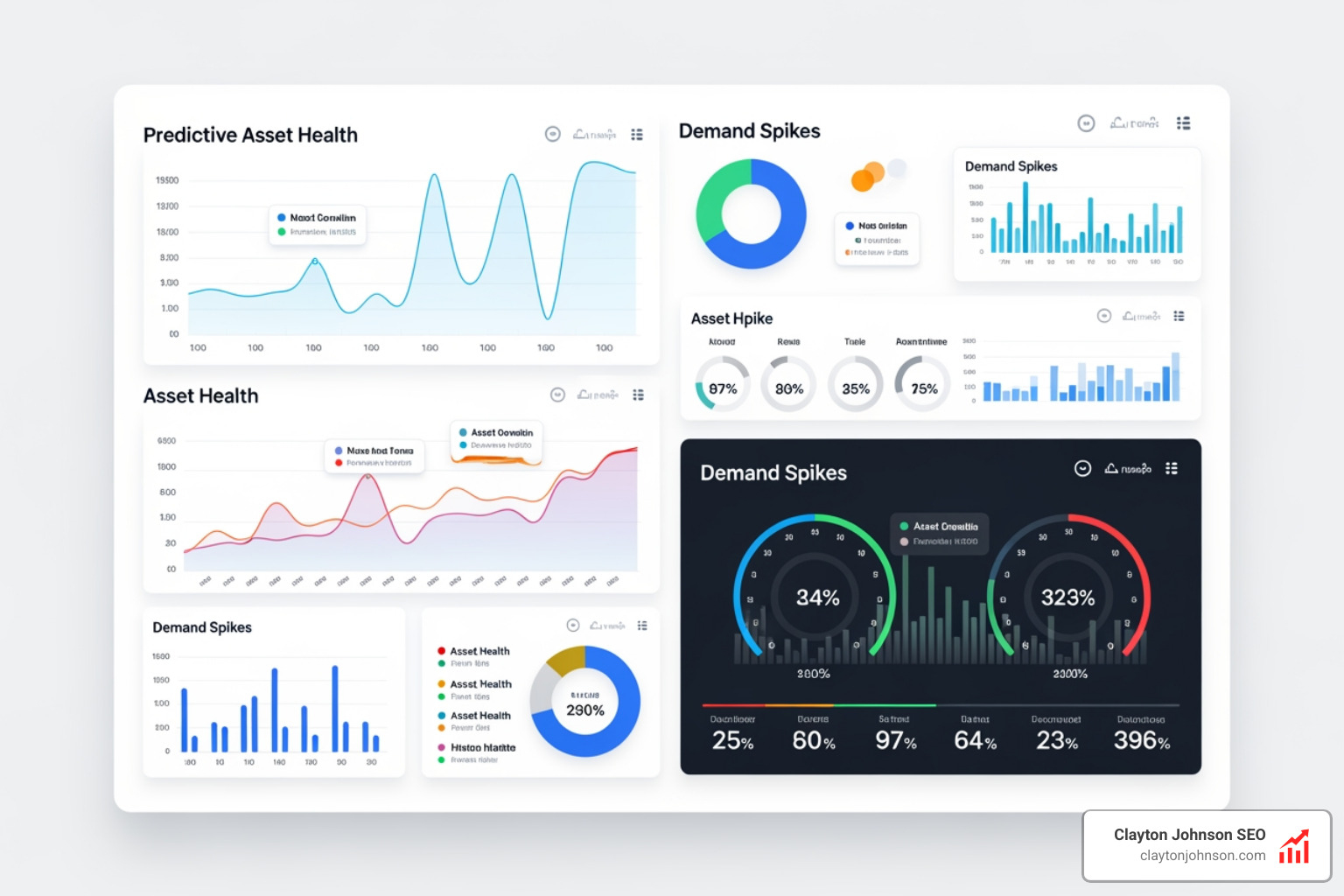
- SymphonyAI Industrial: Built on the IRIS Foundry, this platform excels at “Predictive Asset Intelligence.” It doesn’t just tell you what people will buy; it tells you if your machines are healthy enough to make it. They even offer a scaling production AI playbook to help organizations move past the pilot phase.
- Infor CloudSuite: If you are already in the Infor ecosystem, their demand forecasting module is highly “planner-friendly.” It uses causal modeling to identify why demand is changing, not just that it is changing.
Specialized Industrial AI Forecasting Tools for Niche Sectors
Sometimes, you don’t need a massive enterprise suite; you need a tool that solves a specific operational headache.
- Predictor: A multi-agent AI system that uses dedicated “agents” to clean data, select features, and deploy models to the edge. It’s great for real-time anomaly detection.
- Sight Machine: Focuses heavily on the manufacturing floor, turning plant data into a “Data Foundation” that fuels productivity.
- Fourth: Specialized for the hospitality and restaurant sectors, focusing on labor and inventory forecasting.
- GMDH Streamline: Excellent for handling intermittent demand and new SKU launches where historical data is thin or non-existent.
Key Features to Evaluate in an AI Forecasting Platform
Not all AI is created equal. When evaluating industrial AI forecasting tools, we look for features that provide “leverage”—the ability to do more with less human intervention.

Hierarchical Reconciliation and Granularity
In a complex supply chain, you need to see the world at different resolutions. You might need a “top-down” view for financial planning but a “bottom-up” view for the shop floor.
- SKU Level: What specific part do we need?
- Facility Level: Which plant should produce it?
- Customer Level: Which distributor is seeing a spike?
A top-tier platform reconciles these views automatically so you don’t end up with “double-counting” or conflicting production orders. This is a core part of building the roadmap to a scalable data and analytics strategy.
Integration with ERP, MES, and Supply Chain Systems
An AI tool that doesn’t talk to your ERP (Enterprise Resource Planning) or MES (Manufacturing Execution System) is just a fancy calculator. Look for:
- API Connectivity: Can it pull data in real-time?
- OT/IT Convergence: Does it bridge the gap between “Operational Technology” (the machines) and “Information Technology” (the servers)?
- Unified Namespace: A centralized way to name and organize data so every system speaks the same language.
- Industrial Data Fabric: 63% of industrial leaders say a data fabric is critical for scaling AI because it decouples data from legacy systems, making it usable for any AI application.
Implementation Strategy: Moving from Pilot to Production
Most AI projects die in “Pilot Purgatory”—they look great in a small test but fail when applied to the whole factory. To avoid this, we follow a structured growth architecture.

Data Unification and Cleaning Strategies
Industrial data is notoriously “messy.” It’s heterogeneous (comes in different formats) and often unstructured. Before you can forecast, you must prepare.
- Standardize Definitions: Make sure “Units Shipped” means the same thing in the US as it does in Europe.
- Outlier Detection: AI can automatically flag and remove “one-off” events (like a massive promotional spike) that would otherwise skew future predictions.
- Autonomous Feature Selection: Tools like Predictor can automatically identify which variables (like humidity or a competitor’s price drop) actually drive your demand.
Addressing the Schism of Speed in Industrial Adoption
The industrial world is currently splitting into three cohorts:
- Pacesetters (12.9%): These companies treat AI as a competitive moat. They are doubling their AI budgets and moving toward “autonomous operations.”
- Mainstream (55.3%): These firms are buying isolated “point solutions” but struggling to scale them across the whole company.
- Laggards (31.8%): These companies are still doing “science fair” pilots that don’t move the needle on EBITDA.
To be a Pacesetter, you must move inference workloads to the Edge. This means the AI makes decisions right on the factory floor, reducing latency and cloud costs.
Measuring Success: ROI and Performance Metrics
How do you know if your investment in industrial AI forecasting tools is actually working? You have to track the right KPIs.

Accuracy Improvements and Cost Savings
The most common metric is WAPE (Weighted Average Percentage Error). Reducing WAPE directly impacts your bottom line.
- Inventory Optimization: Businesses using AI report 20–30% lower inventory holding costs. If you know exactly what you need, you don’t have to pay to store “just in case” stock.
- Stockout Prevention: Improving order fill rates keeps customers happy and prevents lost revenue.
- Working Capital: Reducing excess inventory by even 7% can unlock millions in cash flow that was previously tied up in warehouse dust.
- Predictive Asset Intelligence: According to scientific research on predictive asset intelligence, AI can maximize uptime by giving early warnings before a machine fails, preventing costly unplanned downtime.
Typical Timelines for ROI Realization
You shouldn’t have to wait years for a return.
- Week 6: Most companies see the first “Value Delivery” via a pilot in one category or region.
- Month 6: The “Scaling Phase” begins, where the tool is rolled out across multiple plants.
- Ongoing: Continuous improvement happens as the machine learning models “learn” from their own mistakes, getting more accurate every month.
Frequently Asked Questions about Industrial Forecasting
How does AI handle intermittent demand for new SKUs?
Traditional models need years of data to work. AI uses “clustering” and “attribute-based forecasting.” It looks at the characteristics of the new SKU (color, size, price point) and compares it to similar existing products to create a “proxy” forecast.
What is the difference between WAPE and MAPE in industrial contexts?
MAPE (Mean Absolute Percentage Error) treats every error the same. WAPE (Weighted Average Percentage Error) weights the error by volume or value. In manufacturing, a 10% error on a high-value engine is much worse than a 10% error on a cheap bolt. WAPE reflects that reality.
Do planners need advanced data science skills to use these tools?
No. Modern industrial AI forecasting tools are designed with “Generative AI Copilots.” Planners can ask the AI questions in plain English, like “Why is the forecast for July so high?” and the AI will explain the drivers (e.g., “A scheduled promotion combined with a historical heatwave trend”).
Conclusion
The transition from spreadsheet-driven guesswork to industrial AI forecasting tools is the single biggest lever for growth in modern manufacturing. It’s the difference between being a “Laggard” stuck in pilot purgatory and a “Pacesetter” with a scalable competitive moat.
At Clayton Johnson, we believe that most companies don’t lack the will to innovate—they lack the structured growth architecture to make it stick. Whether you are looking for Enterprise AI Solutions or trying to refine your SEO strategy to reach the right industrial partners, the goal is the same: Clarity, Structure, and Leverage.
By unifying your data, selecting the right hierarchical tools, and focusing on measurable ROI like WAPE reduction, you can turn your supply chain from a cost center into a compounding growth engine. Ready to build your own “system of intelligence”? The future is already being predicted—make sure you’re the one holding the data.