So You Want to Be an SEO Expert


Why Organic Search Mastery Is the Highest-ROI Skill in Digital Marketing
Learning how to become a seo expert is one of the smartest career moves you can make right now. Organic search drives over half of all website traffic — and users click organic results over paid ads 94% of the time.
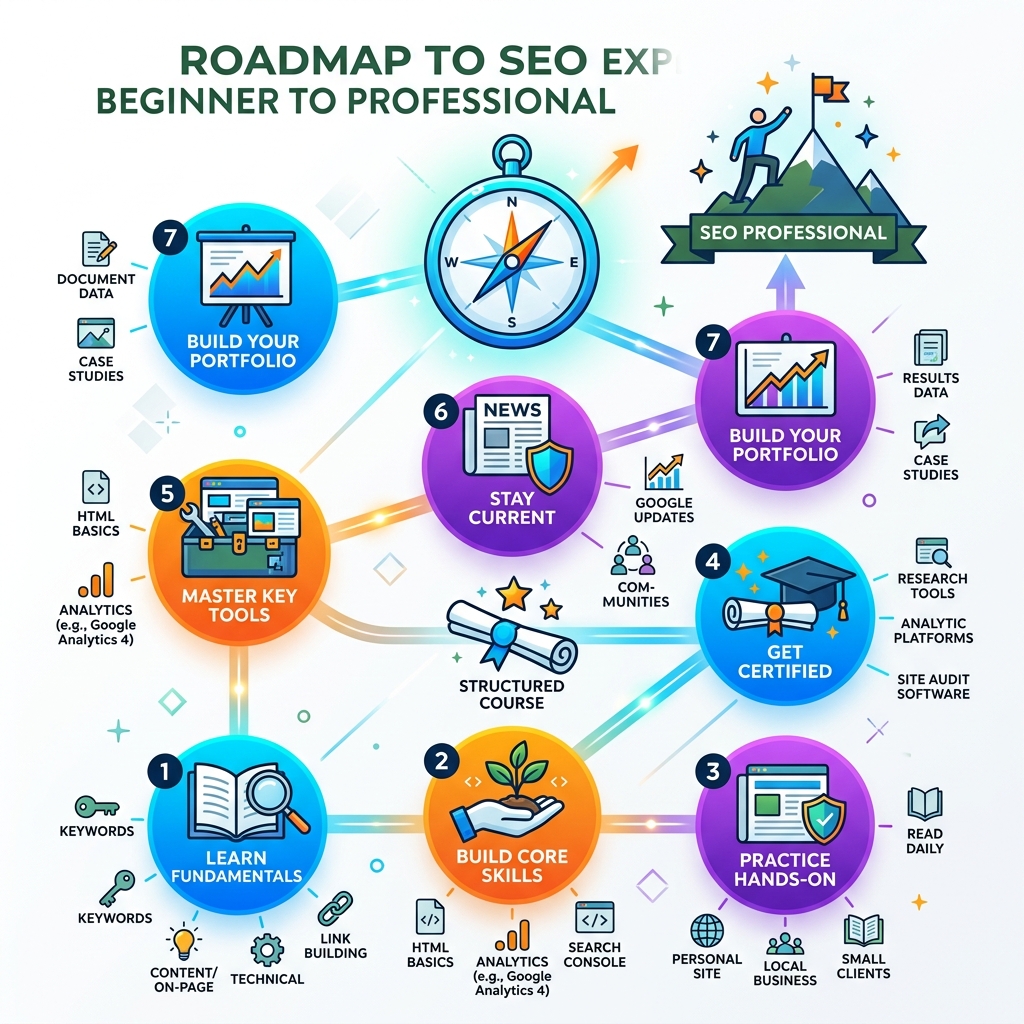
Here’s how to become an SEO expert, step by step:
- Learn the fundamentals — keyword research, on-page SEO, technical SEO, link building
- Build core skills — HTML basics, Google Analytics, Google Search Console
- Practice hands-on — launch a personal site, help a local business, or take on a small client
- Get certified — complete a structured course like the UC Davis SEO Specialization
- Master the tools — Semrush, Ahrefs, Google Search Console
- Stay current — follow Google updates, join SEO communities, read daily
- Build your portfolio — document results with real data and case studies
The top five search results capture roughly 68% of all clicks. If your business — or your clients’ businesses — aren’t ranking there, you’re invisible to most of your market.
That gap is exactly what an SEO expert closes.
SEO isn’t reserved for tech insiders or computer science graduates. It’s a learnable, structured skill set that combines analytical thinking, content strategy, and technical know-how. And the demand for people who truly master it keeps growing.
I’m Clayton Johnson, founder of Clayton Johnson SEO and creator of DemandFlow.ai, with nearly two decades of experience building scalable SEO frameworks for competitive markets — the same experience that shapes everything I’ll share in this guide on how to become a seo expert. Whether you’re starting from zero or looking to sharpen what you already know, this roadmap will get you there faster.
Explore more about how to become a seo expert:
The Definitive Roadmap: How to Become a SEO Expert
The journey to becoming an authority in search engine optimization isn’t a sprint; it’s a marathon where the track is constantly being repaved. If you’re wondering how long it actually takes to gain proficiency, the general consensus among industry pros is that you can grasp the core theories in a few weeks, but true expertise typically takes four to six months of consistent, hands-on application.
To start, we recommend grounding yourself in the official documentation. Google’s own Search Engine Optimization Starter Guide is the “Bible” for beginners. It provides direct insight into what the world’s largest search engine considers important. Reading this guide helps you avoid the “black hat” traps—shady tactics that might offer a quick boost but eventually lead to site penalties.
Our philosophy at Clayton Johnson SEO is built on the idea that SEO is a system, not a set of tricks. We focus on turning fragmented marketing efforts into coherent growth engines. This requires a learning path that moves from theory to technical execution. If you ever feel overwhelmed by the sheer volume of information, remember our core framework: Clarity leads to Structure, which creates Leverage, resulting in Compounding Growth.
As you progress, you’ll find that being an expert means more than just knowing where to put keywords. It’s about understanding user behavior and aligning a business’s goals with search intent. For those looking to see how these systems look in a professional setting, checking out our SEO services can provide a blueprint for how we structure high-level campaigns.
Mastering the Core Fundamentals: How to Become a SEO Expert
Before you can optimize a site, you have to understand how search engines actually work. Think of Google as a giant, automated librarian. To recommend a “book” (a website), it must first find it, read it, and categorize it. This process is broken down into three main stages:
- Crawling: Search engines send out “spiders” or “bots” to discover new and updated content.
- Indexing: Once a page is found, the engine tries to understand what it’s about and stores it in a massive database (the index).
- Ranking: When a user types a query, the engine sifts through its index to provide the most relevant, high-quality answers.
To master these fundamentals, you need to dive into seo-101. This involves learning how to influence these three stages through on-page and off-page tactics.
A critical part of this foundation is understanding Search Intent. Why is the user searching? Are they looking for information (Informational), trying to find a specific site (Navigational), researching a product (Commercial), or ready to buy right now (Transactional)? An expert knows that a page about “how to tie a tie” should be a step-by-step guide, not a sales page for silk ties.
If you are just starting out, we’ve put together an-absolute-beginners-guide-to-mastering-core-seo that breaks these concepts down even further. You’ll learn that backlinks are essentially “votes of confidence” from other sites, and that content relevancy is the bedrock of any successful strategy.
Essential Technical and Analytical Skills
While you don’t need to be a software engineer to figure out how to become a seo expert, you do need to speak the language of the web. Basic knowledge of HTML and CSS is non-negotiable. Why? Because search engines read code, not the pretty images on the screen. You need to know how to identify title tags, header tags (H1, H2), and alt text in the source code.
For a fantastic, action-oriented resource, we suggest Head First HTML and CSS. It’s designed for learners who want to take action after every lesson, which is exactly how we recommend building your technical muscles.
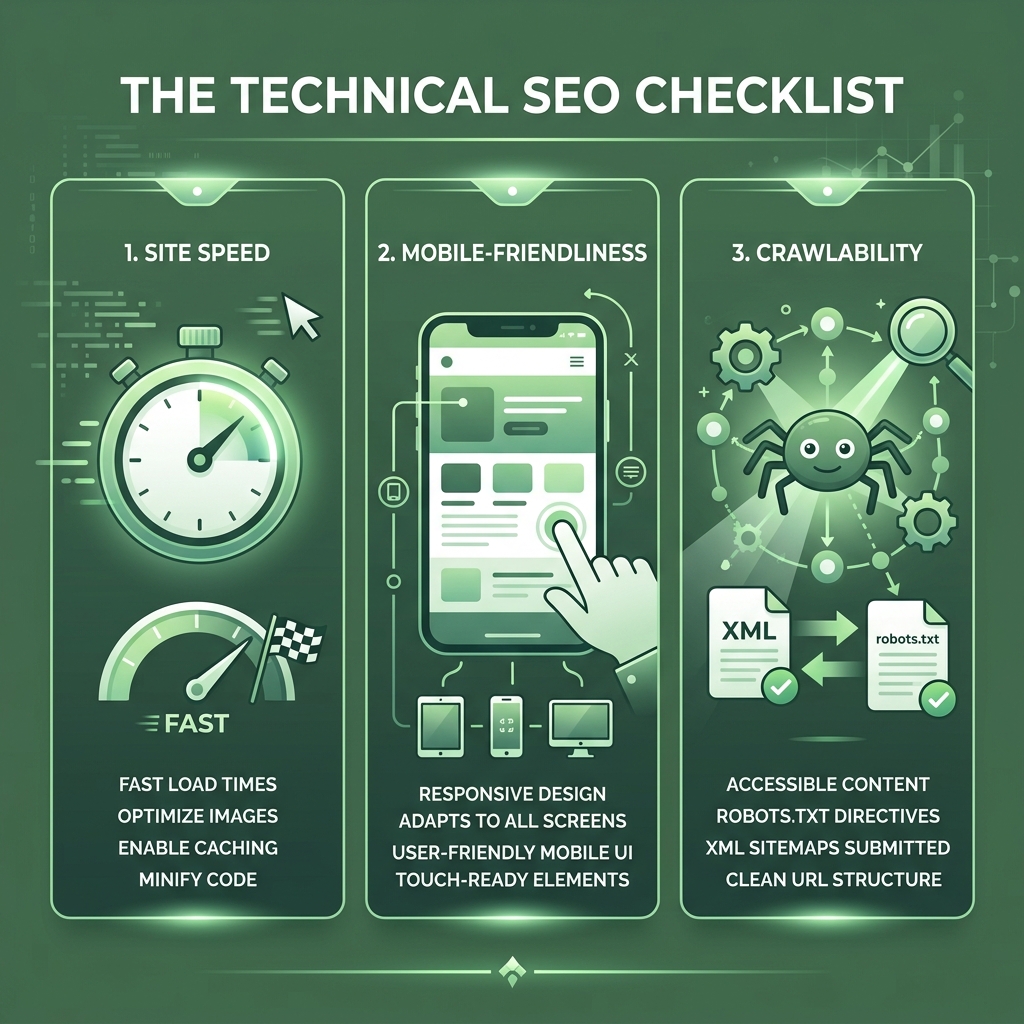
Beyond code, you must master the “Technical Trinity”:
- Site Speed: Users are impatient. Research shows that 70% of people say site speed impacts their willingness to buy. If a site takes longer than two seconds to load, you’re losing money.
- Mobile-First Indexing: Google now uses the mobile version of a site for indexing and ranking. If your site looks great on a desktop but is a mess on a phone, you will not rank.
- Crawlability: Using tools like robots.txt and XML sitemaps to ensure Google doesn’t get lost while exploring your site.
Analytical skills are just as vital. You must be able to look at a spreadsheet and see a story. This means learning Google Analytics 4 (GA4) to track user behavior and Google Search Console to monitor site health. For those working in the B2B space, we’ve developed the-best-b2b-seo-audit-framework-for-growing-your-pipeline to help experts identify technical gaps that are stunting lead generation.
Building a Portfolio Through Hands-on Experience
You can read every SEO blog on the internet, but you won’t become an expert until you break something and fix it. Real-world application is the only way to prove your expertise to yourself and potential clients.

We recommend starting with Personal Projects. Launch a niche blog about a hobby—whether it’s vintage watches or organic gardening. This is your laboratory. You can test different keyword strategies, experiment with internal linking, and see exactly how long it takes for a page to move from position 50 to position 5.
If you don’t want to start your own site, look into Charity Work. Many non-profits have terrible SEO because they lack the budget for a specialist. Reach out to a local charity and offer to optimize their site for free. Use a tool like Hunter.io to find the right contact person. This allows you to gain experience on an established domain with real stakes, which looks great on a resume.
Another powerful way to build a portfolio is through Internships or entry-level roles at marketing agencies. Agencies provide exposure to dozens of different industries and site types in a short period. As you build these projects, document everything. Create case studies that show “The Problem,” “The Strategy,” and “The Results” (using screenshots from Google Search Console).
A key strategy to implement in these early projects is our internal-linking-strategic-framework. Proper internal linking isn’t just about navigation; it’s about passing “link equity” or authority from your strongest pages to your newest ones. Mastering this early will set you apart from beginners who only focus on external backlinks.
Staying Ahead of Algorithm Updates and AI Trends
The only constant in SEO is change. Google makes thousands of updates to its algorithm every year. To stay relevant, an expert must be a lifelong student.
Currently, the industry is focused on E-E-A-T (Experience, Expertise, Authoritativeness, and Trustworthiness). Google wants to rank content written by people who actually know what they’re talking about. This is especially true for “Your Money or Your Life” (YMYL) topics like health and finance.
We are also seeing a massive shift toward AI-augmented workflows. AI isn’t replacing SEO experts; it’s giving them superpowers. At Clayton Johnson SEO, we use AI to help with content architecture, data analysis, and scaling repetitive tasks. However, we always warn beginners: human-made content almost always produces better results than raw, unedited AI output. The goal is to use AI for leverage, not as a shortcut for quality.
You should also keep an eye on Core Web Vitals. These are specific metrics Google uses to measure user experience, such as how fast the largest element on a page loads and how stable the layout is as it loads.
To stay updated, we suggest:
- Subscribing to the Google Search Central Blog.
- Following experts like Lily Ray and Barry Schwartz on social media.
- Learning how-to-audit-seo-with-ai to streamline your workflow without sacrificing the “human touch” Google craves.
Final Steps: How to Become a SEO Expert and Land Your First Role
Once you have the skills and a small portfolio, it’s time to decide on your career path. The SEO world generally offers three routes:
- Agency Life: You’ll work on multiple clients at once. It’s high-pressure but offers the fastest learning curve.
- In-House: You work for one company and focus deeply on their specific site and industry. This often allows for more long-term, systemic strategy.
- Freelance Consulting: You are the boss. This requires not just SEO skills, but sales and project management skills.
Salary Expectations: Entry-level SEO specialists can expect to start in a comfortable range, while seasoned experts with a proven track record of driving revenue can command six-figure salaries. The key to higher pay is moving from “traffic generation” to “revenue generation.”
To give your resume an extra boost, consider formal certifications. While experience is king, a certificate from a reputable source like the UC Davis SEO Specialization on Coursera shows a commitment to the craft.
Networking is also vital. Attend marketing conferences, join Facebook groups, and engage with the community on LinkedIn. Often, the best roles aren’t even posted on job boards; they are filled through referrals within the SEO network.
The Essential Toolkit for Modern Optimization
You wouldn’t try to build a house without a hammer, and you shouldn’t try to do SEO without the right software. Tools allow you to see the data that is hidden from the naked eye.
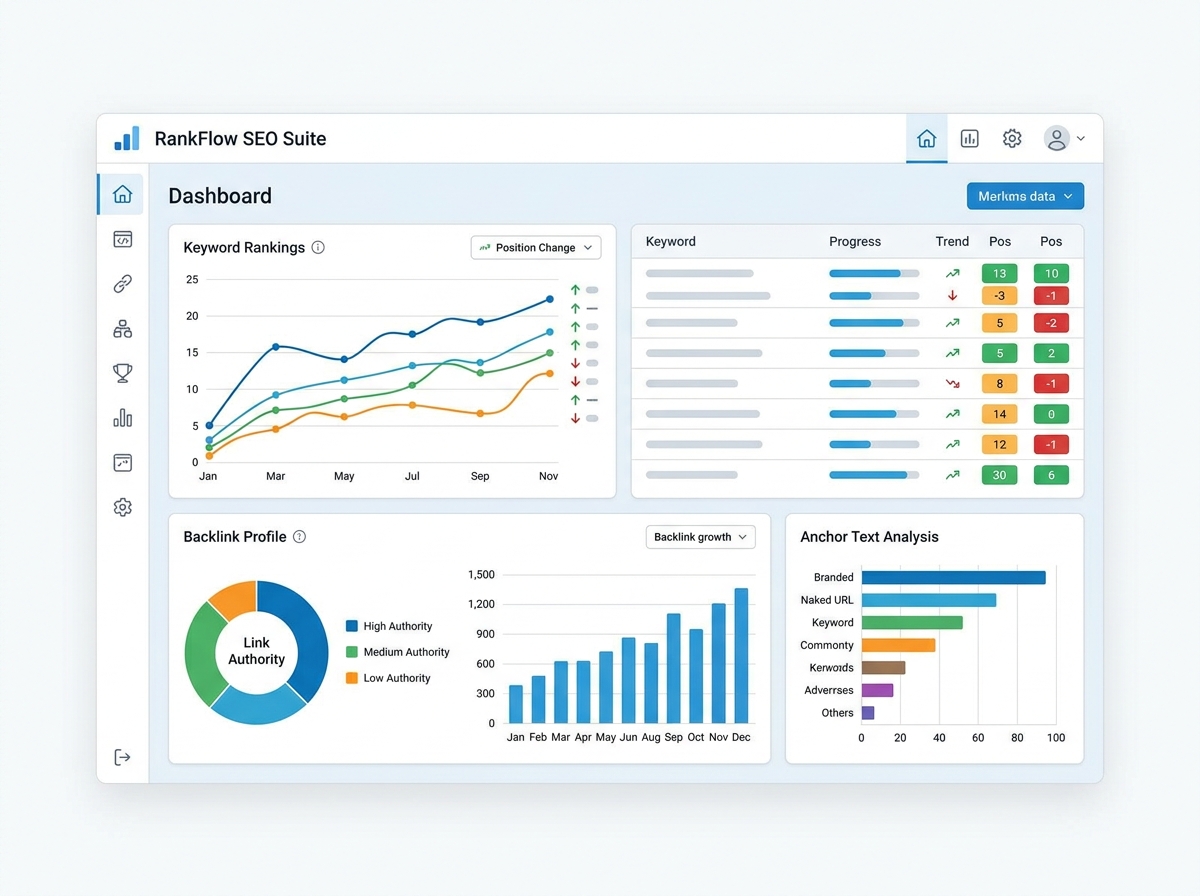
Here is the breakdown of what you need in your digital toolbox:
| Tool Category | Recommended Software | Why You Need It |
|---|---|---|
| Performance Tracking | Google Search Console | To see how Google views your site and find errors. |
| Traffic Analysis | Google Analytics 4 | To understand what users do once they arrive. |
| Keyword Research | Semrush / Ahrefs | To find what people are searching for and analyze competitors. |
| Site Auditing | Screaming Frog | To crawl your site and find broken links or missing tags. |
| Outreach | Hunter.io | To find email addresses for link-building campaigns. |
| Speed Testing | PageSpeed Insights | To identify what is slowing down your website. |
As an expert, you’ll use these tools to perform Competitor Analysis. This isn’t about copying; it’s about “reverse engineering” what is working for the top-ranking sites and doing it better. If a competitor is ranking for a high-volume keyword because they have a great infographic, your job is to create a better infographic and more comprehensive content.
Conclusion
Becoming an SEO expert is about more than just understanding algorithms; it’s about building durable systems that drive compounding growth. It’s the ability to look at a stagnant website and see a roadmap to authority.
At Clayton Johnson SEO, we don’t just chase the latest tactics. We build scalable traffic systems based on clarity and structure. Whether you are a founder looking to grow your own brand or an aspiring specialist, the principles remain the same: focus on the user, respect the technical fundamentals, and never stop testing.
If you’re ready to take the next step in your journey or need a partner to help build your company’s search engine dominance, we invite you to explore our SEO services. Let’s turn your search intent into measurable business outcomes.