What is Paid Search Advertising and How Does It Work?


What Is Paid Search Advertising (and Why It Matters for Growth)
Paid search advertising is a digital marketing model where businesses bid on keywords so their ads appear at the top of search engine results pages (SERPs) — and pay only when someone clicks.
Quick answer:
- What it is: Ads shown on search engines like Google or Bing, triggered by keywords you bid on
- How you pay: Cost-per-click (CPC) — you only pay when someone clicks your ad
- Where ads appear: Top and bottom of the SERP, labeled “Sponsored”
- Who controls it: You set the budget, targeting, and messaging
- Why it works: 65% of all high-intent searches result in an ad click — you reach buyers exactly when they’re ready
Every day, Google alone processes over 3.5 billion searches. The people running those searches are not browsing passively — they are looking for answers, comparing options, and making decisions. Paid search puts your business directly in front of that intent. Unlike organic SEO, which takes time to build, paid search delivers visibility the moment your campaign goes live.
The numbers back it up. Businesses average $2 in return for every $1 spent on Google Ads. The top three paid ads capture 46% of all page clicks. And over half of all ad clicks happen on mobile — meaning your audience is searching on the go, ready to act.
Yet many founders and marketing leaders treat paid search as an afterthought — a button to push when organic traffic dips. That reactive approach leaves serious revenue on the table.
I’m Clayton Johnson, an SEO and growth strategist who has built and optimized paid search advertising systems across dozens of business models, from early-stage startups to scaling operators in competitive markets. This guide breaks down how paid search actually works — and how to use it as a structured growth lever, not a guessing game.
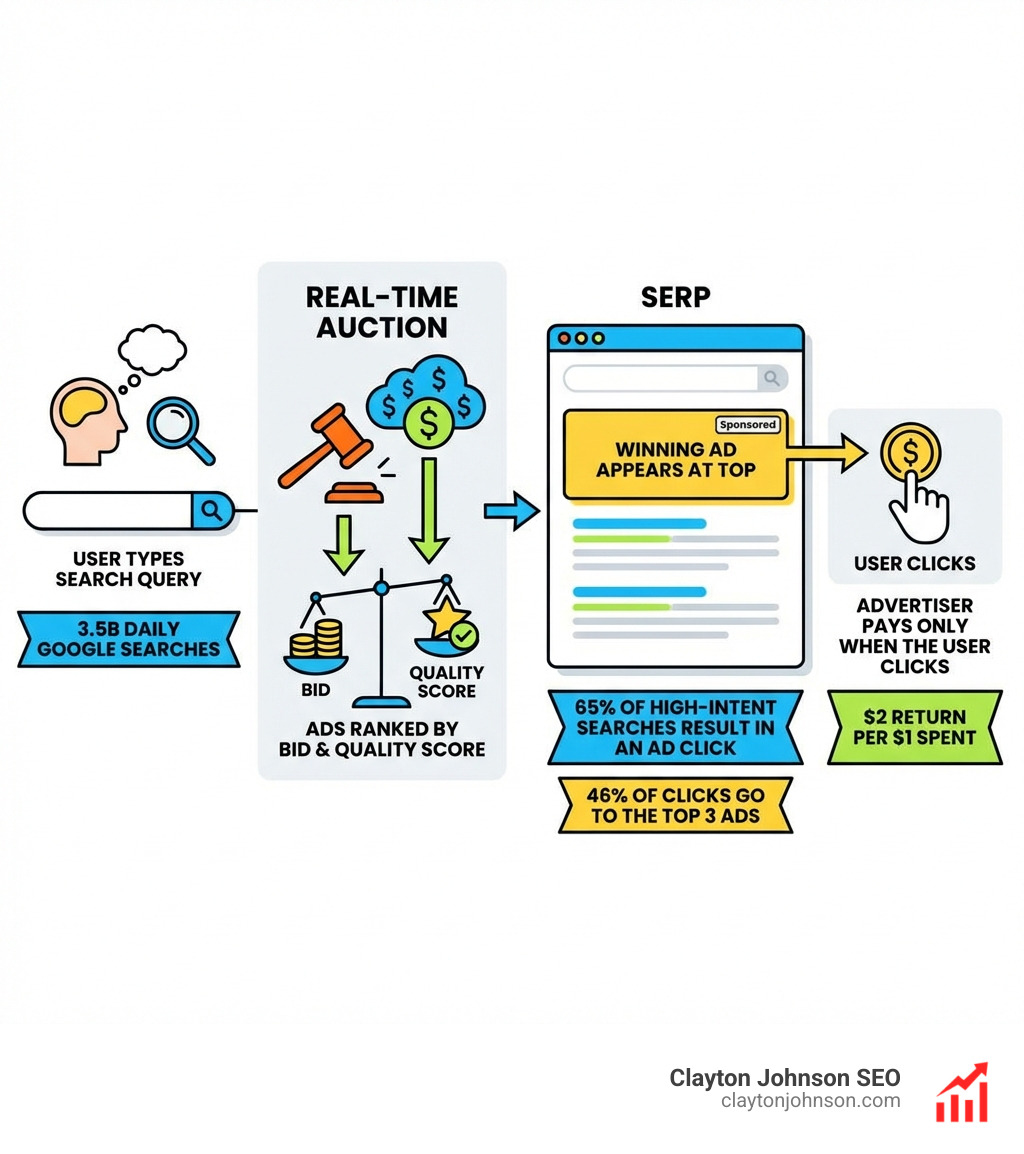
Paid search advertising terms at a glance:
Demystifying Paid Search Advertising: Definitions and Core Mechanics
To master paid search advertising, we first need to clear up the alphabet soup of digital marketing. You’ll often hear terms like PPC, SEM, and SEO tossed around as if they’re interchangeable. They aren’t.
- PPC (Pay-Per-Click): This is the overarching payment model. While most paid search is PPC, you can also have PPC ads on social media (like Facebook or LinkedIn) or display networks.
- SEO (Search Engine Optimization): This is the art of earning “free” or organic traffic by making your website authoritative and relevant to search engines. It’s a long-term play.
- SEM (Search Engine Marketing): Historically, SEM was an umbrella term for both SEO and paid search. Today, most marketers use SEM specifically to refer to the paid side of search.
The primary platforms for these ads are Google Ads (which owns over 91% of the global market share) and Microsoft Advertising (which powers Bing and Yahoo). When we talk about a text ad, we are referring to the standard format consisting of a headline, a display URL, and description text that appears when someone searches for a specific term.
The Mechanics of Paid Search Advertising
How does a search engine decide which ad to show? It isn’t just about who has the biggest wallet. Every time a user types a query into Google, a lightning-fast ad auction occurs.
The search engine looks at every advertiser bidding on that keyword and calculates an Ad Rank. This score determines your ad’s position. Ad Rank isn’t just your Max CPC (the most you’re willing to pay for a click); it’s a combination of your bid, your Quality Score, and the expected impact of your ad extensions. This system ensures that even a smaller business in Minneapolis can outrank a giant corporation if their ad is more relevant to the user’s search intent.
Key Benefits for Modern Businesses
Why do we lean so heavily on paid search advertising? Because it offers control that other channels can’t match.
- Immediate Traffic: Unlike SEO, which can take months to move the needle, a paid campaign can drive qualified visitors to your site within hours of launch.
- 200% ROI: On average, businesses make $2 for every $1 they spend. It is one of the most cost-effective ways to acquire customers.
- Granular Targeting: We can target users based on their location, the device they’re using, the time of day, and even their previous behavior on our site.
- Measurable Results: Every cent is tracked. We know exactly which keyword led to a sale, allowing us to scale what works and kill what doesn’t.
| Feature | SEO | Paid Search (PPC) |
|---|---|---|
| Cost | “Free” (requires time/effort) | Pay per click |
| Speed | Slow (months) | Fast (hours) |
| Sustainability | High (compounding growth) | Low (stops when budget ends) |
| Control | Limited (algorithm dependent) | High (you choose keywords/copy) |
| Placement | Middle of SERP | Top & Bottom of SERP |
The Strategic Engine: Keywords, Match Types, and Quality Score
The heart of any paid search advertising campaign is the keyword. Keywords are the bridge between what a customer wants and the solution we provide. Effective keyword research isn’t about finding the most popular terms; it’s about finding the most profitable ones.
We use tools like the Google Keyword Planner to identify terms with high intent. We look for long-tail keywords—longer, more specific phrases like “emergency plumber in Minneapolis” rather than just “plumber.” These specific terms often have lower search volume but much higher conversion rates and lower competition.
Keyword Match Types and Negative Keywords
Choosing the right keywords is only half the battle; you also have to tell the search engine how strictly to match them to user queries.
- Broad Match: Your ad might show for searches that relate to your keyword, including synonyms and misspellings. It offers the most reach but the least control.
- Phrase Match: Your ad shows for searches that include the meaning of your keyword. It’s a middle ground between reach and relevance.
- Exact Match: Your ad only shows for searches that have the same meaning or intent as your keyword. This offers the highest control over your budget.
To protect your budget, we use negative keyword lists. If you sell “premium leather shoes,” you might add “free,” “cheap,” or “repair” as negative keywords. This prevents your ad from showing to people who aren’t looking to buy what you sell, saving you from wasting money on unqualified clicks.
Optimizing Your Quality Score
Google wants to show the best possible ads to its users. To encourage this, they use a metric called Quality Score (rated 1-10). A high Quality Score can actually lead to lower costs and better ad positions.
Knowing how to improve your Quality Score is essential for any growth strategy. It is calculated based on:
- Expected Click-Through Rate (CTR): How likely is someone to click your ad?
- Ad Relevance: Does your ad copy actually match the keyword?
- Landing Page Experience: Is the page you’re sending people to helpful, fast, and relevant to the ad?
By focusing on relevance, we can win the auction without necessarily being the highest bidder.
Building Your Campaign: From Ad Copy to Landing Page Optimization
A successful paid search advertising campaign requires a logical structure. We organize accounts into campaigns (often based on broad categories or goals) and then into ad groups. Each ad group should contain a tight cluster of related keywords and ads that speak directly to those keywords.
Crafting High-Performing Ad Copy and Extensions
Your ad copy has one job: get the right person to click. To do this, we use compelling headlines that include the target keyword and a clear Call to Action (CTA) like “Get a Free Quote” or “Shop the Sale.”
We also leverage ad assets (formerly called extensions). According to this handy guide to ad assets, these are additional pieces of information that expand your ad.
- Sitelinks: Links to specific pages on your site (e.g., “Our Services,” “Contact Us”).
- Callouts: Short snippets highlighting unique selling points (e.g., “Free Shipping,” “24/7 Support”).
- Structured Snippets: Lists of specific products or types (e.g., “Brands: Nike, Adidas, Puma”).
These assets make your ad larger and more useful, which typically improves your CTR and Quality Score.
Landing Page Best Practices
You can have the best ad in the world, but if your landing page is a mess, you’re just burning cash. The landing page must have perfect message match—if the ad promises a “50% discount on SEO audits,” the landing page should immediately mention that discount.
Key elements of a high-performing landing page include:
- Page Speed: If it takes more than a few seconds to load, users will bounce.
- Mobile Responsiveness: Over 50% of clicks are on mobile. Your page must look and work perfectly on a smartphone.
- Clear Conversion Path: Don’t make people hunt for the “Buy” or “Contact” button. Put it front and center.
- Trust Signals: Include logos, certifications, or brief testimonials to build immediate credibility.
Measuring Success and Scaling Your Paid Search Advertising
In Demandflow and structured growth, we don’t guess—we measure. You must implement conversion tracking from day one. This allows you to see which ads lead to valuable actions like form submissions or purchases.
Following Google Ads conversion measurement guidance ensures that you are connecting ad interactions to the on-site actions that actually drive revenue.
Key Metrics and ROI Analysis
To understand if your paid search advertising is working, you need to track these core KPIs:
- CTR (Click-Through Rate): The percentage of people who saw your ad and clicked it. High CTR usually means your ad is relevant.
- CPC (Cost-Per-Click): The average amount you pay for each click.
- CPA (Cost Per Acquisition): How much it costs you to get one lead or sale.
- ROAS (Return on Ad Spend): Your total revenue divided by your total ad spend. If you spend $100 and make $500, your ROAS is 5x.
- LTV (Lifetime Value): The total value a customer brings over their entire relationship with you. This helps you decide how much you can afford to pay for a click.
Scaling Your Paid Search Advertising
Once you have a campaign that is consistently profitable, it’s time to scale. We don’t just “increase the budget” blindly. We use structured methods:
- AI-Driven Optimization: Modern platforms use machine learning to adjust bids in real-time based on the likelihood of a conversion.
- Audience Remarketing: We show specific ads to people who have already visited our site but didn’t convert. These users are much more likely to buy.
- Cross-Channel Integration: We use insights from our paid ads to inform our SEO strategy. If a keyword converts well in ads, we know it’s worth the effort to rank for it organically.
- Expansion Strategies: We test new geographic areas (starting right here in Minneapolis and expanding) or new product categories once the initial core is stable.
Frequently Asked Questions about Paid Search
How long does it take to see results?
One of the biggest draws of paid search advertising is its speed. You can see impressions and clicks almost immediately after your ads are approved. However, we typically recommend an “optimization phase” of 2 to 4 weeks. This allows the system to gather enough data to see which keywords are actually driving conversions so we can refine the bidding.
Is paid search effective for small budgets?
Absolutely. Because you control your daily spend, you can start small. By focusing on very specific niche keywords and local targeting (like focusing specifically on the Minneapolis area), small businesses can compete effectively against much larger brands. You aren’t paying for “everyone”—you’re only paying for the specific people searching for what you offer.
What are common mistakes to avoid?
The most common pitfall is relying solely on broad match keywords, which can quickly drain a budget on irrelevant traffic. Other mistakes include:
- Ignoring Negative Keywords: Not filtering out “free” or “jobs” when you’re trying to sell a service.
- Poor Landing Pages: Sending paid traffic to a generic homepage instead of a dedicated, relevant page.
- Ignoring Mobile: Not checking if the landing page works on a phone.
- Set it and Forget it: Paid search requires regular monitoring and adjustment to stay profitable.
Conclusion
Paid search advertising is not a “magic button,” but when integrated into a structured growth architecture, it is one of the most powerful tools in your marketing arsenal. It provides the immediate visibility and data needed to fuel long-term growth.
At Demandflow, we believe that clarity leads to structure, and structure leads to compounding growth. We don’t just run ads; we build systems that connect intent to revenue. By combining actionable strategic frameworks with AI-augmented workflows, we help founders and marketing leaders move past the “guessing” phase and into a model of predictable scaling.
Ready to stop guessing and start seeing real results? Start your paid search advertising journey with a strategy built for long-term leverage.